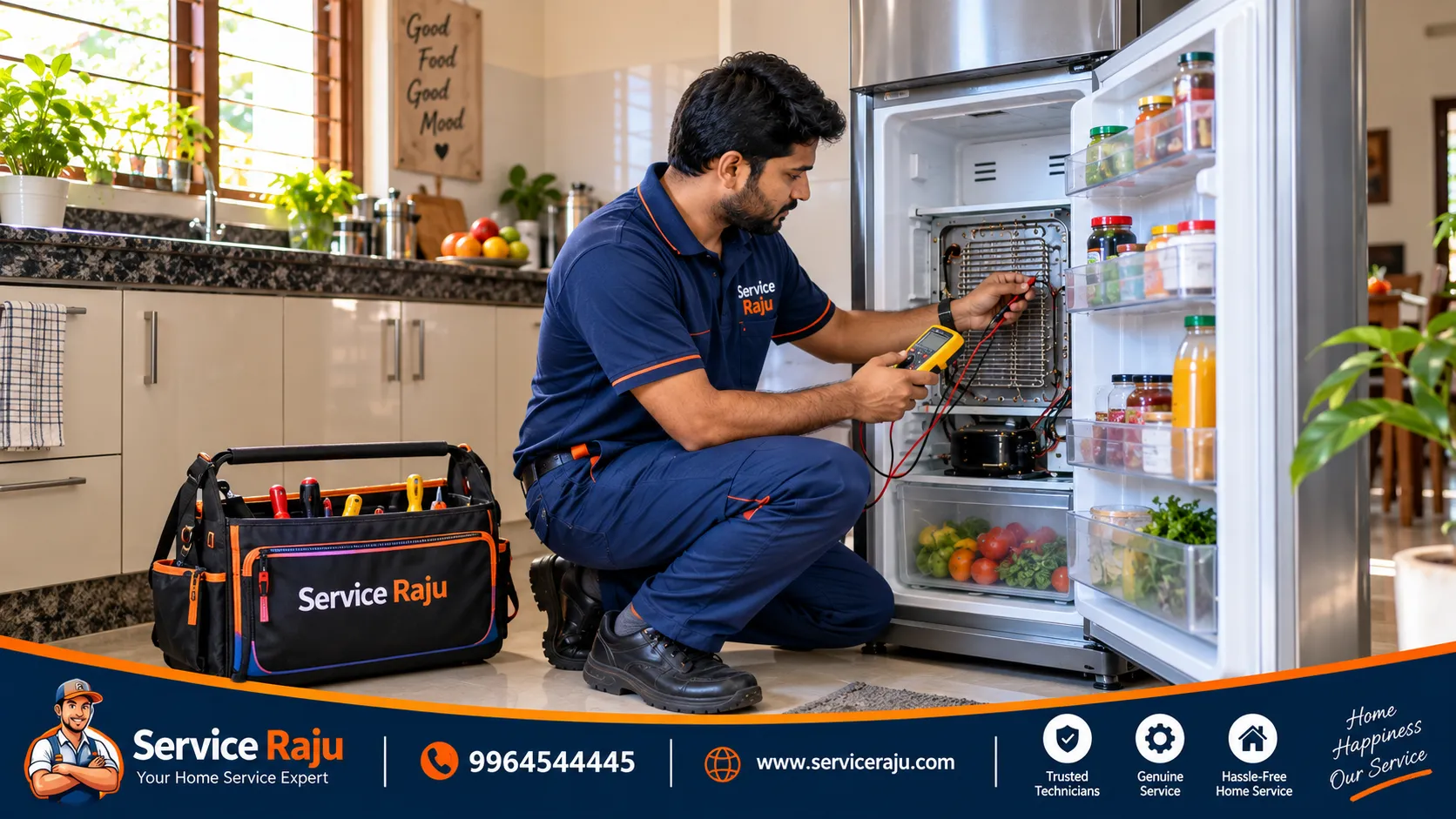
Why Your Refrigerator Is Not Cooling in Summer: Causes & Fixes for Mysore Homes
Every summer in Mysore and Bengaluru, one of the most common calls that home appliance technicians receive is this: "My fridge is running but not cooling properly."
If your fridge is not cooling in summer despite the compressor being on, you are not alone — and it is not always a major repair. Summer heat in Karnataka creates a perfect storm of conditions that push refrigerators to their limit. Understanding why this happens is the first step to fixing it quickly and affordably.
This article explains the real reasons behind summer refrigerator cooling failure, what you can check at home, when you need professional service, and how to protect your fridge before the problem gets expensive.
2. Table of Contents
- Why Summer Is the Hardest Season for Your Refrigerator
- Top Reasons Your Fridge Is Not Cooling in Summer
- Warning Signs You Should Not Ignore
- Quick Checks You Can Do at Home
- When Home Fixes Are Not Enough
- How Service Raju Diagnoses and Fixes the Problem
- Refrigerator Repair Cost in Mysore
- Summer Refrigerator Tips for Mysore and Bengaluru Homes
- FAQs
- Final Takeaway
3. Why Summer Is the Hardest Season for Your Refrigerator
A refrigerator is designed to maintain an internal temperature between 1°C and 4°C regardless of the outside temperature. But when the ambient temperature in your kitchen rises above 35°C — which is common in Mysore and Bengaluru from March to June — the compressor has to work significantly harder to maintain that internal cold.
This extra workload does several things:
- The compressor runs longer and gets hotter
- Electricity consumption increases noticeably
- Components that were already slightly worn begin to fail
- Refrigerant gas circulation becomes less efficient
- Dust and grime on coils reduce heat dissipation further
In short, summer does not create problems out of nothing — it reveals and accelerates existing weaknesses in your refrigerator system.
According to the Bureau of Energy Efficiency (BEE), India's summer conditions significantly increase the energy and mechanical demand on household refrigerators, making regular seasonal maintenance important for performance and longevity.
4. Top Reasons Your Fridge Is Not Cooling in Summer
5. 1. Dirty Condenser Coils
The condenser coils are located either at the back or underneath your refrigerator. Their job is to release heat from inside the fridge into the surrounding air. When these coils are covered in dust, pet hair, or kitchen grease — which is extremely common in Indian kitchens — they cannot release heat effectively.
Result: The refrigerator cannot reach the target internal temperature, even though the compressor is running continuously.
This is one of the most common and most overlooked causes of summer cooling problems.
Cleaning the condenser coils is a straightforward task for a technician and often makes an immediate difference.
6. 2. Poor Ventilation Around the Refrigerator
Many homes in Mysore and Bengaluru place the refrigerator in a tight kitchen corner, a built-in cabinet niche, or pushed directly against a wall. In normal weather this creates mild inefficiency. In summer it becomes a serious problem.
The refrigerator needs a minimum clearance of 5–10 cm on all sides and at the back to release heat properly. Without this, the compressor overheats, cycles on and off too frequently, and the internal temperature rises.
7. 3. Overloading with Food and Drinks
Summer means more cold drinks, more fruits, more leftover food, and more ice usage. When a refrigerator is packed too tightly, cold air cannot circulate properly between items, and certain zones inside the fridge never cool adequately.
Additionally, placing hot or warm food directly inside the fridge forces the compressor to work much harder than designed, raising internal temperature and prolonging recovery time.
8. 4. Voltage Fluctuations
Voltage fluctuations are a well-documented problem in many residential areas of Mysore and Bengaluru, particularly during summer when power demand is at its peak. Low voltage causes the compressor motor to draw higher current, overheat, and underperform. Repeated fluctuations over weeks can damage the compressor's starting components.
Signs of voltage-related problems:
- The fridge compressor makes unusual clicking or humming sounds
- The compressor starts and stops frequently
- Cooling is inconsistent — cold in the morning, warm in the afternoon
A voltage stabilizer designed for refrigerators is a practical and affordable protection for any Mysore home.
9. 5. Refrigerant (Gas) Leak
The refrigerant gas is what actually carries heat out of the fridge. If there is a slow gas leak — which can develop due to vibration, corrosion, or fitting wear — the refrigerant level drops below the threshold needed for effective cooling.
Signs of a refrigerant leak:
- The freezer section is slightly cold but the fridge section is barely cold
- The compressor runs almost continuously but cooling is poor
- You notice an unusual chemical smell near the back of the fridge
- Ice in the freezer is soft or melting faster than normal
A gas leak cannot be fixed with home remedies. It requires a trained technician to locate the leak, repair or seal it, and recharge the refrigerant safely and with the correct refrigerant type for your model.
10. 6. Faulty Evaporator Fan
The evaporator fan circulates cold air from the freezer section into the refrigerator compartment. If this fan fails or is blocked by ice buildup, the refrigerator section will not receive cold air even though the freezer appears to be working.
How to check: Open the refrigerator door and listen. You should hear the fan running. If you hear nothing, or if there is unusual noise from inside the unit, the fan may need inspection.
11. 7. Door Seal (Gasket) Damage
The rubber door seal around the refrigerator door prevents warm outside air from leaking in. In summer, when the temperature difference between inside and outside is at its maximum, even a small gap or crack in the door seal causes constant warm air infiltration — forcing the compressor to run non-stop without achieving proper cooling.
Simple check: Close the door on a piece of paper. If the paper slides out easily, the door seal has lost its grip and needs replacement.
12. 8. Thermostat or Control Board Issues
If the thermostat is faulty, it may not signal the compressor to run long enough to reach the correct internal temperature. In some digital refrigerators, a faulty control board or sensor can cause the cooling cycle to cut off too early. This type of fault typically requires professional diagnosis with the correct tools.
13. Warning Signs You Should Not Ignore
| Warning Sign | Likely Cause |
|---|---|
| Fridge warm but freezer cold | Evaporator fan or defrost system |
| Both sections warm | Gas leak, compressor, thermostat |
| Compressor running continuously | Dirty coils, poor ventilation, gas leak |
| Compressor not starting | Capacitor, relay, voltage issue |
| Water pooling inside fridge | Blocked drain, defrost issue |
| Unusual noise from fridge | Fan blade, compressor wear |
| Ice forming on back wall of fridge | Defrost heater or thermostat |
14. Quick Checks You Can Do at Home
Before calling a technician, try these simple checks:
- Check the temperature setting. Someone may have accidentally turned the thermostat dial to a warmer position. Most refrigerators should be set between 3°C and 5°C for the refrigerator section.
- Check for ventilation. Pull the fridge slightly away from the wall and any cabinet sides. Even a few centimetres of clearance can make a difference.
- Clean the back coils. Unplug the fridge, wait 5 minutes, and gently vacuum or brush the condenser coils at the back.
- Check the door seal. Run your hand around the door edges when the fridge is closed. If you feel cold air escaping, the gasket needs replacement.
- Reduce the load. Remove excess items and ensure food is not blocking the internal vents.
- Check the plug and power. Make sure the fridge is properly plugged in and that there are no tripped circuit breakers.
If the problem persists after these checks, you need a professional inspection.
15. When Home Fixes Are Not Enough
Some refrigerator cooling problems cannot be solved without professional tools and expertise:
- Refrigerant gas recharge — requires licensed tools and correct refrigerant type
- Compressor replacement — requires technical skill and correct parts
- Evaporator fan replacement — requires disassembly of internal panels
- Thermostat or control board diagnosis — requires digital diagnostic equipment
- Door seal replacement — can be a DIY task but must be done correctly for an airtight fit
- Capacitor or relay replacement — small parts, but require correct identification
Attempting these without proper knowledge can cause additional damage or invalidate warranty.
16. How Service Raju Diagnoses and Fixes Refrigerator Cooling Problems
Service Raju provides professional refrigerator repair and service in Mysore and Bengaluru. Here is how the process works:
- Contact us by phone at 9964544445 or 9620550955, or via WhatsApp or the website at www.serviceraju.com
- We assign a trained technician for your area in Mysore or Bengaluru
- The technician inspects the refrigerator — checking gas pressure, compressor performance, fan operation,
 AC Repair
.webp) Ant Control Service
Ant Control Service
 Basin & Sink Services
.webp) Bath & Shower Services
Bath & Shower Services
.webp) Bath Fittings & Mirrors
Bath Fittings & Mirrors
 Bathroom Cleaning Service
 Bathroom Renovation Services
 Bed Bug Control Services
 Bedroom Painting
 Book a Carpenter Consultation
 Book Electrical Consulting
.webp) Cabinet Painting & Wood Refinishing
Cabinet Painting & Wood Refinishing
 Chimney Cleaning
 Civil Masonry Work
 Clean-Up Services
.webp) Clothes Hanger Installation
Clothes Hanger Installation
 Cockroach Control Services
---mysore-mysore-standard-300x200.webp) Commercial Cleaning
Commercial Cleaning
 Commercial Pest Control AMC Service
 Cupboard & Drawer Services
 Decorative Wall Panels
 Deep Sanitisation Service
 Detan & Bleach
 Door, Grill & Cabinet Painting Service
.webp) Doorbell & security
Doorbell & security
 Drain Blockage Clearing
 Electrical Appliance Services
 Electrical Wiring Services
 Empty Home Deep Cleaning
.webp) Fabrication
Fabrication
 Facials
.webp) Fan Installation & Repair
Fan Installation & Repair
 Full Home Cleaning Service
 Full Home Renovation
 Furniture Repair Service
 Gas Stove & Hob Repair
.webp) General Pest Control Services
General Pest Control Services
 General Plumbing & Consultation
 Geyser Repair
 Glass Cleaning
 Head Massage
.webp) Honeybee & Wasp-Services
Honeybee & Wasp-Services
 Kitchen & Bathroom Painting Service
 Kitchen Cleaning
 Kitchen Fittings
.webp) Kitchen Renovation
Kitchen Renovation
.webp) Laptop/Desktop service
Laptop/Desktop service
 Leak Detection and Repair
 LED TV Repair
 Living and Dining Room Painting
 Makeup, Saree & Styling
 Manicure & Pedicure
 MCB,Meter & Fuse Services
 Microwave Repair
 Mosquito Pest Control Service
 Multi-Room Painting Service
 Painting Consultation
 Quick Mini Cleaning Services
 Refrigerator Repair
 RO Water Purifier
.webp) Rodent Control Services (Rat & Mice Treatment)
Rodent Control Services (Rat & Mice Treatment)
.webp) Rooms Cleaning
Rooms Cleaning
 Shelves & Decor
 Sofa, Carpet & Mattress Cleaning
 Solar Water Heater Service
 Sump & Tank Cleaning
 Switch & Socket Services
 Tap & Mixer Service
.webp) Termite-Control-Services
Termite-Control-Services
 Threading & Face Wax
.webp) Tile & Granite Installation & Polishing
Tile & Granite Installation & Polishing
 Toilet & Commode Services
.webp) UPS and Inverter Repair Services
UPS and Inverter Repair Services
.webp) Wall Painting Service
Wall Painting Service
 Washing Machine Repair
 Water Level Controllers
 Water Tank and Pump Repair
 Waterproofing
 Waterproofing Services
 Waxing
 Window & Curtain Services
 Wooden Door Services