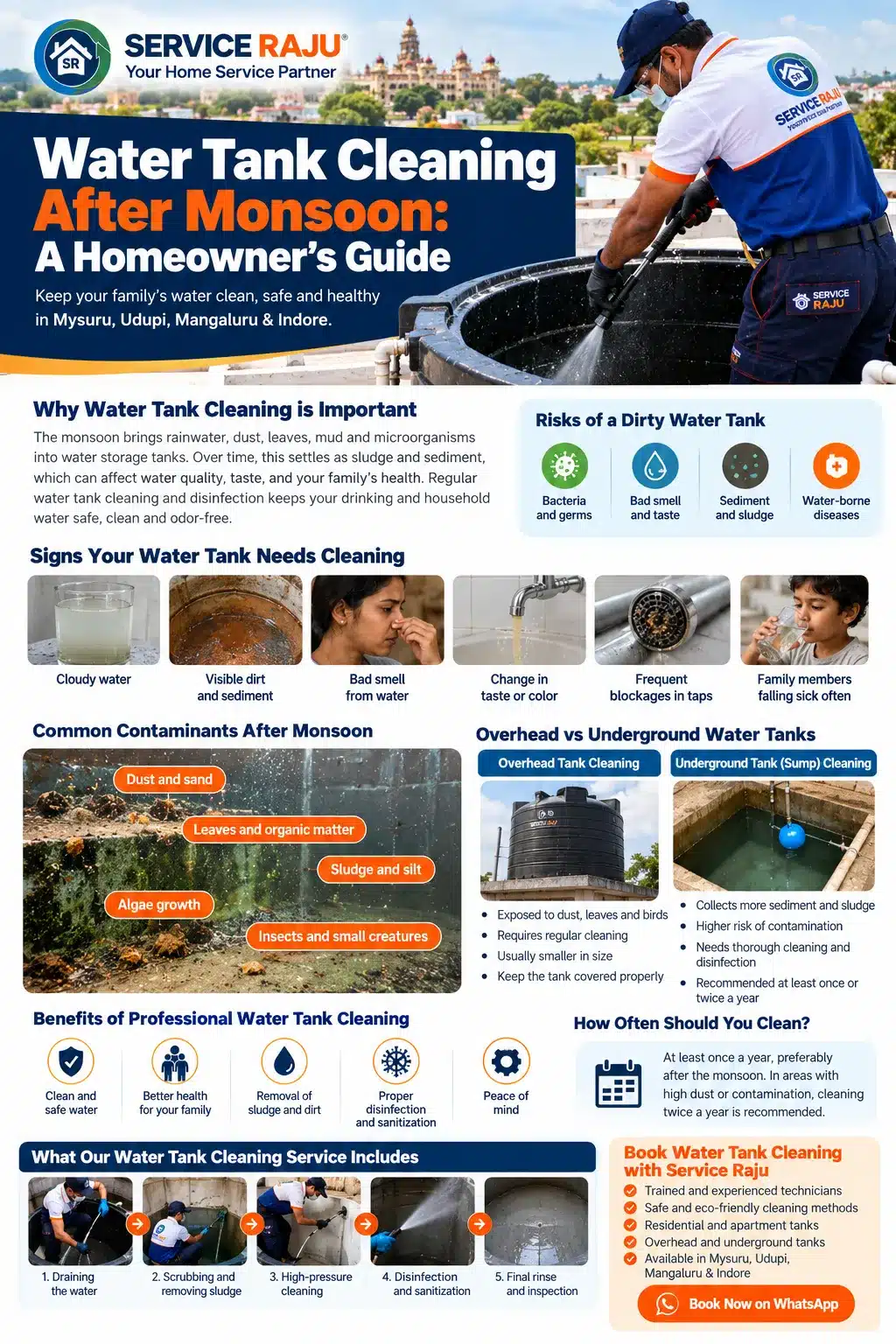
Water Tank Cleaning After Monsoon: A Homeowner's Guide
Water tank cleaning after the monsoon is an important home-maintenance task for households that rely on overhead tanks, underground sumps or other water-storage systems. During the rainy season, dust, suspended sediment and other unwanted material can enter or accumulate around water-storage areas, while previously settled material can remain at the bottom of the tank.
That does not mean every tank must be cleaned immediately after every rainy season. The need depends on the tank's condition, water source, storage environment, maintenance history and whether visible sediment, odour or contamination is present.
This homeowner's guide explains when a tank may need cleaning, how sludge and sediment build up, the difference between cleaning and disinfection, what a professional service should include and what homeowners in Mysuru, Udupi, Mangaluru and Indore should check before booking a service.
Quick Answer: When Should You Clean Your Water Tank After Monsoon?
Consider arranging a tank inspection when you notice:
- Visible sludge or sediment at the tank bottom
- Unusual smell from stored water
- Visible particles or unexpected discolouration
- Dirt or debris around the tank access opening
- Insects or other unwanted material entering the storage area
- The tank has not been inspected or cleaned for a long time
- Recent terrace, roof or plumbing work exposed the tank area to dust
- Persistent water-storage hygiene concerns
- Visible deposits or contamination when the tank is opened for inspection
These signs do not automatically prove that stored water is unsafe. They indicate that the storage system should be inspected and maintained appropriately.
Table of Contents
- Why Clean a Water Tank After Monsoon?
- How Sludge and Sediment Build Up
- 9 Signs Your Tank Needs Attention
- How Often Should a Water Tank Be Cleaned?
- Overhead Tank vs Underground Water Tank Cleaning
- What Professional Water Tank Cleaning Includes
- Water Tank Cleaning vs Water Tank Disinfection
- Post-Monsoon Water Tank Maintenance Checklist
- What to Ask Before Booking a Water Tank Cleaning Service
- Water Tank Cleaning Service in Mysuru, Udupi, Mangaluru & Indore
- FAQs
- Final Takeaway
Why Clean a Water Tank After Monsoon?
A water-storage tank is normally closed, but it is still exposed to the conditions around it.
Depending on the property, the surrounding environment can contribute dust, dirt, organic debris and other unwanted material around the tank and its access points.
Post-monsoon inspection can be useful because it gives homeowners an opportunity to check:
- The condition of the tank interior
- Accumulated sediment
- The tank cover and access opening
- Inlet and overflow arrangements
- Visible leaks or damaged fittings
- The overall cleanliness of the storage system
The purpose of the inspection is not to assume that every tank needs a fixed annual cleaning schedule. Instead, it helps determine whether cleaning or another maintenance action is actually required.
How Sludge and Sediment Build Up
Sludge is a broader term commonly used for accumulated settled material in the bottom of a tank. Depending on the water source and environment, this can include fine sediment, dirt and other material that has settled over time.
Sediment accumulation can be influenced by:
- The source of incoming water
- Tank location
- Age of the storage system
- Condition of the tank cover
- Frequency of maintenance
- Changes in the building's plumbing system
- Dust and environmental exposure around the tank
- Construction or renovation work near the tank
When a tank is left undisturbed, heavier material can settle toward the bottom. During cleaning, this material should be removed rather than simply stirred into the water.
9 Signs Your Tank Needs Attention
1. Visible Sludge at the Bottom
If an inspection reveals an obvious layer of settled material at the bottom of the tank, cleaning may be appropriate.
A small amount of sediment does not by itself indicate a serious water-quality problem, but significant accumulation should not simply be ignored.
2. Unusual Smell From Stored Water
An unexpected odour from water can have several possible causes. Tank condition is one possibility, but plumbing and incoming-water conditions can also matter.
If an unusual smell persists, inspect the storage tank and the wider water system instead of assuming the tank alone is responsible.
3. Visible Particles or Unexpected Discolouration
If water contains visible particles or appears unusually discoloured, investigate the source.
Possible causes can include:
- Tank sediment
- Plumbing disturbance
- Changes in incoming water
- Corrosion or pipe-related material
- Disturbed deposits in the tank
Persistent changes deserve investigation rather than repeated flushing of individual taps.
4. Dirt Around the Tank Cover or Access Opening
Inspect the area around the tank lid or access hatch.
Look for:
- Dust accumulation
- Leaves or debris
- Damaged seals or covers
- Gaps around the access opening
- Signs of water entering from the surrounding area
A clean tank can become contaminated again if its cover or access arrangement does not adequately protect it.
5. Insects or Unwanted Material Inside the Storage Area
Insects, leaves or other foreign material found inside the tank should be treated as a maintenance warning.
Inspect the cover, overflow, inlet and access area to understand how the material entered.
6. The Tank Has Not Been Opened for a Long Time
Many homeowners cannot remember the last time their overhead tank or underground sump was inspected.
There is no single cleaning frequency that fits every property. A tank's condition should be considered along with its environment, water source and maintenance history.
7. Recent Construction or Renovation Near the Tank
Construction and renovation can generate fine dust and debris.
If work was recently carried out around:
- The terrace
- Roof
- Water lines
- Tank platform
- Plumbing connections
- Tank-access area
inspect the storage system before assuming that it remains in the same condition as before the work.
8. Water-System Changes Were Recently Made
Plumbing modifications can disturb settled material or change how water enters and leaves a tank.
After plumbing work, check:
- Inlet connection
- Outlet connection
- Overflow line
- Visible joints
- Tank cover
- Unexpected sediment at taps
9. The Tank Is Visibly Dirty When Opened
This is the clearest reason to consider cleaning.
Visible dirt, sludge, deposits or organic debris inside the tank should be removed using an appropriate tank-cleaning process.
How Often Should a Water Tank Be Cleaned?
There is no single universal cleaning interval that applies to every household, apartment or commercial property.
Cleaning frequency can depend on:
- Water source
- Tank type
- Tank size
- Environmental exposure
- Quality of the tank cover
- Sediment accumulation
- Previous cleaning history
- Building usage
A better approach is to maintain a simple inspection record.
| Maintenance Check | What to Record |
|---|---|
| Last inspection | Date and observations |
| Last cleaning | Date and cleaning scope |
| Sediment | Low, moderate or heavy accumulation |
| Tank cover | Secure or damaged |
| Fittings | Visible leaks or damage |
| Water appearance | Normal or unusual changes |
This makes it easier to identify changes rather than relying only on memory.
Overhead Tank vs Underground Water Tank Cleaning
Both systems require maintenance, but the cleaning conditions are different.
| Storage Type | Typical Maintenance Focus |
|---|---|
| Overhead Tank | Sludge, internal surfaces, cover, inlet, outlet, overflow and visible deposits |
| Underground Sump | Sediment, internal surfaces, access cover, inlet/outlet and accumulated debris |
| Concrete Water Tank | Surface condition, deposits, cracks, access point and storage hygiene |
Overhead tank cleaning may be easier to access but still requires appropriate safety precautions because the tank is elevated.
Underground water tank cleaning can involve difficult or confined access. Homeowners should not enter deep or restricted water-storage spaces without appropriate safety procedures and trained personnel.
What Professional Water Tank Cleaning Includes
Step 1: Inspection
The technician first checks the tank condition, accessibility, storage type, visible deposits and surrounding fittings.
Step 2: Water Isolation and Drainage
The stored water is managed and drained according to the cleaning procedure.
Step 3: Sludge and Sediment Removal
Settled material is removed rather than simply mixed back into the water.
Step 4: Internal Surface Cleaning
The accessible internal floor and walls are cleaned using a method appropriate for the tank material and condition.
Step 5: Rinsing
Loosened dirt and cleaning residue should be removed before the tank is returned to normal use.
Step 6: Inspection of Accessible Fittings
The technician can check the tank cover, inlet, outlet and overflow arrangements for visible issues that may require separate repair.
Step 7: Disinfection Where Included or Required
Where a water tank disinfection process is part of the service, the provider should explain the method and post-treatment procedure.
Step 8: Refill and Final Check
After cleaning, the tank is returned to service and checked for visible leaks, overflow problems or other obvious issues.
Water Tank Cleaning vs Water Tank Disinfection
These terms are sometimes used interchangeably in marketing, but they are not the same thing.
| Cleaning | Disinfection |
|---|---|
| Focuses on removing dirt, sludge and deposits | Focuses on reducing microorganisms using an appropriate disinfection procedure |
| Includes physical removal of accumulated material | Uses a separate treatment step |
| Improves the physical cleanliness of the storage container | Addresses a different hygiene objective |
A cleaned tank is not automatically a laboratory-certified water supply, and tank disinfection is not a substitute for investigating contamination from the water source or plumbing system.
If there is a genuine concern about microbiological or chemical water quality, consider appropriate water testing through a qualified laboratory.
Post-Monsoon Water Tank Maintenance Checklist
Use this simple checklist after the rainy season:
- ☐ Inspect the tank cover.
- ☐ Check for visible sludge or sediment.
- ☐ Look for debris or foreign material.
- ☐ Check inlet and overflow arrangements.
- ☐ Inspect visible pipe connections.
- ☐ Check for unusual water appearance or smell.
- ☐ Record the inspection date.
- ☐ Clean the tank if its condition indicates that cleaning is required.
- ☐ Arrange disinfection if appropriate for the service requirement.
- ☐ Keep the tank securely covered afterward.
What to Ask Before Booking a Water Tank Cleaning Service
Before booking a water tank cleaning service, ask what the quotation actually includes.
| Question | Why It Matters |
|---|---|
| Which tank is included? | Overhead tank, concrete tank and underground sump have different access requirements. |
| What tank size is covered? | Labour and equipment can vary with size. |
| Is sludge removal included? | Heavy sediment may require additional work. |
| Is rinsing included? | Important after physical cleaning. |
| Is disinfection included? | Cleaning and disinfection are different processes. |
| Are fittings inspected? | Tank cleaning does not automatically include plumbing repair. |
| Is before/after documentation available? | Useful for homes and apartment associations. |
A clear scope prevents confusion about what the customer is actually purchasing.
Water Tank Cleaning Service in Mysuru, Udupi, Mangaluru & Indore
Service Raju provides water-storage cleaning support in its service network for customers in Mysuru, Udupi, Mangaluru and Indore.
The relevant cleaning services include:
- Overhead Water Tank Cleaning
- Overhead Concrete Water Tank Cleaning
- Underground Sump Cleaning
- Water Storage Tank Cleaning
- Water Tank Inspection
- Water Tank Disinfection where applicable
The correct service depends on the storage type, size, accessibility, condition and requested cleaning scope.
For Homes and Apartments
Before booking, keep the following information ready:
- Tank type
- Approximate capacity
- Location of the tank
- Last cleaning date if known
- Whether visible sludge is present
- Whether the stored water has an unusual smell or appearance
- Whether the property is an independent house or apartment
This helps the service provider understand the job before preparing a quotation.
Book Water Tank Cleaning
Service Raju — Your Home Service Partner
Call / WhatsApp: 9964544445
Website: www.serviceraju.com
Ask for a quotation based on your actual tank type and cleaning requirement.
FAQs About Water Tank Cleaning After Monsoon
Does every water tank need cleaning immediately after monsoon?
Not necessarily. The need depends on the tank condition, sediment accumulation, water source, environment and maintenance history. A post-monsoon inspection can help determine whether cleaning is needed.
What causes sludge in a water tank?
Sludge can develop from accumulated sediment, dirt and other settled material entering or remaining in the storage system over time.
What is the difference between overhead tank cleaning and sump cleaning?
The basic objective is similar—remove accumulated material and maintain the storage system—but access, safety and cleaning conditions can differ significantly between an elevated tank and an underground sump.
Is water tank cleaning the same as disinfection?
No. Cleaning physically removes accumulated dirt, sludge and deposits. Disinfection is a separate hygiene treatment intended to reduce microorganisms.
Does cleaning the water tank guarantee safe drinking water?
No. Water quality also depends on the source, plumbing system and storage conditions. Tank cleaning addresses the condition of the storage container; it is not a substitute for laboratory water-quality testing where that is required.
Can I clean an underground sump myself?
Do not enter an underground or confined storage space without appropriate safety procedures and trained personnel. Access conditions can create hazards that are not obvious from outside.
Should apartment associations also inspect water tanks after monsoon?
Yes. Apartment associations can benefit from maintaining an inspection and cleaning record for shared storage systems, including the dates of inspection, cleaning and any visible issues.
Can tank cleaning also fix a leaking tank?
Cleaning and repair are separate services. If cracks, damaged fittings or plumbing leaks are found, those issues should be assessed and repaired separately.
Does Service Raju provide water tank cleaning in Mysuru?
Yes. Service Raju provides overhead water-tank and underground sump cleaning services within its service network, including Mysuru, as well as the locations covered by the service offering.
Final Takeaway
Water tank cleaning after monsoon should be treated as a practical inspection-and-maintenance task, not an automatic yearly ritual.
Use this simple process:
Inspect → Check Sludge & Sediment → Assess the Tank → Clean if Required → Disinfect Where Appropriate → Rinse → Check the Fittings → Secure the Tank Cover.
The main warning signs are visible sediment, sludge, unusual smell, discolouration, debris, insects, long periods without inspection, recent construction exposure and visible dirt inside the tank.
For households and apartments in Mysuru, Udupi, Mangaluru and Indore, a clearly defined professional service can make it easier to maintain overhead tanks and underground sumps without confusing ordinary cleaning with disinfection or plumbing repair.
Need water tank or sump cleaning after monsoon?
Book Service Raju Water Tank Cleaning Service.
Call / WhatsApp: 9964544445
Website: www.serviceraju.com
 AC Repair
.webp) Ant Control Service
Ant Control Service
 Basin & Sink Services
.webp) Bath & Shower Services
Bath & Shower Services
.webp) Bath Fittings & Mirrors
Bath Fittings & Mirrors
 Bathroom Cleaning Service
 Bathroom Renovation Services
 Bed Bug Control Services
 Bedroom Painting
 Book a Carpenter Consultation
 Book Electrical Consulting
.webp) Cabinet Painting & Wood Refinishing
Cabinet Painting & Wood Refinishing
 Chimney Cleaning
 Civil Masonry Work
 Clean-Up Services
.webp) Clothes Hanger Installation
Clothes Hanger Installation
 Cockroach Control Services
---mysore-mysore-standard-300x200.webp) Commercial Cleaning
Commercial Cleaning
 Commercial Pest Control AMC Service
 Cupboard & Drawer Services
 Decorative Wall Panels
 Deep Sanitisation Service
 Detan & Bleach
 Door, Grill & Cabinet Painting Service
.webp) Doorbell & security
Doorbell & security
 Drain Blockage Clearing
 Electrical Appliance Services
 Electrical Wiring Services
 Empty Home Deep Cleaning
.webp) Fabrication
Fabrication
 Facials
.webp) Fan Installation & Repair
Fan Installation & Repair
 Full Home Cleaning Service
 Full Home Renovation
 Furniture Repair Service
 Gas Stove & Hob Repair
.webp) General Pest Control Services
General Pest Control Services
 General Plumbing & Consultation
 Geyser Repair
 Glass Cleaning
 Head Massage
.webp) Honeybee & Wasp-Services
Honeybee & Wasp-Services
 Kitchen & Bathroom Painting Service
 Kitchen Cleaning
 Kitchen Fittings
.webp) Kitchen Renovation
Kitchen Renovation
.webp) Laptop/Desktop service
Laptop/Desktop service
 Leak Detection and Repair
 LED TV Repair
 Living and Dining Room Painting
 Makeup, Saree & Styling
 Manicure & Pedicure
 MCB,Meter & Fuse Services
 Microwave Repair
 Mosquito Pest Control Service
 Multi-Room Painting Service
 Painting Consultation
 Quick Mini Cleaning Services
 Refrigerator Repair
 RO Water Purifier
.webp) Rodent Control Services (Rat & Mice Treatment)
Rodent Control Services (Rat & Mice Treatment)
.webp) Rooms Cleaning
Rooms Cleaning
 Shelves & Decor
 Sofa, Carpet & Mattress Cleaning
 Solar Water Heater Service
 Sump & Tank Cleaning
 Switch & Socket Services
 Tap & Mixer Service
.webp) Termite-Control-Services
Termite-Control-Services
 Threading & Face Wax
.webp) Tile & Granite Installation & Polishing
Tile & Granite Installation & Polishing
 Toilet & Commode Services
.webp) UPS and Inverter Repair Services
UPS and Inverter Repair Services
.webp) Wall Painting Service
Wall Painting Service
 Washing Machine Repair
 Water Level Controllers
 Water Tank and Pump Repair
 Waterproofing
 Waterproofing Services
 Waxing
 Window & Curtain Services
 Wooden Door Services