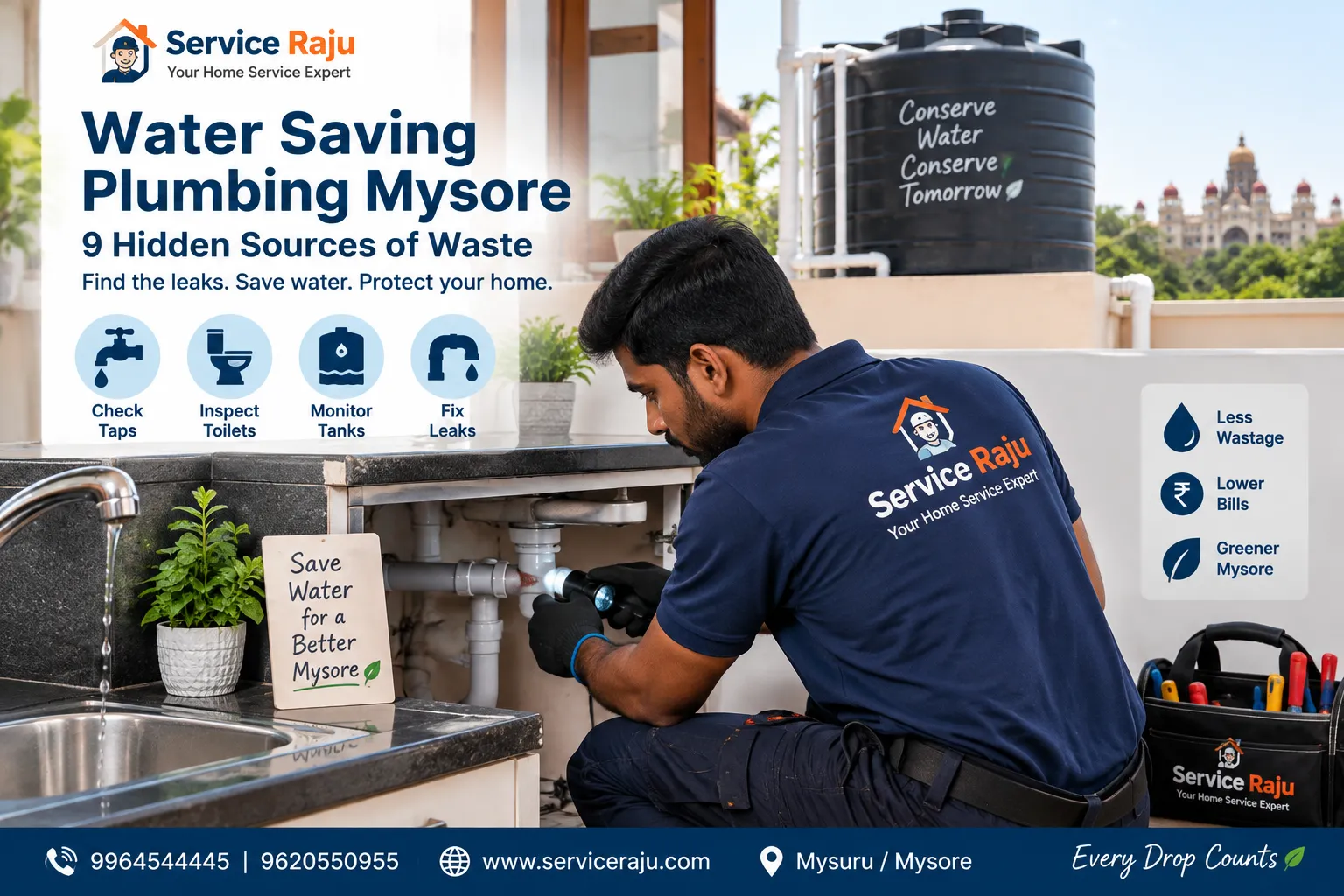
Water-Saving Plumbing Mysore: 9 Hidden Sources of Waste
1. Water-Saving Plumbing Mysore: 9 Hidden Sources of Waste
Water saving plumbing Mysore homeowners need today is not only about using less water while bathing, washing or cleaning. A surprising amount of water can be wasted because of small plumbing faults that continue day after day without getting noticed.
A tap may drip slowly. A toilet may keep refilling. An overhead tank may lose water through an overflow or faulty control. A plumbing joint under the sink may leak into the cabinet instead of onto the floor.
These problems can waste water quietly.
They can also increase the chance of dampness, staining, fixture damage and more expensive repairs.
This topic is particularly relevant in the current environment. Recent reporting says the four major dams in the old Mysuru region are holding about 56% of their combined capacity amid high temperatures and a weak southwest monsoon. Karnataka officials have also warned of possible water and electricity shortages if conditions worsen. Current Mysuru water-availability reporting provides important local context for why reducing avoidable household wastage matters now. :contentReferenceindex=1
The goal of this guide is not to tell homeowners to stop using water.
It is to help them identify where their plumbing may be wasting water unnecessarily.
2. TABLE OF CONTENTS
- Why Water-Saving Plumbing Matters in Mysore
- 9 Hidden Sources of Household Water Waste
- Dripping Taps and Faucets
- Running Toilets and Flush Leaks
- Under-Sink and Fixture Connections
- Tank Overflow and Level-Control Problems
- Washing-Machine and Appliance Connections
- Geyser and Water-Heater Connections
- Hidden Pipe and Wall Leakage
- Outdoor Taps and Hose Connections
- Unusual Water Pressure and Plumbing Behaviour
- How to Check Your Home for Water Waste
- What Your Water Meter Can Tell You
- When to Monitor and When to Call a Plumber
- Why Tank Overflow Deserves Special Attention
- What a Professional Plumbing Inspection Includes
- How Much Does Water-Saving Plumbing Repair Cost in Mysore?
- Service Raju Water-Saving Plumbing in Mysuru
- Water-Waste Prevention Checklist
- FAQs About Water Saving Plumbing Mysore
- Final Takeaway
3. Why Water-Saving Plumbing Matters in Mysore
Water conservation is often discussed in terms of personal habits, but the plumbing system itself plays a major role.
A household can be careful with water and still waste it because of:
- A leaking tap
- A toilet that never fully stops running
- A faulty tank valve
- A leaking pipe connection
- An unnoticed appliance connection leak
- A damaged fixture
- A hidden pipe leak
The important thing is that many of these problems are not dramatic.
You may not see a large stream of water.
Instead, the waste can be slow and continuous.
That makes small plumbing inspections valuable.
It is also why plumbing maintenance should be treated as part of household water management rather than only an emergency repair service.
4. 9 Hidden Sources of Household Water Waste
5. 1. Dripping Taps and Faucets
A dripping tap is one of the easiest problems to ignore.
You may think:
"It is only a few drops."
But a tap that continues dripping throughout the day can become a constant source of avoidable water loss.
Check:
- Kitchen taps
- Bathroom taps
- Washbasin taps
- Utility-area taps
- Outdoor taps
Also inspect around the base of the tap.
Water escaping from a joint or fitting may not always appear as a visible stream from the outlet.
Possible causes include worn washers, cartridge problems, loose connections or fixture damage.
A simple repair may be enough in some cases.
However, repeatedly tightening a damaged fitting is not a substitute for proper repair.
6. 2. Running Toilets and Flush Leaks
A toilet that continues filling after flushing is a classic water-waste problem.
You may hear:
- Constant trickling
- Intermittent refilling
- A short refill every few minutes
- Water moving inside the bowl without a recent flush
Possible causes include:
- Faulty fill valve
- Damaged flush valve
- Worn seals
- Incorrect float adjustment
- Mineral deposits
Because the leak is often quiet, homeowners can live with it for a long time without realizing how much water is being wasted.
Check the toilet even when the bathroom otherwise looks normal.
7. 3. Under-Sink and Fixture Connections
Open the cabinet under your kitchen and bathroom sinks.
Do not inspect only the visible tap above the counter.
Check:
- Flexible hoses
- Angle valves
- Drain connections
- Trap joints
- Water purifier connections
- Dishwasher connections
Look for:
- Water marks
- Swollen cabinet boards
- Rust
- Mineral deposits
- Musty smell
- Repeated dampness
A small connection leak can remain hidden for a long period because the water is absorbed by the cabinet or disappears through the floor area.
8. 4. Tank Overflow and Level-Control Problems
An overhead tank overflowing is more than an annoying sound on the terrace.
It is direct water wastage.
Possible causes include:
- Faulty float valve
- Water-level controller failure
- Sensor problems
- Valve blockage
- Incorrect installation
- High incoming pressure
- Ageing components
Service Raju already has a dedicated article covering frequent overhead-tank overflow and the associated valve, controller, pressure and ageing-infrastructure issues, so this article does not duplicate that repair guide. Read the detailed overhead tank overflow guide. :contentReferenceindex=2
The important water-saving lesson is simple:
A tank should stop filling correctly when the required water level is reached.
If it does not, investigate the control system rather than repeatedly switching the motor manually.
9. 5. Washing-Machine and Appliance Connections
Water-connected appliances can develop small connection leaks.
Check:
- Washing-machine inlet hose
- Drain hose
- Water purifier connections
- Dishwasher connections where applicable
- Refrigerator water connections where applicable
Look for moisture around connection points after the appliance has operated.
A hose may look fine from a distance but have a damaged seal or connection.
Do not pull or bend pressurised hoses unnecessarily.
10. 6. Geyser and Water-Heater Connections
Water heaters have multiple plumbing connections.
Inspect around:
- Inlet connection
- Outlet connection
- Flexible hoses
- Valves
- Safety-valve discharge areas
Water around a geyser should not be ignored, especially if the moisture is persistent or appears around a connection.
Do not dismantle an electrical water heater yourself just to investigate a leak.
Water and electrical systems should be treated carefully.
11. 7. Hidden Pipe and Wall Leakage
Some of the most difficult water-waste problems occur where the pipe itself is hidden.
Warning signs can include:
- Unexpected dampness
- Peeling paint
- Stains
- Musty smell
- Unexplained water-pressure changes
- Repeated wall damage
- Unexpectedly high water use
A hidden leak should not automatically be assumed from one symptom.
It may require:
- Visual inspection
- Moisture measurement
- Pressure testing
- Thermal imaging where appropriate
- Plumbing investigation
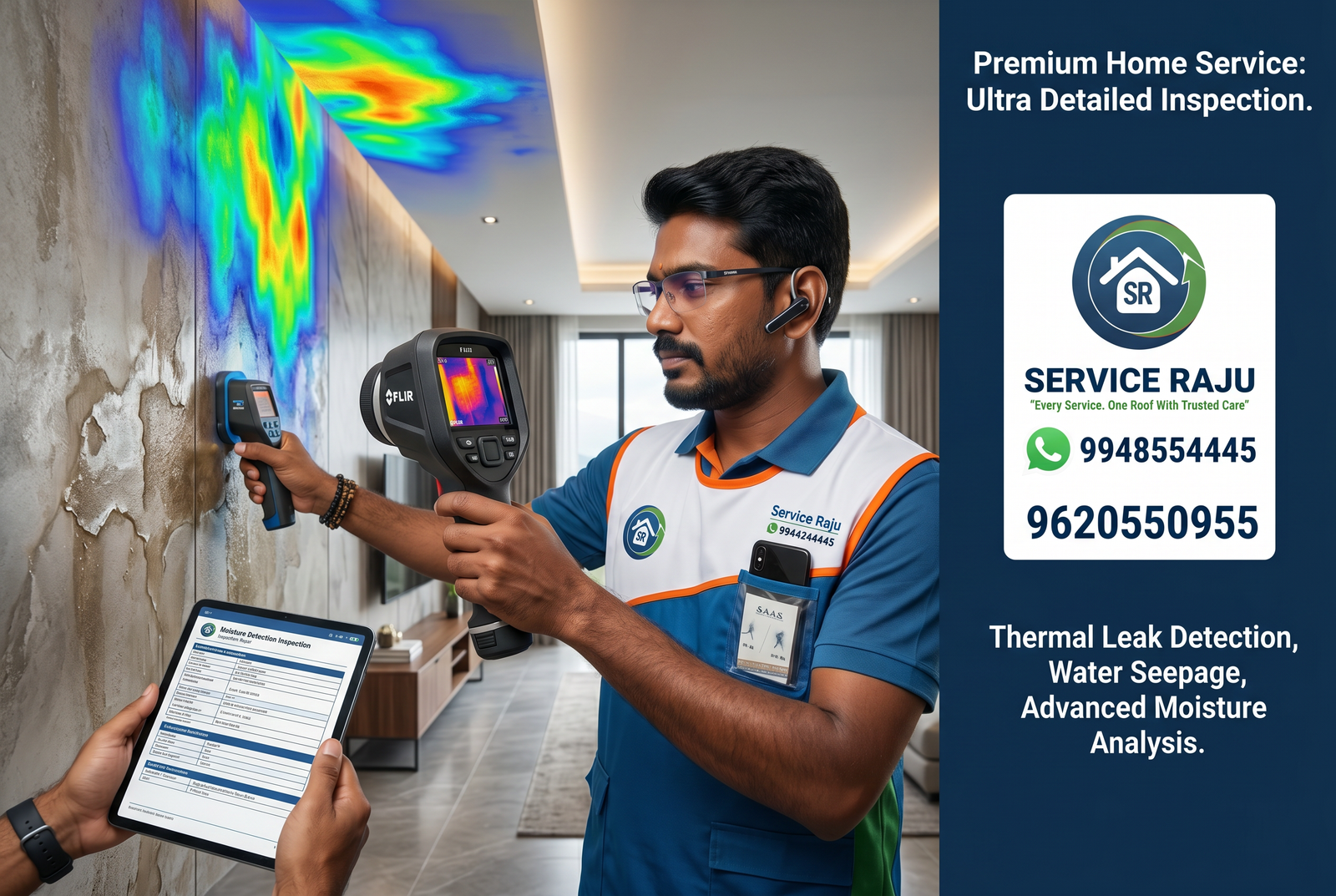
Service Raju's Water Leakage Detection service includes manual inspection, hidden leakage detection, wall leakage detection, bathroom leakage detection, ceiling leakage detection, moisture detection, thermal imaging inspection and non-invasive leakage detection.
12. 8. Outdoor Taps and Hose Connections
Outdoor water points are often forgotten because the water disappears into the ground.
Inspect:
- Garden taps
- Terrace taps
- Cleaning-area taps
- Hose connections
- External pipe joints
If the ground remains unexpectedly wet near one particular connection, investigate it.
Do not assume that every wet outdoor area is caused by rainfall or cleaning.
13. 9. Unusual Water Pressure and Plumbing Behaviour
Water pressure that suddenly changes may deserve attention.
Watch for:
- Sudden pressure drops
- Flow changing when no other tap is operating
- Unusual pipe sounds
- Pump behaviour changes
- Longer tank-filling times
- Water appearing where it normally should not
Pressure changes can have multiple causes.
They do not automatically prove that there is a leak.
But unusual plumbing behaviour is a good reason to investigate rather than ignore the change.
14. How to Check Your Home for Water Waste
Start with the simplest inspection.
15. Step 1: Walk Through the Home
Check every visible water point.
16. Step 2: Listen
In a quiet house, listen near toilets, tanks, taps and water-connected appliances.
17. Step 3: Look Under Cabinets
Check hidden connections under sinks.
18. Step 4: Check the Tank
Make sure the water stops at the intended level and there is no unnecessary overflow.
19. Step 5: Observe the Walls
Look for unexplained dampness, staining or repeated paint damage.
20. Step 6: Watch Your Water Usage
If consumption changes significantly without a clear lifestyle change, investigate.
21. What Your Water Meter Can Tell You
If your property has an accessible water meter, it can provide useful clues.
For example, after all normal water use has stopped, you may notice continued movement indicating that water is still flowing through the system.
However, meter behaviour alone does not identify the exact problem.
It can indicate that further plumbing investigation may be worthwhile.
Possible causes include:
- Visible fixture leaks
- Toilet leaks
- Tank-control problems
- Hidden plumbing leaks
- Other water-consuming connections
Do not tamper with or alter the meter.
Use it only as an observation point and arrange professional inspection when needed.
22. When to Monitor and When to Call a Plumber
Not every tiny drip requires an emergency call.
But certain symptoms should not be ignored.
23. Monitor and Arrange Routine Repair
- Slow tap drip
- Minor worn fixture
- Loose accessible connection
- Small visible seal problem
24. Arrange Professional Inspection Promptly
- Recurring tank overflow
- Hidden wall dampness
- Water disappearing without an obvious reason
- Persistent toilet running
- Repeated pipe-pressure changes
- Water near electrical equipment
- Rapidly worsening leakage
- Ceiling or wall damage
If water is close to electrical equipment, do not continue investigating casually. Treat it as a safety concern.
25. Why Tank Overflow Deserves Special Attention
Tank overflow is one of the easiest forms of water wastage to see but one of the easiest to normalize.
Some homeowners simply turn the pump off manually and continue using the system that way.
That approach may hide the underlying issue.
A recurring overflow can point to:
- Faulty float valve
- Automatic-controller problem
- Sensor issue
- Pressure problem
- Valve blockage
- Ageing plumbing components
Service Raju's existing tank-overflow article identifies these as key causes and explains why repeated overflow can also contribute to property damage and unnecessary water loss. :contentReferenceindex=3
If the problem happens repeatedly, arrange inspection instead of treating manual motor switching as a permanent solution.
26. What a Professional Plumbing Inspection Includes
The exact inspection depends on the complaint.
A practical plumbing inspection can include:
- Understanding the complaint
- Visual inspection
- Fixture and connection checks
- Tank and pump-related inspection where relevant
- Moisture investigation where required
- Pressure or other diagnostic testing where appropriate
- Identification of the likely source
- Repair recommendation
The purpose is not to replace every component automatically.
The purpose is to identify the source and choose the appropriate repair.
27. How Much Does Water-Saving Plumbing Repair Cost in Mysore?
There is no single price for household water-saving plumbing work.
Cost can depend on:
- Type of plumbing problem
- Fixture or valve involved
- Accessibility
- Whether the leak is visible or concealed
- Parts required
- Need for diagnostic testing
- Extent of wall or floor opening, if any
- Repair complexity
A dripping tap repair is very different from locating a concealed pipe leak inside a finished wall.
Likewise, replacing a failed float valve is different from investigating a recurring tank-control problem.
Ask for the inspection scope and repair estimate before approving additional work.
28. Service Raju Water-Saving Plumbing in Mysuru
Service Raju provides plumbing and related home-maintenance services in Mysuru.
The relevant Service Raju service catalog includes:
- Water Tank Consultation
- Drainage & Blockage Solutions Consultation
- General Repair & Maintenance Consultation
- Water Motor Service Consultation
- Plumbing Consultation
- Water Leakage Detection
For a household water-wastage problem, the practical process is:
Inspect → Identify the source → Explain the problem → Approve repair → Repair → Test
When the problem is actually a hidden leak, water leakage detection may be more appropriate than a simple visible plumbing repair.
When the problem is related to the tank, pump or plumbing connections, the appropriate Service Raju plumbing service can be selected based on the diagnosis.
For professional water saving plumbing Mysore support:
Service Raju
9964544445 | 9620550955
www.serviceraju.com
29. Water-Waste Prevention Checklist
30. Weekly
- ☐ Check dripping taps
- ☐ Listen for a running toilet
- ☐ Check under kitchen and bathroom sinks
- ☐ Look at the overhead tank
31. Monthly
- ☐ Inspect flexible hoses
- ☐ Check outdoor taps
- ☐ Check washing-machine connections
- ☐ Check geyser connections
- ☐ Look for unusual dampness
32. When You Notice Something Unusual
- ☐ Check whether water is being used normally
- ☐ Observe the affected area
- ☐ Stop unnecessary water flow where safely possible
- ☐ Arrange inspection if the problem continues
- ☐ Do not ignore recurring leakage
33. FAQs About Water Saving Plumbing Mysore
34. What are the biggest sources of household water wastage?
Common sources include dripping taps, running toilets, tank overflow, leaking plumbing connections, faulty fixtures and hidden pipe leaks.
35. Can a small tap leak really waste significant water?
Continuous dripping can create avoidable water loss over time. The exact amount depends on the flow rate and how long the leak continues.
36. How do I know if my toilet is leaking?
Listen for ongoing refilling, trickling or water movement when the toilet has not been recently flushed. Repeated short refill cycles can also indicate a problem.
37. Why does my water tank keep overflowing?
Possible causes include float-valve failure, water-level-controller problems, sensor issues, pressure conditions, blocked valves or ageing components. The exact cause should be checked before replacing parts.
38. Can a water leak be hidden inside a wall?
Yes. Concealed plumbing problems can sometimes produce dampness, staining, paint damage or unusual water-use patterns before the actual leak becomes visible.
39. Does high water usage always mean there is a leak?
No. Changes in family size, cleaning, gardening, appliance use or other consumption can increase water usage. A persistent unexplained increase may justify a plumbing inspection.
40. Can I find a hidden leak without breaking the wall?
Some hidden-leak investigations can use non-invasive methods such as moisture measurement, thermal imaging and other diagnostic checks. The appropriate method depends on the suspected source.
41. Should I replace a dripping tap or repair it?
It depends on the condition and type of fixture. A worn internal component may be repairable, while a damaged or ageing fixture may make replacement more practical.
42. How often should home plumbing be checked?
There is no universal schedule for every property. Regular visual checks are useful, and professional inspection becomes more important when you notice recurring leaks, dampness, pressure changes or ageing plumbing.
43. Can plumbing inspection reduce water waste?
Inspection can identify faults that may be wasting water. It does not itself save water; the identified problem must then be repaired or corrected.
44. Does Service Raju provide plumbing inspection in Mysuru?
Yes. Service Raju provides plumbing consultation, general plumbing repair and maintenance, water-tank consultation, water-motor service consultation and related water-leakage detection services in Mysuru.
45. Final Takeaway
Saving water at home is not only about changing habits.
Your plumbing system also needs attention.
A dripping tap, running toilet, tank overflow, leaking hose or concealed pipe problem can quietly waste water until somebody notices the damage.
The best approach is:
Check early → Find the source → Repair the fault → Monitor the system
With current water-supply concerns affecting Karnataka and reduced reservoir storage in the old Mysuru region, eliminating avoidable household water wastage is a practical step homeowners can take. :contentReferenceindex=4
If your home has unexplained water loss, recurring leaks, tank overflow, toilet leakage or unusual plumbing behaviour, don't wait for the problem to become expensive.
For professional water saving plumbing Mysore services:
Service Raju
9964544445 | 9620550955
www.serviceraju.com
Mysuru / Mysore
 AC Repair
.webp) Ant Control Service
Ant Control Service
 Basin & Sink Services
.webp) Bath & Shower Services
Bath & Shower Services
.webp) Bath Fittings & Mirrors
Bath Fittings & Mirrors
 Bathroom Cleaning Service
 Bathroom Renovation Services
 Bed Bug Control Services
 Bedroom Painting
 Book a Carpenter Consultation
 Book Electrical Consulting
.webp) Cabinet Painting & Wood Refinishing
Cabinet Painting & Wood Refinishing
 Chimney Cleaning
 Civil Masonry Work
 Clean-Up Services
.webp) Clothes Hanger Installation
Clothes Hanger Installation
 Cockroach Control Services
---mysore-mysore-standard-300x200.webp) Commercial Cleaning
Commercial Cleaning
 Commercial Pest Control AMC Service
 Cupboard & Drawer Services
 Decorative Wall Panels
 Deep Sanitisation Service
 Detan & Bleach
 Door, Grill & Cabinet Painting Service
.webp) Doorbell & security
Doorbell & security
 Drain Blockage Clearing
 Electrical Appliance Services
 Electrical Wiring Services
 Empty Home Deep Cleaning
.webp) Fabrication
Fabrication
 Facials
.webp) Fan Installation & Repair
Fan Installation & Repair
 Full Home Cleaning Service
 Full Home Renovation
 Furniture Repair Service
 Gas Stove & Hob Repair
.webp) General Pest Control Services
General Pest Control Services
 General Plumbing & Consultation
 Geyser Repair
 Glass Cleaning
 Head Massage
.webp) Honeybee & Wasp-Services
Honeybee & Wasp-Services
 Kitchen & Bathroom Painting Service
 Kitchen Cleaning
 Kitchen Fittings
.webp) Kitchen Renovation
Kitchen Renovation
.webp) Laptop/Desktop service
Laptop/Desktop service
 Leak Detection and Repair
 LED TV Repair
 Living and Dining Room Painting
 Makeup, Saree & Styling
 Manicure & Pedicure
 MCB,Meter & Fuse Services
 Microwave Repair
 Mosquito Pest Control Service
 Multi-Room Painting Service
 Painting Consultation
 Quick Mini Cleaning Services
 Refrigerator Repair
 RO Water Purifier
.webp) Rodent Control Services (Rat & Mice Treatment)
Rodent Control Services (Rat & Mice Treatment)
.webp) Rooms Cleaning
Rooms Cleaning
 Shelves & Decor
 Sofa, Carpet & Mattress Cleaning
 Solar Water Heater Service
 Sump & Tank Cleaning
 Switch & Socket Services
 Tap & Mixer Service
.webp) Termite-Control-Services
Termite-Control-Services
 Threading & Face Wax
.webp) Tile & Granite Installation & Polishing
Tile & Granite Installation & Polishing
 Toilet & Commode Services
.webp) UPS and Inverter Repair Services
UPS and Inverter Repair Services
.webp) Wall Painting Service
Wall Painting Service
 Washing Machine Repair
 Water Level Controllers
 Water Tank and Pump Repair
 Waterproofing
 Waterproofing Services
 Waxing
 Window & Curtain Services
 Wooden Door Services