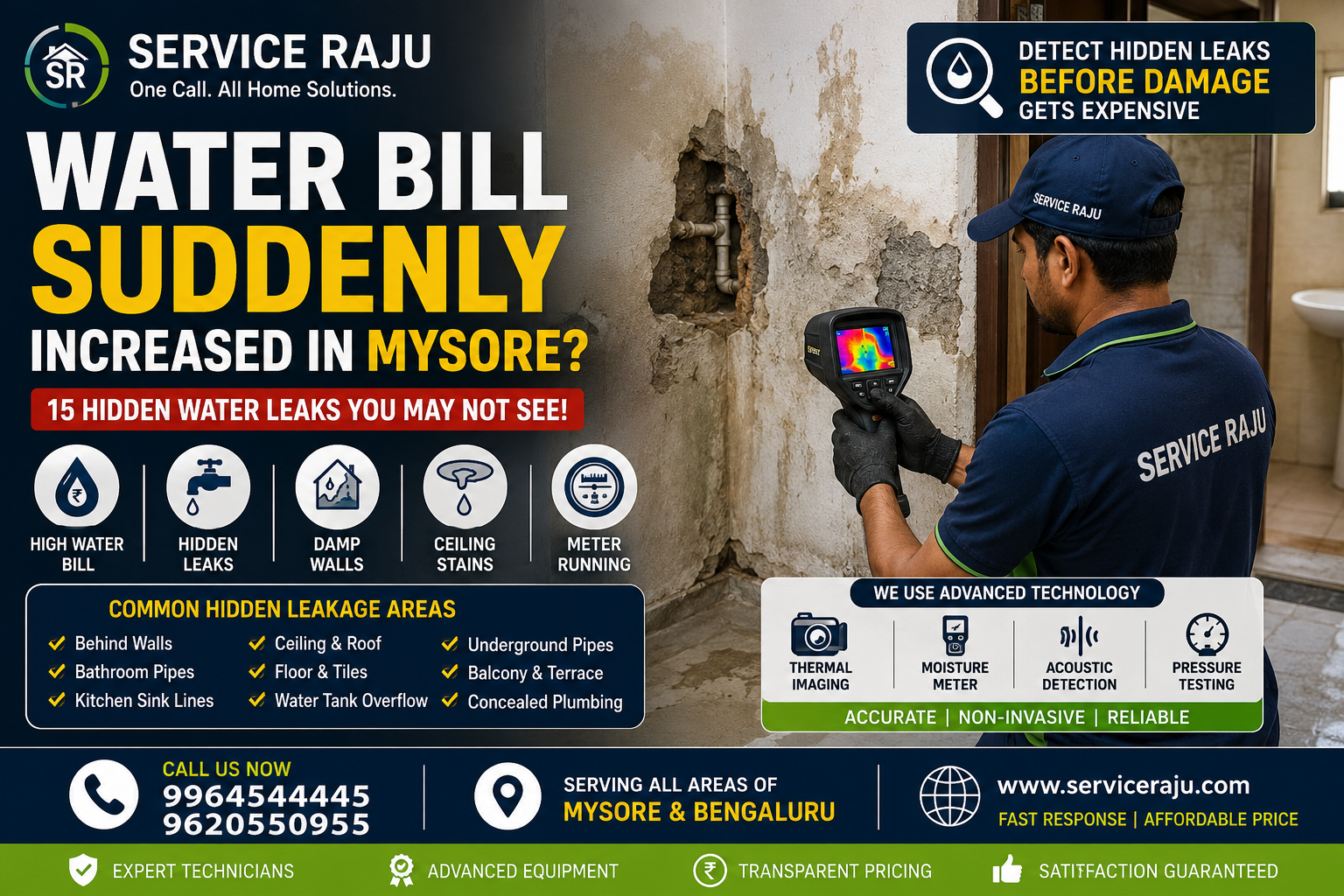
Water Bill Suddenly Increased in Mysore? 15 Hidden Water Leaks You May Not See
How to Find Concealed Pipe Leaks Behind Walls, Floors, Bathrooms & Ceilings Before They Cause Expensive Damage
Last Updated: September 2026
A sudden increase in your water bill can be more than just increased usage.
Sometimes, water is escaping somewhere you cannot see.
A concealed pipe inside a wall, a leaking bathroom line, a damaged underground pipe, or water escaping beneath a floor can continue for days or weeks before the first obvious sign appears.
Hidden leaks are particularly difficult because the visible damage may appear far away from the actual source of the water. Common warning signs include unexplained water consumption, damp or discoloured walls and ceilings, bubbling paint, mould, musty smells and a water meter that continues moving when no water is being used.
If you live in Mysore/Mysuru and have noticed unexplained dampness, recurring seepage or a sudden water-bill increase, this guide explains what to check before breaking walls or replacing tiles unnecessarily.
1. Quick Answer: How Do You Know If Your House Has a Hidden Water Leak?
Look for these warning signs:
- Your water bill suddenly increases
- Water meter moves when all taps are closed
- Damp patches appear on walls
- Ceiling develops yellow or brown stains
- Paint starts bubbling or peeling
- You hear water running inside a wall
- A bathroom wall remains damp
- Floor tiles become unusually wet
- A musty smell keeps returning
- Mould appears without an obvious reason
- Water pressure suddenly changes
- Leakage appears below a bathroom
- Leakage keeps returning after painting
- Water appears only when a particular tap or shower is used
- You repeatedly repair the same leakage without finding its source
The important point: a visible damp patch does not necessarily identify the exact source of the leak.
2. 1. Your Water Bill Suddenly Increased
This is one of the easiest warning signs to overlook.
If your household's water usage hasn't changed significantly but consumption suddenly rises, investigate before assuming the increase is normal.
Possible causes include:
- Concealed pipe leakage
- Underground pipe leakage
- Toilet leakage
- Tap leakage
- Storage-tank overflow
- Faulty plumbing fittings
- Leaking appliances
An unexplained increase in water consumption is a recognised indicator of a possible hidden leak.
3. Don't immediately assume it is a wall leak.
First eliminate obvious leaks such as:
- Taps
- Toilets
- Shower fittings
- Washing-machine connections
- Water tanks
- Visible pipes
If everything appears normal, concealed leakage deserves further investigation.
4. 2. Your Water Meter Keeps Moving
This is one of the simplest checks a homeowner can perform.
5. Try this:
- Turn off all taps.
- Stop using showers.
- Switch off water-using appliances.
- Make sure nobody is using water.
- Observe the water meter.
- Wait and check whether the reading changes.
If the meter continues recording water use when no water should be flowing, there may be leakage somewhere in the property.
The water-meter test is also recommended as an initial way of checking for hidden leaks.
Important: Some properties have multiple tanks, pumps or plumbing connections, so a professional assessment may still be required to identify the actual source.
6. 3. A Damp Patch Appears on Your Wall
A damp patch without an obvious external cause deserves attention.
Look particularly around:
- Bathrooms
- Kitchens
- Utility rooms
- Wash areas
- Pipe shafts
- Sink areas
- Water tanks
- Adjacent rooms
A damp patch can be caused by several things—not just a concealed pipe.
Possible sources include:
- Plumbing leakage
- Bathroom seepage
- Terrace leakage
- External rainwater entry
- Drainage problems
- Waterproofing failure
- Condensation
This is why simply repainting the affected wall often doesn't solve the underlying problem.
7. 4. Your Ceiling Develops Yellow or Brown Marks
A ceiling stain can be an early indication of moisture entering the structure.
The source may be:
- Bathroom above
- Water pipe
- Drainage pipe
- Terrace
- Overhead tank
- External wall
- Roof junction
The difficult part is that water can travel through building materials before becoming visible.
Therefore, the location of the stain isn't always the exact location of the leak.
8. 5. Paint Starts Bubbling or Peeling
Have you noticed:
- Bubbling paint?
- Blistering?
- Peeling?
- Discolouration?
- Cracks around a damp area?
These can occur when moisture is present behind the surface.
Asian Paints also identifies damp patches, peeling/bubbling paint, mould and musty odours among warning signs associated with hidden water leakage.
9. Don't make this mistake:
Damp wall → repaint → problem returns → repaint again
If moisture is still entering the wall, the paint is only hiding the symptom temporarily.
10. 6. You Hear Water Running Inside the Wall
This is a particularly useful clue.
If you hear:
dripping, trickling or running water
when:
- Taps are closed
- Shower isn't running
- Toilet isn't being used
- Washing machine isn't operating
investigate the possibility of an active leak.
However, sound can travel through pipes and walls, so the sound location should not automatically be treated as the exact leak location.
11. 7. One Bathroom Wall Is Always Damp
Bathroom-related leakage is one of the most frustrating household problems.
The source could be:
- Concealed water-supply pipe
- Shower line
- Basin connection
- Toilet connection
- Drainage pipe
- Waterproofing failure
- Tile-joint failure
- Floor trap
- Pipe fitting
This is why bathroom leakage diagnosis should determine whether the problem is plumbing-related or waterproofing-related before major repair work begins.
12. 8. The Floor Feels Damp Without a Visible Spill
If a section of flooring repeatedly becomes damp even though nobody has spilled water, don't ignore it.
Possible causes can include:
- Concealed pipe leakage
- Bathroom seepage
- Underground plumbing
- Drainage leakage
- Water entering from another area
In some situations, moisture can spread underneath flooring before becoming visible at the surface.
13. 9. Your House Has a Persistent Musty Smell
A recurring musty smell can be an important clue when combined with other signs.
Check:
- Behind wardrobes
- Bathroom corners
- Under sinks
- Around plumbing shafts
- Behind kitchen cabinets
- Under flooring
- Ceiling corners
A musty smell alone does not prove a concealed water leak. But if it appears together with dampness, mould or discolouration, moisture should be investigated.
14. 10. Mould Keeps Coming Back
You clean the mould.
It returns.
You repaint the wall.
It returns again.
This can happen when the moisture source hasn't been resolved.
Possible causes include:
- Plumbing leakage
- Bathroom seepage
- Roof leakage
- Condensation
- Poor ventilation
- External moisture
So don't automatically assume that mould means a leaking pipe.
Find the moisture source first.
15. 11. Water Pressure Suddenly Changes
A sudden change in water pressure can have several causes.
For example:
- Supply-side issues
- Blocked pipes
- Faulty valves
- Pump problems
- Plumbing restrictions
- Leakage
Therefore, low pressure by itself isn't proof of a leak.
But if reduced pressure appears together with dampness, unexplained water usage or visible moisture, professional plumbing diagnosis becomes worthwhile.
16. 12. Leakage Appears Only When Someone Uses the Bathroom
This is an extremely useful diagnostic clue.
For example:
17. Leak appears when shower is used
Possible shower-line or waterproofing issue.
18. Leak appears when toilet is flushed
Possible toilet connection or drainage-related problem.
19. Leak appears when basin is used
Possible supply or waste-pipe issue.
20. Leak appears after bathroom floor is washed
Possible drainage or waterproofing issue.
The timing of the leakage can help narrow down the investigation.
21. 13. Leakage Appears Only After Rain
Not every water leak is a plumbing leak.
If the problem appears only after heavy rain, investigate:
- Terrace
- Roof
- External walls
- Windows
- Balcony
- Drainage outlets
- Parapet walls
- Roof pipes
- Waterproofing
This distinction is extremely important.
22. Plumbing leakage
Usually associated with the building's water-supply or drainage system.
23. Rainwater leakage
Usually associated with external water entry, roof/terrace drainage or waterproofing.
Treating the wrong source can waste money.
24. 14. The Same Damp Patch Keeps Returning After Painting
This is one of the biggest warning signs.
You repaint.
The wall looks perfect.
Then after a few weeks or months:
The stain comes back.
That usually means the underlying moisture problem has not been properly resolved.
Before spending money on another round of painting, investigate the source.
25. 15. You Keep Repairing the Leakage Without Finding the Source
This is where professional leak detection becomes especially useful.
If you've already:
- Repainted
- Regrouted
- Changed a tap
- Replaced visible pipes
- Applied waterproofing
- Broken tiles
- Repaired one section
…and the leakage continues, stop guessing.
Diagnose first. Repair second.
26. How Professionals Find Hidden Water Leaks
A proper leakage investigation may use several methods rather than relying on one device.
27. 1. Visual Inspection
The first step is identifying:
- Damp areas
- Stains
- Cracks
- Pipe routes
- Plumbing fixtures
- Drainage points
- Recent repair areas
28. 2. Water Meter / Isolation Testing
Where appropriate, the plumbing system can be isolated and monitored to determine whether water is continuing to flow unexpectedly.
29. 3. Moisture Meter Testing
A moisture meter can help identify areas with elevated moisture compared with surrounding surfaces.
This can be particularly useful when the wall looks relatively normal but moisture is suspected.
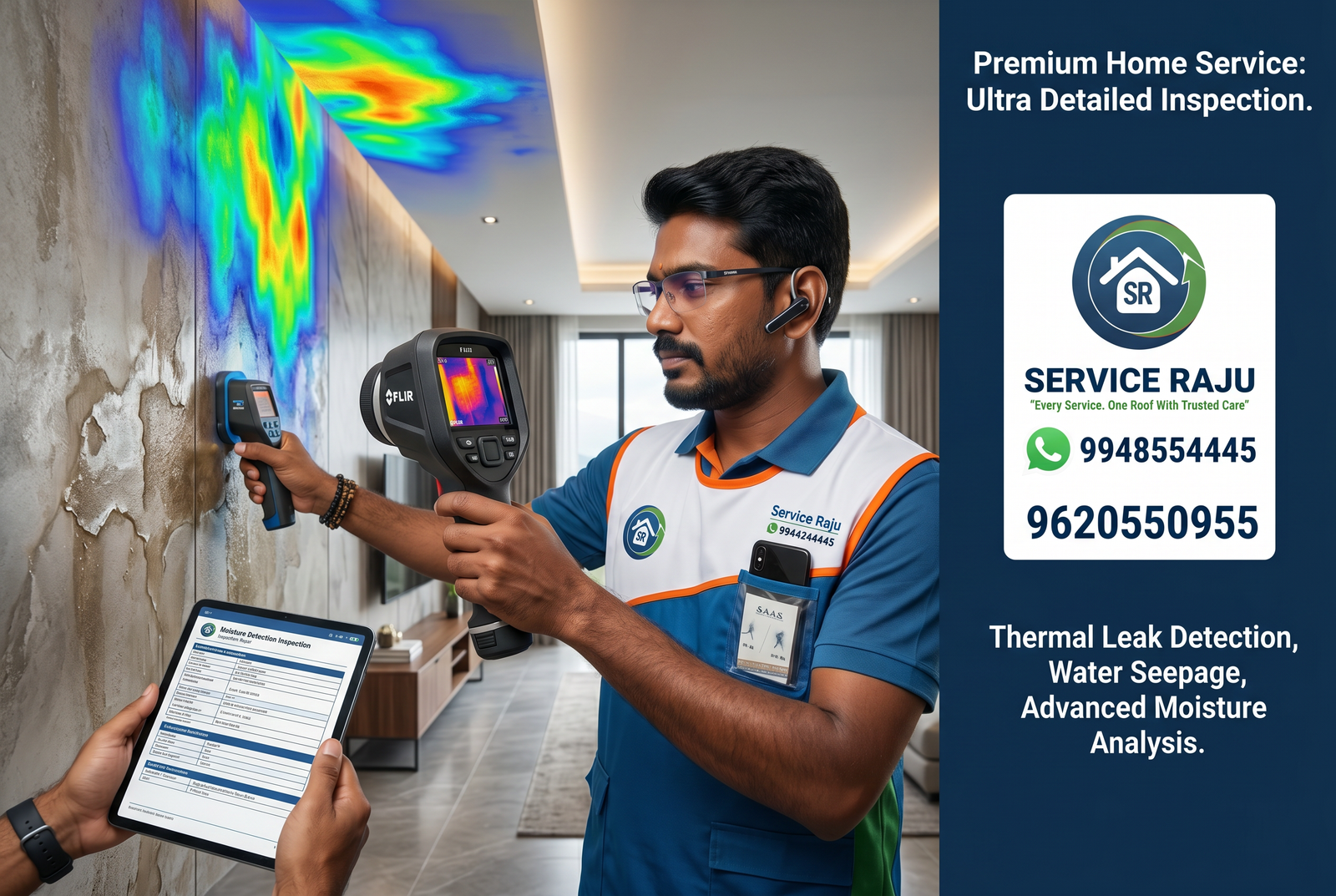
30. 4. Thermal Imaging
Thermal cameras detect differences in surface temperature and thermal patterns.
Moisture can alter the thermal behaviour of building materials, so thermal imaging can sometimes help identify suspicious areas.
Important: A thermal camera does not literally “see water inside a wall.” It detects infrared temperature patterns that must be interpreted together with other evidence.
That distinction matters because a thermal image alone does not prove the exact source of a leak.
31. 5. Acoustic Leak Detection
In suitable situations, specialised acoustic equipment can help identify the sound generated by escaping water from concealed plumbing.
This can be useful when the pipe is inaccessible.
32. 6. Pressure Testing
Pressure testing can help assess whether a plumbing line is maintaining expected pressure.
It can be particularly useful when a concealed supply pipe is suspected.
33. Thermal Imaging vs Breaking the Wall
Traditional troubleshooting may involve opening a wall or removing tiles to investigate.
That can be expensive because you may have to pay for:
- Tile removal
- Plaster breaking
- Labour
- Replacement tiles
- Masonry
- Painting
A non-invasive diagnostic approach can help identify suspicious areas before unnecessary demolition, although no detection method can guarantee that every hidden leak will be located without some form of targeted opening.
34. What Causes Hidden Water Leakage in Homes?
Common causes include:
35. Aging Pipes
Old plumbing can deteriorate over time.
36. Loose Connections
A poorly sealed joint can eventually leak.
37. Cracked Pipes
Physical damage can allow water to escape.
38. High Water Pressure
Excessive pressure can stress plumbing components.
39. Poor Installation
Improperly installed plumbing may develop problems later.
40. Bathroom Waterproofing Failure
Water can migrate through floors and walls when waterproofing is compromised.
41. Damaged Drainage Pipes
Wastewater leakage can create dampness and unpleasant odours.
42. Terrace Leakage
Rainwater entering through the roof can resemble an internal plumbing leak.
43. Underground Pipe Leakage
A damaged buried pipe may remain invisible while continuously losing water.
44. Hidden Water Leak vs Waterproofing Problem
This distinction can save homeowners a lot of money.
| Problem | Possible Source | Typical Investigation |
|---|---|---|
| Wall dampness | Concealed pipe | Moisture + plumbing inspection |
| Ceiling stain | Bathroom/roof/pipe | Visual + moisture investigation |
| Bathroom seepage | Plumbing/waterproofing | Bathroom leakage diagnosis |
| Leak after rain | Terrace/external wall | Roof/external inspection |
| High water bill | Hidden supply leak | Meter + plumbing testing |
| Wet floor | Pipe/drainage/seepage | Moisture + plumbing inspection |
| Recurring paint damage | Ongoing moisture | Source investigation |
Don't waterproof a plumbing leak.
And don't replace a concealed pipe when the actual problem is terrace waterproofing.
The diagnosis comes first.
45. 7 Mistakes Homeowners Make With Water Leakage
46. Mistake 1: Repainting the Damp Wall
Paint doesn't stop the source of water.
47. Mistake 2: Breaking Tiles Immediately
You may damage perfectly good tiles before locating the problem.
48. Mistake 3: Assuming Every Leak Is Plumbing
Rainwater and waterproofing problems can look similar.
49. Mistake 4: Ignoring a Higher Water Bill
An unexplained increase deserves investigation.
50. Mistake 5: Using Waterproofing Everywhere
Waterproofing isn't the correct solution for every concealed plumbing leak.
51. Mistake 6: Waiting Until the Damage Becomes Severe
Moisture can spread beyond the original visible area.
52. Mistake 7: Treating Only the Visible Stain
The visible stain may be the symptom rather than the source.
53. Can a Hidden Water Leak Damage Your House?
Yes, prolonged moisture can contribute to:
- Damaged paint
- Plaster deterioration
- Mould/mildew growth
- Damaged flooring
- Damaged cabinetry
- Wood deterioration
- Persistent odours
- Repeated repair costs
Hidden leaks can continue unnoticed for considerable periods, and early detection can help reduce unnecessary damage.
54. What Should You Do If You Suspect a Concealed Leak?
Follow this order:
55. Step 1
Check visible taps and plumbing fixtures.
56. Step 2
Check your water meter when no water is being used.
57. Step 3
Look for dampness, stains and bubbling paint.
58. Step 4
Identify when the leakage occurs.
59. Step 5
Determine whether rain affects the problem.
60. Step 6
Avoid unnecessary demolition.
61. Step 7
Get professional leakage diagnosis if the source remains unclear.
62. Step 8
Repair the actual source.
63. Step 9
Allow affected areas to dry properly.
64. Step 10
Only then restore plaster, tiles or paint.
65. Water Leakage Detection in Mysore
Service Raju provides water leakage detection and plumbing diagnosis services in Mysore/Mysuru for homeowners facing concealed leakage, seepage and recurring dampness.
Depending on the situation, inspection may involve:
- Visual inspection
- Plumbing diagnosis
- Moisture assessment
- Thermal imaging
- Concealed leakage investigation
- Bathroom leakage diagnosis
- Ceiling leakage investigation
- Pipe leakage diagnosis
- Water-pressure assessment
- Waterproofing assessment
The appropriate method depends on the suspected source and the construction of the property.
Service Raju's existing leakage service content also covers advanced thermal inspection as a non-invasive diagnostic option.
66. Water Leakage Detection Cost in Mysore
The cost depends on the type and complexity of the investigation.
Factors can include:
- Basic inspection requirements
- Concealed pipe accessibility
- Number of affected areas
- Thermal imaging requirements
- Moisture testing
- Pressure testing
- Plumbing repair
- Waterproofing requirements
67. Indicative Service Raju starting prices
| Service | Starting Price |
|---|---|
| Basic plumbing/leakage inspection | ₹199+ |
| Concealed leakage diagnosis | ₹499+ |
| Advanced leakage detection | ₹1,499+ |
| Advanced thermal leakage survey | ₹4,999+ |
| Plumbing repair | Based on fault |
| Waterproofing | Based on area & method |
Note: These are starting/indicative prices, not a guaranteed final quotation. The actual cost depends on the property, suspected leak, equipment required and repair scope. Service Raju currently publishes ₹4,999+ for its advanced thermal leakage survey and separate lower starting points for basic plumbing inspection.
68. Why Choose Service Raju for Water Leakage Detection?
69. ✔ Non-Invasive Diagnosis Options
Where suitable, advanced detection can reduce unnecessary wall or tile breaking.
70. ✔ Multiple Detection Methods
Different leakage problems require different diagnostic approaches.
71. ✔ Plumbing + Waterproofing Support
The source may be plumbing, drainage or waterproofing, so identifying the actual cause matters.
72. ✔ Mysore-Wide Service
Service Raju serves customers across Mysore/Mysuru.
73. ✔ Repair After Diagnosis
Once the source is identified, the required plumbing or waterproofing solution can be planned.
74. Water Leakage Detection in Mysore: Areas We Serve
Service Raju serves customers across Mysore/Mysuru, including:
- Vijayanagar
- Dattagalli
- Kuvempunagar
- Gokulam
- Bogadi
- Hebbal
- Saraswathipuram
- Jayalakshmipuram
- Yadavagiri
- Lakshmipuram
- Nazarbad
- Vidyaranyapuram
- Srirampura
- Hootagalli
- JP Nagar
- Ramakrishna Nagar
- Bannur Road
- Rajarajeshwari Nagar
- Chamundipuram
- Mysore city and surrounding areas
Service availability depends on the exact location.
75. Frequently Asked Questions
76. How can I detect a hidden water leak in my house?
Start by checking visible plumbing, then perform an appropriate water-meter check when no water is being used. Look for damp walls, ceiling stains, bubbling paint, mould, unusual smells and unexplained water consumption.
77. How do I know if water is leaking inside my wall?
Damp patches, discolouration, bubbling paint, mould, musty smells and unexplained water usage can indicate moisture problems. Professional moisture and plumbing inspection may be needed to determine the source.
78. Can a thermal camera detect water inside a wall?
A thermal camera does not directly see water. It detects temperature patterns that may be associated with moisture. Thermal results should be interpreted alongside visual and moisture evidence.
79. Why does my wall become wet after using the bathroom?
Possible causes include a concealed supply pipe, drainage leakage, bathroom waterproofing failure or water escaping around fixtures. The timing of the dampness can provide useful diagnostic information.
80. Why does my ceiling leak only when it rains?
The cause may be terrace waterproofing, roof cracks, drainage problems, external-wall penetration or another rainwater-entry point rather than an internal plumbing pipe.
81. Should I repaint a wall with water stains?
Not before identifying and addressing the moisture source. Otherwise, the stain may return.
82. Does a high water bill always mean a concealed pipe leak?
No. Increased usage, leaking toilets, dripping taps, storage-tank overflow and other plumbing problems can also increase water consumption.
83. Can hidden leakage be repaired without breaking the wall?
Sometimes. The repair method depends on where the leak is located and how accessible the pipe is. Detection equipment can help identify a target area, but some repairs may still require opening the surface.
84. How much does water leakage detection cost in Mysore?
It depends on the type of inspection. Service Raju publishes basic inspection from ₹199+, concealed/advanced diagnosis from higher starting points, and advanced thermal surveys from ₹4,999+.
85. ???? 15-Point Hidden Water Leakage Checklist
Save this checklist:
☐ Water bill suddenly increased ☐ Water meter moves with no water usage ☐ Damp wall ☐ Yellow ceiling stain ☐ Bubbling paint ☐ Peeling paint ☐ Musty smell ☐ Recurring mould ☐ Water running sound inside wall ☐ Unusual floor dampness ☐ Bathroom leakage ☐ Leakage below another bathroom ☐ Water pressure changed ☐ Leakage appears after rain ☐ Same damp patch keeps returning
If several of these signs are present, don't keep guessing where the water is coming from.
86. Final Verdict
If a damp patch, high water bill or recurring seepage keeps returning, find the source before repainting or breaking tiles. Early leak detection can prevent unnecessary repairs and help protect your home.
87. Need Water Leakage Detection in Mysore?
Don't keep repairing the same damp patch without finding the actual source.
Service Raju provides water leakage detection, concealed pipe leakage diagnosis, plumbing inspection, thermal inspection and waterproofing support across Mysore/Mysuru.
???? 9964544445 / 9620550955
???? www.serviceraju.com
???? Serving All Areas of Mysore / Mysuru
Service Raju — One Call. All Home Solutions.
 AC Repair
.webp) Ant Control Service
Ant Control Service
 Basin & Sink Services
.webp) Bath & Shower Services
Bath & Shower Services
.webp) Bath Fittings & Mirrors
Bath Fittings & Mirrors
 Bathroom Cleaning Service
 Bathroom Renovation Services
 Bed Bug Control Services
 Bedroom Painting
 Book a Carpenter Consultation
 Book Electrical Consulting
.webp) Cabinet Painting & Wood Refinishing
Cabinet Painting & Wood Refinishing
 Chimney Cleaning
 Civil Masonry Work
 Clean-Up Services
.webp) Clothes Hanger Installation
Clothes Hanger Installation
 Cockroach Control Services
---mysore-mysore-standard-300x200.webp) Commercial Cleaning
Commercial Cleaning
 Commercial Pest Control AMC Service
 Cupboard & Drawer Services
 Decorative Wall Panels
 Deep Sanitisation Service
 Detan & Bleach
 Door, Grill & Cabinet Painting Service
.webp) Doorbell & security
Doorbell & security
 Drain Blockage Clearing
 Electrical Appliance Services
 Electrical Wiring Services
 Empty Home Deep Cleaning
.webp) Fabrication
Fabrication
 Facials
.webp) Fan Installation & Repair
Fan Installation & Repair
 Full Home Cleaning Service
 Full Home Renovation
 Furniture Repair Service
 Gas Stove & Hob Repair
.webp) General Pest Control Services
General Pest Control Services
 General Plumbing & Consultation
 Geyser Repair
 Glass Cleaning
 Head Massage
.webp) Honeybee & Wasp-Services
Honeybee & Wasp-Services
 Kitchen & Bathroom Painting Service
 Kitchen Cleaning
 Kitchen Fittings
.webp) Kitchen Renovation
Kitchen Renovation
.webp) Laptop/Desktop service
Laptop/Desktop service
 Leak Detection and Repair
 LED TV Repair
 Living and Dining Room Painting
 Makeup, Saree & Styling
 Manicure & Pedicure
 MCB,Meter & Fuse Services
 Microwave Repair
 Mosquito Pest Control Service
 Multi-Room Painting Service
 Painting Consultation
 Quick Mini Cleaning Services
 Refrigerator Repair
 RO Water Purifier
.webp) Rodent Control Services (Rat & Mice Treatment)
Rodent Control Services (Rat & Mice Treatment)
.webp) Rooms Cleaning
Rooms Cleaning
 Shelves & Decor
 Sofa, Carpet & Mattress Cleaning
 Solar Water Heater Service
 Sump & Tank Cleaning
 Switch & Socket Services
 Tap & Mixer Service
.webp) Termite-Control-Services
Termite-Control-Services
 Threading & Face Wax
.webp) Tile & Granite Installation & Polishing
Tile & Granite Installation & Polishing
 Toilet & Commode Services
.webp) UPS and Inverter Repair Services
UPS and Inverter Repair Services
.webp) Wall Painting Service
Wall Painting Service
 Washing Machine Repair
 Water Level Controllers
 Water Tank and Pump Repair
 Waterproofing
 Waterproofing Services
 Waxing
 Window & Curtain Services
 Wooden Door Services