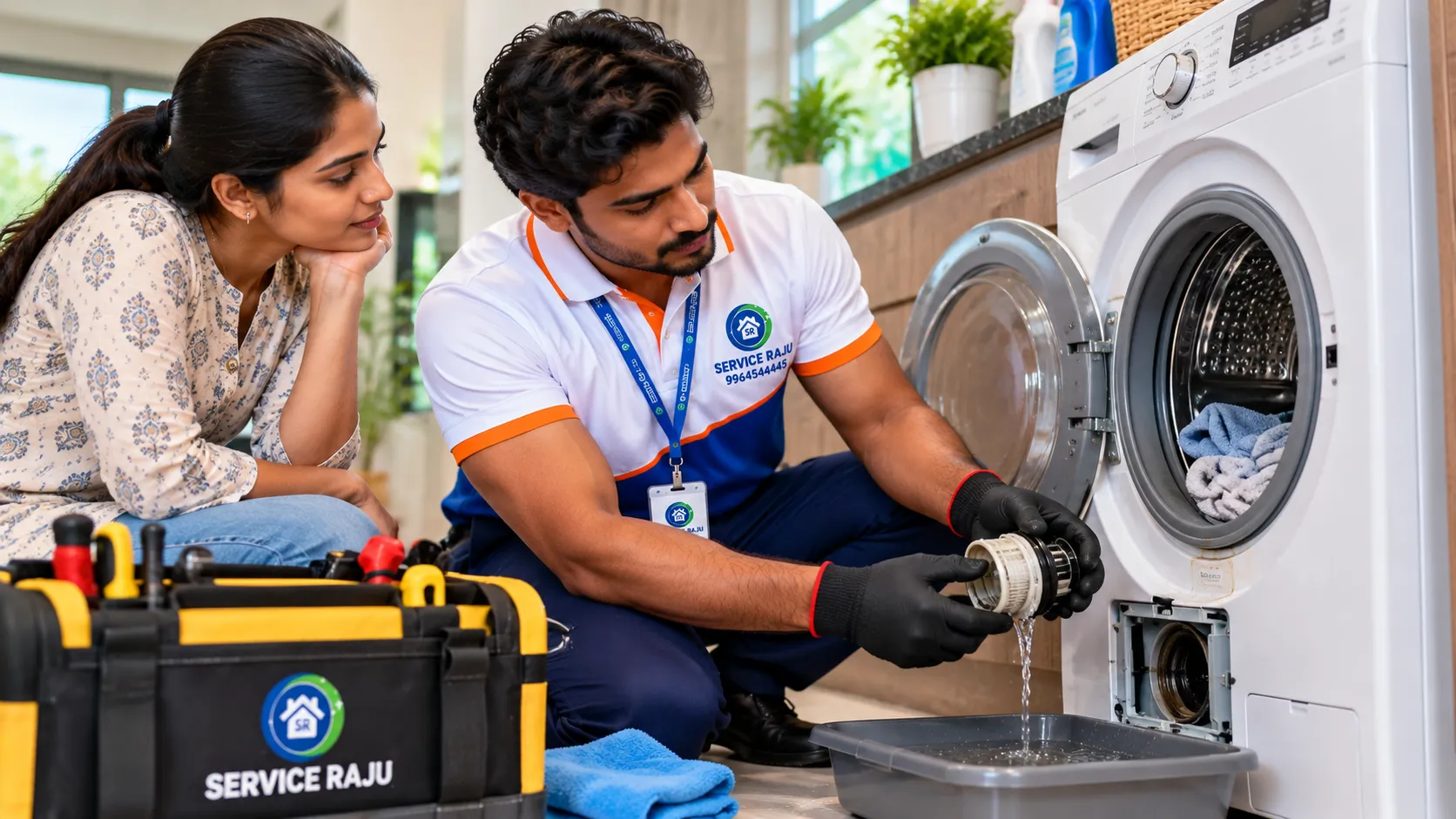
Washing Machine Not Draining Water? Causes and Repair Guide
Has your washing machine completed its wash cycle but left water sitting inside the drum? Are your clothes still soaking wet, or does the machine stop just before the spin cycle?
A washing machine not draining water in Mysore can disrupt your entire laundry routine. The problem may be caused by a blocked drain filter, a restricted hose, an obstruction, a household drainage issue or a faulty drain pump.
The good news is that drainage trouble does not automatically mean you need an expensive replacement part or a new washing machine.
This guide explains the common causes, safe checks you can perform, warning signs to watch for and when to book professional washing machine repair in Mysuru.
Quick Answer: Why Is Your Washing Machine Not Draining?
If your washing machine is holding water after a cycle, the most common areas to investigate are:
- A blocked or dirty drain filter, where fitted
- A kinked, crushed or blocked drain hose
- Coins, lint or other objects obstructing the drainage path
- A blocked household drain connection
- A drain pump that is obstructed or not working correctly
- An interrupted cycle or load-related problem
- A door lock, lid switch, sensor or control issue
- An internal hose or electrical fault
The correct solution depends on the washing machine's design, brand, model and symptoms. Start with safe external checks and consult the manufacturer's instructions before accessing any filter or drain component.
9 Causes of a Washing Machine Not Draining Water
1. Blocked Washing Machine Drain Filter
A drain filter, where fitted, helps catch lint, small objects and other debris before they reach the drain pump.
Over time, the filter may collect:
- Lint and fabric fibres
- Hair
- Coins
- Buttons
- Small pieces of plastic
- Other debris from clothing
A heavily obstructed filter can restrict drainage and leave water inside the drum.
What you can check:
- Check your user manual to confirm whether your model has an accessible drain filter.
- Look for manufacturer instructions on how to access and clean it.
- Switch off and unplug the machine before carrying out any permitted maintenance, provided the plug and surrounding area are completely dry and safe to access.
- Prepare a shallow container and towels if the manual instructs you to drain residual water.
Some machines do not have a user-accessible filter. Do not force open a filter cover or remove internal components if the instructions are unclear.
2. Blocked, Crushed or Kinked Drain Hose
The drain hose carries wastewater away from the washing machine. If it is bent sharply, crushed behind the appliance or obstructed, water may not flow out correctly.
This problem can sometimes occur after the machine has been moved for cleaning, relocation or maintenance.
What you can check:
- Look for visible kinks in the accessible section of the drain hose.
- Check whether the hose is visibly crushed against a wall or cabinet.
- Look for obvious damage or leakage.
- Consult your manual for the correct hose position and permitted height.
Do not pull a tightly fitted washing machine away from the wall aggressively. The hose, water connections and electrical cable may be damaged.
3. Coins or Other Objects in the Drainage System
Small objects left in pockets can enter the washing machine drainage system and restrict water flow.
Common examples include coins, hair clips, safety pins, buttons and small plastic items.
Sometimes the machine may also produce unusual rattling or grinding sounds while trying to drain.
What you can check: Empty clothing pockets before washing and note whether unusual noises occur during the drainage stage.
If you suspect an object is trapped inside the pump or an internal hose, do not dismantle the machine yourself. An appliance technician can inspect the drainage path safely.
4. Blocked Household Drain or Wastewater Connection
Sometimes the washing machine is working correctly, but the household drainage connection is restricted.
This may happen when the drain hose connects to plumbing beneath a sink or to another shared drainage point.
Look for these signs:
- Water backs up when the washing machine drains.
- The connected sink empties slowly.
- Several connected fixtures drain poorly.
- Water or wastewater returns through the drainage connection.
If other fixtures are also affected, a plumbing issue may be responsible. Fixing the washing machine alone will not solve a blockage in the household drain.
5. Faulty or Obstructed Drain Pump
The drain pump moves wastewater out of the washing machine. If the pump is obstructed, worn or electrically faulty, the machine may remain full of water.
Possible warning signs include:
- A humming sound without water draining
- Unusually loud grinding or rattling
- No apparent pump operation during the drainage stage
- Water remaining after repeated correctly selected cycles
- A recurring drainage-related error code
These symptoms can point towards a pump problem, but they do not prove that the pump must be replaced. A blockage, wiring problem, control issue or another fault can produce similar symptoms.
Recommended action: Stop repeated restart attempts and arrange professional inspection if the basic external checks do not resolve the problem.
6. Incorrect Cycle Setting or Unbalanced Laundry Load
Not every drainage-related complaint indicates a damaged part.
Depending on the machine, the selected cycle, spin setting, excessive load or an unbalanced load may interrupt or change the final stages of washing.
For example, the machine may stop before completing the spin cycle, leaving clothes wetter than expected.
What you can check:
- Check whether the selected programme has completed.
- Look for a pause, imbalance or cycle-interruption message.
- Follow the manual's instructions for an unbalanced load.
- Confirm that the correct drain or spin programme has been selected.
If the drum contains standing water and the machine repeatedly refuses to drain, do not assume the load is the only cause.
7. Door Lock, Lid Switch or Safety Interlock Problem
Automatic washing machines use safety mechanisms to control operation. Depending on the model, a door lock, lid switch or related sensor fault can interrupt parts of the wash cycle.
This may cause the machine to stop before draining or spinning has completed.
Check whether the door or lid closes correctly and note any displayed warning.
Never bypass a safety interlock, force a locked door or open an electrical panel to investigate the issue. If a door or lid error keeps returning, request professional diagnosis.
8. Excess Detergent or Residue Build-Up
Using more detergent than recommended may contribute to excessive foam and residue accumulation, depending on the detergent, water conditions and machine design.
Over time, deposits can affect the cleanliness of the drainage system, while excessive foam may interfere with normal cycle operation on some models.
What you can do:
- Use detergent suitable for your washing machine type.
- Follow the dosage instructions for your detergent and load size.
- Clean the detergent drawer according to the manual.
- Follow the manufacturer's routine cleaning recommendations.
Do not pour household drain cleaners or unapproved chemicals into the washing machine. They are not a universal solution for drainage problems and may damage components or create safety risks.
9. Internal Hose, Wiring, Sensor or Control-System Fault
If the filter, accessible hose and household drain appear normal, the problem may be inside the machine.
Possible causes include:
- A restricted internal drainage hose
- A pump impeller problem
- Faulty electrical connections
- A sensor or control-system malfunction
- A door or lid interlock fault
- A problem affecting the drainage sequence
These faults often require access to internal components and proper testing. Because a washing machine combines electricity, water and moving mechanical parts, this work should be performed by a suitably trained technician.
What Do Washing Machine Error Codes Mean?
Modern washing machines may display an error code when the drainage process fails or takes longer than expected.
The meaning of a code varies by manufacturer, model and sometimes the exact model series. Do not assume that the same code means the same fault on every washing machine.
If an error appears:
- Write down the exact code.
- Record the brand and model number.
- Note the stage at which the machine stops.
- Check the manufacturer's instructions for that specific model.
- Share this information when booking a repair.
An error code is a diagnostic clue, not always a definitive reason to replace a particular component.
Front-Load vs Top-Load Washing Machine Drainage Problems
| Machine Type | Possible Areas to Inspect |
|---|---|
| Front-load automatic | Accessible drain filter, drain hose, pump, door interlock and error code |
| Top-load automatic | Drain hose, pump or drain valve, lid switch, load condition and control system |
| Semi-automatic | Drain selector, drain hose, tub obstruction and model-specific drainage mechanism |
The actual design varies between models. A troubleshooting procedure suitable for one machine may not be appropriate for another.
Washing Machine Full of Water? What Should You Do First?
If water remains inside the drum, follow these precautions before attempting any further checks.
Step 1: Stop Repeated Restart Attempts
If the machine repeatedly fails during drainage, continuing to restart it is unlikely to identify the cause and may place unnecessary stress on a faulty component.
Step 2: Check for Electrical or Water Hazards
If you see water near a power socket, plug, damaged cable or other electrical equipment, do not touch the machine or electrical connection. Keep away from the affected area and seek appropriate assistance.
Step 3: Do Not Force the Door
A front-load door may remain locked while water is inside. Never force it open. Consult your model's instructions for the approved emergency-drain procedure.
Step 4: Follow the Manufacturer's Drainage Instructions
If the manufacturer provides a user-accessible emergency drain or filter procedure, follow it exactly. Water may spill out, and it may be hot after a recent wash.
If the drum is full, the access method is unclear or the procedure requires moving heavy equipment, arrange professional assistance instead.
Step 5: Book a Technician if the Fault Persists
If the machine still will not drain after safe external checks, a technician can inspect the pump, internal hose, electrical connections and relevant control components.
Safe Troubleshooting Checklist Before Booking a Repair
You can prepare the following information without dismantling the washing machine.
| Check | What to Look For |
|---|---|
| Cycle status | Whether the programme finished or stopped unexpectedly |
| Error code | Exact letters or numbers displayed |
| Drain hose | Visible kinks, crushing, damage or leakage |
| Household drain | Slow draining or water backing up from a shared connection |
| Pump sound | Unusual humming, grinding or silence during drainage |
| Machine details | Brand, model and front-load, top-load or semi-automatic type |
Do not open electrical compartments, dismantle the pump or attempt wiring repairs as part of these checks.
When Should You Book Washing Machine Repair in Mysore?
Professional washing machine repair in Mysuru is recommended when:
- Water remains inside after every cycle.
- The drain filter or accessible hose appears clear, but drainage still fails.
- The pump makes unusual noises.
- The machine displays a recurring drainage error.
- The washer stops before completing the cycle.
- Water leaks around the machine during drainage.
- The machine trips the electrical supply or produces a burning smell.
- The problem returns after temporary troubleshooting.
If you notice a burning smell, smoke or an electrical hazard, stop using the appliance and seek appropriate assistance immediately.
If the appliance is still under manufacturer warranty, check the manufacturer's service process before arranging third-party repairs.
How Much Does Washing Machine Drainage Repair Cost in Mysore?
The repair cost depends on the actual cause, machine type, model and parts required.
A simple hose-positioning issue is different from a blocked internal drainage path or a failed drain pump. An electrical or control-system fault may require additional diagnosis.
The final quotation may depend on:
- Brand and model
- Inspection findings
- Cleaning or blockage removal required
- Drain pump or other parts required
- Labour and installation complexity
- Availability of compatible spare parts
For this reason, it is better to identify the fault before committing to a major repair or buying a replacement part.
How Service Raju Handles Washing Machine Drainage Problems
Service Raju provides washing machine repair services in Mysuru for customers experiencing drainage faults, water retention and other washing machine problems.
Depending on the machine and reported symptoms, a professional inspection may cover:
- Drain filter and accessible drainage path
- Drain hose and external connections
- Drain pump operation
- Possible internal hose restrictions
- Door or lid safety mechanisms
- Error codes and control-related symptoms
- Relevant electrical and mechanical components
- Testing after the repair
The recommended repair depends on the inspection findings. The aim is to diagnose the fault before replacing parts unnecessarily.
Service Raju offers washing machine servicing and repair for supported front-load, top-load and semi-automatic models.
How to Prevent Future Washing Machine Drainage Problems
Empty Pockets Before Washing
Check clothing for coins, keys, clips and other small objects before loading the machine.
Use the Correct Detergent Quantity
Follow the detergent manufacturer's dosage recommendations and your washing machine's instructions.
Keep the Drain Hose Correctly Positioned
Avoid crushing the hose behind the appliance. Follow the specified routing and height requirements for your model.
Maintain the Filter Where Fitted
Clean an accessible drain filter only as recommended by the manufacturer. Not all machines have the same filter arrangement.
Avoid Overloading
Follow the stated capacity and cycle guidance. Very bulky or uneven loads may interfere with normal washing and spinning on some machines.
Respond to Early Warning Signs
Slow drainage, repeated error codes, unusual pump sounds and incomplete cycles should be investigated before the problem becomes persistent.
Frequently Asked Questions
Why is my washing machine not draining water?
Possible causes include a blocked drain filter, restricted drain hose, foreign object, household drain blockage, pump fault or a problem with the control system. The actual cause depends on your washing machine model and symptoms.
Can I fix a washing machine drainage problem myself?
You may be able to identify a visibly kinked external hose or check the cycle setting. Filter cleaning and emergency draining should be attempted only when your model's instructions permit it. Internal pump, wiring and electrical faults require professional diagnosis.
Why is my washing machine draining slowly?
A partially blocked filter, restricted hose, drainage obstruction, pump problem or household plumbing issue can reduce drainage. An inspection can help distinguish between them.
Why is my washing machine not spinning after washing?
Many machines require water to drain before the spin stage can complete. A drainage fault or an interrupted cycle can therefore leave clothes wet even when the drum and motor are otherwise functional.
Why is my washing machine humming but not draining?
A humming sound may indicate that the pump is attempting to operate, but water is not moving correctly. An obstruction or pump fault is possible, although the sound alone cannot confirm the cause.
Should I open the drain filter when the machine is full of water?
Do not open it without checking the manufacturer's instructions. A large amount of water may spill out, and it may be hot. Use the approved emergency-drain procedure or request professional help if you are unsure.
Can a blocked washing machine drain hose damage the appliance?
A restricted hose can interfere with normal drainage and cause repeated cycle problems. It should be checked and corrected rather than ignored or worked around repeatedly.
Should I replace the washing machine or repair it?
Consider the appliance's age, condition, repair cost, spare-part availability and likely remaining service life. A professional diagnosis is useful before deciding to replace the complete machine.
When should I book a washing machine service near me?
Book a repair when water remains inside despite safe external checks, an error keeps returning, the pump makes unusual noises or the appliance displays electrical or mechanical warning signs.
Book Washing Machine Repair in Mysore
A washing machine that will not drain does not automatically need a new pump or a complete replacement. The actual problem may be a blocked filter, a restricted hose, a household drain issue or a component fault requiring professional repair.
If your washer is holding water, leaving clothes soaking wet or repeatedly stopping before the spin cycle, arranging a proper inspection can help identify the fault and the appropriate next step.
Service Raju provides washing machine repair and appliance service in Mysuru.
Call / WhatsApp: +91 9964544445
Service Raju – Trusted Home Services in Mysuru, Udupi, Mangaluru & Indore.
Book Washing Machine Repair in Mysuru
 AC Repair
.webp) Ant Control Service
Ant Control Service
 Basin & Sink Services
.webp) Bath & Shower Services
Bath & Shower Services
.webp) Bath Fittings & Mirrors
Bath Fittings & Mirrors
 Bathroom Cleaning Service
 Bathroom Renovation Services
 Bed Bug Control Services
 Bedroom Painting
 Book a Carpenter Consultation
 Book Electrical Consulting
.webp) Cabinet Painting & Wood Refinishing
Cabinet Painting & Wood Refinishing
 Chimney Cleaning
 Civil Masonry Work
 Clean-Up Services
.webp) Clothes Hanger Installation
Clothes Hanger Installation
 Cockroach Control Services
---mysore-mysore-standard-300x200.webp) Commercial Cleaning
Commercial Cleaning
 Commercial Pest Control AMC Service
 Cupboard & Drawer Services
 Decorative Wall Panels
 Deep Sanitisation Service
 Detan & Bleach
 Door, Grill & Cabinet Painting Service
.webp) Doorbell & security
Doorbell & security
 Drain Blockage Clearing
 Electrical Appliance Services
 Electrical Wiring Services
 Empty Home Deep Cleaning
.webp) Fabrication
Fabrication
 Facials
.webp) Fan Installation & Repair
Fan Installation & Repair
 Full Home Cleaning Service
 Full Home Renovation
 Furniture Repair Service
 Gas Stove & Hob Repair
.webp) General Pest Control Services
General Pest Control Services
 General Plumbing & Consultation
 Geyser Repair
 Glass Cleaning
 Head Massage
.webp) Honeybee & Wasp-Services
Honeybee & Wasp-Services
 Kitchen & Bathroom Painting Service
 Kitchen Cleaning
 Kitchen Fittings
.webp) Kitchen Renovation
Kitchen Renovation
.webp) Laptop/Desktop service
Laptop/Desktop service
 Leak Detection and Repair
 LED TV Repair
 Living and Dining Room Painting
 Makeup, Saree & Styling
 Manicure & Pedicure
 MCB,Meter & Fuse Services
 Microwave Repair
 Mosquito Pest Control Service
 Multi-Room Painting Service
 Painting Consultation
 Quick Mini Cleaning Services
 Refrigerator Repair
 RO Water Purifier
.webp) Rodent Control Services (Rat & Mice Treatment)
Rodent Control Services (Rat & Mice Treatment)
.webp) Rooms Cleaning
Rooms Cleaning
 Shelves & Decor
 Sofa, Carpet & Mattress Cleaning
 Solar Water Heater Service
 Sump & Tank Cleaning
 Switch & Socket Services
 Tap & Mixer Service
.webp) Termite-Control-Services
Termite-Control-Services
 Threading & Face Wax
.webp) Tile & Granite Installation & Polishing
Tile & Granite Installation & Polishing
 Toilet & Commode Services
.webp) UPS and Inverter Repair Services
UPS and Inverter Repair Services
.webp) Wall Painting Service
Wall Painting Service
 Washing Machine Repair
 Water Level Controllers
 Water Tank and Pump Repair
 Waterproofing
 Waterproofing Services
 Waxing
 Window & Curtain Services
 Wooden Door Services