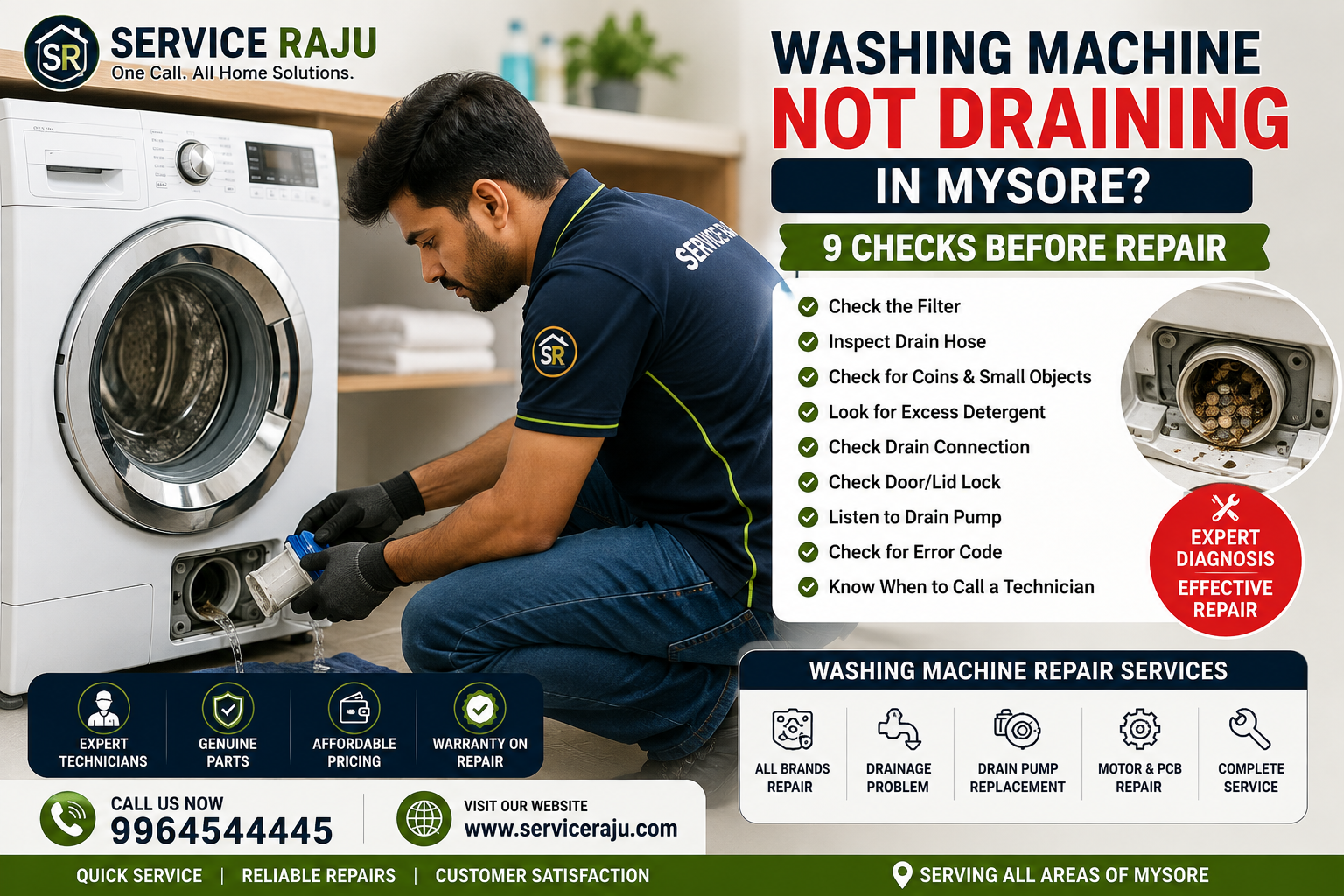
Washing Machine Not Draining in Mysore? 9 Checks Before Repair
If your washing machine not draining Mysore problem has suddenly left water sitting inside the drum, don't immediately assume that the pump or PCB has failed. A blocked filter, kinked drain hose, foreign object or drainage connection can sometimes cause the problem.
A washing machine that fills and washes normally but leaves water inside after the cycle is a clear sign that the drainage system needs attention. Recent manufacturer guidance from Haier and Bosch also highlights blocked filters, drain hoses, pumps and drainage-related errors as common areas to check.
For homeowners in Mysore, this can be particularly frustrating because a drainage problem can stop the entire laundry routine. Before booking a washing machine repair Mysore service, there are several safe checks you can make.
1. Why Is Your Washing Machine Not Draining?
The drainage system has a relatively simple job: remove used water from the drum at the correct stage of the wash cycle.
If water remains inside, possible causes include:
- Blocked lint or coin filter
- Kinked or blocked drain hose
- Coins, hair clips or other objects inside the drainage path
- Detergent or dirt buildup
- Blocked household drain connection
- Drain pump problem
- Door or lid interlock issue
- Electrical or control-board fault
- Incorrect installation or drainage arrangement
The important point is that not every drainage problem requires an expensive part replacement.
Sometimes the obstruction is located outside the machine itself.
2. 9 Checks for a Washing Machine Not Draining in Mysore
3. 1. Check the Washing Machine Filter
Many washing machines have a filter designed to catch lint and small objects before they reach the pump.
Over time, the filter can collect:
- Hair
- Lint
- Coins
- Buttons
- Small plastic pieces
- Detergent residue
A severely blocked filter can restrict water flow.
Before opening any filter, switch the machine off and follow the instructions in your model's user manual. Whirlpool specifically recommends checking the owner's manual for the correct filter location and procedure because designs differ between models.
If the machine contains a large amount of water, be prepared for water to come out when the filter is opened.
4. 2. Inspect the Drain Hose
Look behind the washing machine.
The drain hose should not be:
- Sharply bent
- Crushed against the wall
- Kinked
- Blocked
- Installed incorrectly
A restricted hose can prevent the pump from moving water out efficiently.
Haier identifies a blocked or restricted drain hose as one of the common causes of washing machine drainage problems.
Don't pull the machine aggressively if it is tightly installed. You could damage the hose or other connections.
5. 3. Check for Coins and Small Objects
A surprisingly small object can interfere with the drainage system.
Before washing clothes, empty pockets carefully.
Common objects that can cause trouble include:
- Coins
- Hair clips
- Safety pins
- Small toys
- Buttons
- Fabric pieces
These objects can move into areas where they restrict water flow or interfere with the pump.
If you hear an unusual rattling sound while the machine attempts to drain, stop the cycle and investigate safely.
6. 4. Look for Excess Detergent or Sludge
Too much detergent can contribute to residue buildup.
Over time, detergent residue mixed with dirt and fabric particles can create deposits around parts of the drainage system.
Use the detergent quantity recommended for your machine and detergent type.
Do not assume that more detergent means cleaner clothes.
If the machine has developed a strong smell or repeated drainage problems, professional cleaning and inspection may be worthwhile.
7. 5. Check the Drain Connection
Sometimes the washing machine itself is not the problem.
The household drain connection may be restricted.
For example, if your washing machine drain connects to plumbing under a sink, a blockage in that plumbing can interfere with drainage.
Check whether:
- The sink is draining slowly
- Water backs up during the washing machine drain cycle
- The drain pipe smells unusually bad
- Other connected fixtures are also draining slowly
If multiple fixtures are affected, the problem may be related to household plumbing rather than the washing machine.
In that situation, a plumbing inspection may be more appropriate than immediately replacing a washing machine component.
8. 6. Check the Door or Lid Lock
Modern washing machines use safety systems to control different stages of the wash cycle.
Depending on the model, a door or lid problem can prevent certain operations from starting correctly.
For front-load machines, make sure the door is properly closed and there is no obvious obstruction around the door seal.
For top-load machines, ensure the lid is closing correctly.
Never bypass or disable a safety interlock.
If the machine shows a door or lid-related error, check the manufacturer's instructions for your specific model.
9. 7. Listen to the Drain Pump
When the machine reaches the drainage stage, you may hear the pump operating.
The sound can provide useful information.
A humming sound without water movement may indicate that something is obstructing the pump or drainage path.
No pump sound at all may indicate an electrical, control or pump-related issue.
A loud grinding or unusual mechanical noise should not be ignored.
Do not dismantle the pump yourself unless you are qualified and the manufacturer's instructions specifically allow safe access.
10. 8. Check for an Error Code
Modern washing machines often display an error code when they detect a problem.
The meaning differs by manufacturer and model.
For example, Bosch provides troubleshooting information for washing machines that are not draining, including models that display drainage-related error codes.
Write down the exact code before contacting a technician.
Also record:
- Brand
- Model number
- Front-load or top-load
- What happens during the cycle
- Whether water remains inside
- Whether the machine makes unusual sounds
This information can help the technician diagnose the problem more efficiently.
11. 9. Know When the Problem Needs a Technician
If you have checked the obvious external causes and the machine still does not drain, don't keep repeatedly restarting it.
A technician may need to inspect:
- Drain pump
- Pump impeller
- Internal hose
- Wiring
- Sensors
- Control board
- Door/lid interlock
- Drainage system
- Other model-specific components
At this stage, professional washing machine service Mysore can help identify the actual fault before parts are replaced.
12. Why Washing Machines Develop Drainage Problems
Drainage issues generally develop gradually or after a specific event.
13. Frequent causes include:
Foreign objects: Coins and small objects can enter the drainage system.
Lint accumulation: Fabric fibres can collect over time.
Detergent residue: Excess detergent can contribute to buildup.
Hose problems: A kinked, crushed or incorrectly positioned hose can restrict water flow.
Pump wear: A drain pump can eventually develop mechanical or electrical faults.
Household plumbing: The machine may be connected to a restricted drain.
Improper installation: Incorrect hose positioning can affect drainage performance.
Control or sensor faults: The machine may not correctly initiate or complete the drainage sequence.
This is why simply replacing a pump without diagnosis is not always the right solution.
14. Front-Load vs Top-Load Drainage Problems
Both front-load and top-load machines can develop drainage problems, but their designs differ.
15. Front-load washing machines
Common areas requiring inspection include:
- Coin/lint filter
- Drain pump
- Sump hose
- Drain hose
- Door system
- Error codes
Front-load machines can also retain water when the drainage path becomes restricted.
16. Top-load washing machines
Possible problem areas include:
- Drain hose
- Drain pump or drain valve
- Lid switch
- Internal hoses
- Foreign objects
- Control system
The exact design varies significantly by brand and model.
Therefore, avoid applying a repair procedure from another washing machine model.
17. What Not to Do When Your Washing Machine Is Full of Water
If water remains inside the drum, avoid these common mistakes:
18. Don't keep restarting the cycle
Repeated attempts can put unnecessary stress on a faulty component.
19. Don't use excessive detergent
It will not solve a drainage problem.
20. Don't force the door
A front-load door may remain locked while water is inside for safety reasons.
21. Don't randomly remove electrical panels
Water and electricity create a serious safety risk.
22. Don't pour chemical drain cleaners into the washing machine
These products are not a universal solution for washing-machine drainage problems and can create additional risks.
23. Don't immediately buy a new pump
First determine whether the actual fault is a blockage, hose issue, pump issue, wiring issue or control problem.
24. When Should You Book Washing Machine Repair in Mysore?
Professional washing machine repair near me becomes worthwhile when:
- Water remains inside after every cycle.
- The filter and external hose are clear.
- The machine makes unusual pump noises.
- The pump does not appear to operate.
- An error code repeatedly appears.
- The machine stops during draining.
- The washer leaks while draining.
- The problem returns after temporary cleaning.
- Other washing cycles are also becoming unreliable.
If the machine is still under manufacturer warranty, check the manufacturer's service process before arranging third-party repairs.
25. How Much Does Washing Machine Repair Cost in Mysore?
There is no single repair price because the final cost depends on the fault and the required part.
A simple blockage or hose issue can be very different from a drain-pump, motor or PCB repair.
The final price may depend on:
- Brand
- Model
- Machine age
- Fault type
- Diagnosis required
- Spare-part requirement
- Labour
- Installation or replacement complexity
Service Raju's Mysuru service catalogue currently includes Washing Machine Repair among its appliance services.
For accurate pricing, inspection is better than quoting a major repair before identifying the fault.
26. How Service Raju Handles Washing Machine Problems
When a washing machine stops draining, the objective should be to identify the actual cause before recommending a repair.
Service Raju provides washing machine repair services in Mysuru as part of its appliance-repair category. The Mysuru service catalogue also lists refrigerator repair, AC repair, RO service and other home services.
A typical inspection should consider:
- Customer's description of the problem
- Machine brand and model
- Error codes
- Drain hose and external connections
- Filter and drainage path
- Pump operation
- Internal components where required
- Repair or replacement options
- Testing after the work
The important goal is simple: diagnose first, repair second.
For booking in Mysore, contact Service Raju at 9964544445 or visit www.serviceraju.com.
27. How to Prevent Future Drainage Problems
A few simple habits can reduce avoidable drainage issues.
28. Empty pockets before washing
Check trousers, shirts, jackets and children's clothing for coins and small objects.
29. Don't overload the machine
Follow the manufacturer's recommended load capacity.
30. Use the correct detergent quantity
Too much detergent can contribute to residue and buildup.
31. Inspect the drain hose
Make sure it isn't crushed or sharply kinked.
32. Clean the filter according to the manual
Don't wait until the machine completely stops draining.
33. Keep the area around the machine accessible
A technician should be able to inspect the machine and connections without moving excessive furniture or stored items.
34. Pay attention to early warning signs
Slow drainage, unusual pump noises and repeated error codes should be investigated before the machine stops completely.
35. Frequently Asked Questions
36. Why is my washing machine not draining water?
Common causes include a blocked filter, restricted drain hose, foreign object, drainage connection problem or drain-pump fault. The exact cause depends on the model.
37. Can I fix a blocked washing machine myself?
Some external checks, such as inspecting a kinked hose, may be possible if the manufacturer's instructions allow them. For internal pump, wiring or electrical faults, professional diagnosis is safer.
38. Why is my washing machine draining slowly?
A partially blocked filter, hose, pump or household drain can restrict water flow. Excess buildup can also contribute to slow drainage.
39. Can a blocked drain hose damage the washing machine?
A restricted drainage path can interfere with normal operation and may contribute to stress on the drainage system. It should be corrected rather than repeatedly ignored.
40. Why is the machine not spinning after washing?
Many washing machines will not enter or complete the spin stage if water has not drained properly. A drainage problem can therefore appear to be a spin problem.
41. Should I replace the washing machine or repair it?
Consider the machine's age, repair cost, condition, availability of parts and expected remaining life. A diagnosis is useful before making a replacement decision.
42. Final Checklist
If your washing machine has stopped draining:
- Check the filter according to the manual.
- Inspect the drain hose.
- Look for obvious foreign objects.
- Check the household drain connection.
- Note any error code.
- Listen for unusual pump sounds.
- Don't repeatedly restart a faulty machine.
- Don't dismantle electrical components without proper expertise.
- Book professional diagnosis if the problem continues.
A washing machine drainage problem does not automatically mean the appliance needs an expensive replacement. The fault may be as simple as a blocked filter or hose—or it may require a pump, wiring or control-system repair.
If your washing machine not draining Mysore problem continues after the basic checks, getting the machine properly inspected can help you avoid unnecessary parts replacement and get your laundry routine back on track.
Service Raju Washing Machine Repair & Home Services in Mysore Phone: 9964544445 Website: www.serviceraju.com
IMAGE SEO:
 AC Repair
.webp) Ant Control Service
Ant Control Service
 Basin & Sink Services
.webp) Bath & Shower Services
Bath & Shower Services
.webp) Bath Fittings & Mirrors
Bath Fittings & Mirrors
 Bathroom Cleaning Service
 Bathroom Renovation Services
 Bed Bug Control Services
 Bedroom Painting
 Book a Carpenter Consultation
 Book Electrical Consulting
.webp) Cabinet Painting & Wood Refinishing
Cabinet Painting & Wood Refinishing
 Chimney Cleaning
 Civil Masonry Work
 Clean-Up Services
.webp) Clothes Hanger Installation
Clothes Hanger Installation
 Cockroach Control Services
---mysore-mysore-standard-300x200.webp) Commercial Cleaning
Commercial Cleaning
 Commercial Pest Control AMC Service
 Cupboard & Drawer Services
 Decorative Wall Panels
 Deep Sanitisation Service
 Detan & Bleach
 Door, Grill & Cabinet Painting Service
.webp) Doorbell & security
Doorbell & security
 Drain Blockage Clearing
 Electrical Appliance Services
 Electrical Wiring Services
 Empty Home Deep Cleaning
.webp) Fabrication
Fabrication
 Facials
.webp) Fan Installation & Repair
Fan Installation & Repair
 Full Home Cleaning Service
 Full Home Renovation
 Furniture Repair Service
 Gas Stove & Hob Repair
.webp) General Pest Control Services
General Pest Control Services
 General Plumbing & Consultation
 Geyser Repair
 Glass Cleaning
 Head Massage
.webp) Honeybee & Wasp-Services
Honeybee & Wasp-Services
 Kitchen & Bathroom Painting Service
 Kitchen Cleaning
 Kitchen Fittings
.webp) Kitchen Renovation
Kitchen Renovation
.webp) Laptop/Desktop service
Laptop/Desktop service
 Leak Detection and Repair
 LED TV Repair
 Living and Dining Room Painting
 Makeup, Saree & Styling
 Manicure & Pedicure
 MCB,Meter & Fuse Services
 Microwave Repair
 Mosquito Pest Control Service
 Multi-Room Painting Service
 Painting Consultation
 Quick Mini Cleaning Services
 Refrigerator Repair
 RO Water Purifier
.webp) Rodent Control Services (Rat & Mice Treatment)
Rodent Control Services (Rat & Mice Treatment)
.webp) Rooms Cleaning
Rooms Cleaning
 Shelves & Decor
 Sofa, Carpet & Mattress Cleaning
 Solar Water Heater Service
 Sump & Tank Cleaning
 Switch & Socket Services
 Tap & Mixer Service
.webp) Termite-Control-Services
Termite-Control-Services
 Threading & Face Wax
.webp) Tile & Granite Installation & Polishing
Tile & Granite Installation & Polishing
 Toilet & Commode Services
.webp) UPS and Inverter Repair Services
UPS and Inverter Repair Services
.webp) Wall Painting Service
Wall Painting Service
 Washing Machine Repair
 Water Level Controllers
 Water Tank and Pump Repair
 Waterproofing
 Waterproofing Services
 Waxing
 Window & Curtain Services
 Wooden Door Services