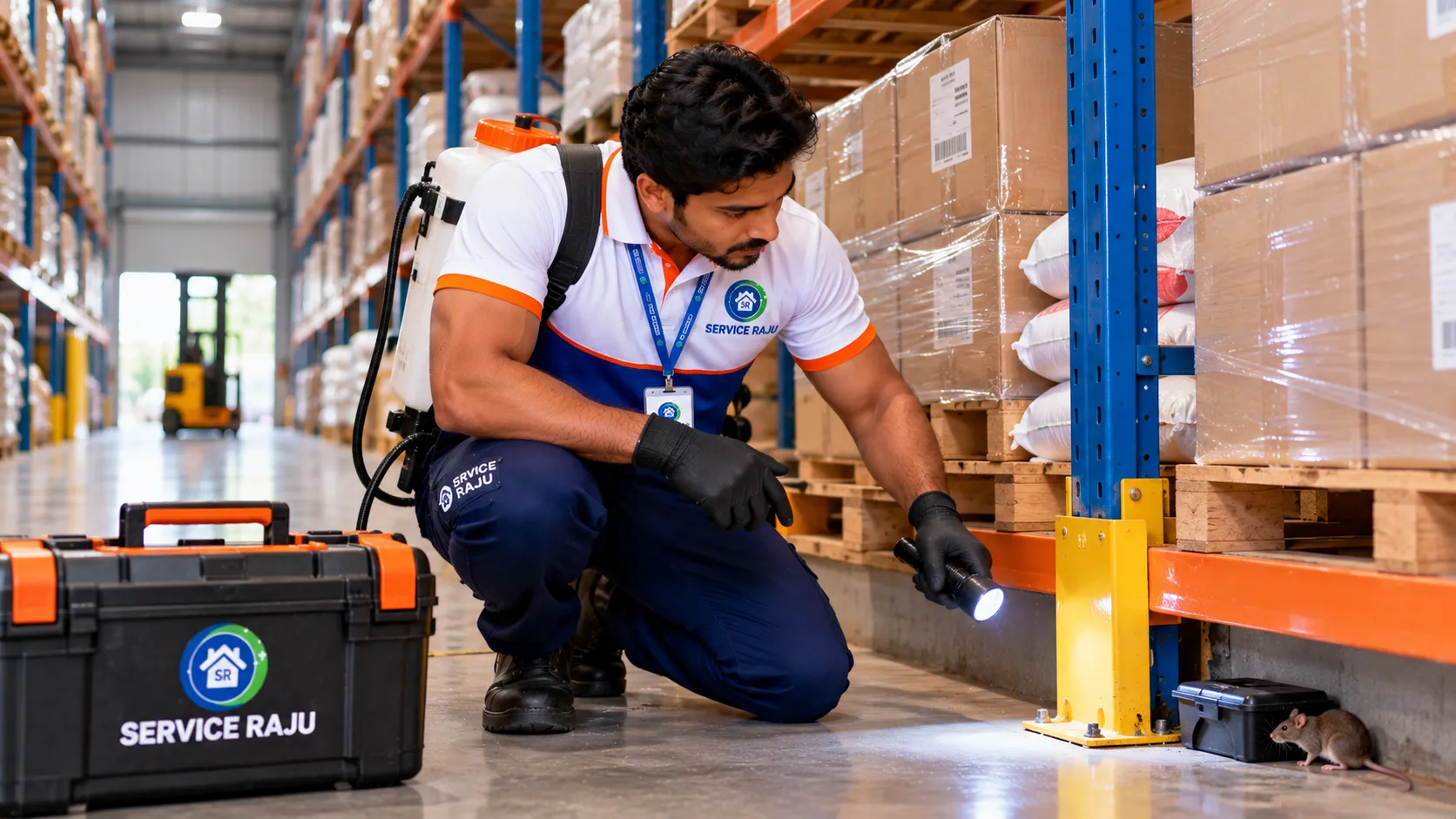
Warehouse Pest Control in Mysore: Protect Stored Stock
A warehouse can hold thousands of products, packaging materials and valuable business inventory. But a small rodent problem, crawling insect infestation or unnoticed entry gap can create stock damage, hygiene concerns, rejected deliveries and avoidable financial losses.
For warehouse managers, distributors, stockists and business owners, pest control for warehouses should be part of routine facility maintenance rather than something arranged only after pests become visible.
If you manage a warehouse in Mysore or Mysuru, this guide explains where pests commonly enter, which areas deserve regular inspection, how to improve warehouse hygiene and when professional commercial pest control may be appropriate.
The objective is to help your team protect inventory, maintain organised storage areas and identify pest activity before it develops into a larger operational problem.
Quick Answer: How Can You Prevent Warehouse Pest Problems?
A practical warehouse pest-prevention programme should include:
- Inspecting loading bays, shutters, doors and wall openings.
- Checking for rodent droppings, gnaw marks, insects and damaged packaging.
- Keeping stored goods organised and accessible for inspection.
- Removing spilled products, waste and unnecessary clutter promptly.
- Keeping stock appropriately elevated and separated from walls where feasible.
- Inspecting incoming stock and packaging for signs of infestation.
- Maintaining suitable monitoring devices and documented inspection records.
- Repairing structural gaps and other pest entry points.
- Arranging professional inspection and targeted treatment when indicated.
Warehouses storing food, grain, animal feed or other sensitive products need additional precautions to protect the stored goods from contamination. FSSAI guidance for food storage facilities emphasises pest monitoring, sanitation, appropriate storage practices and documented corrective action. Read the FSSAI warehouse pest-management guidance.
Why Is Warehouse Pest Control Important?
Pests can affect more than the appearance of a warehouse. Depending on the facility and the products stored, an infestation may damage goods, contaminate packaging, disrupt dispatch operations or create additional cleaning and maintenance requirements.
Common concerns include:
- Stock damage: Rodents may gnaw packaging, cables and certain stored products.
- Product contamination: Pest activity can affect food products and other sensitive inventory.
- Packaging damage: Insects and rodents may damage cartons, sacks and wrapping materials.
- Operational disruption: Cleaning, inspection and stock segregation can interrupt normal warehouse activity.
- Customer complaints: Damaged or contaminated deliveries can affect customer confidence.
- Repeat maintenance costs: Uncorrected entry points and sanitation issues may allow pests to return.
The appropriate prevention measures depend on the type of warehouse, the products stored, the surrounding environment and the pest species involved.
Which Pests Should Warehouse Managers Watch For?
1. Rats and Mice
Rodents may enter through gaps around doors, service penetrations, damaged shutters or other openings. They can also exploit areas where food waste, standing water or undisturbed clutter is available.
Look for:
- Droppings along walls or behind stored goods
- Gnaw marks on packaging, pallets or cables
- Scratching sounds in concealed areas
- Damaged cartons or sacks
- Greasy rub marks along frequently used rodent routes
One sign alone does not always establish the size of an infestation. Record the location and arrange a suitable assessment if rodent activity is suspected.
2. Cockroaches
Cockroaches may be attracted to waste areas, damp locations, food residues and undisturbed spaces. They can also enter through deliveries, packaging or building service openings.
Inspect break rooms, waste storage areas, utility spaces and any locations where food or moisture is present.
3. Stored-Product Insects
Warehouses storing rice, grains, pulses, flour, spices, animal feed or similar commodities may encounter insects that infest stored products.
Possible warning signs include live insects, larvae, damaged packaging, webbing or unusual debris within susceptible products.
Inspect incoming stock and isolate suspected affected goods according to the warehouse's product-protection procedures. Do not apply pesticides directly to stored food or use unapproved treatment methods.
4. Flies and Other Flying Insects
Flies can become a problem near waste areas, drains, loading bays and doors that remain open for long periods.
Check whether waste handling, door management, drainage or exterior conditions are attracting insects. Any insect-monitoring devices should be positioned appropriately for the facility and product type.
5. Ants and Other Crawling Pests
Ants and other crawling insects may follow food residues, moisture or accessible entry routes. Repeated sightings near one area can help identify a sanitation issue or an entry point that needs attention.
Correct identification is important because different pests require different prevention and management approaches.
10 Warehouse Areas That Need Regular Pest Inspection
1. Loading Bays and Shutters
Loading bays are frequently opened for deliveries and dispatch. Inspect door seals, shutter edges, floor gaps and nearby storage for signs of pest entry.
Keep doors closed when they are not in use where operationally practical, and ensure that damaged seals or gaps are reported for repair.
2. Receiving and Dispatch Areas
Incoming pallets, cartons and reusable packaging can conceal pests or show evidence of previous infestation.
Include visible packaging condition and signs of pest activity in the receiving inspection. Follow a documented procedure for segregating suspect stock.
3. Storage Racks and Pallets
Inspect beneath accessible pallets, around rack bases and along the edges of storage zones. Clutter and tightly packed goods can make pest activity harder to detect.
Where the facility layout permits, maintain inspection access between stored goods and walls. Use suitable pallets and keep products off the floor where required by the product and storage system.
4. Wall Gaps and Service Openings
Gaps around cables, pipes, ducts, doors and other service penetrations can provide access for pests.
Record visible openings and arrange appropriate repairs using materials suitable for the location and building requirements.
5. Waste Collection Zones
Uncovered waste, spilled products and overflowing bins can attract pests close to the building.
Use suitable waste containers, clean spills promptly and establish a reliable collection schedule. Keep waste storage separate from clean inventory wherever practical.
6. Drainage and Damp Areas
Leaks, standing water and damp materials can contribute to pest problems and create other maintenance concerns.
Inspect drains, plumbing connections and wet areas, and arrange repairs where water accumulation or leakage is found.
7. Break Rooms and Staff Areas
Food crumbs, discarded packaging and poorly stored refreshments can attract insects and rodents.
Keep these areas clean, use appropriate food-storage containers and remove waste regularly.
8. Exterior Perimeter
Inspect the immediate surroundings for waste, overgrown vegetation, clutter, standing water and openings near the building.
Good exterior maintenance can reduce conditions that support pest activity near entrances and loading areas.
9. Ceilings and Utility Spaces
Where access is safe and permitted, inspect accessible ceiling voids, utility areas and other spaces where pests could remain undetected.
Use trained personnel for inspections involving heights, electrical equipment or restricted spaces.
10. Long-Term and Slow-Moving Stock
Goods that remain untouched for extended periods may receive less frequent inspection. Include slow-moving inventory in stock rotation and pest-monitoring procedures.
Check packaging condition, remove unnecessary clutter and investigate signs of infestation before moving affected goods into other storage areas.
Warehouse Pest Prevention Checklist
Facility managers can use this checklist during routine inspections and maintenance reviews.
| Inspection Item | What to Check | Action if a Problem Is Found |
|---|---|---|
| Doors and shutters | Gaps, damaged seals and openings | Arrange suitable repairs |
| Receiving area | Damaged cartons and signs of pests | Inspect and segregate suspect stock |
| Storage racks | Droppings, insects and inaccessible debris | Clean and investigate the affected area |
| Waste zone | Spills, uncovered bins and waste buildup | Remove waste and improve handling |
| Plumbing and drains | Leaks, standing water and dampness | Correct the underlying maintenance issue |
| Exterior perimeter | Clutter, vegetation and possible entry points | Improve housekeeping and exclusion |
| Monitoring devices | Damage, displacement or pest activity | Record findings and arrange follow-up |
| Stored products | Infestation signs and damaged packaging | Protect and assess affected inventory |
The inspection frequency should reflect the warehouse's risk profile, the products stored, previous pest activity and applicable requirements. High-risk facilities may need more frequent checks.
How to Build an Effective Warehouse Pest-Management Plan
Reliable warehouse pest control combines prevention, monitoring, documentation and appropriate corrective action. A one-time treatment may reduce pest activity, but it will not necessarily solve an underlying entry-point or sanitation problem.
Step 1: Establish a Baseline Inspection
Record the building layout, types of stored goods, previous pest incidents, visible entry points and areas that need additional monitoring.
Step 2: Identify the Pest Correctly
Different pests behave differently and require different responses. Record the evidence and location rather than treating every sighting as the same type of infestation.
Step 3: Improve Sanitation and Exclusion
Remove food debris, organise storage, correct leaks and close suitable entry gaps. Coordinate building repairs with the facility maintenance team.
Step 4: Use Suitable Monitoring Methods
Depending on the pest and warehouse type, monitoring may include appropriately placed traps, inspection devices and documented observations.
Monitoring devices should be positioned and maintained to minimise risks to stored products, staff and warehouse operations.
Step 5: Record Findings and Corrective Actions
Maintain a record of inspection dates, locations, pest evidence, actions taken and follow-up findings.
Review repeated sightings to determine whether the same location continues to have a problem. Records help facility managers assess whether prevention measures are working.
Step 6: Arrange Professional Treatment When Needed
If pest activity continues or the source is difficult to identify, a professional inspection can help determine the appropriate response.
Any pesticide or treatment method must be suitable for the identified pest, authorised for the intended use and applied according to its label and applicable requirements.
Special Precautions for Food and Grain Warehouses
Warehouses storing food, grains, pulses, flour, animal feed or other sensitive goods need additional precautions to prevent contamination.
Managers should consider the following:
- Inspect products and packaging during receiving and storage.
- Keep stock protected from moisture and other contamination sources.
- Maintain appropriate separation between products and inspection areas.
- Follow the warehouse's procedures for suspect or infested goods.
- Use only suitable pest-control methods for the facility and stored products.
- Protect food, packaging and food-contact surfaces from unintended pesticide exposure.
- Maintain required pest-control and corrective-action records.
Never apply pesticides directly to stored food unless a specific treatment is expressly authorised for that commodity and carried out under the applicable requirements by an appropriately qualified professional. Ordinary surface sprays should not be used indiscriminately in food-storage areas.
For food businesses, the facility's pest-management plan should align with applicable food-safety requirements and the relevant FSSAI guidance.
When Should You Book Commercial Pest Control in Mysore?
Professional inspection may be appropriate when routine prevention measures are not sufficient or when the potential impact on inventory is significant.
Consider arranging a warehouse pest inspection if:
- Rodent droppings or gnaw marks are repeatedly found.
- Insects are appearing in stored products or packaging.
- Pest activity continues after cleaning and repairs.
- Loading bays or service openings appear to provide access.
- Several storage zones show evidence of pest activity.
- Staff repeatedly report sightings in the same locations.
- Your facility needs a documented pest-monitoring and prevention plan.
- You need to review an existing pest-control programme.
A professional assessment should identify the reported concern, review relevant site conditions and recommend a proportionate response. The exact scope depends on the building, pest type and operational requirements.
What to Ask Before Hiring a Warehouse Pest-Control Provider
Before approving a commercial pest-control contract, ask the provider:
- Which pests and areas are included in the proposed scope?
- Will the service include inspection, monitoring and prevention recommendations?
- How will pest activity and corrective actions be documented?
- Are the proposed methods suitable for the goods stored at the facility?
- How will staff, inventory and sensitive areas be protected during treatment?
- What preparation or access is required from warehouse staff?
- Will the provider recommend repairs for entry gaps or sanitation issues?
- How will follow-up inspections and recurring issues be handled?
- What qualifications or authorisations are required for the proposed work?
- What is included in the quotation, and what is charged separately?
A clear written scope makes it easier to compare providers and establish responsibilities between the pest-control team and facility management.
Warehouse Pest Control Services by Service Raju
Service Raju offers home and property maintenance services and is expanding its pest-control content to address a wider range of customer needs.
Warehouse managers and business owners in Mysuru can enquire about pest-control inspection requirements and confirm whether the specific commercial premises and scope of work can be accommodated.
Depending on service availability and the inspection findings, a commercial pest-management enquiry may cover:
- Assessment of reported rodent or crawling-pest activity
- Inspection of accessible storage and entry-point areas
- Identification of visible sanitation and pest-entry concerns
- Recommendations for improving pest prevention
- Discussion of appropriate monitoring and follow-up
- Clarification of the proposed treatment scope and safety precautions
Commercial warehouse work should be confirmed in advance, including the facility type, stock stored, affected areas and any special access or food-safety requirements.
Explore the Service Raju Mysuru service directory or contact the team to discuss your requirements.
Frequently Asked Questions
What is pest control for warehouses?
Warehouse pest control combines inspection, prevention, monitoring, sanitation, exclusion and suitable corrective treatment to reduce pest activity and protect stored goods.
Which pests commonly affect warehouses?
Depending on the facility, common concerns include rats, mice, cockroaches, ants, flies and insects that infest stored products. The correct management approach depends on the pest and the goods stored.
How often should a warehouse be inspected for pests?
The appropriate frequency depends on the warehouse's risk profile, previous activity, stored products and applicable requirements. High-risk facilities may need more frequent inspections. Food-storage facilities should follow their documented pest-management plan and relevant food-safety requirements.
How can warehouses prevent rats and mice?
Inspect and repair entry gaps, maintain loading-bay doors, remove waste promptly, keep storage organised and use an appropriate rodent-monitoring programme. Investigate repeated activity rather than relying only on traps.
Can warehouse pest control damage stored products?
Incorrectly selected or applied treatments can create contamination risks. A suitable plan should consider the products stored, protect sensitive inventory and follow the product label and applicable requirements.
Is warehouse pest control different from residential pest control?
Yes. Warehouses often have larger storage areas, loading bays, high racks, delivery traffic and significant inventory. Commercial pest management may therefore require site-specific inspection, monitoring records and coordination with facility operations.
What should be included in a warehouse pest-control report?
Depending on the contract, a useful report may document inspection dates, locations checked, pest evidence, monitoring findings, corrective actions, recommendations and follow-up requirements.
Can a warehouse use one-time pest treatment?
A one-time treatment may be appropriate for a specific, limited problem, but it does not automatically address entry points, waste handling or recurring sources. The need for follow-up should be determined by the pest and inspection findings.
Does Service Raju provide warehouse pest control in Mysore?
Contact Service Raju to confirm the availability and scope of commercial warehouse pest-control services for your premises in Mysuru. Share the warehouse type, approximate size, stored goods and the pest problem so the team can assess the enquiry.
Protect Your Warehouse Inventory in Mysore
Pest activity can damage stock, disrupt operations and create avoidable maintenance costs. A practical prevention programme starts with identifying the problem, inspecting high-risk areas, improving housekeeping and closing suitable entry points.
If your warehouse has recurring rodent or insect activity, do not wait until the problem spreads across multiple storage zones. Arrange a suitable inspection and establish a clear prevention and monitoring plan.
Need a commercial pest-control enquiry in Mysuru?
Contact Service Raju to discuss your warehouse inspection requirements and confirm service availability.
Call / WhatsApp: +91 9964544445
Website: www.serviceraju.com/services/mysuru
Trusted Home Services in Mysuru, Udupi, Mangaluru & Indore.
 AC Repair
.webp) Ant Control Service
Ant Control Service
 Basin & Sink Services
.webp) Bath & Shower Services
Bath & Shower Services
.webp) Bath Fittings & Mirrors
Bath Fittings & Mirrors
 Bathroom Cleaning Service
 Bathroom Renovation Services
 Bed Bug Control Services
 Bedroom Painting
 Book a Carpenter Consultation
 Book Electrical Consulting
.webp) Cabinet Painting & Wood Refinishing
Cabinet Painting & Wood Refinishing
 Chimney Cleaning
 Civil Masonry Work
 Clean-Up Services
.webp) Clothes Hanger Installation
Clothes Hanger Installation
 Cockroach Control Services
---mysore-mysore-standard-300x200.webp) Commercial Cleaning
Commercial Cleaning
 Commercial Pest Control AMC Service
 Cupboard & Drawer Services
 Decorative Wall Panels
 Deep Sanitisation Service
 Detan & Bleach
 Door, Grill & Cabinet Painting Service
.webp) Doorbell & security
Doorbell & security
 Drain Blockage Clearing
 Electrical Appliance Services
 Electrical Wiring Services
 Empty Home Deep Cleaning
.webp) Fabrication
Fabrication
 Facials
.webp) Fan Installation & Repair
Fan Installation & Repair
 Full Home Cleaning Service
 Full Home Renovation
 Furniture Repair Service
 Gas Stove & Hob Repair
.webp) General Pest Control Services
General Pest Control Services
 General Plumbing & Consultation
 Geyser Repair
 Glass Cleaning
 Head Massage
.webp) Honeybee & Wasp-Services
Honeybee & Wasp-Services
 Kitchen & Bathroom Painting Service
 Kitchen Cleaning
 Kitchen Fittings
.webp) Kitchen Renovation
Kitchen Renovation
.webp) Laptop/Desktop service
Laptop/Desktop service
 Leak Detection and Repair
 LED TV Repair
 Living and Dining Room Painting
 Makeup, Saree & Styling
 Manicure & Pedicure
 MCB,Meter & Fuse Services
 Microwave Repair
 Mosquito Pest Control Service
 Multi-Room Painting Service
 Painting Consultation
 Quick Mini Cleaning Services
 Refrigerator Repair
 RO Water Purifier
.webp) Rodent Control Services (Rat & Mice Treatment)
Rodent Control Services (Rat & Mice Treatment)
.webp) Rooms Cleaning
Rooms Cleaning
 Shelves & Decor
 Sofa, Carpet & Mattress Cleaning
 Solar Water Heater Service
 Sump & Tank Cleaning
 Switch & Socket Services
 Tap & Mixer Service
.webp) Termite-Control-Services
Termite-Control-Services
 Threading & Face Wax
.webp) Tile & Granite Installation & Polishing
Tile & Granite Installation & Polishing
 Toilet & Commode Services
.webp) UPS and Inverter Repair Services
UPS and Inverter Repair Services
.webp) Wall Painting Service
Wall Painting Service
 Washing Machine Repair
 Water Level Controllers
 Water Tank and Pump Repair
 Waterproofing
 Waterproofing Services
 Waxing
 Window & Curtain Services
 Wooden Door Services