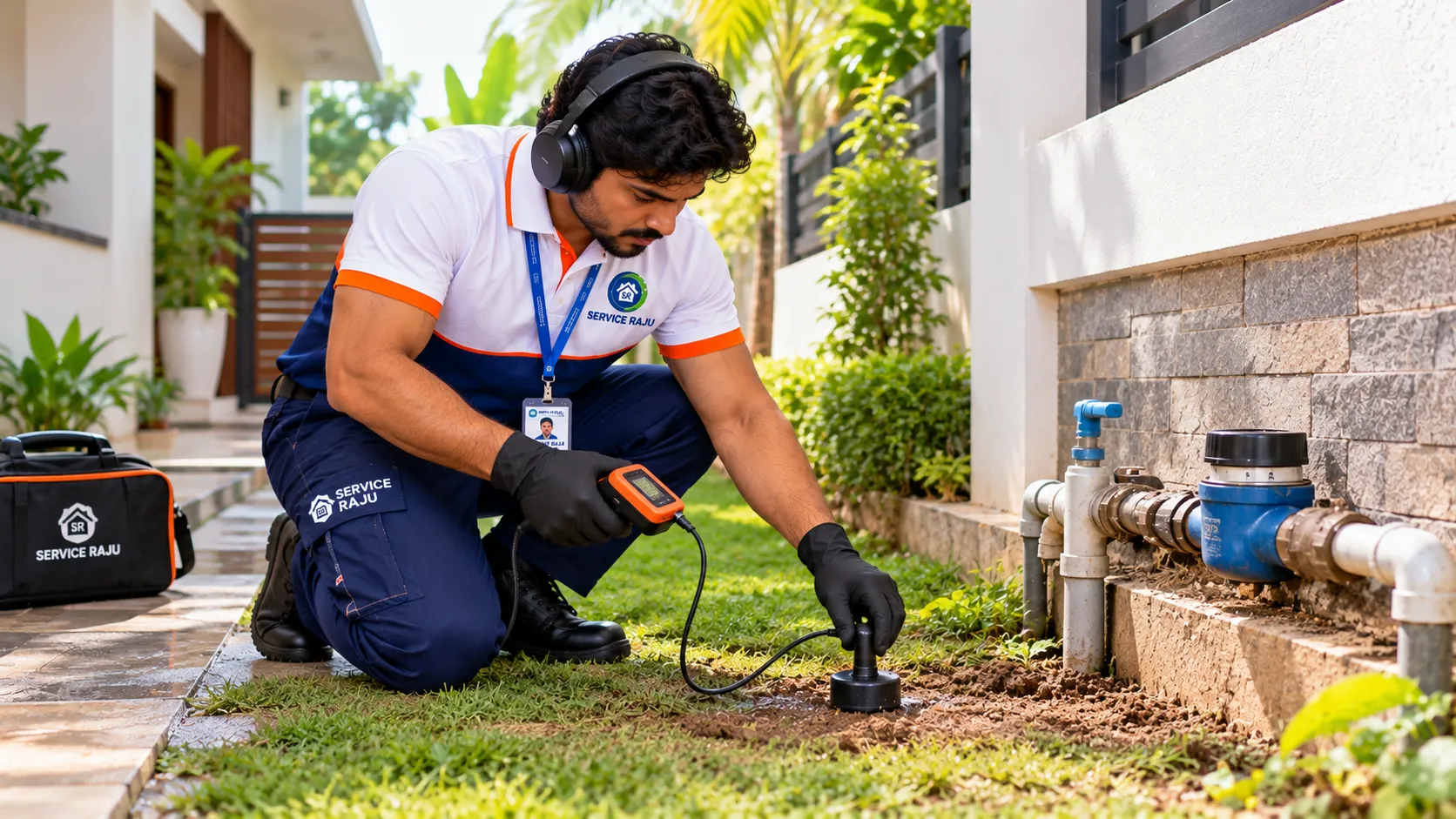
Underground Water Pipe Leak Detection in Mysore: Find the Leak Before Excavation
Suspecting an underground water pipe leak at your home, apartment or commercial property? An unexplained increase in water consumption, a constantly running pump, reduced water pressure or a persistently wet patch of ground can indicate a problem with a buried water-supply line.
However, these signs do not automatically confirm an underground leak. Rainwater, irrigation, tank overflow, leaking taps and other plumbing faults can produce similar symptoms. The important step is to investigate the source systematically before deciding where to dig.
This guide explains the warning signs of underground water supply leakage, the checks you can make safely, the diagnostic methods a technician may select, and how professional underground water leak detection in Mysore can help narrow down the affected pipe section before excavation.
Quick Answer: How Can You Find an Underground Water Pipe Leak Before Excavation?
Start by checking the water meter, accessible pipe connections, tank overflow and pump operation. If the signs still suggest a buried supply-line leak, a qualified technician can investigate the pipe layout and select appropriate diagnostic tests.
- Record the symptoms, including water loss, pressure changes, wet ground and unusual pump operation.
- Check accessible taps, toilets, tanks, valves and visible plumbing for other possible causes.
- If safe and practical, check whether the water meter continues moving when all intended water use is stopped.
- Ask a technician to assess the suspected line and determine whether isolation testing, pressure testing or other suitable methods are appropriate.
- Use the inspection findings to identify the likely fault area and plan a targeted repair.
Important: Leak detection can narrow down the likely location, but no single method guarantees an exact leak point in every buried pipeline. The result depends on pipe material, depth, layout, surrounding ground and access to the system.
7 Warning Signs of an Underground Water Pipe Leak
1. Water consumption increases without an obvious reason
A higher water bill or unexpectedly frequent water-tanker requirement may indicate water loss. First consider changes in household use, irrigation, leaking toilets, faulty tank valves and other plumbing problems. If consumption remains unusually high, investigate further.
2. The water meter moves when no water should be running
If every intended water outlet and appliance is off, unexpected meter movement may indicate continuing water flow. However, automatic systems, tank filling and overlooked outlets can also use water. Follow the meter manufacturer's instructions and, if the system is shared, confirm that other users have stopped drawing water before interpreting the result.
3. The pump starts more frequently than usual
A pump that cycles repeatedly or runs longer than normal may be responding to water loss, a pressure-system fault, a faulty check valve or another issue. Pump behaviour is a useful clue, not proof that an underground pipe has failed.
4. Water pressure drops unexpectedly
Reduced flow at taps can be associated with leakage, but it can also result from a supply interruption, partially closed valve, clogged filter, pump problem or other restriction. Comparing the symptoms across multiple outlets can help a technician determine which part of the system to investigate.
5. A patch of ground stays wet during dry weather
Persistent wet soil, unexplained pooling or unusually lush vegetation near a buried water line may indicate leakage. The same signs can be caused by irrigation, rainwater trapped in the soil, drainage problems or an overflowing tank.
6. Water appears along a paved path or driveway
Water may travel through soil, sand bedding, construction fill or gaps below paving before reaching the surface. The point where water appears may therefore be some distance from the actual pipe defect.
7. You hear unexplained water movement
Water movement or hissing near a suspected pipe route may justify further investigation, particularly when it continues while water use is stopped. Pumps, valves, normal water flow and nearby equipment can create similar sounds, so sound alone should not be treated as confirmation.
If several of these symptoms occur together, document when they happen and where they appear. That information can help a technician select the next diagnostic step.
Is It an Underground Pipe Leak or Another Water Source?
Before assuming a buried supply pipe is leaking, consider other sources of water. This prevents unnecessary excavation for a problem that may actually involve a tank, irrigation system, drain or surface-water route.
| Observation | Possible explanation | Useful next check |
|---|---|---|
| Wet ground after rainfall | Rainwater accumulation, poor surface drainage or a pipe leak | Compare the location and timing with rainfall and water-system operation. |
| Wet patch near a garden | Irrigation overspray, a leaking irrigation line or a supply pipe leak | Check irrigation schedules and accessible connections. |
| Water near an overhead or underground tank | Overflow, faulty float valve, tank leakage or a connected pipe fault | Inspect the tank, inlet, outlet and overflow arrangements. |
| Water meter continues moving | Undetected water use, a leaking fixture or a pipe leak | Stop intended water use and check accessible outlets and tank systems. |
| Low pressure throughout the property | Supply interruption, pump or valve problem, restriction or leakage | Check supply conditions, pump operation and accessible valves. |
| Water appears near a drain | Drainage leakage, blocked drainage, surface water or supply-line leakage | Identify which system carries the water before choosing a test. |
The goal is to distinguish a pressurised water-supply problem from a drainage, rainwater or building-waterproofing problem. These faults may look similar at the surface but require different tests and repairs.
Checks You Can Make Before Booking Underground Pipe Leak Detection
Check 1: Review your water consumption
Compare recent water bills or meter readings with your normal usage. Note changes in occupancy, gardening, cleaning, tank filling and other activities. A single higher bill does not establish that a pipe is leaking.
Check 2: Look at the water meter, where accessible
Follow the meter manufacturer's instructions. If it is safe and practical, stop intended water use and observe whether the meter continues to register flow. For shared buildings, make sure other users are not drawing water. If you cannot isolate the system properly, ask a plumber to conduct the check.
Check 3: Inspect accessible plumbing and tank connections
Look for visible dripping, tank overflow, wet valve connections, leaking taps and toilet cistern problems. Do not open sealed chambers or disturb underground services simply to inspect a suspected pipe.
Check 4: Record pump behaviour
Note when the pump starts, how long it runs and whether it cycles when water use is not expected. Do not repeatedly run a pump that is overheating, running dry or making unusual noises. Arrange a suitable inspection if its operation appears abnormal.
Check 5: Map the visible symptoms
Photograph wet areas, note the distance from the meter, tank or suspected pipeline, and record whether the symptoms change after water use or rainfall. A simple sketch of the property and known pipe route can be helpful.
Check 6: Find available pipe-layout information
Look for construction drawings, plumbing plans, previous repair records or information about the route from the water meter to the tank and building. Even an approximate layout can help guide an inspection.
Do not dig blindly, open pressurised pipework or perform pressure tests without suitable equipment and knowledge. Before excavation, the location of other buried utilities must also be considered.
How Professional Underground Water Leak Detection Works
Professional underground pipe leak detection is a process of narrowing down the fault using the available evidence. The technician should not simply assume that the wettest patch of soil is directly above the leak.
Step 1: Understand the pipe system
The technician establishes what the suspected line supplies, where it begins and ends, whether it is normally pressurised, and which valves or sections can be isolated. The pipe material, approximate depth, age and accessibility can influence the investigation.
Step 2: Review the symptoms
Water-meter movement, pump cycling, pressure changes, unexplained water loss and wet ground are considered together. The timing of the symptoms can help distinguish a continuous leak from an issue linked to a particular use or operating cycle.
Step 3: Inspect accessible components
Accessible meters, valves, tanks, pump connections and exposed sections are checked where relevant. This may identify a simpler fault before specialised testing is needed.
Step 4: Choose a suitable diagnostic method
Depending on the system, the technician may consider isolation testing, controlled pressure testing, flow or meter observations, acoustic methods where suitable, moisture assessment or other appropriate inspection techniques. Not every tool is suitable for every underground line.
Step 5: Narrow down the affected section
The results are used to identify the most likely section of pipe requiring further investigation. Where the evidence is inconclusive, the technician should explain the uncertainty and recommend the next suitable test rather than claiming an exact location without support.
Step 6: Plan the repair
Once the likely fault area is established, the property owner and repair professional can decide how to access the pipe, what repair may be needed and how to verify the result afterwards.
Underground Water Leak Detection Methods: Which Test Is Appropriate?
Different diagnostic methods answer different questions. The appropriate combination depends on the pipe system, access, material, depth and the evidence already available.
| Method | What it can help establish | Important limitation |
|---|---|---|
| Visual inspection | Visible leakage, tank overflow, wet connections and other obvious faults | Cannot directly reveal every buried defect. |
| Water-meter or flow observation | Whether water appears to be flowing when intended use has stopped | Other connected users, fixtures and systems must be accounted for. |
| Isolation testing | Whether a selected section may be responsible for water loss | Requires a suitable isolation arrangement and correct interpretation. |
| Pressure testing | Whether a suitable isolated pipe section maintains pressure under defined test conditions | Pressure loss alone does not always identify the leak location or prove that a particular buried joint has failed. |
| Acoustic detection | Leak-related sound or vibration under suitable conditions | Results depend on pipe material, pressure, leak characteristics, background noise and ground conditions. |
| Moisture assessment | Whether accessible surfaces or surrounding materials show unusual moisture | Moisture may come from rainwater, drainage, groundwater or another source. |
| Thermal imaging | Surface temperature patterns that may help investigate certain moisture or concealed-water problems | It does not directly see through the ground or prove the exact location of a buried pipe leak. |
When is pressure testing appropriate?
A controlled pressure test may help assess a suitable isolated water-supply section. The technician must consider the pipe material, system design, normal operating pressure, condition of fittings, connected equipment and applicable test procedure.
The test pressure and duration should be selected for the particular system, not chosen simply because a pump can produce a high pressure. Testing an unsuitable or damaged pipe at excessive pressure can create further damage or a safety hazard.
For example, CPVC, GI, HDPE and other piping systems have different characteristics and requirements. The technician should identify the system and use a compatible procedure. Never assume that a test method suitable for one pipe material is safe for another.
Can thermal imaging locate an underground pipe leak?
Thermal imaging measures surface temperature patterns. It may support an investigation when a leak creates a detectable thermal effect at an accessible surface, but it is not a universal underground locating method. Soil depth, weather, surface material, water temperature and other conditions can limit what the camera reveals.
For a buried line, thermal imaging may need to be combined with other evidence or tests. A responsible inspection explains what the thermal image does and does not establish.
How Leak Detection Can Help Avoid Unnecessary Excavation
Excavation may ultimately be necessary to access and repair a damaged buried pipe. The objective of diagnosis is not to promise that digging will never be required; it is to improve the information available before deciding where and how to dig.
Why blind excavation can be costly
- The visible wet patch may not be directly above the leak.
- Water may travel along the pipe trench or through loose soil before surfacing elsewhere.
- Several buried lines may run close together.
- Opening the wrong section may require additional excavation and restoration.
- Other underground utilities may be present near the suspected pipe route.
A more practical approach
- Map the known pipeline and accessible isolation points.
- Review the symptoms and eliminate likely alternative causes.
- Use the diagnostic method or combination of tests suitable for the pipe.
- Record the suspected section and the evidence supporting that conclusion.
- Verify buried utility locations before digging.
- Excavate only as needed to access the suspected fault, using safe procedures.
- Repair the pipe and carry out an appropriate post-repair check.
- Restore the affected surface once the repair has been verified and the area is suitable for reinstatement.
Even with good diagnostics, the exact defect may only become visible after the pipe is exposed. Ask the technician how confident the location estimate is and whether additional testing is recommended before excavation.
What Affects Underground Water Leak Detection Cost in Mysore?
The cost depends on the complexity of the investigation rather than the keyword used to describe the service. An accessible line with clear isolation points may be simpler to investigate than a deep buried pipeline with an unknown route.
- Pipe layout: Whether drawings are available and the line can be traced.
- Pipe material and depth: These influence the tests and equipment that may be suitable.
- Access: Meter chambers, valves, tanks and accessible pipe sections can affect the work required.
- Suspected leak location: A short domestic supply line may differ from a long external pipeline.
- Testing required: Visual inspection, pressure testing and specialised diagnostics are different scopes of work.
- Number of suspected sections: Multiple branches or shared systems can require additional isolation and investigation.
- Reporting and follow-up: Written findings, additional testing and repair verification may affect the quotation.
Before booking, ask whether the quoted fee covers an initial inspection, which tests are included, whether a written finding is provided, and whether excavation and pipe repair are charged separately.
Do not assume that a general water-leakage inspection package automatically includes specialised underground pipe tracing or excavation. Confirm the service scope with the provider before making a booking.
What to Ask Before Booking an Underground Pipe Leak Inspection
- Can you inspect the type of underground water-supply line at my property?
- Which pipe materials and system configurations can you assess?
- Will you check accessible connections, meters, tanks and alternative water sources first?
- Which diagnostic methods are appropriate for my suspected pipe?
- Can the inspection narrow down the likely section before excavation?
- What are the limitations if the pipe route or depth is unknown?
- Will you explain the findings and recommended next steps?
- Is excavation included, or is that arranged separately after diagnosis?
- Will the repaired line be tested after the work is completed?
A trustworthy provider should explain the process and its limitations clearly. Be cautious of claims that a camera or single test can identify every buried leak with guaranteed accuracy in all conditions.
Underground Water Leak Detection in Mysore with Service Raju
Service Raju offers water leakage detection and related plumbing services in Mysuru. Depending on the symptoms and property, the broader leakage-detection service may involve inspection, moisture assessment, thermal scanning or suitable pressure testing.
For an underground water-supply pipe, the actual method must be selected according to the pipe material, route, accessibility and suspected fault. Confirm that the team can assess your particular buried pipeline before booking, as not every general leakage inspection includes specialist underground pipe locating.
What information should you share when enquiring?
- Whether the pipe supplies an overhead tank, underground tank, garden, building or another outlet.
- Whether the problem involves low pressure, frequent pump operation, water loss or wet ground.
- Where the meter, tank, pump and accessible valves are located.
- Any known pipe material, approximate route or previous repair details.
- Whether the symptoms change after rainfall or after particular water uses.
This information can help the team understand the problem and determine whether the requested inspection is within its current service scope.
Suspect an underground water pipe leak? Contact Service Raju to confirm the available inspection options and discuss how the likely fault can be investigated before deciding where excavation or repair is needed.
Explore Service Raju services in Mysuru or review the Plumbing & Drainage Services page for current service details.
Frequently Asked Questions About Underground Water Leak Detection
1. How do I know if an underground water pipe is leaking?
Possible signs include unexplained water loss, unexpected meter movement when intended use has stopped, repeated pump operation, reduced pressure and persistent wet ground. These signs need investigation because other faults can cause similar symptoms.
2. Can an underground water leak be detected without digging?
In many cases, inspection and suitable tests can narrow down the likely fault section before excavation. Whether a leak can be located non-invasively depends on the pipe, site conditions, access and diagnostic evidence. Excavation may still be needed to confirm and repair the defect.
3. Does thermal imaging detect every underground pipe leak?
No. Thermal imaging records surface temperature patterns and can support some moisture investigations, but it cannot universally see buried pipes or identify every leak. The appropriate method depends on the installation and the conditions at the site.
4. Can pressure testing confirm a buried pipe leak?
A suitable controlled pressure test can help determine whether an isolated pipe section maintains pressure under the test conditions. Results must be interpreted carefully because connected equipment, valves, temperature changes and test setup can affect readings. Pressure loss alone may not identify the exact leak location.
5. Which pipe materials can be tested?
Different systems, including CPVC, GI, HDPE and other pipe types, require appropriate test procedures. The technician should identify the material and follow a compatible method and safe pressure limits.
6. Why is the ground wet far away from the actual pipe?
Water can travel through soil, construction fill, pipe trenches and gaps below paving before reaching the surface. The wet patch may therefore be some distance from the leak.
7. Should I dig where I see the wet patch?
Not automatically. First investigate other possible water sources and use suitable diagnostic methods to narrow down the likely location. Check for other buried utilities before any excavation.
8. What causes a pump to start frequently?
Possible causes include leakage, pressure-system problems, a faulty check valve, tank controls or other plumbing faults. A technician should assess the pump and connected system rather than assume an underground leak is responsible.
9. How much does underground water leak detection cost in Mysore?
The price depends on the pipe layout, accessibility, suspected fault, tests required and whether reporting or repair is included. Ask for a quotation that separates inspection, specialised testing, excavation and repair where applicable.
10. Does Service Raju provide underground water pipe leak detection?
Service Raju lists water leakage detection and plumbing services in Mysuru. Confirm directly whether specialist underground pipe locating is available for your pipe type and site before booking.
Conclusion: Detect the Likely Fault Before Planning Excavation
Underground water-supply leaks can be difficult to diagnose because the visible symptoms do not always appear directly above the damaged pipe. Unexplained water loss, reduced pressure, frequent pump operation and wet ground are useful clues, but they should be checked against other possible causes.
A systematic inspection, followed by suitable isolation, pressure or other diagnostic testing where appropriate, can help narrow down the affected section before excavation. The best next step is to understand the pipe system, select a compatible test, document the findings and plan a targeted repair.
For water leakage detection and plumbing assistance in Mysuru, visit Service Raju's Mysuru service directory and confirm that the requested underground pipe inspection is available for your property.
 AC Repair
.webp) Ant Control Service
Ant Control Service
 Basin & Sink Services
.webp) Bath & Shower Services
Bath & Shower Services
.webp) Bath Fittings & Mirrors
Bath Fittings & Mirrors
 Bathroom Cleaning Service
 Bathroom Renovation Services
 Bed Bug Control Services
 Bedroom Painting
 Book a Carpenter Consultation
 Book Electrical Consulting
.webp) Cabinet Painting & Wood Refinishing
Cabinet Painting & Wood Refinishing
 Chimney Cleaning
 Civil Masonry Work
 Clean-Up Services
.webp) Clothes Hanger Installation
Clothes Hanger Installation
 Cockroach Control Services
---mysore-mysore-standard-300x200.webp) Commercial Cleaning
Commercial Cleaning
 Commercial Pest Control AMC Service
 Cupboard & Drawer Services
 Decorative Wall Panels
 Deep Sanitisation Service
 Detan & Bleach
 Door, Grill & Cabinet Painting Service
.webp) Doorbell & security
Doorbell & security
 Drain Blockage Clearing
 Electrical Appliance Services
 Electrical Wiring Services
 Empty Home Deep Cleaning
.webp) Fabrication
Fabrication
 Facials
.webp) Fan Installation & Repair
Fan Installation & Repair
 Full Home Cleaning Service
 Full Home Renovation
 Furniture Repair Service
 Gas Stove & Hob Repair
.webp) General Pest Control Services
General Pest Control Services
 General Plumbing & Consultation
 Geyser Repair
 Glass Cleaning
 Head Massage
.webp) Honeybee & Wasp-Services
Honeybee & Wasp-Services
 Kitchen & Bathroom Painting Service
 Kitchen Cleaning
 Kitchen Fittings
.webp) Kitchen Renovation
Kitchen Renovation
.webp) Laptop/Desktop service
Laptop/Desktop service
 Leak Detection and Repair
 LED TV Repair
 Living and Dining Room Painting
 Makeup, Saree & Styling
 Manicure & Pedicure
 MCB,Meter & Fuse Services
 Microwave Repair
 Mosquito Pest Control Service
 Multi-Room Painting Service
 Painting Consultation
 Quick Mini Cleaning Services
 Refrigerator Repair
 RO Water Purifier
.webp) Rodent Control Services (Rat & Mice Treatment)
Rodent Control Services (Rat & Mice Treatment)
.webp) Rooms Cleaning
Rooms Cleaning
 Shelves & Decor
 Sofa, Carpet & Mattress Cleaning
 Solar Water Heater Service
 Sump & Tank Cleaning
 Switch & Socket Services
 Tap & Mixer Service
.webp) Termite-Control-Services
Termite-Control-Services
 Threading & Face Wax
.webp) Tile & Granite Installation & Polishing
Tile & Granite Installation & Polishing
 Toilet & Commode Services
.webp) UPS and Inverter Repair Services
UPS and Inverter Repair Services
.webp) Wall Painting Service
Wall Painting Service
 Washing Machine Repair
 Water Level Controllers
 Water Tank and Pump Repair
 Waterproofing
 Waterproofing Services
 Waxing
 Window & Curtain Services
 Wooden Door Services