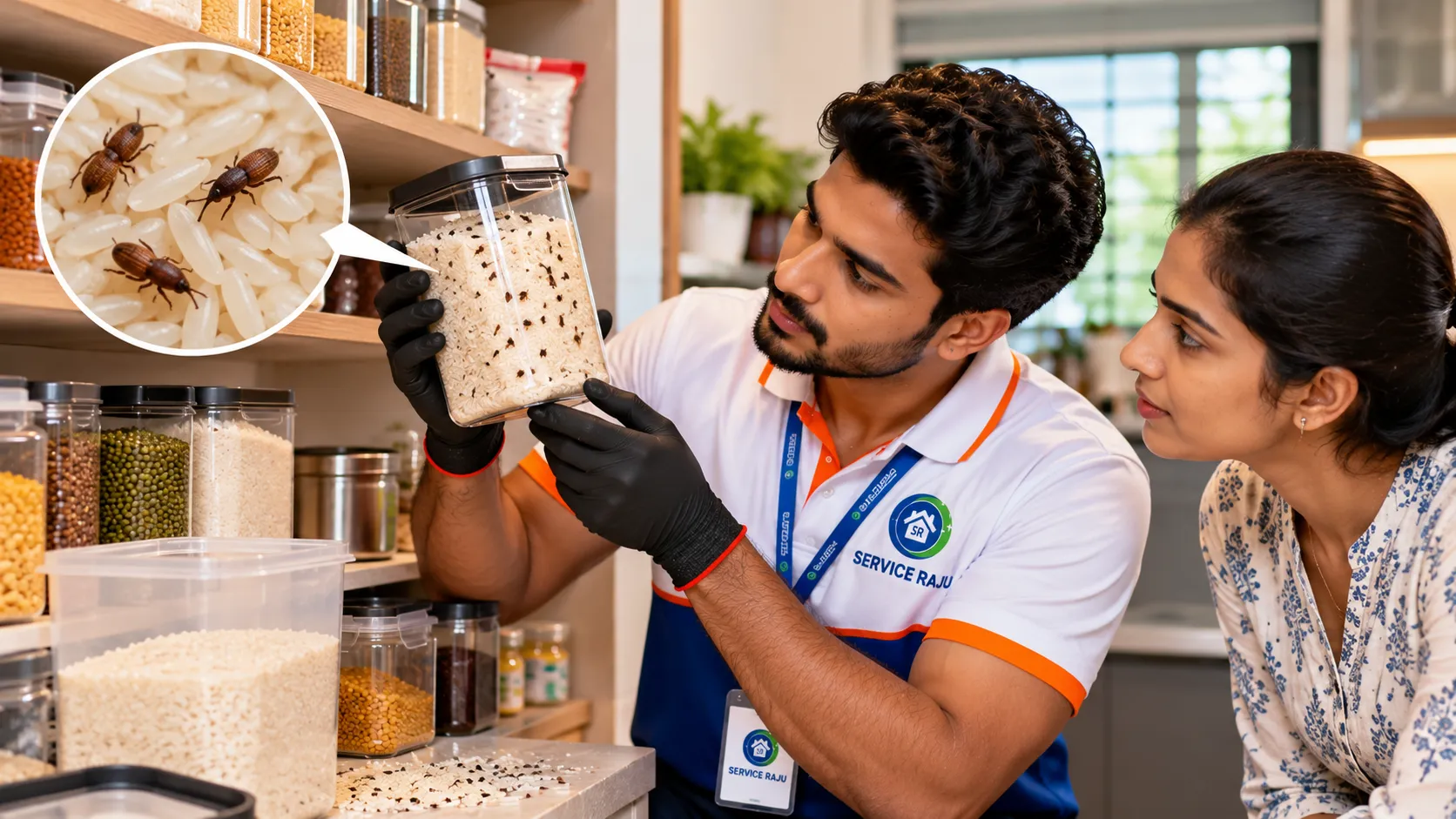
Tiny Beetles in Rice or Dal? Pantry Pest Control in Mysore
Have you opened your rice container and noticed tiny brown beetles crawling between the grains? Or have you found small insects in stored dal, flour, rava or other dry ingredients in your kitchen cupboard?
These insects are commonly known as pantry pests or stored-food pests. Some may be rice weevils, while others may be grain beetles or pantry moths. Identifying the likely source is important because removing the visible insects alone may not stop the infestation.
If you are searching for rice weevil control or pantry pest control in Mysore, the first step is to inspect the affected food, remove contaminated products safely and clean the storage area thoroughly.
This guide explains how to recognise common pantry pests, what to do when you find insects in rice or dal, how to prevent their return and when professional kitchen pest inspection may be useful in Mysuru.
Quick Answer: What Should You Do If You Find Beetles in Rice or Dal?
If you discover insects in stored food, follow these steps:
- Separate the affected food from other ingredients.
- Inspect nearby rice, dal, flour, rava, spices and other dry foods.
- Discard visibly infested food in a securely closed bag.
- Empty the affected cupboard and inspect corners, cracks and shelf joints.
- Vacuum loose grains and debris, then clean the shelves with warm soapy water and allow them to dry completely.
- Transfer unaffected dry ingredients into clean, tightly sealed containers.
- Monitor the cupboard for further insect activity.
Never apply insecticide directly to rice, dal, flour or any other food. Do not spray pesticide onto food containers, utensils or food-contact surfaces.
If insects continue appearing after the affected products have been removed and the cupboard cleaned, a professional pantry pest inspection can help identify the remaining source.
What Are the Tiny Beetles Found in Rice and Dal?
Several insects can infest stored grains and other dry food products. Although people often call all of them rice bugs, they may belong to different insect groups.
1. Rice Weevils
Rice weevils are small beetles that typically have an elongated snout. They can infest whole grains, including rice, and their immature stages may develop inside individual grain kernels.
Possible signs include:
- Small reddish-brown to dark beetles among the grains
- Small round holes in affected grains
- Beetles crawling around the storage container
- Repeated activity after a container has been opened
Rice weevils are only one possible explanation for insects in rice. Not every small brown beetle found in a kitchen is a rice weevil.
2. Other Grain Beetles
Other stored-product beetles can infest grain, flour, processed cereals, spices and dry food ingredients. Their body shape, colour and preferred food sources can differ.
Some pantry beetles are small and narrow, while others are more rounded. Visual identification may be difficult without a clear photograph or specimen.
If different products appear affected, check the entire food-storage area rather than assuming that the original rice container is the only source.
3. Pantry Moths and Their Larvae
Not every pantry infestation involves beetles. Pantry moths may also infest stored foods.
Possible signs include:
- Small moths flying around the kitchen
- Fine webbing inside food packages
- Larvae crawling around food containers or cupboard corners
- Clumped or contaminated dry ingredients
If you see webbing or larvae rather than adult beetles, the infestation may involve a different stored-food pest.
4. Insects in Stored Dal, Flour and Other Ingredients
Pantry pests can affect more than rice. Depending on the insect, susceptible products may include dal, flour, rava, cereals, dried chillies, nuts, spices and other stored ingredients.
Inspect products that are stored near the affected package, even when they appear unopened. In some cases, an infestation may have started before the food was purchased or packaged.
Correctly identifying the insect and locating the affected product helps prevent repeated infestations.
Why Do Rice Bugs Appear in a Clean Kitchen?
Finding insects in stored food does not automatically mean that your kitchen is dirty.
Pantry pests can enter a home in an already infested food package. Tiny eggs or immature insects may be difficult to notice during ordinary inspection.
Once susceptible food is stored in a warm, undisturbed cupboard, the insects may develop and become visible over time.
Other factors can make an infestation easier to maintain:
- Opened food packages that are not tightly sealed
- Grains stored for long periods
- Spilled grains or flour inside cupboards
- Food residue in shelf corners and cracks
- Several food products stored together without adequate inspection
- Old, forgotten or infrequently used dry ingredients
Cleaning and better storage help control these conditions, but they may not be sufficient until the infested food source has also been located and removed.
How to Identify the Source of a Pantry Infestation
Before purchasing pest-control products or arranging treatment, inspect the surrounding food storage systematically.
Check the Original Package
Look at the food in which the insects were first discovered. Check for live beetles, damaged grains, unusual debris, holes in kernels, webbing or other signs of infestation.
Keep the package separate from unaffected food while you assess the situation.
Inspect Nearby Dry Ingredients
Examine the other products stored in the same cupboard, including:
- Rice and different varieties of rice
- Toor dal, moong dal, chana dal and other pulses
- Wheat flour, rice flour and besan
- Rava and other cereals
- Dried chillies and spices
- Nuts, seeds and other dry foods
The list is not exhaustive. Check any dry food that may be susceptible to stored-product insects.
Check Containers and Cupboard Corners
Look for loose grains, insect remains and food debris around container lids, shelf edges, joints and cracks.
Pantry insects may be difficult to locate when they are hiding in small crevices or when the original contaminated package has been moved.
Cleaning these locations is an important step in preventing the problem from continuing.
How to Remove Rice Weevils and Pantry Beetles Safely
Step 1: Separate the Affected Food
Remove the suspect package from the main food-storage area. Avoid shaking or pouring it near clean ingredients because insects can spread into adjacent products.
Step 2: Discard Visibly Infested Food
For a practical household response, discard food that is visibly infested, contaminated with larvae or webbing, or significantly damaged by insects.
Place it in a securely closed bag and dispose of it appropriately. Do not mix contaminated food back into unaffected ingredients.
If you are unsure whether a product is contaminated, it is safer to discard the suspect item rather than use food with signs of infestation.
Step 3: Empty the Cupboard
Remove the remaining food products, containers and loose items from the affected shelf.
Inspect each product before returning it to the cupboard. If a package shows signs of insects, isolate it and assess it separately.
Step 4: Vacuum Cracks and Shelf Corners
Use a suitable vacuum cleaner to remove loose grains, insect remains and debris from shelf edges, joints and accessible crevices.
Empty the vacuum contents safely after cleaning so that the removed insects and debris are not left in the kitchen.
Step 5: Wash and Dry the Shelves
Clean the empty shelves with warm soapy water, following the requirements of the cabinet material. Wipe away food residues and allow all surfaces to dry fully before replacing any food.
Avoid soaking wooden or moisture-sensitive cabinets. Do not mix cleaning chemicals, and follow the manufacturer's instructions for the surface being cleaned.
Step 6: Clean the Storage Containers
Check the lids, grooves and corners of containers that held susceptible products.
Wash suitable containers with soap and water, rinse them thoroughly and allow them to dry completely before refilling. Follow the manufacturer's care instructions for containers that cannot be washed in the same way.
Step 7: Monitor the Pantry
After cleaning, check the cupboard and stored food periodically for renewed activity.
If insects continue appearing, inspect food products that were missed during the first check. A professional inspection may help where the source is difficult to find or the problem keeps returning.
How to Prevent Rice Bugs and Insects in Stored Dal
Good storage practices are among the most useful ways to reduce repeat pantry infestations.
Use Airtight Containers
Transfer susceptible dry ingredients into clean, dry containers with tightly fitting lids. Glass, suitable rigid plastic and metal containers can be practical options when they are food-safe and seal correctly.
Thin bags and loosely closed packets offer less protection against insects than well-sealed containers.
Inspect Food Before Storing It
Check rice, dal, flour, rava, spices and other dry goods when bringing them home.
Look for visible insects, webbing, damaged grains, holes or unusual debris. Inspection reduces the chance of storing an already infested product unnoticed.
Avoid Mixing New Food With Old Stock
Finish inspecting and cleaning an existing container before adding a new batch of rice or dal. Adding fresh ingredients to a container that still contains insects or contaminated food debris can make the problem harder to trace.
Keep the Pantry Cool and Dry
Store dry ingredients in a clean area away from water leaks, dampness and unnecessary heat.
Check that containers and shelves are completely dry before storing grains. Moisture control is useful for general food storage, although dryness alone does not guarantee that insects will be eliminated.
Buy Practical Quantities
Purchasing quantities that your household can use within a reasonable period may make inspection and stock rotation easier.
Check older products periodically and remove any that have become unsuitable for use.
Clean Spills Promptly
Loose rice, dal, flour and spice particles can collect under containers and inside shelf joints. Clean these spills when they occur rather than allowing them to accumulate.
Consider Freezing Suitable Dry Goods
Freezing may be useful for certain susceptible dry foods when performed under appropriate conditions. However, the effective treatment depends on the product, the freezer temperature and the required exposure time.
Do not assume a brief period in a domestic freezer will eliminate every stage of every pantry pest. Follow reliable product-specific guidance if you choose this approach.
Should You Spray Insecticide Inside a Rice or Dal Cupboard?
No. Never spray insecticide directly onto rice, dal, flour, spices or other food.
Do not apply pesticides to food-contact surfaces, cooking utensils or food containers in a way that could contaminate the ingredients.
For many household pantry infestations, removing the contaminated food, vacuuming debris, cleaning shelves and storing unaffected food in sealed containers are the appropriate initial measures.
If professional treatment is considered necessary, the treatment must be suitable for the identified pest and location. Food, utensils and food-contact items must be protected in accordance with the product label and applicable requirements.
Do not assume that a general household insecticide, mosquito spray or cockroach treatment is appropriate for a cupboard containing stored food.
When Is Professional Pantry Pest Control in Mysore Useful?
Professional inspection may be useful when the infestation is recurring, the source is unclear or insects continue appearing after the affected products have been removed and the shelves cleaned.
Consider requesting an inspection if:
- You repeatedly find beetles in newly opened or stored food.
- Several different dry ingredients appear affected.
- Small beetles keep appearing around cupboard corners.
- You find larvae, webbing or moths in multiple storage areas.
- You cannot identify the insect confidently.
- The same problem returns despite appropriate cleaning and storage changes.
- The infestation appears to extend beyond one cupboard.
A professional can assess the affected storage area, help identify possible sources and recommend suitable non-chemical prevention or targeted control measures as appropriate.
What Happens During a Professional Kitchen Pest Inspection?
A practical inspection should focus on identifying the pest and locating the conditions that allow the infestation to persist.
Depending on the reported problem, an inspection may include:
- Examining accessible pantry shelves and cupboard corners
- Reviewing the type and distribution of insect activity
- Checking for other affected stored products
- Identifying visible food residues and storage issues
- Looking for accessible cracks and crevices where debris collects
- Recommending cleaning and storage improvements
- Determining whether any additional pest-control work is appropriate
The scope of work depends on the findings. A pantry infestation is not automatically a reason to spray the entire kitchen.
Rice Weevil Control vs General Kitchen Pest Control
| Situation | Recommended Starting Point |
|---|---|
| Beetles confined to one rice packet | Isolate the package, discard infested food and inspect nearby products |
| Insects in rice and stored dal | Inspect the full dry-food cupboard and clean affected storage areas |
| Beetles keep returning after cleaning | Look for overlooked infested products and request an inspection if needed |
| Moths and webbing in food packages | Inspect susceptible dry foods for pantry moth infestation |
| Insects appear beyond the pantry | Assess other potential food sources and affected areas |
| Unidentified insects in several cupboards | Arrange professional identification and targeted recommendations |
Pantry Pest Control Services by Service Raju
Service Raju provides home-service and pest-control assistance for residential customers in Mysuru.
If tiny beetles repeatedly appear in rice, dal or other stored dry foods, professional inspection may help identify the source and establish a suitable prevention plan.
Depending on the inspection findings and services available, assistance may include:
- Assessment of recurring pantry insect activity
- Identification of likely infestation sources
- Advice on cleaning and dry-food storage practices
- Recommendations for reducing conditions that support pantry pests
- Assessment of whether targeted pest treatment is appropriate
- Guidance on preventing the problem from recurring
Our recommendations are based on the reported problem and inspection findings. The objective is to address the source of the infestation rather than relying on indiscriminate spraying near stored food.
For general pest-control enquiries, visit the Service Raju Mysuru service directory.
Frequently Asked Questions
Why are there tiny beetles in my rice?
They may be rice weevils or another stored-product insect. Infestation can begin before the food is purchased or during storage. Inspect the rice and nearby dry ingredients, remove visibly infested products and clean the storage area.
Are the insects in my rice definitely rice weevils?
No. Several beetles and other insects infest stored foods. Rice weevils typically have an elongated snout, but reliable identification may require a clear photograph or specimen.
Should I throw away rice containing live insects?
For a practical household response, discard rice that is visibly infested or contaminated. Do not mix it with unaffected food or attempt to treat it using household insecticides.
Why are there insects in stored dal?
Several stored-product pests can infest pulses and other dry ingredients. They may enter through an already infested package or persist when an affected product remains in storage. Inspect nearby items and use clean, tightly sealed containers.
Can rice weevils spread from one packet to another?
Yes, pantry insects can spread between susceptible products. Separate the affected food, inspect nearby products and clean the surrounding shelves to reduce the risk of further infestation.
Does a rice weevil infestation mean my kitchen is dirty?
Not necessarily. An infested food package can introduce pantry pests into a clean home. Good hygiene, inspection and sealed storage help reduce the chance of an infestation persisting.
Can I use insecticide spray to kill rice bugs?
Never spray insecticide directly onto rice, dal or any food. Start with removal of infested products and thorough cleaning. Any additional professional treatment must be appropriate for the identified pest and used in accordance with its label and applicable requirements.
How do I prevent rice bugs from returning?
Discard visibly infested food, inspect other susceptible ingredients, clean and dry the shelves, use airtight containers and check new purchases. If insects keep returning, arrange an inspection to identify an overlooked source.
When should I book pantry pest control in Mysore?
Consider professional inspection if insects continue appearing after cleaning, multiple food products are affected or you cannot identify the source. Targeted recommendations can help address the underlying problem.
Book a Pantry Pest Inspection in Mysore
Finding tiny beetles in rice or dal can be frustrating, especially when the same problem returns after cleaning the cupboard.
The best first step is to identify the likely pest, remove visibly infested food, clean the storage area and protect unaffected ingredients in airtight containers.
If pantry insects continue appearing or the source remains unclear, Service Raju can help you enquire about professional pest inspection in Mysuru.
Call / WhatsApp: +91 9964544445
Service Raju – Trusted Home Services in Mysuru, Udupi, Mangaluru & Indore.
Explore Service Raju Services in Mysuru
 AC Repair
.webp) Ant Control Service
Ant Control Service
 Basin & Sink Services
.webp) Bath & Shower Services
Bath & Shower Services
.webp) Bath Fittings & Mirrors
Bath Fittings & Mirrors
 Bathroom Cleaning Service
 Bathroom Renovation Services
 Bed Bug Control Services
 Bedroom Painting
 Book a Carpenter Consultation
 Book Electrical Consulting
.webp) Cabinet Painting & Wood Refinishing
Cabinet Painting & Wood Refinishing
 Chimney Cleaning
 Civil Masonry Work
 Clean-Up Services
.webp) Clothes Hanger Installation
Clothes Hanger Installation
 Cockroach Control Services
---mysore-mysore-standard-300x200.webp) Commercial Cleaning
Commercial Cleaning
 Commercial Pest Control AMC Service
 Cupboard & Drawer Services
 Decorative Wall Panels
 Deep Sanitisation Service
 Detan & Bleach
 Door, Grill & Cabinet Painting Service
.webp) Doorbell & security
Doorbell & security
 Drain Blockage Clearing
 Electrical Appliance Services
 Electrical Wiring Services
 Empty Home Deep Cleaning
.webp) Fabrication
Fabrication
 Facials
.webp) Fan Installation & Repair
Fan Installation & Repair
 Full Home Cleaning Service
 Full Home Renovation
 Furniture Repair Service
 Gas Stove & Hob Repair
.webp) General Pest Control Services
General Pest Control Services
 General Plumbing & Consultation
 Geyser Repair
 Glass Cleaning
 Head Massage
.webp) Honeybee & Wasp-Services
Honeybee & Wasp-Services
 Kitchen & Bathroom Painting Service
 Kitchen Cleaning
 Kitchen Fittings
.webp) Kitchen Renovation
Kitchen Renovation
.webp) Laptop/Desktop service
Laptop/Desktop service
 Leak Detection and Repair
 LED TV Repair
 Living and Dining Room Painting
 Makeup, Saree & Styling
 Manicure & Pedicure
 MCB,Meter & Fuse Services
 Microwave Repair
 Mosquito Pest Control Service
 Multi-Room Painting Service
 Painting Consultation
 Quick Mini Cleaning Services
 Refrigerator Repair
 RO Water Purifier
.webp) Rodent Control Services (Rat & Mice Treatment)
Rodent Control Services (Rat & Mice Treatment)
.webp) Rooms Cleaning
Rooms Cleaning
 Shelves & Decor
 Sofa, Carpet & Mattress Cleaning
 Solar Water Heater Service
 Sump & Tank Cleaning
 Switch & Socket Services
 Tap & Mixer Service
.webp) Termite-Control-Services
Termite-Control-Services
 Threading & Face Wax
.webp) Tile & Granite Installation & Polishing
Tile & Granite Installation & Polishing
 Toilet & Commode Services
.webp) UPS and Inverter Repair Services
UPS and Inverter Repair Services
.webp) Wall Painting Service
Wall Painting Service
 Washing Machine Repair
 Water Level Controllers
 Water Tank and Pump Repair
 Waterproofing
 Waterproofing Services
 Waxing
 Window & Curtain Services
 Wooden Door Services