Tiny Beetles Damaging Rugs and Clothes? Carpet Beetle Control Guide
Have you noticed tiny beetles near your carpet, small hairy larvae along the edges of a rug, or unexplained holes in stored clothes? These signs may indicate a carpet beetle infestation, a problem that can damage susceptible fabrics if the source remains untreated.
Carpet beetles are small insects whose larvae feed on various animal-derived materials and other suitable organic matter. Depending on the species and material, susceptible items can include wool rugs, blankets, clothing, upholstery and stored textiles.
For homeowners searching for carpet beetle control in Mysore, the first step is to identify the insect and determine where it is developing. Ordinary carpet cleaning may remove dust and debris, but it may not eliminate an infestation hidden in a cupboard, under furniture or inside stored textiles.
This guide explains the warning signs, common hiding places, practical prevention measures and situations in which a professional pest inspection may help.
Quick Answer: How Do You Control Carpet Beetles?
If you suspect carpet beetles in your home, follow these initial steps:
- Inspect the damaged fabric and look for larvae, shed skins or adult beetles.
- Check carpet edges, cupboard corners, upholstered furniture and stored textiles.
- Vacuum affected areas thoroughly, including accessible edges and crevices.
- Wash or professionally clean suitable affected textiles according to their care labels.
- Inspect stored clothing, blankets and other susceptible items before putting them away again.
- Store clean, completely dry textiles in suitable sealed containers or garment storage.
- Monitor for fresh damage and recurring insect activity.
If new damage continues after cleaning, the infestation may be developing in an overlooked location. A professional inspection can help identify the likely source and determine whether additional pest-control measures are appropriate.
Important: Do not indiscriminately spray insecticides on clothing, bedding, children's items or carpets. Any pesticide use must be appropriate for the identified pest, the intended surface and the product label.
What Are Carpet Beetles?
Carpet beetles are small beetles belonging to the family Dermestidae. Several species occur in residential environments, and their appearance can vary.
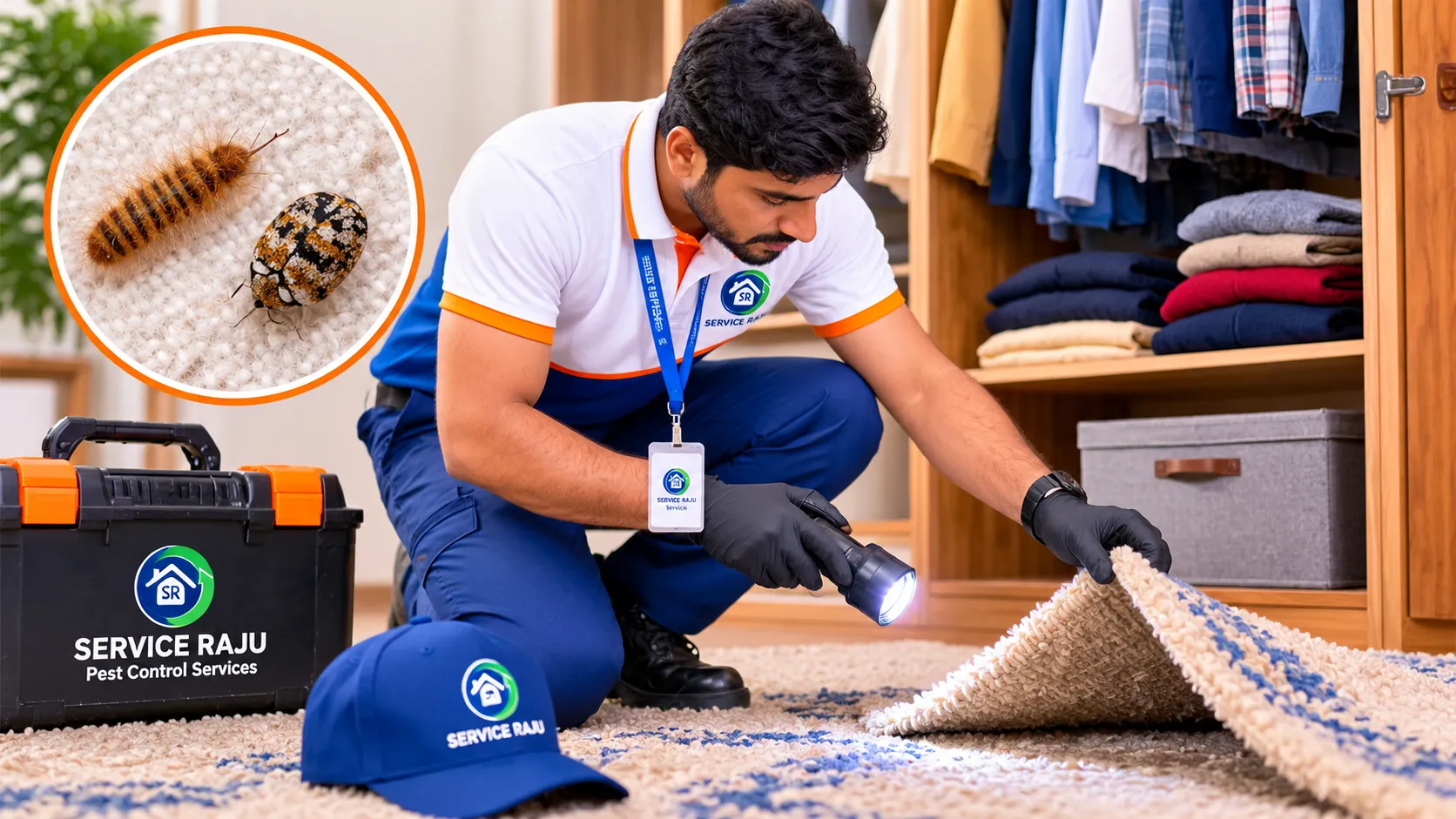
Adult carpet beetles are often small and oval-shaped. Depending on the species, they may appear black, brown, mottled or patterned with lighter and darker scales.
The larvae are especially important because they are responsible for much of the damage to susceptible textiles. They may be elongated, brownish and covered with noticeable bristles or hairs.
Carpet beetle larvae can be difficult to spot because they may hide along carpet edges, under furniture, inside cupboards or among stored materials.
How to Identify a Carpet Beetle Infestation
One small beetle does not automatically prove that a carpet or wardrobe is infested. Look for a combination of signs before deciding what action to take.
1. Tiny Hairy Larvae
Carpet beetle larvae may look like small, bristly caterpillars. They can be brown or tan and may have visible bands or tufts of hairs, depending on the species and developmental stage.
Finding larvae near a damaged rug, clothing storage area or upholstered item deserves closer inspection.
2. Small Holes in Natural-Fibre Fabrics
Carpet beetle larvae can damage susceptible natural-fibre materials, including wool and some animal-derived textiles.
Look for irregular holes, thinning patches or localised damage in:
- Woollen carpets and rugs
- Wool sweaters and shawls
- Blankets and stored winter clothing
- Natural-fibre upholstery
- Some feather-, fur- or other animal-derived items
Fabric damage alone is not enough to confirm carpet beetles. Clothes moths, friction, ageing and other causes can produce similar problems.
3. Shed Larval Skins
As larvae grow, they shed their outer skins. These may remain in carpet edges, cupboards, under furniture or among stored textiles.
Finding several shed skins together with larvae or fresh fabric damage provides a stronger reason to investigate a possible infestation.
4. Adult Beetles Near Windows
Adult carpet beetles may be seen near windows or light sources. Some adults enter from outdoors, while others emerge from an infestation inside the property.
An adult beetle near a window does not necessarily mean that clothes or carpets are being damaged. Inspect the surrounding areas for larvae and other evidence.
5. Repeated Damage in Stored Clothing
If the same stored garments develop fresh holes or damaged patches, inspect the wardrobe, storage boxes and nearby floor edges.
Pay particular attention to items that remain undisturbed for long periods and to places where dust, hair or other organic debris collects.
Why Do Carpet Beetles Keep Returning?
Recurring carpet beetle activity often means that a suitable food source or developing population has not been fully identified.
Hidden Lint, Hair and Debris
Dust, pet hair, lint and other organic debris can accumulate under furniture, behind cupboards and along carpet edges. Some of this material can provide suitable food for carpet beetle larvae.
Cleaning only the visible centre of a carpet may leave debris undisturbed in the surrounding edges and crevices.
Stored Woollen Clothing and Blankets
Clothes kept in cupboards, suitcases or storage boxes for long periods may be overlooked during routine cleaning.
Inspect susceptible textiles before storing them and again before using them after an extended period.
Upholstery and Furniture
Carpet beetle larvae may occur around furniture containing susceptible materials or in areas where hair, lint and debris accumulate.
Check accessible seams, the undersides of upholstered furniture and nearby floor edges when signs of infestation are found.
Natural-Fibre Decorative Items
Wool rugs, textile decorations, stored fabrics and other susceptible household materials can provide additional places for larvae to feed.
When damage appears in more than one location, inspect the wider room and nearby storage areas instead of focusing on a single rug.
Items Brought Into the Home
Infested textiles, second-hand furnishings and other susceptible items can introduce carpet beetles into a home.
Inspect newly acquired rugs, blankets and stored fabric items when practical, particularly if there are visible signs of insect activity.
Which Areas of Your Home Should You Inspect?
A useful inspection covers both the visibly damaged item and nearby places where larvae may be hiding.
| Location | What to Look For |
|---|---|
| Carpet edges | Larvae, shed skins, loose fibres and localised damage |
| Under furniture | Accumulated hair, lint, larvae and debris |
| Wardrobes | Damaged garments, shed skins and insects around stored textiles |
| Storage boxes | Damage to woollens, blankets and other susceptible materials |
| Upholstered furniture | Activity around seams, undersides and nearby debris |
| Window areas | Adult beetles and possible entry points |
| Unused rooms | Undisturbed textiles, dust accumulation and recurring damage |
Do not dismantle furniture or open inaccessible building cavities unnecessarily. If the source remains unclear, a professional inspection may help narrow down the affected areas.
How to Remove Carpet Beetles From Rugs and Clothes
Step 1: Separate Suspect Items
Move visibly affected garments or textiles away from clean items where practical. Avoid shaking infested fabrics around the room, as this can distribute debris and insects.
Keep the items separate until they have been inspected and cleaned appropriately.
Step 2: Vacuum Thoroughly
Vacuum the affected carpet and surrounding floor, paying attention to accessible edges, corners, skirting boards and areas beneath movable furniture.
Use suitable attachments to clean accessible furniture crevices without damaging the material.
Dispose of vacuum contents promptly and safely. Cleaning the visible carpet surface alone may not address larvae hidden in overlooked locations.
Step 3: Clean Affected Textiles Correctly
Wash suitable clothing and fabrics according to their care labels. Where appropriate, professional textile cleaning may be a better choice for delicate woollens, valuable rugs or items that cannot be safely washed at home.
Use a cleaning method suitable for the specific textile. Do not assume that every fabric can tolerate hot washing, steam or aggressive cleaning products.
Step 4: Inspect Stored Items
Check nearby garments, blankets, rugs and other susceptible materials. Clean unaffected items where appropriate before returning them to storage.
Do not place suspect textiles back into a clean cupboard without checking them first.
Step 5: Clean Storage Areas
Remove loose lint and debris from wardrobe corners, shelf joints, storage boxes and accessible crevices.
Allow cleaned areas and textiles to dry fully before putting items away.
Step 6: Monitor for New Activity
Check previously affected locations periodically. Fresh larvae, new fabric damage or repeated adult beetle sightings may indicate that the source remains.
If activity continues, reassess the affected areas rather than repeatedly cleaning only the same visible surface.
How to Prevent Carpet Beetles in Mysore Homes
Regular inspection and good storage habits can reduce the chance of carpet beetles becoming established or returning.
Vacuum Carpet Edges and Hidden Areas
Include carpet edges, spaces under furniture, cupboard corners and other places where dust or hair accumulates in your routine cleaning.
Pay additional attention to rooms that contain wool rugs or other susceptible textiles.
Clean Clothing Before Long-Term Storage
Before packing away seasonal garments, inspect and clean them according to their care labels.
Store clean, fully dry textiles in suitable sealed containers or garment-storage systems that protect them from insects and dust.
Inspect Rugs and Upholstery
Periodically inspect rugs, fabric furniture and decorative textiles, particularly if a household has experienced fabric damage before.
Early identification can help you address the problem before more items are affected.
Reduce Accumulated Pet Hair and Lint
Where pets are present, remove accumulated hair from floors, rugs, furniture and storage areas. Clean around furniture and along edges instead of focusing only on open floor surfaces.
Check Second-Hand Textiles
Inspect second-hand rugs, woollens and upholstered items before bringing them into your main storage areas.
If you find signs of insects, keep the item separate until you have determined the appropriate cleaning or treatment method.
Keep Storage Areas Organised
Avoid leaving susceptible textiles undisturbed for long periods without inspection. Organised storage makes it easier to notice fresh damage and identify the item that may be affected.
Carpet Cleaning vs Carpet Beetle Pest Control
Carpet cleaning and pest control address different problems. Understanding the difference helps you choose the appropriate service.
| Situation | Suitable Starting Point |
|---|---|
| Carpet is dusty but no pest signs are present | Routine carpet cleaning and maintenance |
| Carpet has stains or odours | Cleaning appropriate for the carpet material |
| Small holes appear in woollen fabrics | Inspect for carpet beetles and other textile pests |
| Hairy larvae or shed skins are found | Investigate a possible carpet beetle infestation |
| Fabric damage continues after cleaning | Identify the pest source and consider professional inspection |
| Several rugs or stored garments are affected | Inspect the wider room and susceptible storage areas |
Professional carpet cleaning may help remove dust and debris, but it should not automatically be treated as a complete pest-control solution. Likewise, pest treatment does not repair holes or restore damaged textiles.
The appropriate response depends on the identified pest, affected materials and extent of the problem.
Should You Spray Insecticide on Carpets, Clothes or Bedding?
Do not indiscriminately spray insecticides on clothing, bedding or household textiles. A product intended for one pest or surface may not be suitable for another application.
Before any pesticide is considered, the insect should be identified as accurately as practical and the proposed treatment should be appropriate for the affected location and material.
Any pesticide used must be applied in accordance with its label, applicable Indian requirements and professional safety instructions. Keep children and pets away from treated areas as directed, and follow all required re-entry and cleaning instructions.
For many initial household investigations, removing debris, cleaning affected textiles and locating the source are useful first steps.
If the infestation persists, a qualified pest-control professional can assess whether targeted treatment is warranted and explain the precautions required.
When Should You Book Professional Carpet Beetle Control in Mysore?
Professional inspection may be useful when the problem is recurring, the source is difficult to locate or multiple susceptible items show signs of damage.
Consider requesting an inspection if:
- You repeatedly find hairy larvae around carpet edges or cupboards.
- New holes appear in woollen clothing or rugs.
- You find shed larval skins in several locations.
- Furniture, stored blankets and carpets appear affected.
- Cleaning has not stopped the signs of activity.
- You cannot confidently identify the insect.
- You want to establish whether pest treatment is needed before spending money on repeated cleaning.
A professional inspection can help distinguish carpet beetles from other fabric pests and identify areas that require further attention.
What Happens During a Professional Fabric Pest Inspection?
The purpose of an inspection is to establish the likely pest, identify affected locations and recommend an appropriate response.
Depending on the reported issue, the assessment may include:
- Examining visible insects or photographs supplied by the customer
- Inspecting affected rugs, carpet edges and accessible furniture areas
- Checking wardrobes and stored textiles where access is available
- Looking for larvae, shed skins and other signs of insect activity
- Identifying accumulated lint, hair and debris that may support pests
- Recommending suitable cleaning and storage measures
- Assessing whether targeted pest treatment is appropriate
- Explaining precautions for people, pets and susceptible household materials
The recommended work should be based on the inspection findings. Not every adult beetle sighting requires chemical treatment, and not every case of fabric damage is caused by carpet beetles.
Carpet Beetle Control Services by Service Raju
Service Raju provides home-service and pest-control assistance for residential customers in Mysuru.
If you have noticed recurring fabric damage, tiny larvae around a rug or insects in stored clothing, an inspection may help identify the cause before you select a treatment.
Depending on the service available and the inspection findings, assistance may include:
- Assessment of reported insect activity
- Inspection of accessible affected areas
- Recommendations for cleaning and storage improvements
- Identification of conditions that may support recurring pests
- Advice on whether additional pest-control work is appropriate
- Recommendations for monitoring after corrective action
Carpet beetle control should be distinguished from ordinary carpet shampooing or stain removal. If the problem involves both fabric damage and a possible insect infestation, the pest source and the condition of the textile may need separate attention.
For service enquiries, visit the Service Raju Mysuru service directory.
Frequently Asked Questions About Carpet Beetles
What do carpet beetle larvae look like?
Carpet beetle larvae are generally small, elongated and bristly. Their colour and markings vary by species and stage of development. A clear photograph or specimen may help with identification.
Do carpet beetles damage clothes?
Yes. The larvae of certain carpet beetle species can damage susceptible clothing, especially items made from wool and other animal-derived materials. The damage depends on the material and the insect involved.
Can carpet beetles damage rugs and upholstery?
Yes. Some carpet beetle larvae feed on susceptible natural-fibre rugs and materials found in upholstery. Inspect damaged items and nearby areas for larvae and shed skins.
Are carpet beetles the same as clothes moths?
No. Carpet beetles and clothes moths are different insects, although their larvae can damage some of the same materials. Correct identification helps determine the appropriate control measures.
Why do I keep finding carpet beetles after vacuuming?
The source may remain in an overlooked location, such as a storage box, wardrobe corner, furniture crevice or another susceptible textile. Repeated sightings warrant a wider inspection.
Will carpet shampooing eliminate a carpet beetle infestation?
Not necessarily. Cleaning may remove debris and some insects, but an infestation can persist in hidden areas or stored materials. Pest identification and source inspection may still be necessary.
Can I use insecticide on my clothes to kill carpet beetles?
Do not apply insecticides to clothing or bedding unless the specific product is expressly suitable for that use and all label requirements are followed. Cleaning and proper storage are useful initial measures, while persistent infestations may require professional advice.
Do carpet beetles bite people?
Carpet beetle larvae do not feed on people, but their bristly hairs can cause skin irritation or dermatitis in some individuals. Skin irritation alone does not confirm an infestation, and other causes may need to be considered.
When should I seek carpet beetle control in Mysore?
Consider professional inspection if larvae keep appearing, fresh fabric damage continues, several locations are affected or you cannot identify the insect. Early identification can help prevent further damage to susceptible items.
Book a Carpet Beetle Inspection in Mysore
Noticed tiny beetles near your rugs, hairy larvae in your wardrobe or unexplained holes in stored clothes? Do not rely on repeated surface cleaning without checking what is causing the damage.
Inspect affected textiles, clean accessible areas and monitor for further activity. If the problem persists, a professional inspection can help identify the source and determine whether targeted pest control is appropriate.
Service Raju – Trusted Home Services in Mysuru, Udupi, Mangaluru & Indore.
Contact Service Raju to enquire about pest inspection and available residential pest-control services in Mysuru.
Call / WhatsApp: +91 9964544445
Explore Service Raju Services in Mysuru
 AC Repair
.webp) Ant Control Service
Ant Control Service
 Basin & Sink Services
.webp) Bath & Shower Services
Bath & Shower Services
.webp) Bath Fittings & Mirrors
Bath Fittings & Mirrors
 Bathroom Cleaning Service
 Bathroom Renovation Services
 Bed Bug Control Services
 Bedroom Painting
 Book a Carpenter Consultation
 Book Electrical Consulting
.webp) Cabinet Painting & Wood Refinishing
Cabinet Painting & Wood Refinishing
 Chimney Cleaning
 Civil Masonry Work
 Clean-Up Services
.webp) Clothes Hanger Installation
Clothes Hanger Installation
 Cockroach Control Services
---mysore-mysore-standard-300x200.webp) Commercial Cleaning
Commercial Cleaning
 Commercial Pest Control AMC Service
 Cupboard & Drawer Services
 Decorative Wall Panels
 Deep Sanitisation Service
 Detan & Bleach
 Door, Grill & Cabinet Painting Service
.webp) Doorbell & security
Doorbell & security
 Drain Blockage Clearing
 Electrical Appliance Services
 Electrical Wiring Services
 Empty Home Deep Cleaning
.webp) Fabrication
Fabrication
 Facials
.webp) Fan Installation & Repair
Fan Installation & Repair
 Full Home Cleaning Service
 Full Home Renovation
 Furniture Repair Service
 Gas Stove & Hob Repair
.webp) General Pest Control Services
General Pest Control Services
 General Plumbing & Consultation
 Geyser Repair
 Glass Cleaning
 Head Massage
.webp) Honeybee & Wasp-Services
Honeybee & Wasp-Services
 Kitchen & Bathroom Painting Service
 Kitchen Cleaning
 Kitchen Fittings
.webp) Kitchen Renovation
Kitchen Renovation
.webp) Laptop/Desktop service
Laptop/Desktop service
 Leak Detection and Repair
 LED TV Repair
 Living and Dining Room Painting
 Makeup, Saree & Styling
 Manicure & Pedicure
 MCB,Meter & Fuse Services
 Microwave Repair
 Mosquito Pest Control Service
 Multi-Room Painting Service
 Painting Consultation
 Quick Mini Cleaning Services
 Refrigerator Repair
 RO Water Purifier
.webp) Rodent Control Services (Rat & Mice Treatment)
Rodent Control Services (Rat & Mice Treatment)
.webp) Rooms Cleaning
Rooms Cleaning
 Shelves & Decor
 Sofa, Carpet & Mattress Cleaning
 Solar Water Heater Service
 Sump & Tank Cleaning
 Switch & Socket Services
 Tap & Mixer Service
.webp) Termite-Control-Services
Termite-Control-Services
 Threading & Face Wax
.webp) Tile & Granite Installation & Polishing
Tile & Granite Installation & Polishing
 Toilet & Commode Services
.webp) UPS and Inverter Repair Services
UPS and Inverter Repair Services
.webp) Wall Painting Service
Wall Painting Service
 Washing Machine Repair
 Water Level Controllers
 Water Tank and Pump Repair
 Waterproofing
 Waterproofing Services
 Waxing
 Window & Curtain Services
 Wooden Door Services