Termite Control Service: Apartment vs House Treatment Guide
1. Termite Control Service: Apartment vs House Treatment Guide
Termites can remain hidden inside walls, wooden frames, flooring areas and other parts of a property before obvious damage becomes visible. A Termite Control Service therefore should not be selected only according to the size of a property. The building type, affected areas, access points, construction condition and extent of infestation all matter.
An apartment and an independent house can experience similar termite symptoms, but the treatment approach may be different. Apartments may require attention around skirting, wooden fixtures, wall-floor junctions and shared building structures, while independent houses may have additional soil and ground-contact areas to inspect.
The Bureau of Indian Standards has specific guidance covering anti-termite measures for buildings, including constructional and chemical treatment approaches for subterranean termites.
2. Why Property Type Matters for Termite Control
Termites do not necessarily appear only where the visible damage is located.
- Hollow-sounding wooden doors
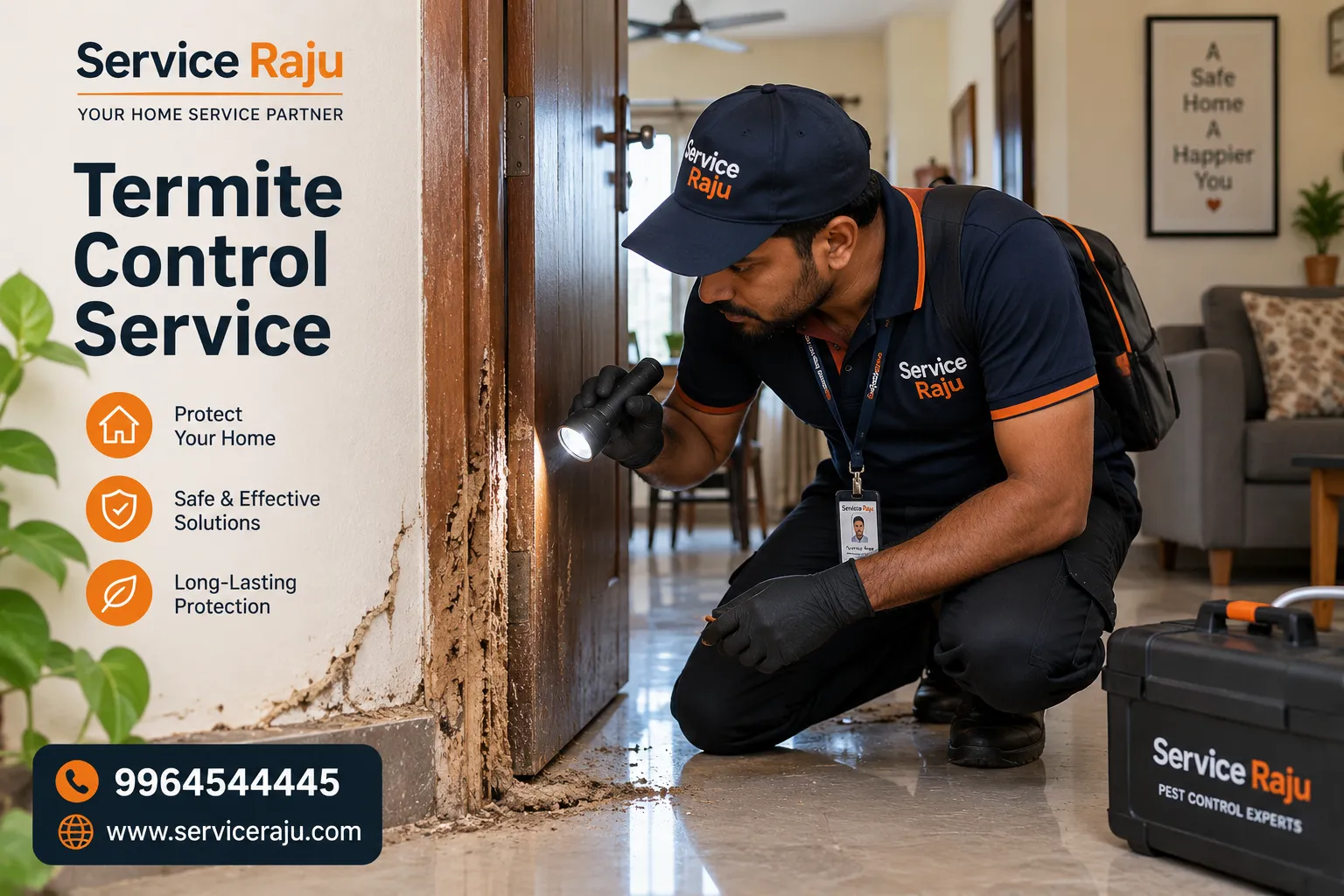
- Mud tubes along walls
- Small holes in wooden furniture
- Damaged skirting
- Discarded termite wings
- Bubbling or damaged wooden surfaces
- Crumbling wood around frames
- Termite activity near damp areas
The visible location is not always the complete infestation area. Subterranean termites can travel through soil and concealed pathways to reach cellulose-containing materials.
3. Termite Control in Apartments
Apartments have a different treatment environment from independent houses. A homeowner may have access to the inside of their apartment but not to every part of the building's foundation, external soil or neighbouring units.
4. Common termite-prone areas in apartments
- Main door frames
- Bedroom door frames
- Wooden wardrobes
- Kitchen cabinets
- Skirting areas
- Wall-floor junctions
- Wooden partitions
- Bathroom-adjacent woodwork
- Utility areas
- Areas showing mud tubes or termite activity
5. Why apartment treatment can be complicated
A termite problem may appear inside one apartment while the underlying route is associated with a concealed building pathway. This does not automatically mean that the entire apartment block is infested. The source and route should be assessed before deciding the treatment area.
6. Termite Control in Independent Houses
Independent houses can provide more treatment access, particularly around ground-contact areas.
- External perimeter
- Ground-floor walls
- Foundation-adjacent areas
- Door and window frames
- Wooden flooring
- Cabinets
- Storage areas
- Garden-side walls
- Utility areas
- Plumbing-entry locations
- Damp or poorly ventilated areas
Independent houses can therefore require a broader inspection than a single apartment. This does not mean every house requires extensive drilling or chemical treatment. The treatment should be based on the actual property condition and termite activity.
7. Apartment vs House Termite Treatment
| Factor | Apartment | Independent House |
|---|---|---|
| Inspection area | Mainly accessible apartment areas | Interior and accessible exterior areas |
| Soil access | Often limited | Usually greater |
| Wooden fixtures | Important inspection point | Important inspection point |
| External perimeter | May be restricted | Usually easier to inspect |
| Shared structure | May require additional consideration | Generally less complicated |
| Treatment scope | Often targeted | Can be more comprehensive |
| Infestation source | May be concealed | Easier to investigate in some cases |
The important point is that property type alone does not determine the treatment. Two apartments of the same size can require completely different solutions. Likewise, two independent houses can have very different termite conditions.
8. Signs That Your Property Needs Termite Inspection
9. 1. Mud Tubes
Thin mud-like tubes on walls, foundations or other surfaces can indicate termite movement.
10. 2. Hollow Wood
Hollow-sounding areas in wooden doors, frames or furniture can be a warning sign, although this alone cannot confirm termite infestation.
11. 3. Damaged Door Frames
Termites may attack concealed portions of wooden frames, especially near wall and floor junctions.
12. 4. Discarded Wings
After termite swarming, discarded wings may be found around windows, lights or other areas.
13. 5. Small Holes or Surface Damage
Unusual holes, cracking or damaged wooden surfaces deserve closer inspection.
14. 6. Repeated Termite Activity
If termites appear again after cleaning or removing visible insects, there may be an underlying infestation.
15. 7. Damage Near Damp Areas
Moisture does not automatically mean termites, but damp conditions can contribute to building and wood problems that deserve investigation.
16. How Professional Termite Treatment Works
17. Step 1: Inspection
The technician checks visible termite signs, wooden elements, accessible wall-floor junctions and other relevant areas.
18. Step 2: Identify the Treatment Requirement
The objective is to determine whether the property needs targeted treatment, broader post-construction treatment, preventive treatment or another approach.
19. Step 3: Explain the Treatment
- Areas to be treated
- Reason for treatment
- Whether drilling is necessary
- Required preparation
- Expected treatment duration
- Safety precautions
- Follow-up requirements
- Warranty or re-treatment terms, if offered
20. Step 4: Treatment
Depending on the approved treatment plan, professional termite control can involve methods such as injection, targeted application or other suitable anti-termite treatment techniques.
21. Step 5: Post-Treatment Checks
After treatment, affected areas should be monitored according to the service plan.
22. What Affects Termite Treatment Cost?
There is no single price that accurately applies to every property. Cost may depend on property type, approximate area, infestation severity, accessibility, treatment method, number of floors, construction condition, drilling or injection requirements and follow-up requirements.
| Cost Factor | Why It Matters |
|---|---|
| Property type | Apartments and houses can require different treatment access |
| Area | Larger treatment areas may require more work |
| Infestation severity | More extensive activity may require broader treatment |
| Accessibility | Difficult areas can increase labour and treatment complexity |
| Treatment method | Different methods have different application requirements |
| Follow-up | Warranty or re-treatment arrangements can affect package pricing |
23. How to Prepare Your Home for Termite Treatment
- Keep access clear around affected walls.
- Move small objects away from skirting areas.
- Keep wooden furniture accessible for inspection.
- Inform the technician about previous termite treatments.
- Mention areas where termite activity was recently noticed.
- Keep children and pets away from active treatment areas as instructed.
- Follow ventilation and re-entry instructions.
24. Termite Prevention Tips for Mysore and Bengaluru
Homeowners in Mysore/Mysuru and Bengaluru should pay attention to termite-prone conditions around buildings, especially where soil, wood, moisture and concealed access routes come together.
- Inspect wooden surfaces periodically.
- Fix water-related problems promptly.
- Avoid unnecessary wood-to-soil contact.
- Inspect concealed areas during renovation.
- Do not ignore early termite signs.
- Consider professional inspection for older properties.
25. When Should You Call a Professional?
- You find mud tubes.
- Wooden doors sound hollow.
- Termites repeatedly appear.
- You discover discarded wings.
- Furniture shows unexplained internal damage.
- Door frames are deteriorating.
- You are renovating an older property.
- You are buying a property and notice possible termite activity.
- A previous termite treatment did not resolve the problem.
26. Frequently Asked Questions
27. Is termite treatment different for an apartment and a house?
Yes. The treatment plan can differ because access, construction, soil exposure, affected areas and shared building structures are different.
28. Does every termite problem require drilling?
Not necessarily. The required method depends on the property, construction and infestation.
29. Can termites damage furniture?
Yes. Termites can damage wood and other cellulose-based materials.
30. How do I know if termites are coming from the soil?
Mud tubes, activity near ground-level areas and other signs can suggest subterranean termite activity, but the source should be professionally assessed.
31. Is termite control the same as general pest control?
No. Termite treatment is a specialised pest-control requirement and may involve inspection and targeted treatment.
32. How much does termite control cost in Mysore?
Prices vary according to property type, size, infestation and treatment method. An inspection-based quotation is more useful than assuming one flat rate.
33. How much does termite control cost in Bangalore?
The cost varies by property and treatment scope. Different providers use different pricing models, including property-based packages and square-foot rates.
34. Service Raju Termite Control Service
If you notice termite activity in your apartment, independent house, office or other property, Service Raju can assess the visible signs and help determine the appropriate termite-control requirement.
The service is available for termite-control enquiries in Mysore/Mysuru and Bengaluru.
Service Raju
Phone: 9964544445 / 9620550955
Website: www.serviceraju.com
35. Final Takeaway
The right termite treatment depends on the property, construction and infestation—not simply the square footage. Apartments and independent houses can require different inspection and treatment strategies. Early professional assessment can help identify the appropriate solution before termite damage becomes more extensive.
 AC Repair
.webp) Ant Control Service
Ant Control Service
 Basin & Sink Services
.webp) Bath & Shower Services
Bath & Shower Services
.webp) Bath Fittings & Mirrors
Bath Fittings & Mirrors
 Bathroom Cleaning Service
 Bathroom Renovation Services
 Bed Bug Control Services
 Bedroom Painting
 Book a Carpenter Consultation
 Book Electrical Consulting
.webp) Cabinet Painting & Wood Refinishing
Cabinet Painting & Wood Refinishing
 Chimney Cleaning
 Civil Masonry Work
 Clean-Up Services
.webp) Clothes Hanger Installation
Clothes Hanger Installation
 Cockroach Control Services
---mysore-mysore-standard-300x200.webp) Commercial Cleaning
Commercial Cleaning
 Commercial Pest Control AMC Service
 Cupboard & Drawer Services
 Decorative Wall Panels
 Deep Sanitisation Service
 Detan & Bleach
 Door, Grill & Cabinet Painting Service
.webp) Doorbell & security
Doorbell & security
 Drain Blockage Clearing
 Electrical Appliance Services
 Electrical Wiring Services
 Empty Home Deep Cleaning
.webp) Fabrication
Fabrication
 Facials
.webp) Fan Installation & Repair
Fan Installation & Repair
 Full Home Cleaning Service
 Full Home Renovation
 Furniture Repair Service
 Gas Stove & Hob Repair
.webp) General Pest Control Services
General Pest Control Services
 General Plumbing & Consultation
 Geyser Repair
 Glass Cleaning
 Head Massage
.webp) Honeybee & Wasp-Services
Honeybee & Wasp-Services
 Kitchen & Bathroom Painting Service
 Kitchen Cleaning
 Kitchen Fittings
.webp) Kitchen Renovation
Kitchen Renovation
.webp) Laptop/Desktop service
Laptop/Desktop service
 Leak Detection and Repair
 LED TV Repair
 Living and Dining Room Painting
 Makeup, Saree & Styling
 Manicure & Pedicure
 MCB,Meter & Fuse Services
 Microwave Repair
 Mosquito Pest Control Service
 Multi-Room Painting Service
 Painting Consultation
 Quick Mini Cleaning Services
 Refrigerator Repair
 RO Water Purifier
.webp) Rodent Control Services (Rat & Mice Treatment)
Rodent Control Services (Rat & Mice Treatment)
.webp) Rooms Cleaning
Rooms Cleaning
 Shelves & Decor
 Sofa, Carpet & Mattress Cleaning
 Solar Water Heater Service
 Sump & Tank Cleaning
 Switch & Socket Services
 Tap & Mixer Service
.webp) Termite-Control-Services
Termite-Control-Services
 Threading & Face Wax
.webp) Tile & Granite Installation & Polishing
Tile & Granite Installation & Polishing
 Toilet & Commode Services
.webp) UPS and Inverter Repair Services
UPS and Inverter Repair Services
.webp) Wall Painting Service
Wall Painting Service
 Washing Machine Repair
 Water Level Controllers
 Water Tank and Pump Repair
 Waterproofing
 Waterproofing Services
 Waxing
 Window & Curtain Services
 Wooden Door Services