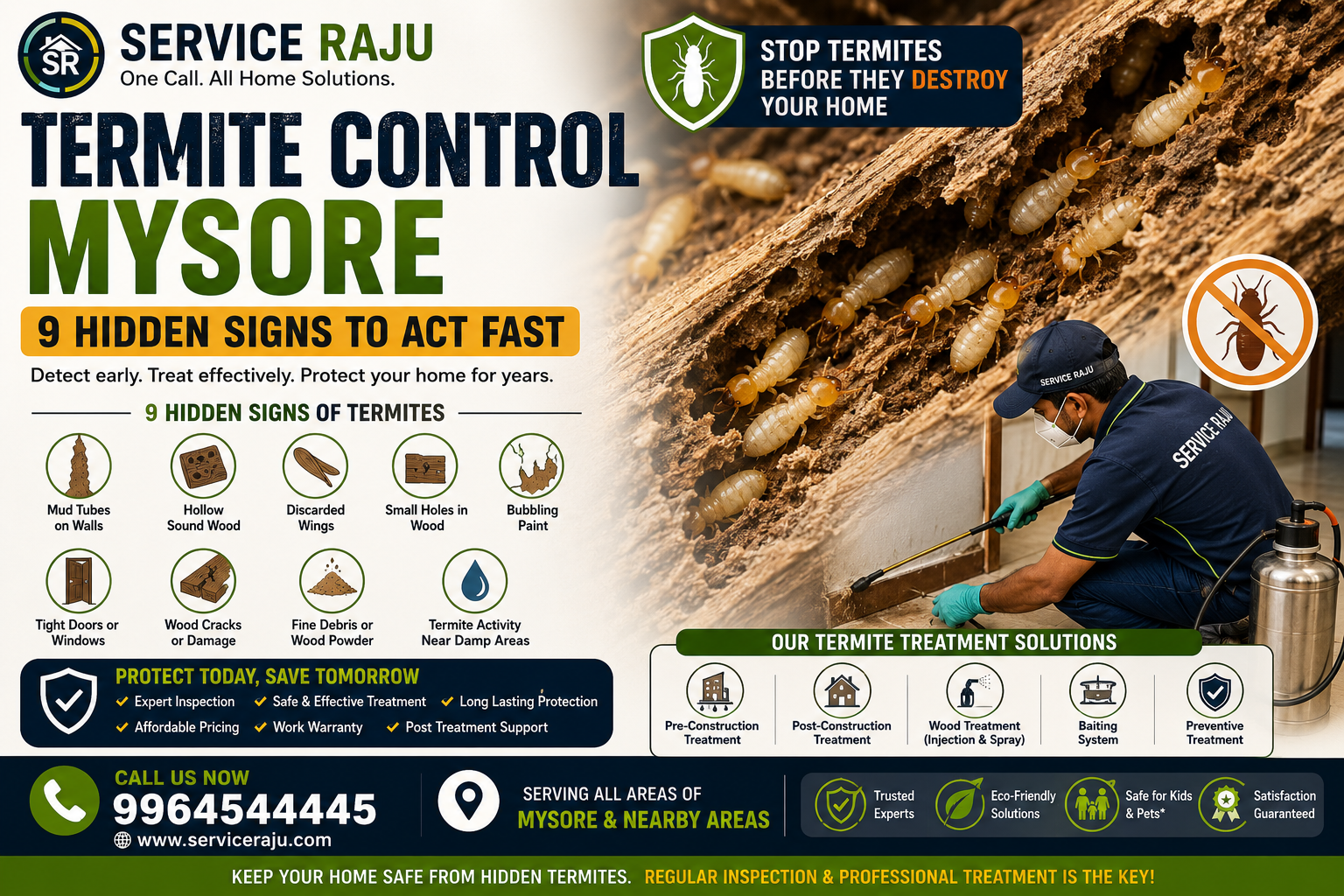
Termite Control Mysore: 9 Hidden Signs to Act Fast
1. Termite Control Mysore: Why Early Detection Matters
Termite control Mysore is not only about removing termites after wooden furniture has already been damaged. The more important goal is to identify termite activity early and stop it before the infestation spreads into additional woodwork, flooring, walls or other parts of the property.
Termites can remain hidden for long periods. By the time homeowners notice damaged wood, mud tubes, discarded wings or hollow-sounding timber, the infestation may already have been active for some time.
Indian building guidance recognises the importance of anti-termite measures for both new and existing buildings. BIS has a dedicated standard covering anti-termite measures for existing buildings, while CPWD specifications address prevention and post-construction treatment for subterranean termites.
So, what should Mysore homeowners actually look for?
2. Why Termites Can Be Difficult to Notice
Termites don't always announce their presence.
They can move through:
- Soil
- Cracks
- Foundations
- Wall cavities
- Floor gaps
- Pipe openings
- Construction joints
- Wooden structures
Subterranean termites can establish colonies in or around the soil and reach buildings through concealed routes. CPWD guidance describes termites gaining access through foundations and mud shelter tubes or other protected pathways.
This means you shouldn't wait for a large piece of furniture to collapse before arranging an inspection.
3. 9 Hidden Signs You May Have Termites
4. 1. Mud Tubes Appearing on Walls
One of the most recognisable signs of subterranean termite activity is a narrow mud or soil-like tube running across:
- Walls
- Foundations
- Columns
- Skirting
- Floor edges
- Wooden structures
These tubes provide protected routes for termites.
If you discover a new mud tube, don't simply scrape it away and assume the problem is solved.
Photograph the area and arrange an inspection.
5. 2. Wooden Furniture Sounds Hollow
Tap carefully on suspicious wooden surfaces.
If part of a wooden:
- Door
- Wardrobe
- Bed
- Cabinet
- Table
- Window frame
sounds noticeably hollow compared with surrounding areas, further inspection may be worthwhile.
Termites can consume material internally while leaving parts of the outer surface apparently intact.
However, a hollow sound alone does not prove termite activity. Old, lightweight or damaged wood can also sound hollow.
6. 3. Small Holes or Damaged Wood
Look closely at:
- Door frames
- Skirting boards
- Wooden cupboards
- Window frames
- False-ceiling woodwork
- Furniture
Possible warning signs include:
- Small holes
- Crumbling wood
- Cracks
- Blistered surfaces
- Damaged edges
- Unusual powder or debris
Don't automatically assume every small hole is caused by termites. Wood borers and other insects can create different types of damage.
Correct identification matters.
7. 4. Doors or Windows Suddenly Become Difficult to Close
This sign is often ignored.
A wooden door that previously worked perfectly may suddenly:
- Rub against the frame
- Become difficult to close
- Swell
- Develop gaps
- Feel unusually weak
Moisture can cause similar problems, so this is not proof of termites.
But if swelling or deformation occurs together with other termite warning signs, inspect the surrounding woodwork.
8. 5. Discarded Wings Near Windows or Lights
After termite reproductive flights, homeowners may find small discarded wings around:
- Windows
- Doors
- Light fixtures
- Balconies
- Furniture
- Floors
A pile of wings can be a useful warning sign.
If you repeatedly find them indoors, don't simply sweep them away and forget about them.
Check the property for additional evidence.
9. 6. Bubbling or Damaged Paint on Wooden Surfaces
Paint can sometimes hide underlying wood damage.
Look for:
- Bubbling
- Blistering
- Uneven surfaces
- Cracks
- Discolouration
- Soft wood underneath
This can have many causes, including moisture.
But where paint damage occurs around wooden frames or furniture alongside other termite indicators, professional inspection is recommended.
10. 7. Fine Debris Appears Around Wood
Unusual material collecting below wooden furniture or frames can indicate insect activity.
Pay attention to:
- Fine particles
- Small pellets
- Wood debris
- Frass-like material
- Soil deposits
Different wood-destroying insects produce different evidence, so don't rely on appearance alone.
A professional should identify what is actually causing the damage.
11. 8. Termite Activity Near Damp Areas
Moisture problems don't automatically cause termites, but damp conditions can make buildings more vulnerable to pest problems.
Inspect areas around:
- Bathrooms
- Kitchens
- Leaking plumbing
- Water tanks
- Utility rooms
- Damp walls
- Garden-facing walls
If you have both moisture and termite activity, address both issues.
For example:
Water leakage → damp wood → favourable conditions → greater pest risk
Fixing the moisture source can therefore be an important part of long-term pest management.
12. 9. Repeated Damage to Wooden Structures
If you repair or replace one wooden component and later discover similar damage elsewhere, don't treat each repair as an isolated problem.
Repeated damage may indicate:
- An established infestation
- Hidden entry routes
- Soil-to-building access
- Multiple affected wood components
- Moisture-related conditions
This is when a complete property inspection becomes more useful than treating one piece of furniture.
13. Where Do Termites Hide in a House?
Termite inspections should not focus only on furniture.
Check:
14. Wooden Doors
Inspect frames, bottom edges and areas close to the floor.
15. Wardrobes
Look behind, underneath and around wall junctions.
16. Kitchen Cabinets
Check wooden or board components close to plumbing and damp walls.
17. Window Frames
Pay attention to older timber and areas exposed to moisture.
18. Skirting
Inspect the junction between floor, wall and woodwork.
19. Flooring
Wooden flooring and floor-wall junctions can require inspection where termite activity is suspected.
20. False Ceilings
Wooden supports or concealed areas may require access for inspection.
21. Store Rooms
Dark, undisturbed spaces can easily go unchecked.
22. Garden-Facing Walls
External conditions can provide potential termite entry routes.
23. Plumbing Penetrations
Gaps around pipes can create concealed pathways.
24. Termite Inspection Mysore: What Should Be Checked?
A proper termite inspection Mysore should look beyond the one place where damage is visible.
A technician may assess:
- Visible termite activity
- Wooden structures
- Floor-wall junctions
- Skirting
- Door frames
- Window frames
- Moisture-prone areas
- Foundation-access areas
- Soil contact
- Cracks and openings
- Previous treatment areas
The purpose is to understand where the termites are active and how they may be accessing the structure.
25. Termite Treatment Mysore: What Are the Main Options?
The correct treatment depends on whether the property is under construction, already occupied, or already affected by termites.
26. Post-Construction Treatment
Existing buildings may require targeted treatment around areas where termites can enter or move through the structure.
BIS's IS 6313 Part 3 specifically addresses eradication and control of subterranean termites in existing buildings.
Depending on the property, treatment may involve appropriate soil, foundation, floor, wall or woodwork treatment.
27. Pre-Construction Anti-Termite Treatment
For a building still under construction, termite prevention can be incorporated into the construction process.
The goal is to create appropriate protective measures between termite sources and the building structure.
CPWD specifications describe anti-termite construction measures involving treatment of soil and building interfaces.
This is one reason termite planning is much easier before floors, walls and finishes are completed.
28. Anti Termite Treatment Mysore: Why Method Matters
There is no universal termite treatment that should be used for every property.
A professional should consider:
- Type of termite
- Infestation severity
- Property construction
- Ground-floor access
- Woodwork
- Moisture conditions
- Previous treatment
- Treatment history
- Occupancy
- Appropriate product and application method
A current 2026 market guide also notes that termite treatment pricing and methods vary significantly according to property size, treatment type and whether the work is preventive or corrective.
29. Why Cheap Termite Treatment Can Become Expensive
Suppose someone notices termites in one wardrobe.
They spray that wardrobe.
The visible activity disappears.
Six months later, termites appear in:
- Door frames
- Another wardrobe
- Kitchen cabinets
- Skirting
The homeowner has now paid for multiple individual repairs without necessarily addressing the underlying route or infestation.
The better approach is:
Inspect → Identify → Treat → Monitor → Prevent
Not:
See termite → Spray one spot → Forget about it
30. Does Termite Spray Kill the Entire Colony?
Don't assume it does.
The effectiveness of a treatment depends on:
- Pest species
- Product
- Application
- Location
- Infestation
- Treatment method
- Access to affected areas
A surface spray may affect exposed insects without addressing concealed activity.
For structural termite problems, the treatment strategy should be selected according to the infestation and building.
31. Termite Control vs Wood Protection
These are not exactly the same thing.
32. Termite Control
Focuses on controlling an existing termite problem and reducing routes of infestation.
33. Wood Protection
Focuses on protecting susceptible wooden components from future damage.
A home with active termites may require both structural treatment and attention to damaged woodwork.
Replacing damaged furniture without dealing with the infestation can allow new items to become affected.
34. How Much Does Termite Control Cost in Mysore?
There is no single price for every house.
Current Mysuru market pricing varies substantially depending on property type and treatment scope.
For example, one current Mysuru benchmark lists:
- Apartment termite treatment from ₹3,949
- Bungalow termite treatment from ₹7,949
Another current Mysuru provider lists termite control from around ₹3,000.
The final cost can depend on:
- Apartment or independent house
- Property size
- Number of affected areas
- Treatment method
- Level of infestation
- Accessibility
- Number of treatment points
- Follow-up requirements
- Warranty/service terms
Don't compare termite treatment only by the lowest price.
Ask what treatment method is included and whether the quotation covers inspection, treatment, sealing/finishing and follow-up.
35. 7 Questions to Ask Before Booking Termite Treatment
Before selecting a termite control service, ask:
36. 1. Will you inspect the entire affected area?
37. 2. What type of termite activity did you identify?
38. 3. What treatment method will you use?
39. 4. Which areas will actually be treated?
40. 5. Is follow-up included?
41. 6. What warranty terms are provided in writing?
42. 7. What safety and re-entry instructions should occupants follow?
A professional quotation should be clear about the scope rather than simply saying “termite spray.”
43. How to Prevent Termites in Your Mysore Home
44. Control Moisture
Repair:
- Plumbing leaks
- Bathroom seepage
- Roof leakage
- Water accumulation
45. Keep Wood Away From Soil Where Practical
Avoid unnecessary direct contact between untreated wood and soil.
46. Seal Unnecessary Gaps
Pay attention to openings around:
- Pipes
- Cables
- Doors
- Windows
- Walls
47. Keep Storage Areas Clean
Avoid unnecessary piles of:
- Cardboard
- Wood
- Paper
- Construction debris
48. Inspect Wooden Furniture
Check furniture periodically, especially older pieces.
49. Don't Ignore Mud Tubes
If you see one, investigate it.
50. Schedule Periodic Inspections
Early detection is generally easier than dealing with extensive damage.
51. Termite Control for Apartments
Apartment owners should inspect:
- Main doors
- Wooden frames
- Kitchen cabinets
- Bathroom-adjacent woodwork
- Skirting
- Utility areas
- Balcony doors
- Storage rooms
If termite activity seems connected to common building areas, the apartment association or building management may also need to investigate the wider source.
Treating only one visible location may not solve a building-wide problem.
52. Termite Control for Independent Houses and Villas
Independent houses often have more ground contact and exterior areas to inspect.
Pay attention to:
- Compound-side walls
- Garden areas
- Ground-floor woodwork
- Storage rooms
- Garages
- Door frames
- Wooden structures
- Soil around the foundation
- Water drainage
CPWD guidance specifically recognises the importance of preventing subterranean termites from reaching the superstructure through protected routes from the surrounding soil.
53. When Should You Book a Termite Inspection?
Don't wait until severe damage appears.
Arrange a termite inspection Mysore when you notice:
- Mud tubes
- Discarded wings
- Damaged wood
- Hollow-sounding timber
- Repeated wood damage
- Unusual debris
- Doors becoming difficult to close
- Termite activity around damp areas
- Previous termite infestation
- Termites appearing in more than one location
An inspection is particularly useful before major woodwork or renovation projects.
54. Service Raju Termite Control Service in Mysore
Service Raju provides termite control service Mysore for residential properties, apartments, villas and independent houses.
The service can include assessment of:
- Wooden furniture
- Door frames
- Window frames
- Kitchen cabinets
- Skirting
- Floor edges
- Damp areas
- Suspected termite entry points
- Existing termite damage
Depending on the property and infestation, the appropriate termite treatment can then be recommended.
Service Raju also provides other pest-control services including:
- Cockroach Control
- Ant Control
- Mosquito Control
- Bed Bug Control
- Rodent Control
- General Pest Control
The goal is to recommend the treatment that matches the actual pest problem rather than applying the same method to every property.
55. Why Choose Professional Termite Control?
Professional termite management can help you:
✔ Identify hidden activity
✔ Determine likely entry routes
✔ Distinguish termite damage from other wood damage
✔ Select an appropriate treatment method
✔ Treat affected areas systematically
✔ Identify conditions that may encourage recurrence
✔ Avoid unnecessary DIY chemical application
For structural termite problems, proper diagnosis matters as much as the treatment itself.
56. Frequently Asked Questions
57. What is the best termite treatment for a house?
There isn't one treatment that is best for every house. The correct method depends on the termite type, property construction, infestation level and whether the building is new or existing.
58. How do I know if my house has termites?
Look for mud tubes, discarded wings, damaged wood, hollow-sounding timber, unusual debris and repeated wood damage. One sign alone does not always confirm termites.
59. Can termites damage furniture?
Yes. Termites can damage wooden and other cellulosic materials. Indian standards specifically recognise termite damage to buildings and household articles as a significant concern.
60. Can termites live inside walls?
Termites can travel through concealed routes associated with building structures. An inspection is needed to determine whether activity is present inside or around a wall.
61. Does painting stop termites?
No. Painting may improve appearance but does not address an active termite infestation.
62. Should I replace termite-damaged furniture?
Not necessarily. First determine whether the furniture can be repaired and whether active termite infestation exists elsewhere.
63. Is termite treatment required every year?
Not automatically. The appropriate inspection and treatment schedule depends on the property, treatment system, infestation and applicable service/warranty terms.
64. Is termite control safe for children and pets?
Safety depends on the product, application method and label requirements. Occupants should follow the technician's specific preparation and re-entry instructions.
65. How much does termite control cost in Mysore?
Current online Mysuru benchmarks show prices varying by property type, with examples around ₹3,949 for apartments and ₹7,949 for bungalows from one provider. Other local providers advertise different starting prices.
66. Termite Inspection Checklist
Before calling a professional, check these areas:
67. Inside the Home
☐ Door frames ☐ Window frames ☐ Wardrobes ☐ Kitchen cabinets ☐ Skirting ☐ Wooden beds ☐ Storage furniture ☐ Floor edges
68. Signs
☐ Mud tubes ☐ Discarded wings ☐ Small holes ☐ Damaged wood ☐ Hollow sounds ☐ Unusual debris ☐ Bubbling surfaces ☐ Repeated damage
69. Outside
☐ Garden soil ☐ Compound walls ☐ Ground-floor perimeter ☐ Drainage ☐ Wood stored near the house ☐ Moisture areas
70. Don't Wait Until Your Furniture Is Damaged
The biggest termite mistake is waiting for obvious damage.
Termites can remain concealed while damage develops gradually.
If you notice mud tubes, discarded wings, damaged wood or repeated termite activity, get the problem assessed instead of repeatedly treating only the visible area.
The earlier the source and extent are understood, the easier it can be to plan the right response.
71. Book Termite Control in Mysore
If you suspect termites in your home, contact Service Raju for termite inspection and treatment assistance.
Service Raju
???? 9964544445
???? www.serviceraju.com
???? Serving All Areas of Mysore / Mysuru
Termite Control | Pest Inspection | Termite Treatment | Preventive Solutions
Service Raju — One Call. All Home Solutions.
 AC Repair
.webp) Ant Control Service
Ant Control Service
 Basin & Sink Services
.webp) Bath & Shower Services
Bath & Shower Services
.webp) Bath Fittings & Mirrors
Bath Fittings & Mirrors
 Bathroom Cleaning Service
 Bathroom Renovation Services
 Bed Bug Control Services
 Bedroom Painting
 Book a Carpenter Consultation
 Book Electrical Consulting
.webp) Cabinet Painting & Wood Refinishing
Cabinet Painting & Wood Refinishing
 Chimney Cleaning
 Civil Masonry Work
 Clean-Up Services
.webp) Clothes Hanger Installation
Clothes Hanger Installation
 Cockroach Control Services
---mysore-mysore-standard-300x200.webp) Commercial Cleaning
Commercial Cleaning
 Commercial Pest Control AMC Service
 Cupboard & Drawer Services
 Decorative Wall Panels
 Deep Sanitisation Service
 Detan & Bleach
 Door, Grill & Cabinet Painting Service
.webp) Doorbell & security
Doorbell & security
 Drain Blockage Clearing
 Electrical Appliance Services
 Electrical Wiring Services
 Empty Home Deep Cleaning
.webp) Fabrication
Fabrication
 Facials
.webp) Fan Installation & Repair
Fan Installation & Repair
 Full Home Cleaning Service
 Full Home Renovation
 Furniture Repair Service
 Gas Stove & Hob Repair
.webp) General Pest Control Services
General Pest Control Services
 General Plumbing & Consultation
 Geyser Repair
 Glass Cleaning
 Head Massage
.webp) Honeybee & Wasp-Services
Honeybee & Wasp-Services
 Kitchen & Bathroom Painting Service
 Kitchen Cleaning
 Kitchen Fittings
.webp) Kitchen Renovation
Kitchen Renovation
.webp) Laptop/Desktop service
Laptop/Desktop service
 Leak Detection and Repair
 LED TV Repair
 Living and Dining Room Painting
 Makeup, Saree & Styling
 Manicure & Pedicure
 MCB,Meter & Fuse Services
 Microwave Repair
 Mosquito Pest Control Service
 Multi-Room Painting Service
 Painting Consultation
 Quick Mini Cleaning Services
 Refrigerator Repair
 RO Water Purifier
.webp) Rodent Control Services (Rat & Mice Treatment)
Rodent Control Services (Rat & Mice Treatment)
.webp) Rooms Cleaning
Rooms Cleaning
 Shelves & Decor
 Sofa, Carpet & Mattress Cleaning
 Solar Water Heater Service
 Sump & Tank Cleaning
 Switch & Socket Services
 Tap & Mixer Service
.webp) Termite-Control-Services
Termite-Control-Services
 Threading & Face Wax
.webp) Tile & Granite Installation & Polishing
Tile & Granite Installation & Polishing
 Toilet & Commode Services
.webp) UPS and Inverter Repair Services
UPS and Inverter Repair Services
.webp) Wall Painting Service
Wall Painting Service
 Washing Machine Repair
 Water Level Controllers
 Water Tank and Pump Repair
 Waterproofing
 Waterproofing Services
 Waxing
 Window & Curtain Services
 Wooden Door Services