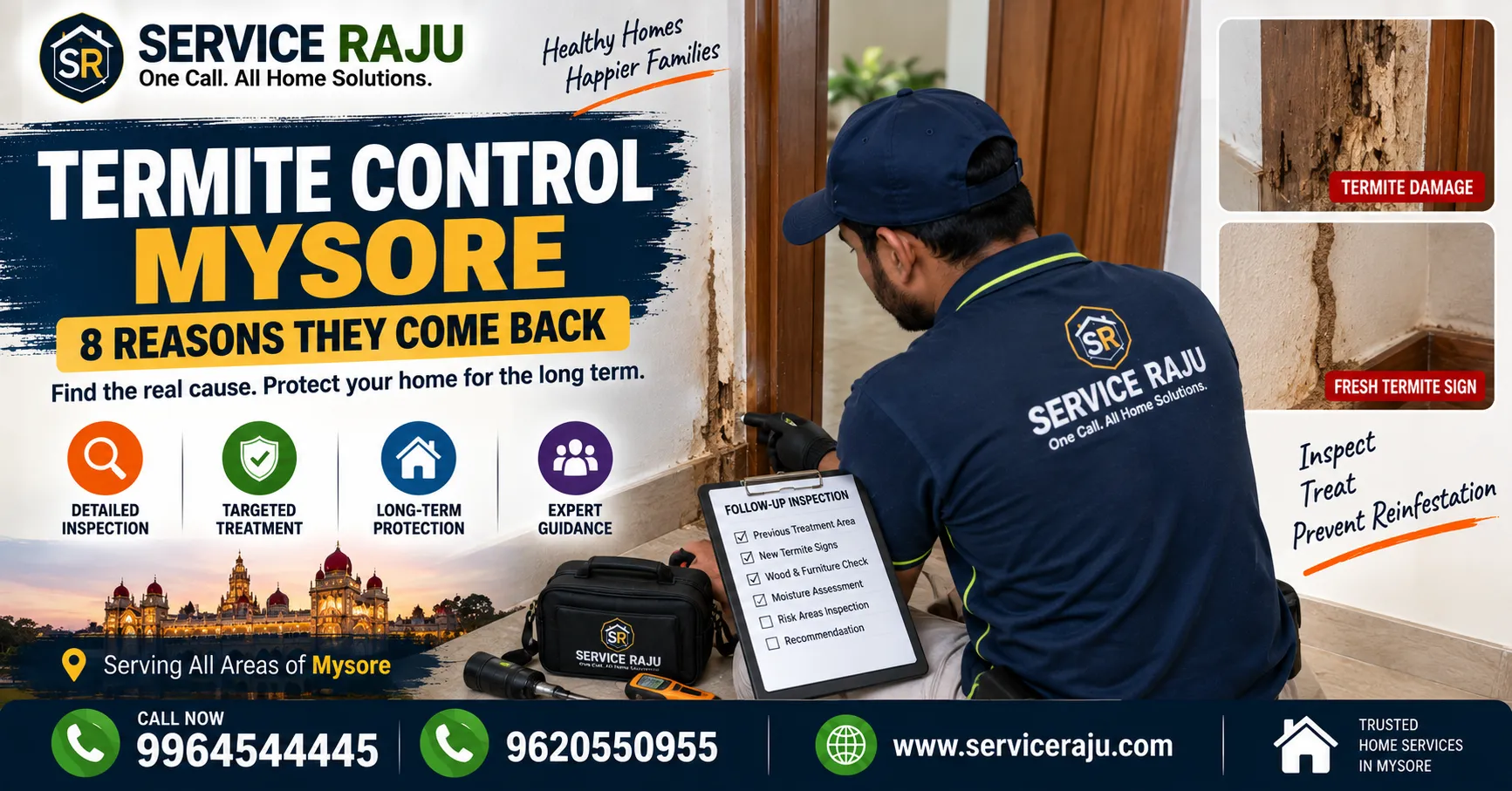
Termite Control Mysore: 8 Reasons They Come Back
1. Termite Control Mysore: 8 Reasons They Come Back
You paid for termite treatment.
The visible termites disappeared.
The house looked normal again.
Then a few weeks or months later, you notice:
- A fresh mud tube
- New wood damage
- Small wings near a window
- New activity around a door frame
- Termites appearing in a different room
And the first question is usually:
“Why are termites coming back after treatment?”
With termite control Mysore homeowners should understand that recurring activity does not automatically mean the original treatment was useless. It can have several possible explanations: an area was outside the original treatment scope, a new access route developed, moisture conditions changed, a building renovation disturbed the treated area, or the property needs a different treatment strategy.
BIS currently lists IS 6313 (Part 3):2022 as the standard covering anti-termite treatment for existing buildings.
So the right response is not automatically:
“Spray again.”
It is:
“Find out why the activity returned.”
2. Quick Answer: Why Do Termites Come Back After Treatment?
- The original treatment did not cover every affected area.
- Termites are entering through a different route.
- Renovation disturbed a treated barrier.
- New woodwork was installed after treatment.
- Persistent moisture is creating a vulnerable environment.
- The visible termites are in a new area rather than the original one.
- The treatment method may not match the problem.
- Follow-up inspection was skipped.
Not every new sighting means the same thing.
A proper inspection should determine whether it is residual activity, recurrence, a new entry route, or a different problem entirely.
3. TABLE OF CONTENTS
- Why Termites Can Reappear After Treatment
- 8 Reasons Termites Come Back in Mysore
- Does Seeing One Termite Mean Treatment Failed?
- What You Should Do When Termites Reappear
- Why You Should Photograph New Termite Activity
- Termite Treatment vs Follow-Up Inspection
- When Re-Treatment May Be Needed
- Termite Treatment Cost After a Previous Treatment
- How to Choose a Termite Control Service Mysore
- Service Raju Termite Control in Mysuru
- Repeat-Termite Activity Checklist
- FAQs About Termite Control Mysore
- Final Takeaway
4. Why Termites Can Reappear After Treatment
Termite treatment is not simply about killing insects that are visible on a wall or piece of wood.
The important questions are:
Where are termites entering?
What part of the property is affected?
Is the same route still active?
Has anything changed since the previous treatment?
For existing buildings, termite-control guidance focuses on inspection and treatment of the building and termite entry routes rather than simply spraying visible insects.
That matters because the place where you see termites is not always the place where they entered the structure.
5. 8 Reasons Termites Come Back in Mysore
6. 1. The Original Treatment Did Not Cover Every Risk Area
A treatment may have covered the visibly affected rooms but not every relevant route or accessible area.
For example, termite activity might later appear around:
- A different door frame
- Another room
- A floor-wall junction
- A concealed utility penetration
- Another section of the perimeter
- Woodwork that was not treated previously
Ask:
What areas were actually treated the first time?
Keep the original invoice, service report, photos and warranty documents.
7. 2. Termites Found a Different Entry Route
Subterranean termites can move through concealed routes associated with buildings.
Possible areas include:
- Wall-floor junctions
- Pipe penetrations
- Utility shafts
- Gaps near foundations
- Wooden frames
- Areas adjoining damp zones
This is why a follow-up inspection should look at the new pattern, not blindly repeat the old treatment.
8. 3. Renovation Disturbed the Treated Area
Renovation can involve:
- New flooring
- Bathroom renovation
- Kitchen renovation
- Wall drilling
- Plumbing modifications
- New door frames
- New wardrobes
- Floor replacement
If activity appears after renovation, tell the technician exactly what was changed.
9. 4. New Woodwork Was Installed After Treatment
A previous termite treatment does not automatically mean every future piece of furniture is protected.
New installations can include modular kitchen cabinets, wardrobes, door frames, wooden partitions, built-in storage, flooring and shelving.
If the property already had a termite history, newly installed woodwork deserves inspection.
10. 5. Moisture Problems Were Left Unresolved
Moisture and termites are not the same problem, but they can become connected maintenance issues.
For example:
Leaking pipe → damp cabinet → damaged wood → hidden area → termite activity becomes harder to notice
Another example:
Terrace seepage → damp wall → damaged wooden fixture → concealed termite risk
A damp wall does not prove termites are present.
Likewise, termite activity does not prove a wall is leaking.
Treat them as separate questions that may need to be investigated together.
11. 6. The New Activity Is in a Different Part of the Property
Suppose termites were treated near one bedroom door and six months later you see activity around a kitchen cabinet.
Don't assume immediately that:
“The treatment failed.”
The new activity could be a different colony, a different access point, a previously untreated area, a new structural route or a moisture-related vulnerability.
12. 7. The Treatment Method May Not Match the Problem
Not every termite problem is identical.
A property may require different approaches depending on:
- Building construction
- Termite activity
- Access to soil
- Wood damage
- Entry route
- Location of activity
- Previous treatment history
The method should be selected after inspection.
A surface treatment aimed only at visible insects may not address an underlying structural entry route.
13. 8. Follow-Up Inspection Was Skipped
After treatment, homeowners may simply assume:
“Problem solved.”
But follow-up can be useful when:
- The infestation was extensive
- Activity was found in multiple locations
- The property has ongoing moisture problems
- Renovation has taken place
- New activity appears
- The original treatment included a follow-up schedule
A follow-up does not necessarily mean more chemicals.
It means checking the result and deciding what the evidence says.
14. Does Seeing One Termite Mean Treatment Failed?
Not necessarily.
One visible termite does not tell you:
- How large the infestation is
- Where the colony is
- Whether it is new activity
- Whether the original treated area is involved
- Whether another route has opened
However, you should not ignore it either.
A sensible response is:
Photograph → Record location → Check nearby areas → Contact the service provider → Request inspection
15. What You Should Do When Termites Reappear
16. Step 1: Photograph the evidence
Take clear photographs of termites, mud tubes, damaged wood, wings, fine debris and the surrounding area.
17. Step 2: Record the location
Write down room, wall, approximate position and date.
Example:
Kitchen → sink-side cabinet → lower rear corner → September 19
18. Step 3: Check the treatment record
- Invoice
- Treatment date
- Warranty
- Areas treated
- Service report
- Photos
- Follow-up details
19. Step 4: Do not spray random household chemicals
A quick spray may kill visible insects without answering why they are appearing.
20. Step 5: Request a follow-up inspection
Ask the technician to compare the new activity with the previous treatment.
21. Why You Should Photograph New Termite Activity
Photographs are useful because termite evidence can disappear quickly.
A mud tube might be removed during cleaning. A damaged piece of wood might be replaced. A swarm of winged termites might disappear.
A clear photograph creates a record.
For larger properties, keep a simple termite-maintenance file containing:
- Treatment date
- Areas treated
- Service report
- Warranty
- Photos
- Follow-up dates
- Renovation dates
- Repairs near previous termite areas
22. Termite Treatment vs Follow-Up Inspection
| Situation | First Step |
|---|---|
| One suspicious insect | Inspect surrounding area |
| New mud tube | Follow-up inspection |
| New wood damage | Inspect and assess |
| Activity in a new room | Map new activity |
| Same activity repeatedly returns | Reassess treatment scope |
| Activity after renovation | Inspect modified areas |
| Damp wood plus termite signs | Check moisture and termites separately |
| Severe recurring activity | Professional reassessment |
The point is simple:
Don't buy another treatment before understanding what changed.
23. When Re-Treatment May Be Needed
Re-treatment may be appropriate when inspection finds:
- Confirmed active termite activity
- A missed or untreated route
- A newly vulnerable area
- Treatment damage or disruption
- Reinfestation within the relevant service or warranty conditions
- An unsuitable original treatment scope
The exact action should be based on the property and evidence.
A responsible provider should explain:
What was found → Why it matters → What needs treatment → Which areas are included → What the follow-up terms are
24. Termite Treatment Cost After a Previous Treatment
A second visit does not automatically mean a full second treatment.
Cost may depend on:
- Whether inspection is required
- Number of active areas
- Previous treatment scope
- Warranty status
- Property size
- Access
- New construction or renovation
- Required treatment method
Before paying again, ask whether the visit is an inspection, follow-up, warranty re-treatment or new treatment.
Those are not necessarily the same service.
25. How to Choose a Termite Control Service Mysore
When your property has already been treated once, ask for more than a fresh price.
- Can you inspect the previous treatment area?
- Will you compare the new activity with the old service record?
- Which areas will you inspect?
- Will you check moisture-related conditions?
- What exactly is included in the follow-up?
- What does the warranty cover?
- Will any re-treatment terms be provided in writing?
A good quotation should identify the scope rather than simply saying:
“Termite spray – ₹____.”
26. Service Raju Termite Control in Mysuru
Service Raju provides termite control service Mysore for residential properties including apartments and independent houses.
For a property where termite activity appears again after an earlier treatment, the useful approach is:
Review previous treatment → Inspect new activity → Identify likely route → Assess moisture and vulnerable woodwork → Recommend appropriate treatment or follow-up
Service Raju's termite service framework includes assessment of wooden areas, door and window frames, kitchen cabinets, wardrobes, skirting, floor edges, suspected entry points and damp or vulnerable areas.
For professional termite inspection and treatment in Mysuru:
Service Raju
9964544445 | 9620550955
www.serviceraju.com
Relevant Service Raju services include Independent House Termite Control and Apartment Termite Control.
27. Repeat-Termite Activity Checklist
28. When You See New Activity
- ☐ Take photographs
- ☐ Record the location
- ☐ Record the date
- ☐ Check nearby woodwork
- ☐ Check nearby damp areas
- ☐ Find your previous service report
- ☐ Check warranty terms
- ☐ Contact the previous provider
- ☐ Request a follow-up inspection
- ☐ Do not spray random household chemicals
- ☐ Do not destroy all visible evidence before inspection
29. If You Renovated After Treatment
- ☐ Record what was changed
- ☐ Note new flooring
- ☐ Note new kitchen or wardrobe work
- ☐ Note plumbing modifications
- ☐ Note wall drilling
- ☐ Check previously treated areas
- ☐ Ask whether the renovation affected treatment access
30. FAQs About Termite Control Mysore
31. Why are termites coming back after treatment?
Possible reasons include a different entry route, untreated areas, changes caused by renovation, new woodwork, moisture-related vulnerability, new activity elsewhere in the property or a treatment scope that did not match the problem.
32. Does seeing one termite mean my previous treatment failed?
No. One sighting is not enough to determine whether the original treatment failed. It should trigger inspection of the surrounding area.
33. How soon should I call a pest-control professional if termites reappear?
As soon as practical, especially if you see mud tubes, repeated activity, new wood damage or activity in multiple areas.
34. Can termites return after a professional treatment?
Yes. A property can experience new or recurring activity. The appropriate response depends on the original treatment, coverage, building changes and current evidence.
35. Does moisture cause termites?
Moisture does not automatically cause an infestation, but persistent damp conditions can create building and wood conditions that deserve attention when termite risk is being assessed.
36. Can renovation cause termite problems to reappear?
Renovation can disturb building areas, modify access routes or create new vulnerable locations. If termites appear after renovation, tell the technician exactly what was changed.
37. Should I replace the damaged wood before termite treatment?
Not automatically. The active termite problem should be assessed first, because replacing damaged wood alone does not address an active infestation.
38. Do I need another full termite treatment if termites appear in one new room?
Not necessarily. The first step should be reassessment. The required scope depends on where the new activity is coming from and whether the original treatment remains relevant.
39. Is termite treatment the same as wood repair?
No. Termite treatment addresses termite activity; wood repair or replacement addresses damage that has already occurred.
40. What should I keep after termite treatment?
Keep the invoice, service report, warranty, areas treated, treatment date and any photographs. These records can help with future follow-up.
41. How much does termite treatment cost in Mysore?
The cost depends on property type, treatment scope, infestation level, access and whether the visit is an inspection, follow-up or new treatment. Current Mysuru marketplace prices vary by apartment and bungalow scope.
42. Can painting hide termite activity?
Painting can cover visual evidence, but it does not control termites. If termite activity is suspected, inspect before covering or repairing the affected area.
43. Does Service Raju provide termite inspection and treatment in Mysuru?
Yes. Service Raju provides termite-control services for residential properties, including independent houses and apartments, subject to inspection and service availability.
44. Final Takeaway
When termites appear again after treatment, don't immediately assume:
“The whole treatment failed.”
And don't automatically spend money on exactly the same treatment again.
Instead:
Document the evidence → Review the old treatment → Inspect the new activity → Find the likely route → Check changes and moisture → Decide on follow-up or re-treatment
Termite control works best when the treatment is connected to the actual property condition, not just the visible insect.
For professional termite control Mysore, termite inspection and follow-up treatment:
Service Raju
9964544445 | 9620550955
www.serviceraju.com
Mysuru / Mysore
 AC Repair
.webp) Ant Control Service
Ant Control Service
 Basin & Sink Services
.webp) Bath & Shower Services
Bath & Shower Services
.webp) Bath Fittings & Mirrors
Bath Fittings & Mirrors
 Bathroom Cleaning Service
 Bathroom Renovation Services
 Bed Bug Control Services
 Bedroom Painting
 Book a Carpenter Consultation
 Book Electrical Consulting
.webp) Cabinet Painting & Wood Refinishing
Cabinet Painting & Wood Refinishing
 Chimney Cleaning
 Civil Masonry Work
 Clean-Up Services
.webp) Clothes Hanger Installation
Clothes Hanger Installation
 Cockroach Control Services
---mysore-mysore-standard-300x200.webp) Commercial Cleaning
Commercial Cleaning
 Commercial Pest Control AMC Service
 Cupboard & Drawer Services
 Decorative Wall Panels
 Deep Sanitisation Service
 Detan & Bleach
 Door, Grill & Cabinet Painting Service
.webp) Doorbell & security
Doorbell & security
 Drain Blockage Clearing
 Electrical Appliance Services
 Electrical Wiring Services
 Empty Home Deep Cleaning
.webp) Fabrication
Fabrication
 Facials
.webp) Fan Installation & Repair
Fan Installation & Repair
 Full Home Cleaning Service
 Full Home Renovation
 Furniture Repair Service
 Gas Stove & Hob Repair
.webp) General Pest Control Services
General Pest Control Services
 General Plumbing & Consultation
 Geyser Repair
 Glass Cleaning
 Head Massage
.webp) Honeybee & Wasp-Services
Honeybee & Wasp-Services
 Kitchen & Bathroom Painting Service
 Kitchen Cleaning
 Kitchen Fittings
.webp) Kitchen Renovation
Kitchen Renovation
.webp) Laptop/Desktop service
Laptop/Desktop service
 Leak Detection and Repair
 LED TV Repair
 Living and Dining Room Painting
 Makeup, Saree & Styling
 Manicure & Pedicure
 MCB,Meter & Fuse Services
 Microwave Repair
 Mosquito Pest Control Service
 Multi-Room Painting Service
 Painting Consultation
 Quick Mini Cleaning Services
 Refrigerator Repair
 RO Water Purifier
.webp) Rodent Control Services (Rat & Mice Treatment)
Rodent Control Services (Rat & Mice Treatment)
.webp) Rooms Cleaning
Rooms Cleaning
 Shelves & Decor
 Sofa, Carpet & Mattress Cleaning
 Solar Water Heater Service
 Sump & Tank Cleaning
 Switch & Socket Services
 Tap & Mixer Service
.webp) Termite-Control-Services
Termite-Control-Services
 Threading & Face Wax
.webp) Tile & Granite Installation & Polishing
Tile & Granite Installation & Polishing
 Toilet & Commode Services
.webp) UPS and Inverter Repair Services
UPS and Inverter Repair Services
.webp) Wall Painting Service
Wall Painting Service
 Washing Machine Repair
 Water Level Controllers
 Water Tank and Pump Repair
 Waterproofing
 Waterproofing Services
 Waxing
 Window & Curtain Services
 Wooden Door Services