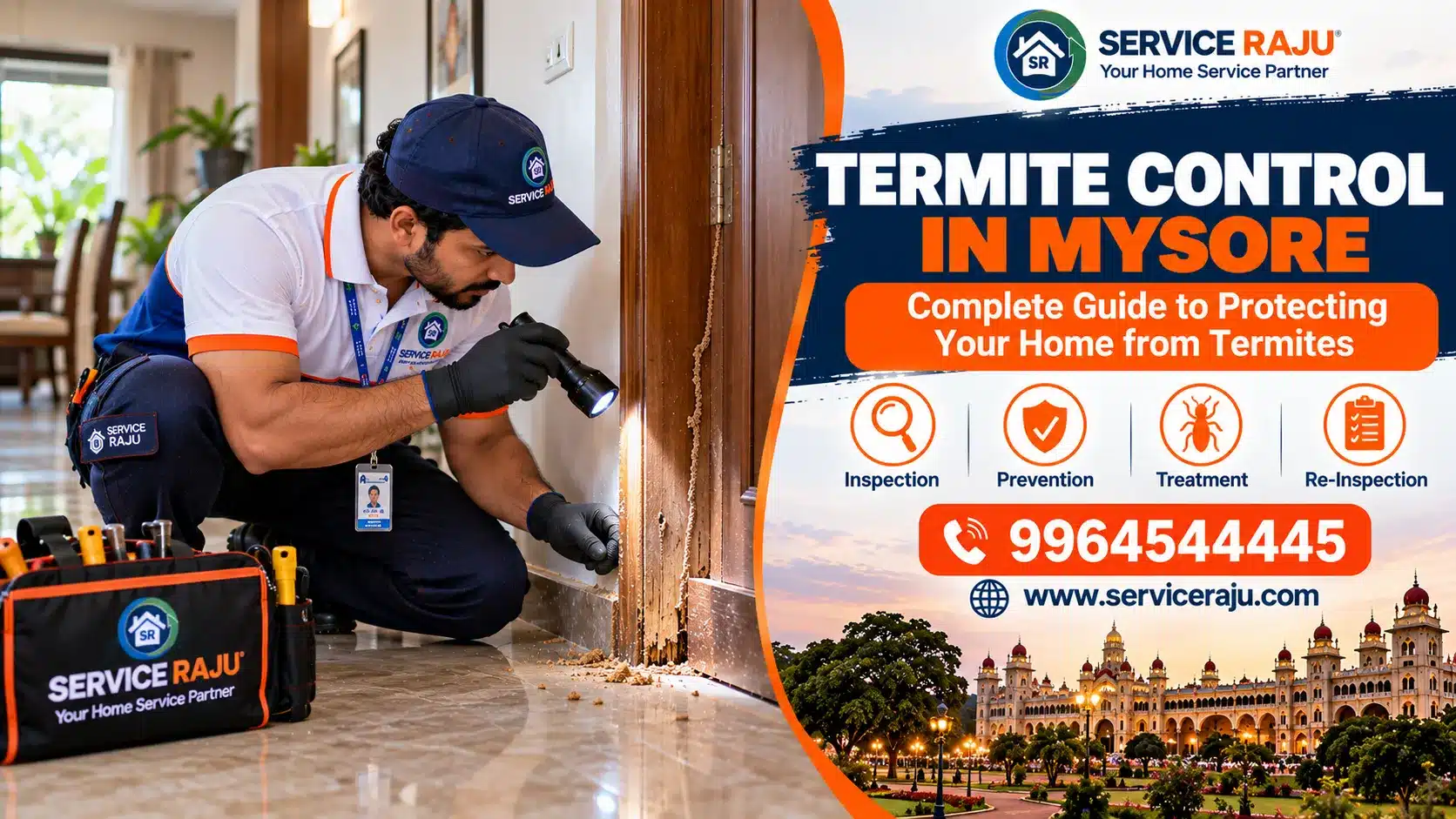
Termite Control in Mysore: Complete Guide to Protecting Your Home from Termites
Termite Control in Mysore is not simply about spraying visible termites. A reliable protection plan starts by understanding where termites are entering, which areas show evidence of activity, whether moisture is contributing to the risk, and whether the property needs prevention, treatment or a re-inspection.
Termites can remain hidden for long periods. Subterranean termites commonly use soil, shelter tubes, cracks, joints and utility openings to reach buildings, which means the place where you notice damage may not be the place where the infestation began.
This complete guide explains how to identify termite activity, protect a new home, deal with an existing infestation, choose between treatment options, compare quotations and maintain termite protection after the initial service.
Quick Answer: What Is the Best Way to Protect a Mysore Home From Termites?
A practical termite-protection process is:
- Inspect the property for current or previous termite evidence.
- Identify possible entry routes and vulnerable areas.
- Correct moisture and building conditions that increase vulnerability.
- Choose pre-construction or post-construction protection according to the property's stage.
- Use a treatment method appropriate to the structure and infestation.
- Document the treatment area, method and warranty.
- Monitor the property and arrange re-inspection when new signs appear.
The important point is that termite control is a process, not just a single spray.
Table of Contents
- What Is Termite Control?
- 12 Signs of Possible Termite Activity
- What Makes a Home More Vulnerable?
- Termite Protection for New Construction
- Termite Treatment for Existing Homes
- Which Termite Treatment Method May Be Appropriate?
- What Happens During a Professional Termite Inspection?
- 10 Ways to Reduce Termite Risk
- How to Compare Termite Treatment Quotes
- What to Check in a Termite Warranty
- What to Do After Treatment
- Termite Control Service in Mysore
- FAQs
- Final Takeaway
What Is Termite Control?
Termite control is the inspection, prevention, treatment and monitoring of termite activity around a building.
For an existing home, the objective is to identify current termite activity and reduce access to vulnerable parts of the structure using an appropriate treatment plan.
For a building under construction, the approach is different because protective treatment can be incorporated at relevant construction stages.
BIS currently lists IS 6313 (Part 2):2022 for pre-construction chemical anti-termite measures and IS 6313 (Part 3):2022 for treatment of existing buildings.
The exact method, chemical product and application procedure should be selected according to the property, applicable instructions and treatment requirements rather than using one identical package for every building.
12 Signs of Possible Termite Activity
1. Mud or Shelter Tubes
Fresh mud tubes or shelter tubes along walls, foundations, cracks or other protected routes can be an important sign of subterranean termite activity.
2. Live Termites
Finding live termites in wood, cracks or other parts of the property is a reason to arrange an inspection.
3. Winged Termites or Discarded Wings
Winged reproductive termites, often called swarmers, can appear when mature colonies produce reproductive individuals. Wings around windows or light sources can warrant further investigation.
4. New Wood Damage
Look at door frames, window frames, skirting, cabinets, wardrobes and other wooden components for fresh or worsening damage.
5. Hollow or Weakened Wood
Wood that has become unexpectedly weak or damaged should be inspected rather than diagnosed only by sound.
6. Small Mud Pinholes
Fresh mud spots or repaired mud openings can indicate activity in concealed areas.
7. Activity Near Wall-Floor Junctions
These areas can provide concealed pathways between the structure and termite entry routes.
8. Repeated Termite Signs After Previous Treatment
New activity after treatment does not automatically prove that the earlier treatment failed. It does mean that a fresh inspection is appropriate.
9. Termite Activity in a Different Room
A new location can indicate another activity area, a new route or conditions that have changed since the previous treatment.
10. Wood Near Damp Areas Is Deteriorating
Persistent moisture can make parts of a building more vulnerable, although moisture alone does not prove termite infestation.
11. Termite Evidence Around Utility Openings
Cracks, joints and utility or pipe penetrations can provide access routes in some buildings.
12. Recurrent Fine Dust or Damage Around Woodwork
Repeated unexplained changes around timber or furniture should be inspected before cosmetic repair hides the evidence.
Remember: one visual sign does not automatically prove an active infestation. Current activity should be assessed during inspection.
What Makes a Home More Vulnerable?
Termites do not attack every building in exactly the same way. Property conditions can influence where termites gain access and where they find favourable conditions.
Wood-to-Soil Contact
Wood in direct contact with soil creates an especially favourable route for subterranean termites. Purdue Extension identifies breaking the connection between soil and structural wood as a basic principle of termite prevention.
Cracks and Utility Openings
Foundation cracks, expansion joints and utility or sewer pipe openings can provide concealed routes into buildings.
Moisture Problems
Leaking roofs, pipes or other moisture sources can contribute to conditions that support termite activity. Purdue Extension notes that termite infestations can sometimes become established where a leaking roof or pipe supplies moisture even without direct soil contact.
Untreated Vulnerable Areas
Construction changes, repairs, landscaping or alterations can create conditions that were not present during an earlier inspection or treatment.
Inaccessible Voids
Concealed areas can make it more difficult to identify the complete activity route without a detailed inspection.
Termite Protection for New Construction
If you are building a new house, termite protection should be considered before the building is completed.
Pre-construction treatment is different from post-construction treatment because relevant soil and structural interfaces can be addressed during construction.
BIS lists IS 6313 Part 2:2022 as the Indian Standard for pre-construction chemical anti-termite treatment measures.
Why Plan It Early?
- Access is easier before floors and finishes are completed.
- Relevant construction stages can be treated according to the planned system.
- Potential entry points can be considered during construction.
- Documentation can be maintained from the beginning of the project.
For a new building, the exact treatment stages should be coordinated with the construction programme and applicable technical requirements.
Termite Treatment for Existing Homes
Existing buildings present a different challenge because walls, floors, cabinets and finished surfaces are already in place.
BIS separately covers treatment of existing buildings through IS 6313 (Part 3):2022.
A post-construction inspection should consider:
- Visible termite activity
- Wooden structures
- Wall-floor junctions
- Potential soil-entry routes
- Utility penetrations
- Moisture conditions
- Previous termite treatments
- Accessibility of treatment areas
The treatment plan should then be based on the property's actual condition.
Which Termite Treatment Method May Be Appropriate?
There is no single method that should automatically be applied to every property.
| Situation | Possible Approach | What Determines the Final Plan? |
|---|---|---|
| New building | Pre-construction anti-termite treatment | Construction stage and applicable treatment requirements |
| Existing house with active termites | Post-construction treatment | Entry routes, accessible areas and infestation pattern |
| Localized activity in wood | Targeted treatment | Extent and location of the affected wood |
| Repeated activity after previous treatment | Re-inspection and revised treatment plan | Current evidence and previous treatment scope |
| Apartment with possible spread | Targeted inspection and treatment | Building configuration and affected areas |
Methods can involve targeted chemical application, drilling and injection in appropriate existing-building situations, localized wood treatment or other termite-management approaches selected by a qualified professional.
The method should never be chosen simply because it is the cheapest package.
What Happens During a Professional Termite Inspection?
A professional termite inspection Mysore should investigate the property systematically.
Step 1: Customer History
The technician asks where termites were seen, when the signs appeared and whether the property was treated previously.
Step 2: Visual Inspection
The technician checks accessible wooden, structural and vulnerable areas.
Step 3: Entry-Route Investigation
The inspection looks for possible connections between soil, walls, floors, utility openings and wooden components.
Step 4: Moisture Assessment
Where relevant, the technician identifies plumbing leakage, dampness or other environmental conditions that may be contributing to risk.
Step 5: Previous-Treatment Review
If the property was treated previously, the technician compares current findings with the earlier treatment scope where records are available.
Step 6: Treatment Recommendation
The customer receives an explanation of what was found and what treatment, if any, is recommended.
Step 7: Written Scope
A clear quotation should state the areas included, proposed treatment, price, warranty and follow-up terms.
10 Ways to Reduce Termite Risk
1. Reduce Wood-to-Soil Contact
Avoid unnecessary direct contact between structural wood and soil.
2. Fix Plumbing Leaks
Correct leaking pipes, taps, bathrooms and other moisture sources rather than allowing damp conditions to remain.
3. Maintain Roof and Terrace Drainage
Prevent persistent water accumulation near the structure.
4. Keep Foundations and External Edges Accessible for Inspection
Do not permanently cover vulnerable areas with clutter or soil that makes inspection difficult.
5. Seal Appropriate Building Gaps
Repair suitable cracks and gaps around construction interfaces and utility penetrations where necessary.
6. Inspect Wooden Frames
Door frames, window frames, wardrobes and kitchen cabinets should be checked periodically.
7. Control Persistent Dampness
Moisture management supports broader building maintenance and can reduce conditions favourable to termite activity.
8. Be Careful During Renovation
Flooring, plumbing, landscaping and structural work can alter existing conditions. Re-inspection may be useful after major changes.
9. Keep Previous Treatment Records
Maintain invoices, treatment reports, warranty certificates and the date of treatment.
10. Re-Inspect When New Signs Appear
Do not wait for visible structural damage to become extensive. New termite evidence should be assessed promptly.
How to Compare Termite Treatment Quotes
When you receive two termite quotations, do not compare only the total price.
| Quote Item | What to Ask |
|---|---|
| Inspection | Was the property actually inspected? |
| Infestation | Where was current evidence found? |
| Treatment method | What method is proposed and why? |
| Coverage | Which rooms, structures or areas are included? |
| Drilling | Is drilling and sealing included where applicable? |
| Chemical/product | What product and application method will be used? |
| Warranty | What exactly is covered? |
| Follow-up | What happens if activity returns? |
| Documentation | Will you receive a service report? |
| Final price | Are exclusions and additional charges stated? |
A recent 2026 India termite-control market guide also recommends getting the treatment method, chemical information and warranty terms in writing rather than comparing only the headline price.
What to Check in a Termite Warranty
A warranty is useful only when the terms are clear.
Check:
- Warranty start date
- Warranty duration
- Covered property or treated areas
- Covered termite activity
- Re-treatment conditions
- Customer responsibilities
- Exclusions
- How to request service
Do not assume that a longer warranty automatically means better protection. The actual treatment scope and warranty conditions matter.
What to Do After Treatment
Termite protection does not end when the technician leaves.
Keep the Documentation
Store the invoice, service report, warranty and treatment details.
Monitor Known Risk Areas
Continue checking wooden frames, skirting, vulnerable wall-floor areas and locations where previous activity was detected.
Fix New Moisture Problems Quickly
Leaking plumbing, roof leakage and persistent dampness should be addressed.
Report New Activity
If new mud tubes, live termites, swarmers or fresh damage appear, contact the pest-control provider for re-inspection rather than simply removing the visible evidence.
Termite Control Service in Mysore
Service Raju provides termite-control and termite-inspection services for homes and other properties in Mysuru.
Current Service Raju termite services include:
- Termite Inspection & Diagnosis
- Independent House Termite Control
- Apartment Termite Control
- Post-Construction Termite Treatment
- Termite Activity Re-Inspection
- Targeted Termite Treatment
Service Raju's current termite articles also provide separate guidance on post-monsoon inspection, previous-treatment re-inspection, pre-construction treatment and cost, allowing this pillar article to act as the central guide while those pages cover specialist search intents.
Start With Inspection
If you are not sure whether the property has active termites, start with an inspection rather than automatically choosing a full treatment package.
Termite Inspection & Diagnosis: ₹99 visiting charge.
Treatment charges are separate and depend on the property condition and required treatment scope after inspection.
When booking, share:
- Property type
- Where termite signs were found
- Whether treatment was done before
- Approximate date of previous treatment
- Whether the property has recently been renovated
- Any current leakage or dampness
Book Termite Control in Mysore
Call / WhatsApp: 9964544445
Website: www.serviceraju.com
Service Raju — Your Home Service Partner
FAQs About Termite Control in Mysore
How do I know if my Mysore home has termites?
Look for mud or shelter tubes, live termites, swarmers or discarded wings, fresh wood damage and other recurring evidence. A professional inspection is needed to determine whether the activity is current and where it is entering.
Are termites only a problem in wooden furniture?
No. Subterranean termites can travel through concealed structural routes to reach wood and other cellulose-containing materials. Foundations, cracks and utility openings can be involved in their entry routes.
What is the difference between pre-construction and post-construction termite treatment?
Pre-construction treatment is carried out during the construction process at relevant soil and structural stages. Post-construction treatment is applied to an existing building. BIS lists separate standards for these two situations: IS 6313 Part 2:2022 and Part 3:2022.
Does every termite infestation require drilling?
No. The appropriate method depends on the building, infestation pattern, accessibility and treatment requirements. Drilling and injection may be used in suitable existing-building treatments, but it should be part of an inspected and justified treatment plan.
Can moisture attract or support termites?
Moisture can make some areas more favourable to termite activity. Purdue Extension notes that leaky roofs or pipes can sometimes provide moisture that supports termite infestations even without direct soil contact.
Should I paint or repair damaged wood before termite inspection?
It is better to inspect first. Fresh damage and termite evidence can be harder to interpret after cosmetic repairs.
Can termites return after treatment?
New activity after treatment can result from new entry routes, untreated or inaccessible areas, building changes or other conditions. The correct response is a re-inspection rather than automatically repeating the identical treatment.
How much does termite control cost in Mysore?
Current Service Raju published guides show that termite-treatment pricing varies by property size, treatment method and infestation severity, with different published ranges for spot treatment, apartments, independent houses and pre-construction work. The final quotation should be based on inspection rather than a generic online price.
How long does termite treatment last?
There is no single duration that applies to every treatment. Longevity depends on the treatment system, application quality, building condition, environmental changes and the warranty terms provided by the service company.
Does Service Raju offer termite re-inspection?
Yes. Service Raju offers termite activity re-inspection and inspection & diagnosis, with treatment quoted separately after the property's current condition is assessed.
Final Takeaway
Termite Control in Mysore should be treated as a complete property-protection process rather than a one-time spray.
Use this sequence:
Inspect → Identify → Prevent → Choose the Right Treatment → Document → Monitor → Re-Inspect When Needed.
For a new building, plan protection during construction. For an existing house, investigate current termite evidence and possible entry routes before selecting a treatment. For a previously treated property, re-inspect when new signs appear instead of automatically repeating the old treatment.
The most important rule is simple:
Do not treat only the termite you can see. Find the route, understand the building condition and choose the treatment for the actual problem.
Think your home may have termites?
Book Service Raju Termite Inspection & Diagnosis — ₹99 visiting charge.
Call / WhatsApp: 9964544445
Website: www.serviceraju.com
 AC Repair
.webp) Ant Control Service
Ant Control Service
 Basin & Sink Services
.webp) Bath & Shower Services
Bath & Shower Services
.webp) Bath Fittings & Mirrors
Bath Fittings & Mirrors
 Bathroom Cleaning Service
 Bathroom Renovation Services
 Bed Bug Control Services
 Bedroom Painting
 Book a Carpenter Consultation
 Book Electrical Consulting
.webp) Cabinet Painting & Wood Refinishing
Cabinet Painting & Wood Refinishing
 Chimney Cleaning
 Civil Masonry Work
 Clean-Up Services
.webp) Clothes Hanger Installation
Clothes Hanger Installation
 Cockroach Control Services
---mysore-mysore-standard-300x200.webp) Commercial Cleaning
Commercial Cleaning
 Commercial Pest Control AMC Service
 Cupboard & Drawer Services
 Decorative Wall Panels
 Deep Sanitisation Service
 Detan & Bleach
 Door, Grill & Cabinet Painting Service
.webp) Doorbell & security
Doorbell & security
 Drain Blockage Clearing
 Electrical Appliance Services
 Electrical Wiring Services
 Empty Home Deep Cleaning
.webp) Fabrication
Fabrication
 Facials
.webp) Fan Installation & Repair
Fan Installation & Repair
 Full Home Cleaning Service
 Full Home Renovation
 Furniture Repair Service
 Gas Stove & Hob Repair
.webp) General Pest Control Services
General Pest Control Services
 General Plumbing & Consultation
 Geyser Repair
 Glass Cleaning
 Head Massage
.webp) Honeybee & Wasp-Services
Honeybee & Wasp-Services
 Kitchen & Bathroom Painting Service
 Kitchen Cleaning
 Kitchen Fittings
.webp) Kitchen Renovation
Kitchen Renovation
.webp) Laptop/Desktop service
Laptop/Desktop service
 Leak Detection and Repair
 LED TV Repair
 Living and Dining Room Painting
 Makeup, Saree & Styling
 Manicure & Pedicure
 MCB,Meter & Fuse Services
 Microwave Repair
 Mosquito Pest Control Service
 Multi-Room Painting Service
 Painting Consultation
 Quick Mini Cleaning Services
 Refrigerator Repair
 RO Water Purifier
.webp) Rodent Control Services (Rat & Mice Treatment)
Rodent Control Services (Rat & Mice Treatment)
.webp) Rooms Cleaning
Rooms Cleaning
 Shelves & Decor
 Sofa, Carpet & Mattress Cleaning
 Solar Water Heater Service
 Sump & Tank Cleaning
 Switch & Socket Services
 Tap & Mixer Service
.webp) Termite-Control-Services
Termite-Control-Services
 Threading & Face Wax
.webp) Tile & Granite Installation & Polishing
Tile & Granite Installation & Polishing
 Toilet & Commode Services
.webp) UPS and Inverter Repair Services
UPS and Inverter Repair Services
.webp) Wall Painting Service
Wall Painting Service
 Washing Machine Repair
 Water Level Controllers
 Water Tank and Pump Repair
 Waterproofing
 Waterproofing Services
 Waxing
 Window & Curtain Services
 Wooden Door Services