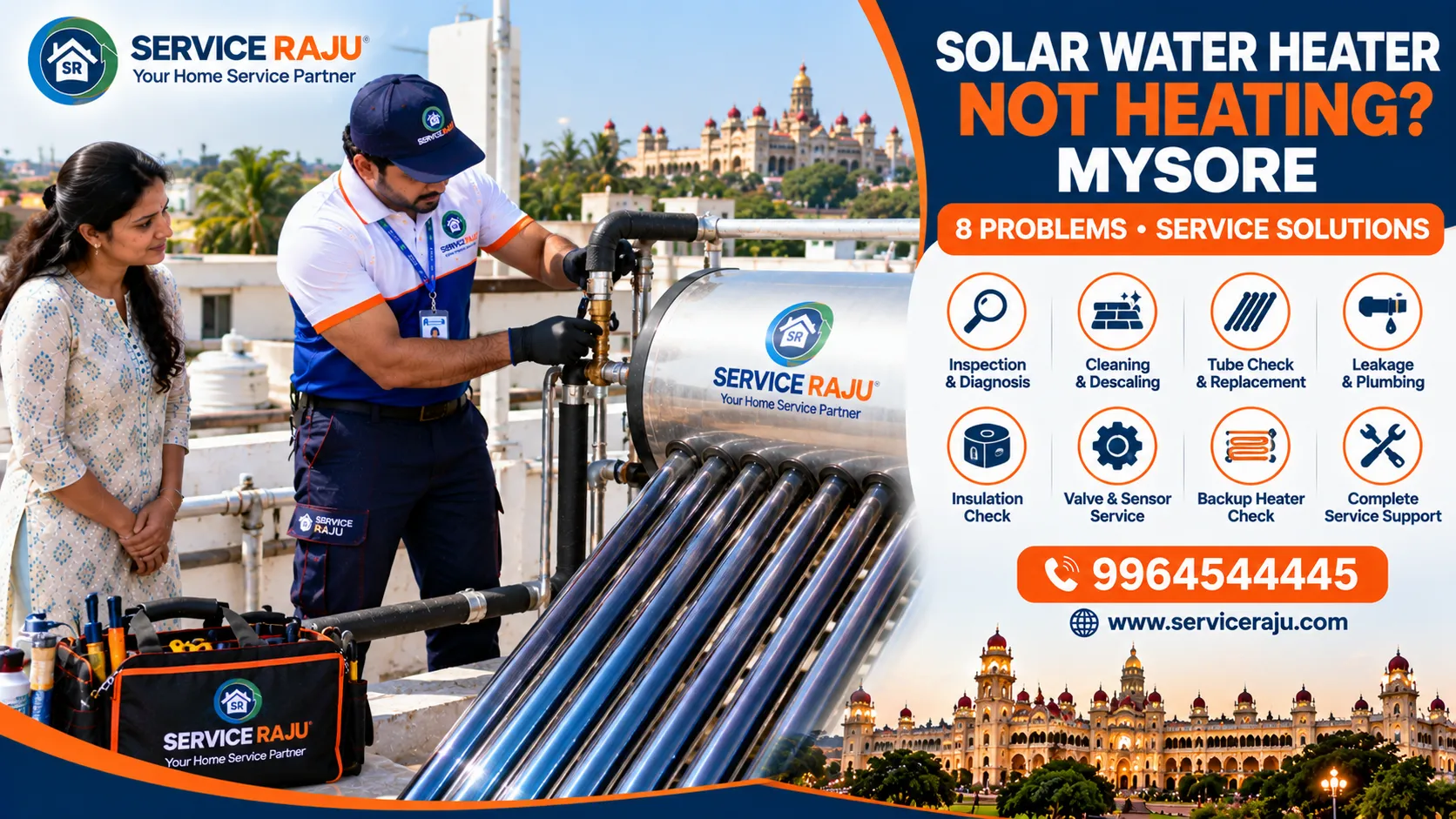
Solar Water Heater Not Heating Properly in Mysore? 8 Problems & Service Solutions
Solar Water Heater Not Heating Mysore problems can be confusing because the system may appear normal from the outside while the actual fault is inside the collector, tank, circulation line, insulation or plumbing. Sometimes the system is not faulty at all and is simply receiving less solar energy because of cloud, shade, dirt or increased hot-water demand.
MNRE describes a typical solar water-heating system as a combination of solar collectors, a storage tank and piping. That means a no-heat or low-heat complaint should be diagnosed as a complete system rather than blaming only the collector or tank.
This guide explains 8 practical problems that can reduce hot-water performance in Mysore homes and, more importantly, what service solution should be considered for each one.
Quick Answer: Why Is My Solar Water Heater Not Heating Properly?
If your solar water heater is giving cold or lukewarm water, check these major possibilities:
- Insufficient sunlight or new shading
- Dirty collector surface or blocked tubes
- Scaling restricting water circulation
- Air lock or interrupted thermosyphon flow
- Broken or damaged collector tubes/components
- Heat loss from damaged insulation or faulty non-return/mixing components
- Tank, pipe or valve leakage
- Backup-heater, plumbing, sizing or system-configuration problems
These symptoms can overlap. A professional inspection should determine which condition actually applies before expensive parts are replaced.
Table of Contents
- How a Solar Water Heater Should Work
- 8 Problems That Can Cause Poor Heating
- How to Diagnose the Problem Before Repair
- Which Service Does Your System Actually Need?
- Solar Water Heater Maintenance Checklist
- What You Can Check Safely Yourself
- When You Should Call a Technician
- Solar Water Heater Service in Mysore
- FAQs
- Final Takeaway
How a Solar Water Heater Should Work
A conventional rooftop solar water-heating system uses solar collectors to capture heat and transfer it to water, which is then stored in the tank. Depending on the system design, water circulation may occur naturally through thermosyphon action or through a pump and control system.
This means poor hot-water output can originate in several places:
- Solar collector
- Evacuated tubes or flat-plate collector surface
- Storage tank
- Hot and cold water piping
- Valves
- Insulation
- Circulation path
- Backup heating system where fitted
MNRE lists solar collectors, storage tanks and piping among the principal components of solar water-heating systems.
8 Problems That Can Cause Poor Heating
1. The Collector Is Not Receiving Enough Sunlight
A solar heater cannot produce the same amount of heat when solar radiation is significantly reduced.
Check whether the collector has developed:
- New building shade
- Tree shade
- Nearby rooftop obstruction
- Incorrect orientation or installation changes
- Seasonal reduction in available sunlight
Manufacturer troubleshooting guidance identifies poor weather, reduced sunshine and insufficient solar radiation as possible causes of low water temperature. MNRE's solar-water-heater guidance also recognises system orientation and collector performance as important design considerations.
Service solution: inspect the collector's actual sunlight exposure and installation condition before replacing components. If a new permanent obstruction is responsible, the technician may recommend corrective installation work or system relocation where practical.
2. Dust, Dirt or Debris Is Reducing Collector Performance
Collector surfaces need to receive sunlight efficiently.
Dust, leaves, bird droppings and other deposits can reduce the useful solar energy reaching the collector.
Common clues include:
- Heating has gradually become weaker
- The glass or collector surface looks visibly dirty
- The system heats better immediately after cleaning
- Water remains only lukewarm despite a sunny day
Technical troubleshooting guidance identifies dirty collectors as a possible cause of inadequate water temperature.
Service solution: clean the collector using a method appropriate to the collector design and manufacturer's instructions. Avoid harsh chemicals, abrasive materials and unsafe rooftop climbing.
3. Hard-Water Scaling Is Restricting Heat Transfer or Flow
Mineral deposits can accumulate over time in water-heating systems, particularly where the water has significant hardness.
Scaling can affect:
- Collector passages
- Hot-water outlets
- Pipes
- Valves
- Heat-transfer surfaces
Symptoms can include:
- Slow heating
- Reduced hot-water flow
- Hot water that is less hot than before
- Inconsistent output
- Repeated performance loss after a period of normal operation
Current technical references identify scaling and restricted collector flow as potential causes of poor heating, and MNRE maintenance guidance recommends checking flow in hot-water pipes in hard-water systems and cleaning affected components when scaling restricts them.
Service solution: arrange professional solar water heater descaling Mysore where inspection confirms scale buildup. The correct descaling procedure should be selected according to the system, components and manufacturer requirements.
4. Air Lock or Interrupted Circulation
Solar water heating depends on proper circulation between the collector and storage tank.
If air becomes trapped in a circulation line, or if the water path is restricted, heat may not transfer effectively to the tank.
Possible clues include:
- Normal water flow at some points but poor heating
- Sudden change in performance after plumbing work
- Uneven heating
- Gurgling or unusual flow behaviour
- Hot water that reaches the tap inconsistently
Current troubleshooting references identify air locks or vapour locks as possible causes of inadequate hot-water flow or heating.
Service solution: inspect the circulation path, valves and air-release arrangement. Do not randomly open rooftop connections or valves without understanding the system design.
5. One or More Collector Tubes or Collector Components Are Damaged
Evacuated-tube systems depend on the condition of the individual tubes and collector assembly.
A damaged, cracked or failed tube can reduce the effective collector area.
Look for:
- Visible cracked glass
- Broken vacuum tubes
- Unusual discolouration
- Physical damage
- A collector section that appears different from the others
Current Mysuru solar-service providers list broken glass tubes among common repair requirements, while MNRE maintains standards for evacuated-tube systems and collector tubes.
Service solution: damaged tubes or collector components should be inspected and replaced with suitable parts for the system rather than attempting improvised repairs.
6. Heat Is Being Lost Through Damaged Insulation or Faulty Flow Components
Your solar heater may produce hot water during the day but deliver lukewarm water later because heat is escaping from the storage or hot-water piping.
Check for:
- Wet or damaged tank insulation
- Exposed hot-water pipes
- Missing insulation
- Damaged insulation cladding
- Incorrectly functioning non-return or mixing components
MNRE maintenance guidance specifically recommends checking and repairing damaged insulation and investigating systems that cool too quickly. It also identifies storage cooling and circulation-related problems as maintenance issues.
Service solution: inspect the tank insulation, hot-water line insulation and relevant valves before assuming that the collector itself is not producing heat.
7. Tank, Pipe or Valve Leakage Is Reducing Performance
A leak can waste water, reduce available hot water and create another maintenance problem on the roof.
Inspect accessible areas for:
- Dripping pipe joints
- Tank connections
- Collector connections
- Valves
- Overflow points
- Corrosion around fittings
- Wet insulation
MNRE maintenance guidance recommends checking solar-water-heating systems for leakage and reporting tank or component deterioration. Current Mysuru service providers also list tank and pipe leakage among common solar-heater service requirements.
Service solution: identify whether the leak is from a replaceable fitting, pipe connection, valve, collector or tank before deciding whether repair or component replacement is required.
8. Backup Heating, Plumbing, Capacity or System Configuration Is the Real Problem
Sometimes the solar collector is working, but the customer's hot-water requirement is greater than what the system can reliably provide under current conditions.
Check:
- Storage capacity
- Number of users
- Daily hot-water demand
- Whether several bathrooms are used simultaneously
- Backup electric heater, where fitted
- Thermostat or control operation
- Water inlet and outlet arrangement
- System sizing
Manufacturer troubleshooting guidance identifies undersizing and high water demand as possible causes of insufficient hot-water quantity, while current Indian solar-service guidance also highlights capacity and plumbing configuration when diagnosing poor heating.
Service solution: first determine whether the system has a technical fault or whether its present capacity and configuration no longer match household demand. If a backup electrical heater is involved, electrical testing should be performed by a qualified technician.
How to Diagnose the Problem Before Repair
Before replacing tubes, tank parts or valves, use a structured inspection.
Step 1: Confirm the Weather and Sunlight
Check whether the system has recently experienced cloudy, rainy or unusually low-sunlight conditions.
Step 2: Check the Collector Surface
Look for dust, leaves, bird droppings, broken tubes or obvious obstruction.
Step 3: Check Hot-Water Flow
Low flow can point toward scaling, a valve issue, air in the line or another plumbing restriction.
Step 4: Inspect for Leakage
Look around tank, collector and pipe connections for signs of water loss.
Step 5: Check Heat Retention
If the water is hot in the afternoon but becomes cold unusually quickly, investigate insulation, circulation and relevant valves rather than assuming the collector has failed.
Step 6: Compare Performance on a Sunny Day
If the system performs poorly even after a clear sunny period, a technical fault becomes more likely and professional inspection is appropriate.
Which Service Does Your System Actually Need?
| Symptom | Potential Service |
|---|---|
| Collector visibly dirty | Solar water heater cleaning |
| Reduced flow plus scale signs | Descaling and circulation inspection |
| Broken evacuated tube | Tube inspection/replacement |
| Water dripping from connections | Leakage inspection and plumbing repair |
| Hot water cools quickly | Insulation/valve/circulation diagnosis |
| No circulation or suspected air lock | Circulation and plumbing diagnosis |
| Cold water on cloudy days | Backup-heater inspection where fitted |
| Insufficient quantity for household demand | Capacity and system-sizing assessment |
The same symptom can have several possible causes, so avoid buying a replacement part before the failed component is actually confirmed.
Solar Water Heater Maintenance Checklist
A practical maintenance inspection should include:
- Collector surface condition
- Tube condition
- Tank condition
- Visible pipe leakage
- Valve condition
- Hot-water flow
- Collector circulation
- Insulation condition
- Mounting/support condition
- Backup-heater function where fitted
MNRE's published solar-water-heater material highlights maintenance checks including hot-water flow, support condition, leakage, shading, insulation and insufficient heating on clear days.
What You Can Check Safely Yourself
Some basic checks are reasonable without opening the system.
- Look for obvious shading on the collectors.
- Check whether the collector glass is visibly dirty.
- Look for broken tubes from a safe ground-level viewpoint.
- Look for visible leaks around accessible pipe joints.
- Check whether hot water reaches the bathroom.
- Note whether the problem occurs only during cloudy weather.
- Record unusual sounds or changes in water flow.
Do not climb onto a risky roof, remove collector tubes, open pressurized connections or work on electrical backup components without suitable training and safety equipment.
When You Should Call a Technician
Professional solar water heater repair Mysore is appropriate when:
- The heater remains ineffective on clear sunny days.
- Water flow is very low.
- A tube or collector component is damaged.
- The tank or piping is leaking.
- Scaling is suspected inside the circulation path.
- The system appears to have an air lock or circulation problem.
- Hot water becomes cold unusually quickly.
- The electrical backup heater is not functioning.
- The system has been modified or relocated.
- The existing capacity no longer matches household demand.
Solar Water Heater Service in Mysore
Service Raju provides solar water-heater maintenance support for Mysore homes, including:
- Solar Water Heater Cleaning
- Solar Water Heater Descaling
- ETC Tube Cleaning
- Flat Panel Cleaning
- Solar Water Heater Inspection
- Leakage Inspection
- Plumbing and circulation checks
- Installation and shifting support
The service should be selected according to the actual problem. For example, a dirty collector needs cleaning, while restricted flow from scaling may require descaling, and a damaged tube or leaking connection may require component repair or replacement.
What to Tell the Technician
For faster diagnosis, provide:
- Solar water heater brand, if known
- Approximate capacity in LPD
- ETC tube or flat-plate type
- Age of the system
- Whether hot water is completely cold or only lukewarm
- Whether the issue happens only during cloudy weather
- Any visible leakage
- Whether water flow has reduced
- When the system was last cleaned or descaled
Book Solar Water Heater Service in Mysore
Call / WhatsApp: 9964544445
Website: www.serviceraju.com
Service Raju — Your Home Service Partner
FAQs About Solar Water Heater Service in Mysore
Why is my solar water heater not heating water even when there is sunlight?
Possible causes include dirty collectors, scaling, poor circulation, air lock, damaged tubes, shading, leaks, insulation problems or incorrect system sizing. A clear sunny day with poor heating is a good reason to arrange a technical inspection.
Why is the water hot in the afternoon but cold in the morning?
Possible causes include heat loss through damaged insulation, circulation or valve problems, or other storage-related issues. MNRE maintenance guidance specifically identifies rapid storage cooling and damaged insulation as conditions worth checking.
Can hard water reduce solar water-heater performance?
Yes. Mineral scaling can restrict flow or affect heat-transfer surfaces in some systems. Technical troubleshooting guidance identifies scaling and choked collector flow as possible causes of inadequate heating.
How often should a solar water heater be serviced?
There is no single interval that applies to every system. Maintenance frequency depends on water quality, collector type, system design, local conditions and manufacturer guidance. Systems operating with hard water may need more frequent inspection of flow and scaling.
Can I clean the solar collector myself?
Basic surface cleaning may be possible when the collector is safely accessible, but rooftop work can be hazardous. Avoid climbing on an unsafe roof and do not use abrasive materials or unapproved chemicals.
What is the difference between solar water heater cleaning and descaling?
Cleaning generally addresses external dirt and accessible deposits, while descaling targets mineral buildup that may restrict internal flow or heat transfer. The required process depends on the system and condition.
Why is hot water flow low from my solar heater?
Possible causes include scale restriction, air lock, valve problems, pinched or blocked piping, or another plumbing issue. The correct cause should be confirmed before parts are replaced.
Can a larger tank fix low hot-water availability?
Only when the existing system is genuinely undersized for household demand. First confirm that the collector, circulation, insulation and plumbing are functioning properly before deciding that capacity is the problem.
Does solar water heater repair involve electrical work?
Some systems have an electrical backup heater or controls. Any electrical diagnosis or repair should be performed by a qualified professional because water and electricity present a serious safety risk.
Final Takeaway
Solar Water Heater Not Heating Mysore does not automatically mean the entire system needs replacement.
Use this diagnostic sequence:
Check Sunlight → Check Collector → Check Flow → Check Scaling → Check Tubes → Check Leakage → Check Insulation → Check Capacity & Backup.
A solar water heater is a complete system of collectors, storage and piping, so the correct service depends on where the actual loss of performance is occurring. MNRE also publishes standards for solar-water-heating systems and maintains an approved-manufacturer framework, reinforcing the importance of appropriate system components and maintenance.
When a system is dirty, clean it. When it is scaled, descale it. When circulation is restricted, diagnose the flow problem. When a tube, valve, pipe or insulation component has failed, repair or replace the affected component. And when capacity is the real problem, assess the system size before spending money on unrelated repairs.
Solar water heater giving cold or lukewarm water in Mysore?
Book Service Raju for solar water heater cleaning, descaling, inspection and repair support.
Call / WhatsApp: 9964544445
Website: www.serviceraju.com
 AC Repair
.webp) Ant Control Service
Ant Control Service
 Basin & Sink Services
.webp) Bath & Shower Services
Bath & Shower Services
.webp) Bath Fittings & Mirrors
Bath Fittings & Mirrors
 Bathroom Cleaning Service
 Bathroom Renovation Services
 Bed Bug Control Services
 Bedroom Painting
 Book a Carpenter Consultation
 Book Electrical Consulting
.webp) Cabinet Painting & Wood Refinishing
Cabinet Painting & Wood Refinishing
 Chimney Cleaning
 Civil Masonry Work
 Clean-Up Services
.webp) Clothes Hanger Installation
Clothes Hanger Installation
 Cockroach Control Services
---mysore-mysore-standard-300x200.webp) Commercial Cleaning
Commercial Cleaning
 Commercial Pest Control AMC Service
 Cupboard & Drawer Services
 Decorative Wall Panels
 Deep Sanitisation Service
 Detan & Bleach
 Door, Grill & Cabinet Painting Service
.webp) Doorbell & security
Doorbell & security
 Drain Blockage Clearing
 Electrical Appliance Services
 Electrical Wiring Services
 Empty Home Deep Cleaning
.webp) Fabrication
Fabrication
 Facials
.webp) Fan Installation & Repair
Fan Installation & Repair
 Full Home Cleaning Service
 Full Home Renovation
 Furniture Repair Service
 Gas Stove & Hob Repair
.webp) General Pest Control Services
General Pest Control Services
 General Plumbing & Consultation
 Geyser Repair
 Glass Cleaning
 Head Massage
.webp) Honeybee & Wasp-Services
Honeybee & Wasp-Services
 Kitchen & Bathroom Painting Service
 Kitchen Cleaning
 Kitchen Fittings
.webp) Kitchen Renovation
Kitchen Renovation
.webp) Laptop/Desktop service
Laptop/Desktop service
 Leak Detection and Repair
 LED TV Repair
 Living and Dining Room Painting
 Makeup, Saree & Styling
 Manicure & Pedicure
 MCB,Meter & Fuse Services
 Microwave Repair
 Mosquito Pest Control Service
 Multi-Room Painting Service
 Painting Consultation
 Quick Mini Cleaning Services
 Refrigerator Repair
 RO Water Purifier
.webp) Rodent Control Services (Rat & Mice Treatment)
Rodent Control Services (Rat & Mice Treatment)
.webp) Rooms Cleaning
Rooms Cleaning
 Shelves & Decor
 Sofa, Carpet & Mattress Cleaning
 Solar Water Heater Service
 Sump & Tank Cleaning
 Switch & Socket Services
 Tap & Mixer Service
.webp) Termite-Control-Services
Termite-Control-Services
 Threading & Face Wax
.webp) Tile & Granite Installation & Polishing
Tile & Granite Installation & Polishing
 Toilet & Commode Services
.webp) UPS and Inverter Repair Services
UPS and Inverter Repair Services
.webp) Wall Painting Service
Wall Painting Service
 Washing Machine Repair
 Water Level Controllers
 Water Tank and Pump Repair
 Waterproofing
 Waterproofing Services
 Waxing
 Window & Curtain Services
 Wooden Door Services