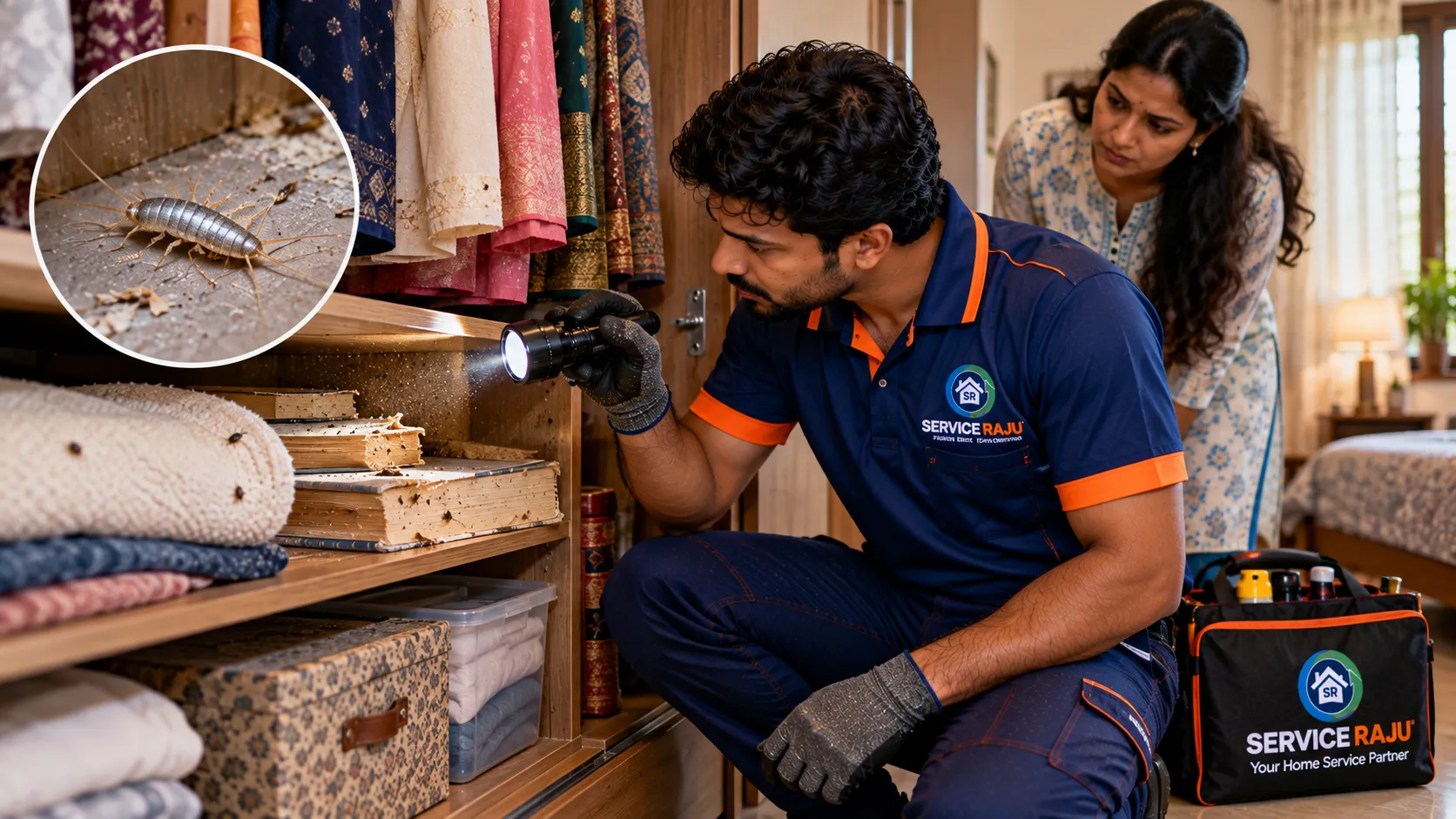
Silverfish in Wardrobes Before Dasara? Why They Attack Clothes, Books & Storage Areas
Opening a wardrobe before Dasara and finding a small, silver-coloured insect moving quickly between clothes, books or storage boxes can be an unpleasant surprise. Silverfish are attracted to dark, protected and sometimes humid areas, which makes wardrobes, cupboards, bookshelves and storage spaces potential hiding locations.
If you are repeatedly finding silverfish in your wardrobe, simply removing the insects you can see may not solve the underlying problem. Silverfish control Mysore should begin by understanding why they are appearing, where they are hiding and whether excess moisture, paper materials, clutter or other conditions are supporting their activity.
2. What Are Silverfish?
Silverfish are small, wingless insects with a silvery or grey appearance and a distinctive elongated body. They move quickly and usually avoid bright, open areas. They are commonly associated with quiet spaces such as cupboards, storage rooms, bookshelves, bathrooms and other sheltered parts of a home.
Unlike many household pests that are immediately noticed because of their size or noise, silverfish can remain hidden for long periods. This means homeowners may only discover them when moving stored clothes, opening an old cupboard or preparing a room for guests.
The presence of one silverfish does not necessarily mean there is a major infestation. However, repeated sightings, insect activity around stored materials or recurring findings in several storage areas are reasons to investigate further.
3. Why Do Silverfish Enter Wardrobes?
Wardrobes can provide several conditions that silverfish prefer: darkness, shelter, limited disturbance and access to materials containing starches or other organic components. Poor ventilation or excess humidity can make enclosed storage areas even more favourable.
4. 1. Dark and undisturbed spaces
Wardrobe corners, gaps behind shelves and spaces underneath stored items can remain undisturbed for months. These areas can provide shelter from light and regular household activity.
5. 2. Humidity and poor ventilation
A wardrobe positioned against a damp wall or located in a poorly ventilated room may develop a more humid internal environment. Moisture problems elsewhere in the room can also contribute to conditions that support silverfish activity.
6. 3. Paper and cardboard storage
Old books, newspapers, cardboard boxes, paper files and similar stored materials can provide attractive food sources or harbourage opportunities.
7. 4. Stored clothing and fabrics
Silverfish are not primarily a fabric-eating pest in the same way as clothes moth larvae. However, they can be found around stored textiles, especially when clothing is stored alongside paper, starch-containing materials, dust or other organic debris.
8. 5. Clutter inside cupboards
Overfilled wardrobes and storage cabinets create more hidden spaces. Clothes, bags, boxes and folded materials can make inspection and cleaning difficult.
9. Where Silverfish Hide in Homes
If you are looking for the source of recurring silverfish in wardrobe activity, do not inspect only the visible shelves. Look at the surrounding environment as well.
- Behind wardrobes placed close to walls
- Inside wardrobe corners and shelf joints
- Under stored clothing and bags
- Behind books and paper files
- Inside cardboard storage boxes
- Around bookshelves
- Under furniture that remains undisturbed
- Near damp walls or moisture-affected areas
- Around bathroom and utility-room storage
- Inside dark gaps and cracks
- Around stored paper materials
- In rooms with poor ventilation or persistent humidity
A useful inspection should also consider what is happening behind the storage furniture. If a wardrobe is against a damp or moisture-affected wall, treating only the insect without addressing the environmental condition may provide limited long-term results.
10. Signs of Silverfish Activity
Silverfish can be difficult to detect because they are fast and generally remain hidden. Look for a combination of direct sightings and indirect signs.
11. Repeated sightings at night
Silverfish are often more noticeable when a room is dark and quiet. Seeing them repeatedly at night can indicate activity around nearby storage or hiding areas.
12. Small marks or damage around paper materials
Check old books, paper files, newspapers, cardboard and stored documents for unusual surface damage or feeding-related marks.
13. Insects appearing when wardrobes are opened
If silverfish repeatedly emerge when clothes or storage boxes are moved, the cupboard itself or the area around it deserves closer inspection.
14. Activity around damp areas
Silverfish found near damp walls, bathrooms, utility spaces or poorly ventilated rooms may indicate that moisture is contributing to the problem.
15. Recurring activity after cleaning
If the wardrobe is cleaned and the insects continue appearing, there may be hidden harbourage, surrounding moisture or another untreated source.
16. Do Silverfish Really Damage Clothes and Books?
Silverfish can feed on materials containing starches and other carbohydrates. They may also damage paper, book bindings, adhesives and certain stored materials.
However, it is important not to assume that every hole or mark found on clothing is caused by silverfish. Clothes moths, carpet beetles and other insects can also damage textiles.
If the main concern is damage to clothing, identify the insect before deciding on treatment. If you are uncertain, a professional pest inspection can help distinguish between different household pest problems.
17. Books and documents
Old books, paper files and cardboard boxes deserve particular attention when silverfish are repeatedly found nearby. Inspect the edges, bindings, storage surfaces and surrounding shelves.
18. Clothing
Inspect stored clothes for unexplained marks, but also look at the storage environment. Dust, humidity, paper packaging and undisturbed corners may be more important clues than the clothing itself.
19. Storage boxes
Cardboard boxes stored for long periods can provide both shelter and material that attracts certain household pests. Plastic containers with secure lids can be more suitable for long-term storage when appropriate.
20. Why Check Your Wardrobe Before Dasara?
Festival preparation often means opening cupboards that have remained closed for weeks or months. Clothes are removed, traditional outfits are taken out, old boxes are moved and guest rooms are prepared.
This is exactly when hidden pest activity becomes noticeable.
Before storing or wearing festival clothing, take a few minutes to inspect wardrobes and storage areas. Look for insects, unusual debris, moisture, mould, damaged paper materials and areas that have not been cleaned recently.
Early inspection can help you identify a small storage-area problem before it becomes a larger household pest concern.
21. The Connection Between Silverfish and Moisture
Moisture is one of the most important environmental factors to investigate when silverfish activity keeps returning.
A wardrobe may appear dry from the outside while the wall behind it has elevated moisture. Poor ventilation, damp walls, plumbing problems or high indoor humidity can also contribute to a more suitable environment for silverfish.
This is why silverfish removal should not always be treated as an isolated insect problem.
If silverfish activity is concentrated around one wall or storage unit, check for:
- Dampness behind the wardrobe
- Water leakage from nearby plumbing
- Condensation or poor ventilation
- Moisture-affected walls
- Damp cardboard or paper storage
- Persistent humidity inside closed cupboards
If there is an underlying dampness problem, correcting the moisture source can be an important part of long-term pest prevention.
22. How to Reduce Silverfish Activity
Simple changes can make storage areas less attractive to silverfish and other household pests.
- Improve wardrobe ventilation: Avoid keeping cupboards permanently packed and sealed when ventilation is needed.
- Remove unnecessary cardboard: Reduce long-term storage of cardboard boxes inside wardrobes.
- Keep clothes dry: Do not store damp or insufficiently dried clothing.
- Clean wardrobe corners: Remove dust, paper fragments and accumulated debris.
- Inspect books regularly: Especially books and documents stored for long periods.
- Check behind furniture: Look for dampness, dust and pest activity.
- Repair moisture problems: Investigate damp walls, plumbing leaks and persistent condensation.
- Reduce clutter: Organised storage makes inspection and cleaning easier.
- Use suitable sealed storage: Protect important documents and other sensitive materials where practical.
- Inspect before festival storage: Check wardrobes before putting away valuable clothing after Dasara.
23. How Professional Silverfish Pest Control Works
When silverfish activity is recurring, professional silverfish pest control should begin with an inspection rather than automatically applying treatment everywhere.
24. Step 1: Identify the activity area
The technician checks wardrobes, cupboards, bookshelves, storage areas and nearby rooms to determine where activity is concentrated.
25. Step 2: Check environmental conditions
Moisture, dampness, ventilation, clutter and potential food or harbourage sources are considered during the inspection.
26. Step 3: Identify possible entry and hiding locations
Cracks, gaps, furniture spaces and concealed areas may provide shelter. Identifying these locations helps determine where control measures may be required.
27. Step 4: Apply an appropriate control strategy
Depending on the site conditions and pest assessment, a professional may recommend targeted treatment in appropriate areas. Product selection and application should follow the applicable label directions and safety requirements.
28. Step 5: Address contributing conditions
Where moisture, clutter or storage conditions are contributing to pest activity, correcting those conditions is important for longer-term control.
29. Step 6: Monitor after treatment
Continued monitoring helps determine whether activity has reduced and whether additional inspection or treatment is required.
30. When Should You Book a Pest Inspection?
Professional inspection becomes more useful when silverfish are no longer an occasional sighting but a recurring household problem.
Consider booking an inspection if:
- You repeatedly find silverfish inside wardrobes.
- Silverfish are appearing in several cupboards or rooms.
- You are finding them around books or stored documents.
- Activity continues after cleaning the wardrobe.
- The wardrobe or surrounding wall has dampness.
- You find recurring insect activity around storage boxes.
- You are unsure whether the insect is actually a silverfish.
- You want to protect valuable books, documents or stored items.
If you are discovering silverfish in wardrobes, cupboards, bookshelves or storage areas before Dasara, Service Raju can help you identify the likely source of the activity and determine whether professional pest treatment is appropriate.
Our inspection approach can consider the storage area, surrounding conditions, possible harbourage and contributing moisture or hygiene factors rather than focusing only on the insects that are visible.
Book a Pest Inspection if silverfish activity keeps returning or you are concerned about stored clothing, books, documents or household storage.
Service Raju
Trusted Home Services in Mysuru, Udupi, Mangaluru & Indore.
Call Now: +91 9964544445
32. Frequently Asked Questions
33. Why am I finding silverfish in my wardrobe?
Silverfish may enter wardrobes because they provide dark, sheltered conditions. Moisture, poor ventilation, paper materials, cardboard and clutter can make storage areas more favourable for their activity.
34. Do silverfish eat clothes?
Silverfish can damage certain materials containing starches and related compounds, but unexplained clothing damage should not automatically be blamed on silverfish. Other textile pests can cause similar problems.
35. Can silverfish damage books?
Yes. Silverfish may damage paper, book bindings, adhesives and other stored materials. Books stored for long periods in dark or humid conditions should be inspected if silverfish are present.
36. How can I prevent silverfish in my clothes cupboard?
Keep clothing dry, reduce clutter, clean cupboard corners, reduce unnecessary cardboard storage, improve ventilation and investigate any dampness around the wardrobe.
37. Does moisture cause silverfish problems?
Moist environments can make areas more suitable for silverfish. If activity repeatedly occurs around a particular wall or cupboard, investigate possible dampness or leakage as well as the pest itself.
38. Can I remove silverfish myself?
An occasional silverfish can be removed manually, but recurring activity requires a different approach. If insects continue appearing after cleaning, inspect the surrounding storage and environmental conditions or book a professional pest inspection.
39. When should I call silverfish pest control?
Professional help is worth considering when silverfish activity is recurring, widespread, associated with damage to stored materials, or connected with dampness that is difficult to identify or control.
 AC Repair
.webp) Ant Control Service
Ant Control Service
 Basin & Sink Services
.webp) Bath & Shower Services
Bath & Shower Services
.webp) Bath Fittings & Mirrors
Bath Fittings & Mirrors
 Bathroom Cleaning Service
 Bathroom Renovation Services
 Bed Bug Control Services
 Bedroom Painting
 Book a Carpenter Consultation
 Book Electrical Consulting
.webp) Cabinet Painting & Wood Refinishing
Cabinet Painting & Wood Refinishing
 Chimney Cleaning
 Civil Masonry Work
 Clean-Up Services
.webp) Clothes Hanger Installation
Clothes Hanger Installation
 Cockroach Control Services
---mysore-mysore-standard-300x200.webp) Commercial Cleaning
Commercial Cleaning
 Commercial Pest Control AMC Service
 Cupboard & Drawer Services
 Decorative Wall Panels
 Deep Sanitisation Service
 Detan & Bleach
 Door, Grill & Cabinet Painting Service
.webp) Doorbell & security
Doorbell & security
 Drain Blockage Clearing
 Electrical Appliance Services
 Electrical Wiring Services
 Empty Home Deep Cleaning
.webp) Fabrication
Fabrication
 Facials
.webp) Fan Installation & Repair
Fan Installation & Repair
 Full Home Cleaning Service
 Full Home Renovation
 Furniture Repair Service
 Gas Stove & Hob Repair
.webp) General Pest Control Services
General Pest Control Services
 General Plumbing & Consultation
 Geyser Repair
 Glass Cleaning
 Head Massage
.webp) Honeybee & Wasp-Services
Honeybee & Wasp-Services
 Kitchen & Bathroom Painting Service
 Kitchen Cleaning
 Kitchen Fittings
.webp) Kitchen Renovation
Kitchen Renovation
.webp) Laptop/Desktop service
Laptop/Desktop service
 Leak Detection and Repair
 LED TV Repair
 Living and Dining Room Painting
 Makeup, Saree & Styling
 Manicure & Pedicure
 MCB,Meter & Fuse Services
 Microwave Repair
 Mosquito Pest Control Service
 Multi-Room Painting Service
 Painting Consultation
 Quick Mini Cleaning Services
 Refrigerator Repair
 RO Water Purifier
.webp) Rodent Control Services (Rat & Mice Treatment)
Rodent Control Services (Rat & Mice Treatment)
.webp) Rooms Cleaning
Rooms Cleaning
 Shelves & Decor
 Sofa, Carpet & Mattress Cleaning
 Solar Water Heater Service
 Sump & Tank Cleaning
 Switch & Socket Services
 Tap & Mixer Service
.webp) Termite-Control-Services
Termite-Control-Services
 Threading & Face Wax
.webp) Tile & Granite Installation & Polishing
Tile & Granite Installation & Polishing
 Toilet & Commode Services
.webp) UPS and Inverter Repair Services
UPS and Inverter Repair Services
.webp) Wall Painting Service
Wall Painting Service
 Washing Machine Repair
 Water Level Controllers
 Water Tank and Pump Repair
 Waterproofing
 Waterproofing Services
 Waxing
 Window & Curtain Services
 Wooden Door Services