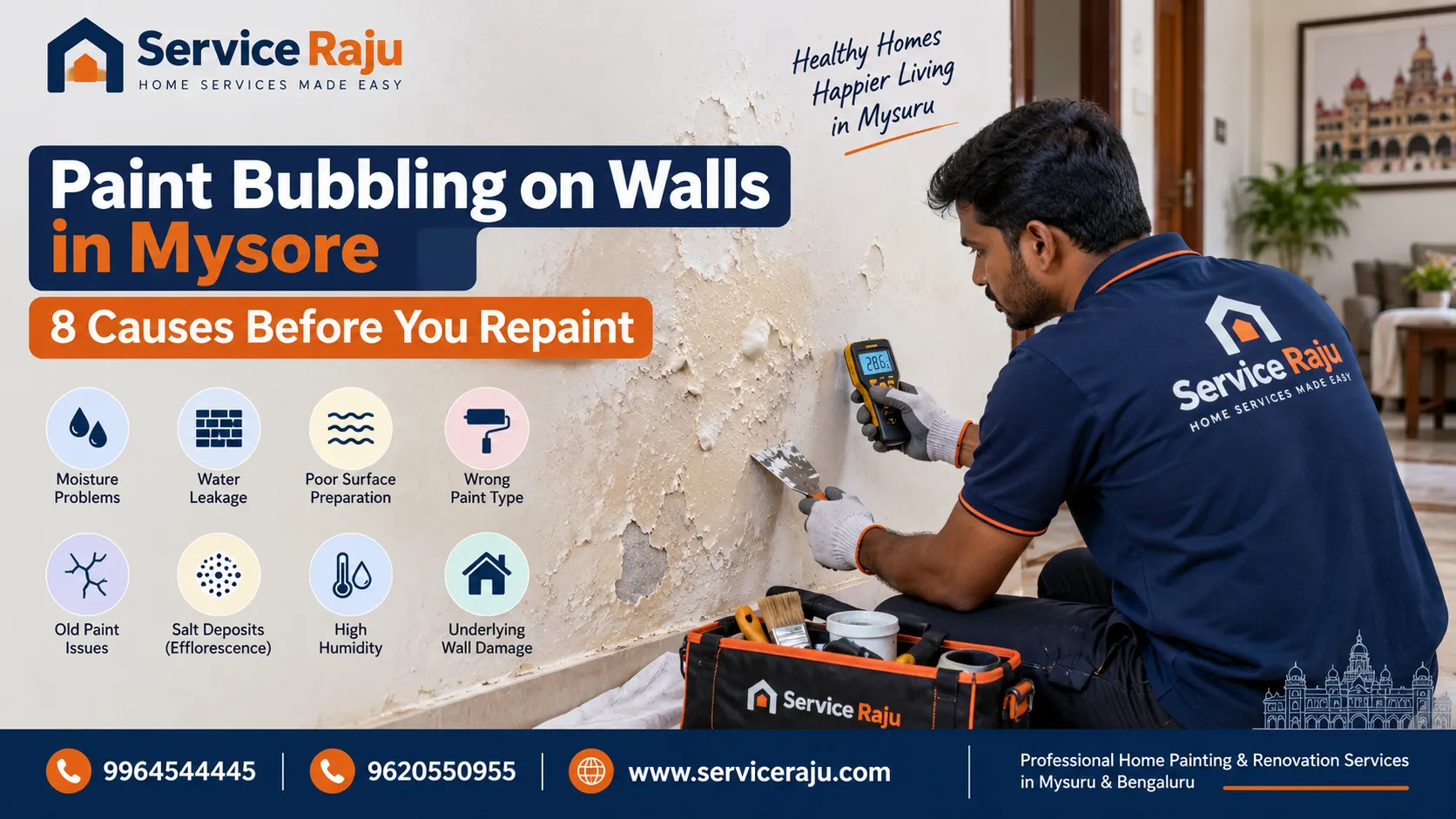
Paint Bubbling on Walls in Mysore: 8 Causes Before You Repaint
1. Paint Bubbling on Walls in Mysore: 8 Causes Before You Repaint
Seeing small bubbles, raised patches or blister-like areas on a painted wall can be frustrating, especially when the paint was applied recently.
The natural reaction is often: "The paint has gone bad. I need to repaint the wall."
But that is not always the correct answer.
Paint bubbling can be caused by moisture trapped behind the coating, water seepage, poor surface preparation, thick coating layers, insufficient drying or curing, incompatible old coatings and application conditions.
For homeowners searching for paint bubbling Mysore solutions, the most important question is not simply which paint to use.
It is: What is causing the paint to lose its bond with the wall?
If the underlying problem is moisture or leakage, repainting alone may only hide the problem temporarily.
2. Quick Answer: Why Is My Wall Paint Bubbling?
The eight common causes to investigate are:
- Moisture or dampness behind the paint
- Plumbing leakage or seepage
- Terrace or exterior-wall water penetration
- Poor surface preparation
- Painting over an unsuitable old coating
- Thick putty or paint layers
- Insufficient drying or curing
- Incorrect application conditions
The appearance alone does not prove which cause is responsible.
The location, pattern, age of the paint, moisture signs and condition of the underlying surface all matter.
3. What Does Bubbling Paint Actually Mean?
Paint is designed to form a bonded film over a properly prepared surface.
When that bond is disturbed, the coating can develop:
- Small raised bubbles
- Large blisters
- Peeling edges
- Flaking sections
- Craters after bubbles break
- Soft or swollen areas
- Discoloured patches
These symptoms can look similar even though their causes are different.
For example, moisture behind the coating can push the paint away from the substrate, while trapped air or solvent within the coating can create bubbles during application.
4. 8 Causes of Paint Bubbling on Walls
5. 1. Moisture Trapped Behind the Paint
This is one of the first things to investigate when bubbling appears on an interior wall.
Moisture can enter or remain inside a wall because of:
- Water seepage
- Damp plaster
- Plumbing leakage
- External rain penetration
- Bathroom moisture
- Terrace leakage
- Ground moisture
- Poor waterproofing
When moisture remains behind the coating, it can weaken paint adhesion and contribute to blistering, peeling and flaking.
6. 2. A Concealed Plumbing Leak
Sometimes the paint is only showing the symptom. A concealed water pipe behind the wall may develop a slow leak.
You may not immediately see flowing water. Instead, the wall may gradually develop:
- Damp patches
- Discolouration
- Bubbling paint
- Peeling
- Musty odour
- Soft plaster
- Recurring stains
A bubbling patch near a bathroom or plumbing route should therefore not automatically be treated as a painting problem.
7. 3. Water Coming Through an Exterior Wall or Terrace
An interior wall can show bubbling even when the visible problem is not inside the room.
Rainwater can enter through defects such as:
- Exterior cracks
- Damaged joints
- Porous surfaces
- Poorly protected walls
- Terrace defects
- Window-area leakage
- Damaged waterproofing
If bubbling becomes worse after heavy rain and appears on a wall facing the outside, investigate exterior water entry before spending money on a new interior paint coat.
8. 4. Poor Surface Preparation
A beautiful paint colour cannot compensate for a poorly prepared wall.
Before painting, the surface may need appropriate:
- Cleaning
- Scraping
- Sanding
- Crack repair
- Putty work
- Primer
- Removal of loose material
Dust, grease, loose particles, old flaky paint or an excessively smooth surface can interfere with adhesion.
9. 5. Painting Over an Unsuitable Old Coating
The previous coating matters.
Applying a new paint system over an unsuitable old coating without proper preparation can create adhesion problems.
During repainting, determine whether the existing coating is a suitable base for the new paint system.
If not, removal or appropriate surface preparation may be required.
10. 6. Putty or Paint Applied Too Thickly
More material does not necessarily mean a stronger paint finish.
Excessively thick paint or putty layers can contribute to coating problems, particularly where drying and adhesion are affected.
If bubbling appears relatively soon after painting and is concentrated in areas with heavy putty or coating build-up, surface preparation and application technique deserve investigation.
11. 7. The Wall or Previous Layer Was Not Dry Enough
A wall may look dry on the outside while retaining moisture underneath.
This can happen with:
- Fresh plaster
- Recently repaired areas
- Waterproofing work
- Putty
- Primer
- Previous paint layers
Painting too early can trap moisture within the coating system.
Proper curing and drying are therefore important before subsequent coating stages.
12. 8. Incorrect Application Conditions
Paint application conditions can also influence the final coating.
Depending on the product, problems can arise from:
- Excessive heat
- High humidity
- Poor ventilation
- Incorrect dilution
- Incorrect mixing
- Applying coatings outside the manufacturer's recommended conditions
- Applying a subsequent coat before the previous coat is ready
13. How to Tell Moisture Damage From a Painting Defect
| Observation | What It May Suggest |
|---|---|
| Bubbling near bathroom | Possible moisture or plumbing issue |
| Bubbling below terrace | Possible terrace seepage |
| Bubbling after heavy rain | Possible external water penetration |
| Bubbling near a concealed pipe | Possible plumbing leakage |
| Bubbling across freshly painted areas | Surface or application problem may need investigation |
| White powder around bubbling | Possible salt or efflorescence |
| Musty smell with bubbling | Moisture should be investigated |
| Paint bubbling with no dampness | Surface preparation or application may be involved |
These are diagnostic clues, not proof.
14. What Is Efflorescence?
Efflorescence is a white, powdery salt deposit that can appear when moisture moves through masonry and carries soluble salts toward the surface.
It can occur alongside paint failure.
If you see:
White powder + dampness + bubbling or peeling
the wall may require moisture-source investigation before repainting.
Do not simply brush away the powder and apply another coat. The moisture movement should be understood first.
15. Should You Repaint or Fix the Wall First?
16. If the Wall Is Dry and Only the Coating Is Defective
- Remove loose or defective paint.
- Sand the affected area.
- Clean the surface.
- Correct surface defects.
- Apply suitable primer.
- Repaint.
17. If the Wall Is Damp
Do not start with the final paint coat.
First identify why the wall is damp.
- Plumbing leakage
- Terrace seepage
- Exterior-wall penetration
- Bathroom waterproofing failure
- Rising damp
- Persistent indoor moisture
18. If There Is Active Leakage
Repair the leakage source first.
Painting before stopping the water path can lead to another round of bubbling and peeling.
19. If the Problem Is Widespread
A broader inspection may be necessary to determine whether the issue is moisture-related, surface-related, coating-related, plaster-related or a combination of problems.
20. How Bubbling Paint Should Be Repaired
21. Step 1: Inspect the Affected Area
Look at the location, size and pattern of bubbling.
22. Step 2: Identify Moisture
Check whether the wall shows dampness, staining or other moisture indicators.
23. Step 3: Find the Source
If moisture is present, determine whether it is coming from plumbing, exterior exposure, terrace, bathroom or another source.
24. Step 4: Remove Defective Material
Loose or failed paint and damaged surface material should be removed as appropriate.
25. Step 5: Repair the Substrate
Cracks, damaged plaster and other defects should be corrected where required.
26. Step 6: Allow Adequate Drying and Curing
Do not rush the next coating stage.
27. Step 7: Apply the Appropriate Preparation System
Primer, waterproofing treatment or other preparation should match the wall condition and selected coating system.
28. Step 8: Repaint
The final paint should be applied according to the product manufacturer's recommendations.
29. When Waterproofing or Leakage Detection Is Needed
You should consider professional inspection when:
- Bubbling repeatedly returns after repainting
- The wall feels damp
- There are water stains
- Bubbling increases after rain
- The affected wall is adjacent to a bathroom
- The area is below a terrace
- There is a concealed plumbing line nearby
- White salt deposits appear
- Plaster feels soft or damaged
- You cannot identify the moisture source
In these situations, painting may be the final step rather than the first step.
A suitable sequence may be:
Leakage → Repair → Drying → Surface Preparation → Waterproofing Where Required → Primer → Paint
30. How Service Raju Can Help
Service Raju handles painting and related home-maintenance requirements in Mysuru and Bengaluru.
For a bubbling-wall complaint, the useful first step is to understand whether the customer needs:
- Wall painting
- Repainting
- Surface preparation
- Waterproofing
- Wall leakage repair
- Plumbing repair
- Water leakage detection
- Plaster or masonry repair
The exact service should be selected after understanding the condition of the wall.
A typical service approach may include:
- Customer enquiry
- Site or service booking
- Inspection of the affected area
- Identification of the likely problem
- Explanation of the recommended work
- Estimate before additional work
- Approved repair or painting
- Final inspection
Service Raju can also coordinate relevant painting, waterproofing, plumbing and water-leakage detection services when the wall problem involves more than paint alone.
Service Raju
Call: 9964544445
Second Phone: 9620550955
Website: www.serviceraju.com
31. FAQs
32. Why is my wall paint bubbling after painting?
Possible causes include trapped moisture, poor surface preparation, unsuitable previous coatings, thick paint or putty layers, insufficient drying, or application problems.
33. Does bubbling paint always mean there is a water leak?
No. Moisture is an important cause, but bubbling can also result from trapped air or solvent, excessive coating thickness, poor preparation or application conditions.
34. Can I simply repaint over bubbling paint?
Usually, repainting directly over loose or bubbling paint is not a reliable solution. The defective coating and underlying cause should be addressed first.
35. Why does paint bubble near my bathroom?
Moisture from plumbing leaks, bathroom seepage, waterproofing problems or persistent humidity can contribute to paint failure near bathrooms. The exact source should be investigated.
36. Why is my paint bubbling after the monsoon?
Rain can expose weaknesses in exterior walls, terraces, joints and waterproofing. If moisture enters the wall, it can contribute to blistering, peeling and other coating failures.
37. What is the difference between bubbling and blistering?
They can look similar but are not always caused by exactly the same mechanism. Blistering is commonly associated with trapped moisture or gases, while bubbling can also result from trapped air or solvent within the coating.
38. Can waterproofing stop paint bubbling?
If moisture ingress is the underlying cause, correcting the water source and using an appropriate waterproofing system can help prevent recurring paint failure. Waterproofing does not replace proper surface preparation and painting.
39. Should I use a moisture meter before repainting?
A moisture meter can provide useful information during an inspection, but readings need to be interpreted in context. It should not be treated as an automatic diagnosis of the source of moisture.
40. When should I call a professional?
Call for professional inspection when bubbling is widespread, repeatedly returns, appears with dampness or stains, occurs near plumbing or terraces, or is accompanied by damaged plaster or suspected leakage.
41. Final Takeaway
Paint bubbling Mysore homeowners see is not always a simple painting defect.
The bubble is often the symptom, not the cause.
Before repainting, check whether the wall has moisture, plumbing leakage, terrace seepage, poor surface preparation, incompatible old coatings or application-related problems.
If the wall is damp, fix the moisture source first.
If the surface is dry but the coating has failed, proper removal, preparation, priming and repainting may be enough.
The key is simple:
Diagnose the wall before repainting it.
For professional painting, waterproofing, wall leakage repair, plumbing or water leakage detection support in Mysuru and Bengaluru, contact Service Raju.
9964544445 | 9620550955 | www.serviceraju.com
 AC Repair
.webp) Ant Control Service
Ant Control Service
 Basin & Sink Services
.webp) Bath & Shower Services
Bath & Shower Services
.webp) Bath Fittings & Mirrors
Bath Fittings & Mirrors
 Bathroom Cleaning Service
 Bathroom Renovation Services
 Bed Bug Control Services
 Bedroom Painting
 Book a Carpenter Consultation
 Book Electrical Consulting
.webp) Cabinet Painting & Wood Refinishing
Cabinet Painting & Wood Refinishing
 Chimney Cleaning
 Civil Masonry Work
 Clean-Up Services
.webp) Clothes Hanger Installation
Clothes Hanger Installation
 Cockroach Control Services
---mysore-mysore-standard-300x200.webp) Commercial Cleaning
Commercial Cleaning
 Commercial Pest Control AMC Service
 Cupboard & Drawer Services
 Decorative Wall Panels
 Deep Sanitisation Service
 Detan & Bleach
 Door, Grill & Cabinet Painting Service
.webp) Doorbell & security
Doorbell & security
 Drain Blockage Clearing
 Electrical Appliance Services
 Electrical Wiring Services
 Empty Home Deep Cleaning
.webp) Fabrication
Fabrication
 Facials
.webp) Fan Installation & Repair
Fan Installation & Repair
 Full Home Cleaning Service
 Full Home Renovation
 Furniture Repair Service
 Gas Stove & Hob Repair
.webp) General Pest Control Services
General Pest Control Services
 General Plumbing & Consultation
 Geyser Repair
 Glass Cleaning
 Head Massage
.webp) Honeybee & Wasp-Services
Honeybee & Wasp-Services
 Kitchen & Bathroom Painting Service
 Kitchen Cleaning
 Kitchen Fittings
.webp) Kitchen Renovation
Kitchen Renovation
.webp) Laptop/Desktop service
Laptop/Desktop service
 Leak Detection and Repair
 LED TV Repair
 Living and Dining Room Painting
 Makeup, Saree & Styling
 Manicure & Pedicure
 MCB,Meter & Fuse Services
 Microwave Repair
 Mosquito Pest Control Service
 Multi-Room Painting Service
 Painting Consultation
 Quick Mini Cleaning Services
 Refrigerator Repair
 RO Water Purifier
.webp) Rodent Control Services (Rat & Mice Treatment)
Rodent Control Services (Rat & Mice Treatment)
.webp) Rooms Cleaning
Rooms Cleaning
 Shelves & Decor
 Sofa, Carpet & Mattress Cleaning
 Solar Water Heater Service
 Sump & Tank Cleaning
 Switch & Socket Services
 Tap & Mixer Service
.webp) Termite-Control-Services
Termite-Control-Services
 Threading & Face Wax
.webp) Tile & Granite Installation & Polishing
Tile & Granite Installation & Polishing
 Toilet & Commode Services
.webp) UPS and Inverter Repair Services
UPS and Inverter Repair Services
.webp) Wall Painting Service
Wall Painting Service
 Washing Machine Repair
 Water Level Controllers
 Water Tank and Pump Repair
 Waterproofing
 Waterproofing Services
 Waxing
 Window & Curtain Services
 Wooden Door Services