Mysore Monsoon Bathroom: Repair, Waterproofing or Cleaning?
1. Mysore Monsoon Bathroom: Repair, Waterproofing or Cleaning?
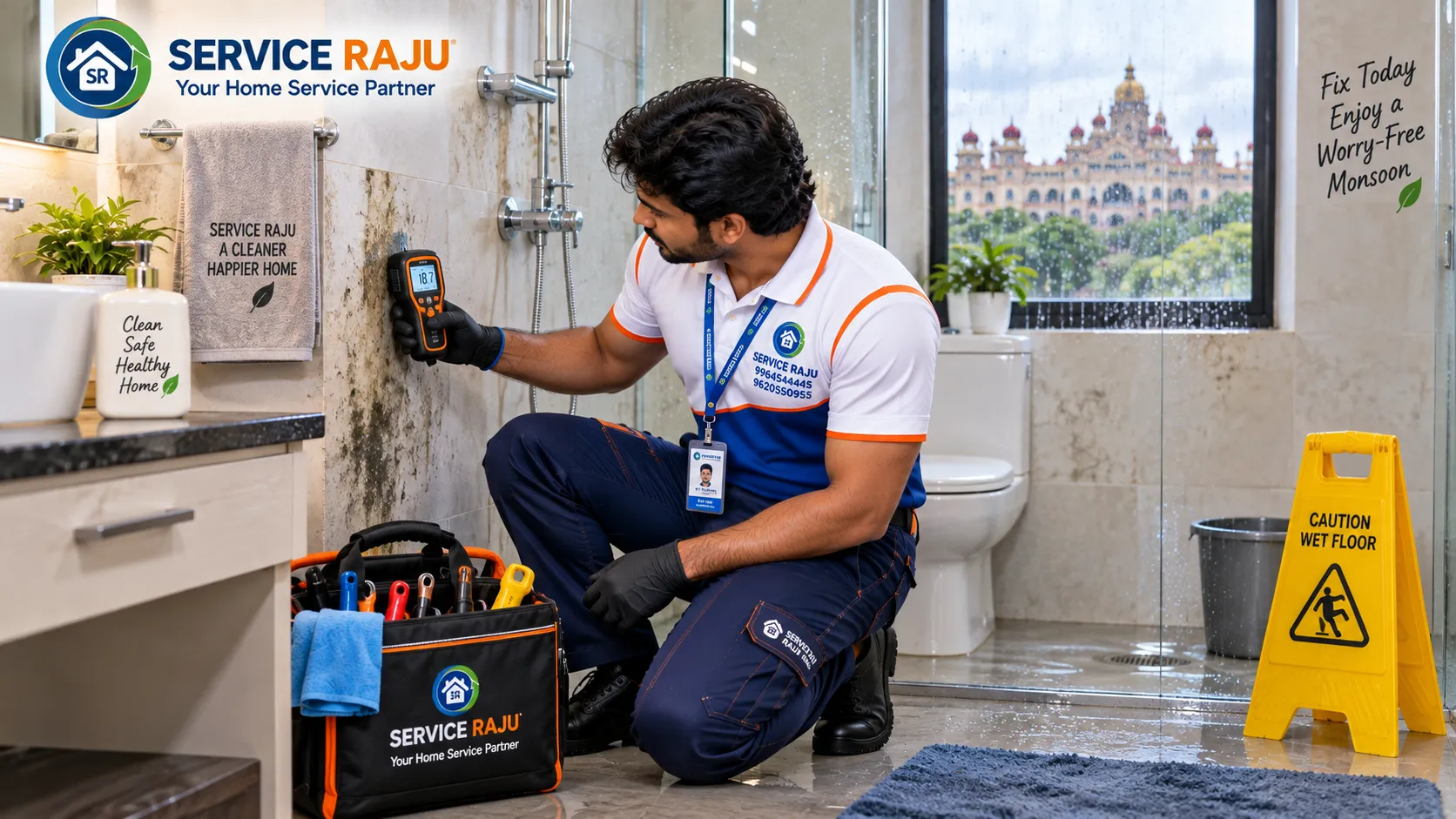
Mysore monsoon bathroom problems can look very similar at first. A dark patch near the shower, black marks on grout, peeling paint, a damp ceiling or a musty smell may all appear to be “just a cleaning problem.” But the correct solution depends on what is actually causing the moisture.
Sometimes the answer is better ventilation and deep cleaning. Sometimes it is a leaking plumbing connection. In other cases, the bathroom may need leakage detection or waterproofing work.
That distinction matters because cleaning a leaking wall will not stop the leak, while waterproofing a bathroom that only has surface mould may be unnecessary.
Current weather and water conditions make bathroom moisture management particularly relevant for Mysuru homeowners. Recent local reporting has highlighted unusual weather conditions and pressure on water resources, while the India Meteorological Department has issued current Karnataka weather warnings for September 2026.
This guide helps you identify what kind of bathroom problem you may actually have before spending money on the wrong service.
2. Quick Answer: Does Your Bathroom Need Cleaning, Repair or Waterproofing?
| What You Notice | Likely First Step |
|---|---|
| Surface mould on tiles or grout | Cleaning and ventilation check |
| Dripping tap or visible pipe leak | Plumbing repair |
| Water around a fixture | Plumbing inspection |
| Damp patch returning after cleaning | Leakage or moisture investigation |
| Water appearing below the bathroom | Leakage detection and assessment |
| Persistent seepage through floor or wall | Waterproofing assessment |
| Bad smell from floor drain | Drain and trap inspection |
| Hard-water scale on fittings | Deep cleaning and descaling |
3. Table of Contents
- Why Bathroom Problems Are Easy to Misdiagnose
- 9 Signs and What They Usually Point To
- When Bathroom Cleaning Is Enough
- When You Need Bathroom Plumbing Repair
- When You Need Leakage Detection
- When Bathroom Waterproofing May Be Required
- Repair, Waterproofing or Cleaning: Decision Guide
- How a Professional Bathroom Inspection Helps
- 5 Mistakes to Avoid
- Mysore Monsoon Bathroom Checklist
- FAQs
- Service Raju Bathroom Support in Mysuru
- Final Takeaway
4. Why Bathroom Problems Are Easy to Misdiagnose
Bathrooms contain several systems in a small area: water supply pipes, drainage, taps, showers, toilets, floor traps, tiles, grout, waterproofing layers, ventilation and electrical fittings.
One visible symptom can therefore have several possible causes.
For example, a damp patch near a bathroom wall could come from:
- A leaking supply pipe
- A leaking drain connection
- Water escaping around a fixture
- Failed waterproofing
- Water entering from an adjoining area
- Condensation or poor ventilation
This is why the first step should be identifying the source, not automatically applying a chemical, repainting the wall or breaking tiles.
5. 9 Signs and What They Usually Point To
6. 1. Black Spots on Grout or Silicone
Small areas of surface mould can develop where moisture remains for long periods.
Poor ventilation, wet surfaces and slow drying can all contribute to recurring surface mould.
First check: ventilation and surface moisture.
Likely service: bathroom cleaning if the problem is superficial.
If the same area returns quickly after proper cleaning, investigate whether there is an underlying moisture source.
7. 2. A Damp Patch That Keeps Coming Back
If a patch disappears after cleaning but returns repeatedly, do not automatically keep cleaning it.
A recurring patch can justify moisture or leakage investigation.
First check: whether the affected area becomes wet even when the bathroom has not recently been used.
Likely service: leakage detection or plumbing inspection.
8. 3. Water Appearing Below the Bathroom
If the ceiling below a bathroom develops staining or dampness, the source may be above it. But the visible location does not necessarily identify the exact leak point.
The problem could involve a plumbing connection, drain, fixture or waterproofing layer.
Likely service: professional leakage detection before deciding on waterproofing.
9. 4. Water Escaping Around the Toilet
Water around the toilet base should not automatically be treated as a waterproofing failure.
Possible causes include a plumbing connection, seal, flush-related leak or water escaping from the surrounding floor area.
Likely service: plumbing inspection first.
10. 5. Shower-Area Dampness Beyond the Wet Zone
The shower area is designed to become wet. The concern is when moisture appears outside the expected wet zone or begins affecting adjoining walls, flooring or the ceiling below.
Likely service: moisture or leakage investigation, followed by the appropriate repair.
11. 6. Peeling Paint on a Bathroom-Adjacent Wall
Peeling paint is a symptom, not necessarily the source of the problem.
Painting over a damp wall without identifying the moisture source can result in the same damage returning.
Likely service: determine whether the issue is plumbing leakage, waterproofing failure or surface moisture before repainting.
12. 7. Musty Smell After the Bathroom Is Cleaned
A persistent smell can come from damp towels, poor ventilation, dirty drains, floor traps, moisture behind surfaces or other causes.
Service Raju already has a dedicated article covering bathroom drain smell in Mysore, so this article does not repeat that subject.
Likely service: identify the source before choosing cleaning or plumbing work.
13. 8. White Scale on Taps and Shower Fittings
White deposits around taps, showerheads and bathroom fittings may be mineral scale rather than a leakage problem.
In that situation, deep cleaning and appropriate descaling may be more relevant than waterproofing.
Likely service: bathroom deep cleaning or descaling.
14. 9. Water Takes Too Long to Drain
Slow drainage usually deserves attention before it becomes a complete blockage.
Hair, soap residue, deposits and other material can restrict flow. More serious drainage problems may require professional blockage clearance.
Likely service: drainage inspection and blockage clearance.
15. When Bathroom Cleaning Is Enough
Cleaning may be the correct first step when the problem is primarily on the surface.
Typical examples include:
- Soap residue
- Surface grime
- Hard-water deposits
- Light mould on accessible surfaces
- Dirty grout
- Dust around exhaust fans
- Surface stains
Good ventilation after cleaning is also important because trapped moisture can contribute to recurring mould and musty smells.
However, cleaning should not be used to hide an active leak.
16. When You Need Bathroom Plumbing Repair
Choose plumbing inspection or repair when the problem involves water supply, drainage or bathroom fixtures.
Examples include:
- Dripping taps
- Leaking shower connections
- Loose flexible hoses
- Toilet inlet or outlet problems
- Health-faucet leakage
- Blocked washbasin
- Slow floor drain
- Leaking visible pipe joints
Visible plumbing faults are usually easier to diagnose than concealed leakage.
The important point is to repair the actual source rather than repeatedly cleaning the water damage.
17. When You Need Leakage Detection
Leakage detection becomes more useful when you can see the effect of water but cannot identify its source.
Consider professional investigation when:
- Dampness returns after cleaning
- A ceiling below the bathroom develops stains
- Wall paint repeatedly bubbles or peels
- Water appears without an obvious visible leak
- Moisture spreads beyond the shower area
- There is unexplained water consumption
- A hidden pipe is suspected
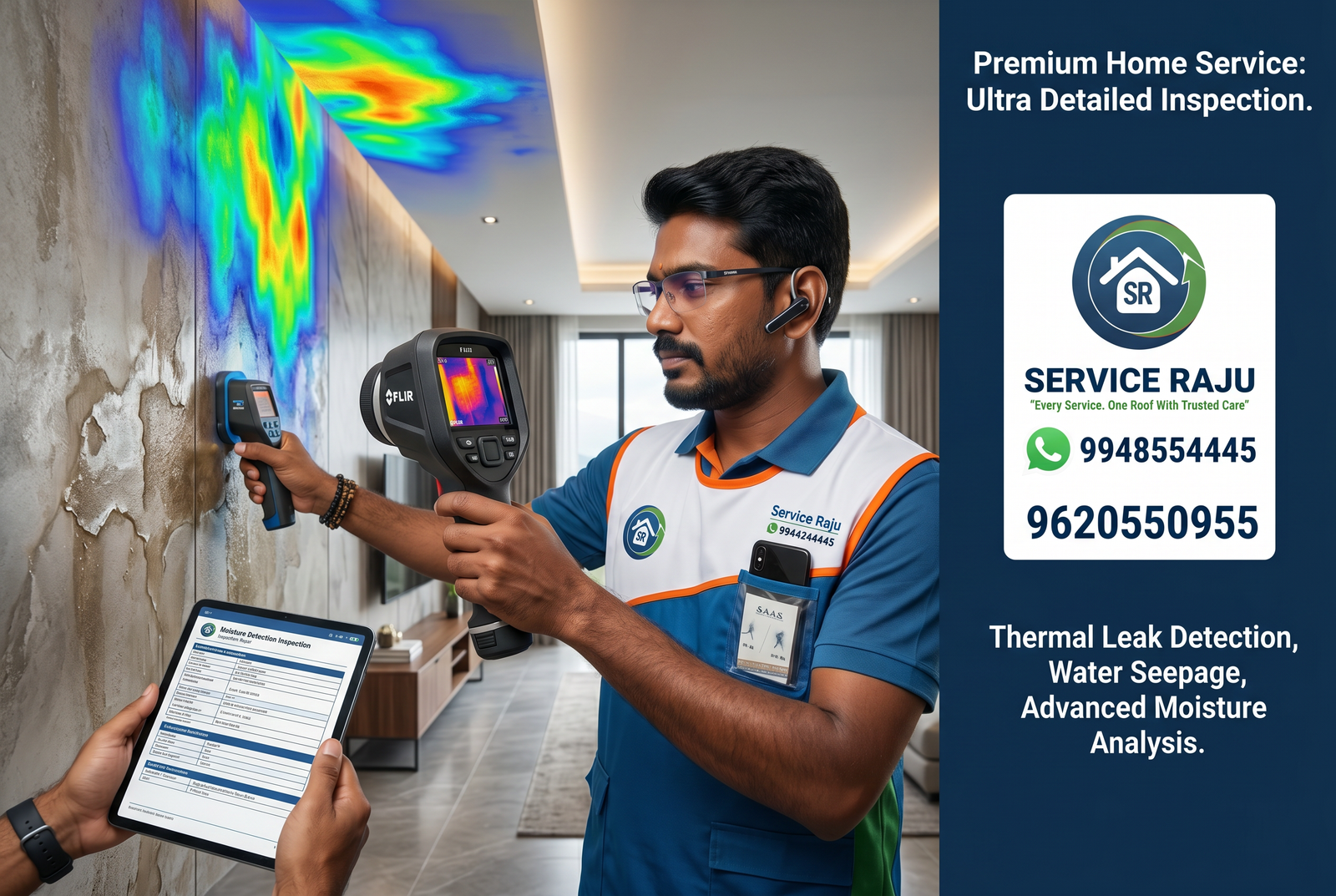
Depending on the situation, investigation may involve visual inspection, moisture measurement, pressure testing or thermal imaging.
The correct diagnostic method depends on the suspected source.
Service Raju's existing hidden bathroom pipe-leak case study also describes the use of thermal imaging and moisture-related investigation where appropriate. See the hidden bathroom pipe leak case study.
18. When Bathroom Waterproofing May Be Required
Waterproofing should not be treated as the automatic solution for every wet bathroom.
It becomes more relevant when water is moving through areas that should remain protected, particularly when plumbing faults have been investigated and ruled out.
Possible warning signs include:
- Recurring seepage around wet-area boundaries
- Persistent dampness affecting adjoining areas
- Repeated leakage below the bathroom
- Water penetration associated with the bathroom floor or wall system
- Old or deteriorated waterproofing with recurring symptoms
Before major waterproofing work, identify whether the actual cause is a pipe, drain, fixture or waterproofing layer.
Bathroom waterproofing guidance from Asian Paints also identifies damp patches, peeling paint, musty smells, ceiling stains and cracked grout among problems that can be associated with bathroom seepage and waterproofing failures. Read the bathroom waterproofing guide.
19. Repair, Waterproofing or Cleaning: Decision Guide
| Problem | Start With | Do Not Do First |
|---|---|---|
| Surface mould | Cleaning and ventilation | Immediate waterproofing |
| Dripping tap | Plumbing repair | Wall breaking |
| Visible pipe leak | Plumbing inspection | Painting over damage |
| Recurring damp wall | Leakage detection | Repeated repainting |
| Ceiling stain below bathroom | Leak investigation | Assuming waterproofing immediately |
| Hard-water scale | Deep cleaning and descaling | Waterproofing |
| Slow drain | Drain inspection | Ignoring it until blockage |
| Persistent wet-area seepage | Waterproofing assessment | Only surface cleaning |
20. How a Professional Bathroom Inspection Helps
A useful inspection should begin with the symptom and work backwards toward the possible source.
- Understand where and when the moisture appears.
- Inspect visible plumbing and fixtures.
- Check drainage and floor areas.
- Inspect adjoining walls and ceilings.
- Measure moisture where appropriate.
- Use additional diagnostic methods if required.
- Identify the likely source.
- Recommend the appropriate repair rather than automatically replacing everything.
This approach helps prevent a common mistake: spending money on cosmetic work before understanding the underlying problem.
21. 5 Mistakes to Avoid
22. 1. Painting Over Dampness
Fresh paint can improve appearance temporarily but does not necessarily stop moisture entering the wall.
23. 2. Waterproofing Every Wet Bathroom
A dripping fixture or blocked drain does not automatically mean the waterproofing layer has failed.
24. 3. Using Strong Cleaning Chemicals Without Checking the Surface
Bathroom finishes, grout, metal fittings and sealants can react differently to cleaning products.
Follow product instructions and avoid unsafe chemical combinations.
25. 4. Ignoring Recurring Moisture
If the same patch returns repeatedly, investigate the source instead of repeatedly cleaning or repainting it.
26. 5. Breaking Tiles Before Diagnosis
Unnecessary demolition can increase repair cost and mess.
Diagnosis should guide where intervention is actually needed.
27. Mysore Monsoon Bathroom Checklist
- ☐ Check taps for dripping
- ☐ Check toilet for continuous running
- ☐ Test floor-drain flow
- ☐ Inspect visible plumbing connections
- ☐ Check shower-area grout and seals
- ☐ Look for recurring damp patches
- ☐ Check the ceiling below the bathroom
- ☐ Inspect adjoining walls
- ☐ Clean visible mould safely
- ☐ Improve ventilation
- ☐ Check for hard-water scale
- ☐ Investigate recurring seepage
- ☐ Arrange leakage detection when the source is unclear
- ☐ Consider waterproofing only after diagnosis where appropriate
28. FAQs
29. How do I know whether bathroom mould needs cleaning or repair?
If mould is limited to accessible surfaces and improves after cleaning and drying, cleaning may be sufficient. If it repeatedly returns or is associated with damp walls, ceilings or unexplained moisture, investigate the moisture source.
30. Does a damp bathroom wall always mean waterproofing has failed?
No. Plumbing leaks, drain problems, fixture leaks, condensation and other moisture sources can produce similar symptoms. Diagnosis should come before major waterproofing work.
31. When should I call a plumber for a bathroom problem?
Call for plumbing inspection when you notice visible pipe leakage, dripping fixtures, toilet leakage, slow drainage, recurring blockages or other water-supply and drainage problems.
32. When is water leakage detection useful?
It is particularly useful when moisture or water damage is visible but the source is not obvious, such as recurring wall dampness or a ceiling stain below a bathroom.
33. Can monsoon make bathroom dampness worse?
Rainy and humid conditions can make moisture management more difficult and can make existing seepage or ventilation problems more noticeable.
34. Should I clean the bathroom before calling a professional?
Basic cleaning is fine, but do not cover stains, seal leaks temporarily or repaint damaged areas before an inspection if you are trying to identify the source of recurring moisture.
35. Does slow bathroom drainage mean waterproofing has failed?
No. Slow drainage is more commonly associated with restricted flow, debris, trap or drainage problems. Waterproofing should not be assumed without evidence of seepage.
36. Can I waterproof a bathroom without finding the leak source?
Major waterproofing work should ideally follow an assessment of the moisture source. If a supply pipe or drain is leaking, waterproofing alone may not solve the underlying problem.
37. Can hidden bathroom leaks be detected without immediately breaking tiles?
Some investigations can use visual inspection, moisture measurement, pressure testing or thermal imaging before deciding whether opening a wall or floor is necessary.
38. Does Service Raju provide bathroom cleaning and repair services in Mysuru?
Service Raju provides bathroom cleaning as well as plumbing, leakage detection, waterproofing and related home services in Mysuru. The appropriate service depends on the actual cause of the problem.
39. Service Raju Bathroom Support in Mysuru
Service Raju can help homeowners identify the appropriate service instead of treating every bathroom problem as the same type of job.
Depending on the diagnosis, the relevant service may include:
- Bathroom Deep Cleaning
- Plumbing Repair & Maintenance
- Drainage & Blockage Solutions
- Bathroom Leakage Detection
- Moisture Detection
- Thermal Imaging Inspection
- Bathroom Waterproofing Consultation
The practical approach is:
Identify the symptom → Find the likely source → Choose the right service → Repair → Test → Clean
For bathroom problems in Mysuru:
Service Raju
9964544445 | 9620550955
www.serviceraju.com
40. Final Takeaway
A bathroom that looks damp during the monsoon does not automatically need waterproofing.
It may need cleaning. It may need plumbing repair. It may need drainage work. It may need leakage detection. Or, after proper diagnosis, it may genuinely need waterproofing.
The smartest first step is therefore not choosing a treatment. It is finding out what is causing the moisture.
That approach can help Mysuru homeowners avoid unnecessary work while addressing genuine bathroom problems before they spread.
If you notice recurring dampness, unexplained bathroom leakage, wall stains, slow drainage or moisture below the bathroom, contact Service Raju for professional assistance.
Service Raju
9964544445 | 9620550955
www.serviceraju.com
Mysuru / Mysore
 AC Repair
.webp) Ant Control Service
Ant Control Service
 Basin & Sink Services
.webp) Bath & Shower Services
Bath & Shower Services
.webp) Bath Fittings & Mirrors
Bath Fittings & Mirrors
 Bathroom Cleaning Service
 Bathroom Renovation Services
 Bed Bug Control Services
 Bedroom Painting
 Book a Carpenter Consultation
 Book Electrical Consulting
.webp) Cabinet Painting & Wood Refinishing
Cabinet Painting & Wood Refinishing
 Chimney Cleaning
 Civil Masonry Work
 Clean-Up Services
.webp) Clothes Hanger Installation
Clothes Hanger Installation
 Cockroach Control Services
---mysore-mysore-standard-300x200.webp) Commercial Cleaning
Commercial Cleaning
 Commercial Pest Control AMC Service
 Cupboard & Drawer Services
 Decorative Wall Panels
 Deep Sanitisation Service
 Detan & Bleach
 Door, Grill & Cabinet Painting Service
.webp) Doorbell & security
Doorbell & security
 Drain Blockage Clearing
 Electrical Appliance Services
 Electrical Wiring Services
 Empty Home Deep Cleaning
.webp) Fabrication
Fabrication
 Facials
.webp) Fan Installation & Repair
Fan Installation & Repair
 Full Home Cleaning Service
 Full Home Renovation
 Furniture Repair Service
 Gas Stove & Hob Repair
.webp) General Pest Control Services
General Pest Control Services
 General Plumbing & Consultation
 Geyser Repair
 Glass Cleaning
 Head Massage
.webp) Honeybee & Wasp-Services
Honeybee & Wasp-Services
 Kitchen & Bathroom Painting Service
 Kitchen Cleaning
 Kitchen Fittings
.webp) Kitchen Renovation
Kitchen Renovation
.webp) Laptop/Desktop service
Laptop/Desktop service
 Leak Detection and Repair
 LED TV Repair
 Living and Dining Room Painting
 Makeup, Saree & Styling
 Manicure & Pedicure
 MCB,Meter & Fuse Services
 Microwave Repair
 Mosquito Pest Control Service
 Multi-Room Painting Service
 Painting Consultation
 Quick Mini Cleaning Services
 Refrigerator Repair
 RO Water Purifier
.webp) Rodent Control Services (Rat & Mice Treatment)
Rodent Control Services (Rat & Mice Treatment)
.webp) Rooms Cleaning
Rooms Cleaning
 Shelves & Decor
 Sofa, Carpet & Mattress Cleaning
 Solar Water Heater Service
 Sump & Tank Cleaning
 Switch & Socket Services
 Tap & Mixer Service
.webp) Termite-Control-Services
Termite-Control-Services
 Threading & Face Wax
.webp) Tile & Granite Installation & Polishing
Tile & Granite Installation & Polishing
 Toilet & Commode Services
.webp) UPS and Inverter Repair Services
UPS and Inverter Repair Services
.webp) Wall Painting Service
Wall Painting Service
 Washing Machine Repair
 Water Level Controllers
 Water Tank and Pump Repair
 Waterproofing
 Waterproofing Services
 Waxing
 Window & Curtain Services
 Wooden Door Services