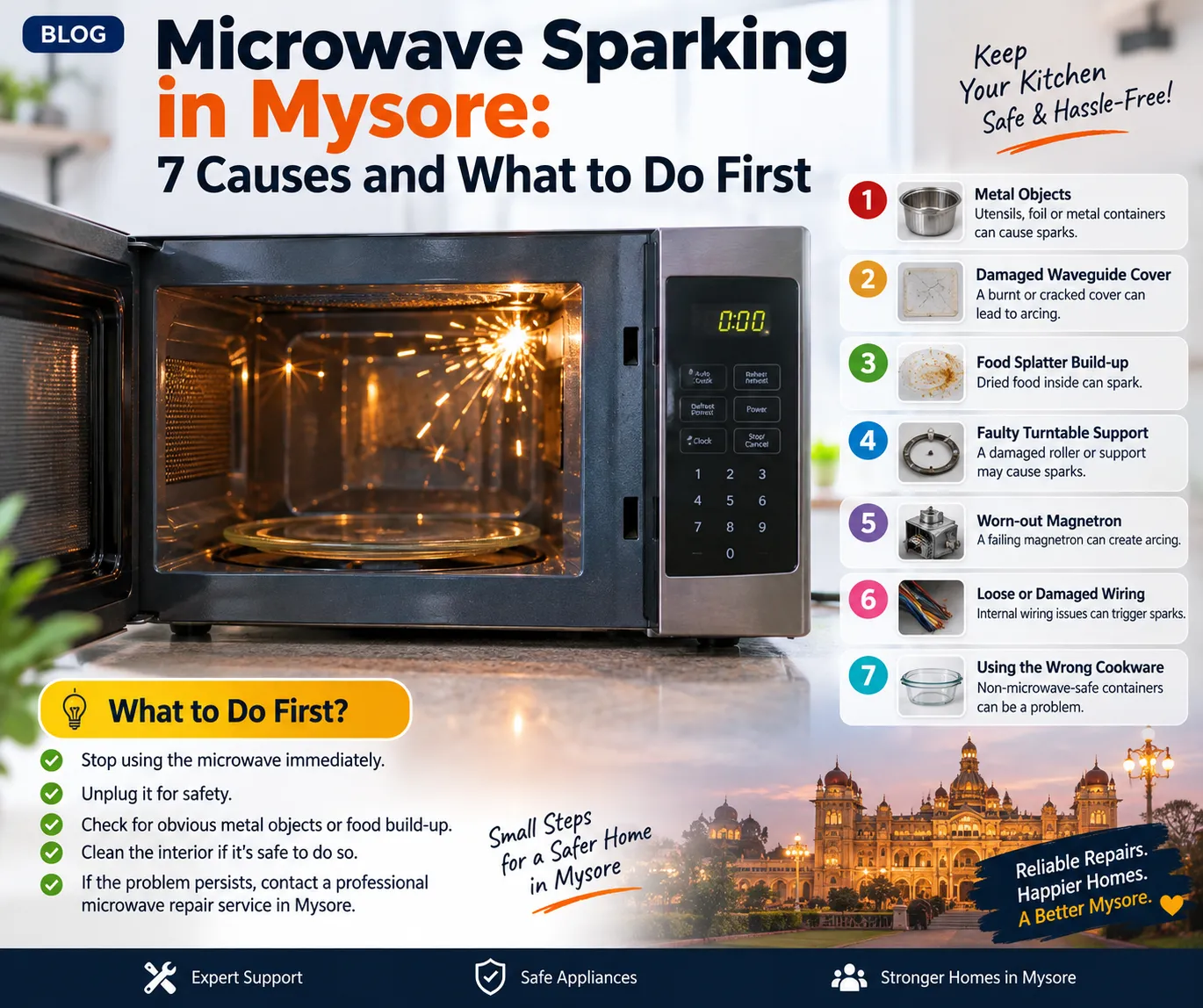
Microwave Sparking in Mysore: 7 Causes and What to Do First
1. Microwave Sparking in Mysore: 7 Causes and What to Do First
Seeing blue or bright flashes inside your microwave can be alarming. If your appliance suddenly starts sparking while heating food, stop the microwave first and identify the cause before continuing to use it.
Microwave sparking in Mysore can happen for a simple reason such as aluminium foil or food residue. But persistent sparking can also indicate damage inside the microwave that requires professional inspection.
Manufacturers including Samsung, LG and Whirlpool identify metal objects, metallic cookware, food residue, incorrect racks and damaged internal surfaces among possible causes of arcing or sparking.
2. Quick Answer: What Should You Do When a Microwave Sparks?
- Stop the cooking cycle.
- Remove the food only when it is safe to do so.
- Check whether metal, aluminium foil or metallic decoration was inside.
- Check for burnt food particles or heavy food residue.
- Inspect the visible interior for damage or a damaged cover.
- Do not open the microwave's outer cabinet yourself.
- If sparking continues after the obvious cause is removed, stop using the appliance and arrange professional diagnosis.
3. Why Is My Microwave Sparking?
Microwave ovens use electromagnetic energy to heat food. The metal cavity reflects microwave energy toward the food, while the food absorbs that energy.
Metal objects can reflect microwave energy differently from the food and cookware intended for microwave use. This can create concentrated electrical discharges that appear as sparks or flashes.
Sparking is commonly called arcing.
4. 7 Common Causes of Microwave Sparking
5. 1. Metal or Aluminium Foil Inside
Examples include metal spoons, forks, metal containers, aluminium foil, metal twist ties, takeaway containers with metallic parts and plates or cups with gold or silver decorative edges.
Use cookware clearly labelled as microwave-safe and follow your microwave manufacturer's instructions.
6. 2. Food Splashes and Burnt Residue
Food particles and splashes can become overheated or carbonised. Accumulated residue can contribute to arcing.
Pay particular attention to burnt food, oil splashes, dried sauces, food particles around the microwave cover, cavity walls and rack supports.
If the appliance has no visible damage and food residue is the suspected cause, clean the cavity according to the manufacturer's instructions.
7. 3. Damaged or Contaminated Waveguide/Magnetron Cover
Many microwaves contain a cover that protects the microwave-generating area from food splashes and debris.
If this cover is burnt, cracked, heavily contaminated, swollen, missing or repeatedly arcing, the microwave should be inspected.
Do not remove the cover or replace it with improvised material.
8. 4. Damaged Interior Cavity
Look at the inside walls and ceiling of the microwave for burn marks, chipped coating, deep scratches, scorching, rusted areas or visible damage around the waveguide area.
If the interior cavity is damaged, discontinue use and arrange professional inspection.
9. 5. Incorrect Microwave Rack or Accessory
Some grill or convection microwave models include metal racks. These are safe only when designed for the appliance and installed correctly.
- Check that the original rack is being used.
- Check that its plastic supports are present.
- Make sure the rack is positioned correctly.
- Make sure it is not touching the cavity wall.
10. 6. Running the Microwave Empty
Some microwave models can spark or suffer damage when operated without a suitable load. Follow the operating instructions for your specific model.
Do not deliberately run an empty microwave as a test unless the manufacturer specifically instructs you to do so.
11. 7. Internal Electrical or High-Voltage Fault
If the microwave sparks even when no metal is present, microwave-safe cookware is being used, the cavity is clean, the rack is correctly installed and there is no obvious cavity damage, an internal fault should be investigated.
Possible causes can include damaged internal components or other electrical faults.
Do not remove the outer cabinet to investigate the problem yourself.
12. What to Do Immediately After Seeing Sparks
- Stop the microwave.
- Identify what was inside.
- Look for food residue.
- Inspect the visible cavity.
- Do not open the cabinet.
- Stop using the appliance if the cause is unclear.
13. When Can You Safely Use the Microwave Again?
If the cause was clearly an unsuitable item such as a metal spoon, and the microwave has no visible damage, removing the item may resolve the problem.
If the cause was food residue, cleaning the cavity according to the manufacturer's instructions may resolve the issue.
Do not keep testing the appliance if sparks continue.
- Sparking returns
- The interior is damaged
- The microwave cover is damaged
- There is a burning smell
- You hear unusual buzzing or popping
- The microwave stops heating correctly
- The appliance trips a circuit breaker
- The door or latch is damaged
14. When Do You Need Microwave Repair?
Professional inspection is appropriate when the cause cannot be resolved through normal user checks.
- Cavity condition
- Waveguide or magnetron cover
- Internal electrical components
- Magnetron-related faults
- High-voltage circuit
- Door and interlock condition
- Turntable and drive system
- Internal wiring
- Signs of overheating or arcing
15. Repair or Replace: What Should You Consider?
| Situation | What to Consider |
|---|---|
| Metal utensil caused one spark | Remove the item and inspect for damage |
| Food residue caused arcing | Clean and inspect the cavity |
| Damaged internal cover | Professional inspection or replacement |
| Damaged cavity | Repair feasibility depends on extent |
| Repeated unexplained sparking | Professional diagnosis |
| Multiple major component failures | Compare repair cost with replacement |
| Very old appliance | Consider age, condition and spare-part availability |
16. Microwave Maintenance Tips
17. Keep the cavity clean
Wipe food splashes before they become burnt deposits.
18. Use suitable cookware
Follow the manufacturer's cookware instructions.
19. Avoid unapproved metal
Do not use metal utensils, foil or decorative cookware unless your specific appliance instructions explicitly permit the item.
20. Keep the internal cover intact
Do not remove or modify the magnetron or waveguide cover.
21. Never ignore repeated sparking
One obvious usage mistake and repeated unexplained sparking are two very different situations.
22. Keep the door and seals in good condition
A microwave with a damaged door, latch or seal should not continue operating normally.
23. Service Raju Microwave Repair in Mysore
If your microwave continues sparking after the obvious causes have been eliminated, professional diagnosis can help identify whether the problem is related to the cavity, cover, electrical components or another part of the appliance.
Service Raju provides microwave repair and appliance service in Mysuru/Mysore, with support for common microwave problems such as sparking, heating issues, turntable problems and control-panel faults.
A typical service flow may include:
- Customer enquiry
- Service booking
- Technician visit
- Microwave inspection
- Fault diagnosis
- Repair estimate
- Customer approval
- Repair or service
- Testing after the work
For a microwave that is repeatedly sparking, avoid opening the appliance yourself.
Service Raju: Professional microwave repair and appliance service in Mysuru and Bengaluru.
Phone: 9964544445
Second Phone: 9620550955
Website: www.serviceraju.com
24. Frequently Asked Questions
25. Why is my microwave sparking?
Common causes include metal objects, aluminium foil, metallic cookware, food residue, an incorrectly installed rack, a damaged internal cover or damaged cavity.
26. Is it safe to use a microwave that sparks once?
If a clear cause such as an unsuitable metal item is identified and the appliance has no visible damage, removing the cause may resolve the problem. If sparking continues or the cause is unclear, stop using the appliance and arrange an inspection.
27. Can food residue cause microwave sparking?
Yes. Food particles and cooked-on residue can become carbonised and contribute to arcing. Keeping the cavity clean is part of normal microwave maintenance.
28. What is the sheet inside my microwave?
Many microwave models have a magnetron or waveguide cover that protects the microwave-generating component from food splashes and debris. It should not be removed or replaced with improvised material.
29. Can a microwave spark without metal inside?
Yes. Food residue, damaged internal surfaces, an incorrectly positioned rack, operating conditions and internal component faults can also cause arcing.
30. Should I open my microwave to find the problem?
No. Microwave ovens contain high-voltage components. The outer cabinet should be handled by a trained technician rather than opened as a DIY repair.
31. Can a damaged microwave door be dangerous?
A damaged, bent or improperly closing door should not be ignored. Stop using the microwave and arrange appropriate professional assistance.
32. Does microwave sparking always mean the magnetron is damaged?
No. Sparking is a symptom with several possible causes. Diagnosis is needed before identifying a failed component.
33. Final Takeaway
Microwave sparking in Mysore does not automatically mean your microwave is beyond repair.
Start with the simple checks: remove metal, check the cookware, clean food residue and inspect the visible cavity and internal cover.
But if the microwave continues to spark, smells burnt, shows visible internal damage, makes unusual noises, trips the electrical supply or has a damaged door, stop using it and arrange professional inspection.
The safest repair decision comes from identifying the actual cause rather than repeatedly testing the appliance.
 AC Repair
.webp) Ant Control Service
Ant Control Service
 Basin & Sink Services
.webp) Bath & Shower Services
Bath & Shower Services
.webp) Bath Fittings & Mirrors
Bath Fittings & Mirrors
 Bathroom Cleaning Service
 Bathroom Renovation Services
 Bed Bug Control Services
 Bedroom Painting
 Book a Carpenter Consultation
 Book Electrical Consulting
.webp) Cabinet Painting & Wood Refinishing
Cabinet Painting & Wood Refinishing
 Chimney Cleaning
 Civil Masonry Work
 Clean-Up Services
.webp) Clothes Hanger Installation
Clothes Hanger Installation
 Cockroach Control Services
---mysore-mysore-standard-300x200.webp) Commercial Cleaning
Commercial Cleaning
 Commercial Pest Control AMC Service
 Cupboard & Drawer Services
 Decorative Wall Panels
 Deep Sanitisation Service
 Detan & Bleach
 Door, Grill & Cabinet Painting Service
.webp) Doorbell & security
Doorbell & security
 Drain Blockage Clearing
 Electrical Appliance Services
 Electrical Wiring Services
 Empty Home Deep Cleaning
.webp) Fabrication
Fabrication
 Facials
.webp) Fan Installation & Repair
Fan Installation & Repair
 Full Home Cleaning Service
 Full Home Renovation
 Furniture Repair Service
 Gas Stove & Hob Repair
.webp) General Pest Control Services
General Pest Control Services
 General Plumbing & Consultation
 Geyser Repair
 Glass Cleaning
 Head Massage
.webp) Honeybee & Wasp-Services
Honeybee & Wasp-Services
 Kitchen & Bathroom Painting Service
 Kitchen Cleaning
 Kitchen Fittings
.webp) Kitchen Renovation
Kitchen Renovation
.webp) Laptop/Desktop service
Laptop/Desktop service
 Leak Detection and Repair
 LED TV Repair
 Living and Dining Room Painting
 Makeup, Saree & Styling
 Manicure & Pedicure
 MCB,Meter & Fuse Services
 Microwave Repair
 Mosquito Pest Control Service
 Multi-Room Painting Service
 Painting Consultation
 Quick Mini Cleaning Services
 Refrigerator Repair
 RO Water Purifier
.webp) Rodent Control Services (Rat & Mice Treatment)
Rodent Control Services (Rat & Mice Treatment)
.webp) Rooms Cleaning
Rooms Cleaning
 Shelves & Decor
 Sofa, Carpet & Mattress Cleaning
 Solar Water Heater Service
 Sump & Tank Cleaning
 Switch & Socket Services
 Tap & Mixer Service
.webp) Termite-Control-Services
Termite-Control-Services
 Threading & Face Wax
.webp) Tile & Granite Installation & Polishing
Tile & Granite Installation & Polishing
 Toilet & Commode Services
.webp) UPS and Inverter Repair Services
UPS and Inverter Repair Services
.webp) Wall Painting Service
Wall Painting Service
 Washing Machine Repair
 Water Level Controllers
 Water Tank and Pump Repair
 Waterproofing
 Waterproofing Services
 Waxing
 Window & Curtain Services
 Wooden Door Services