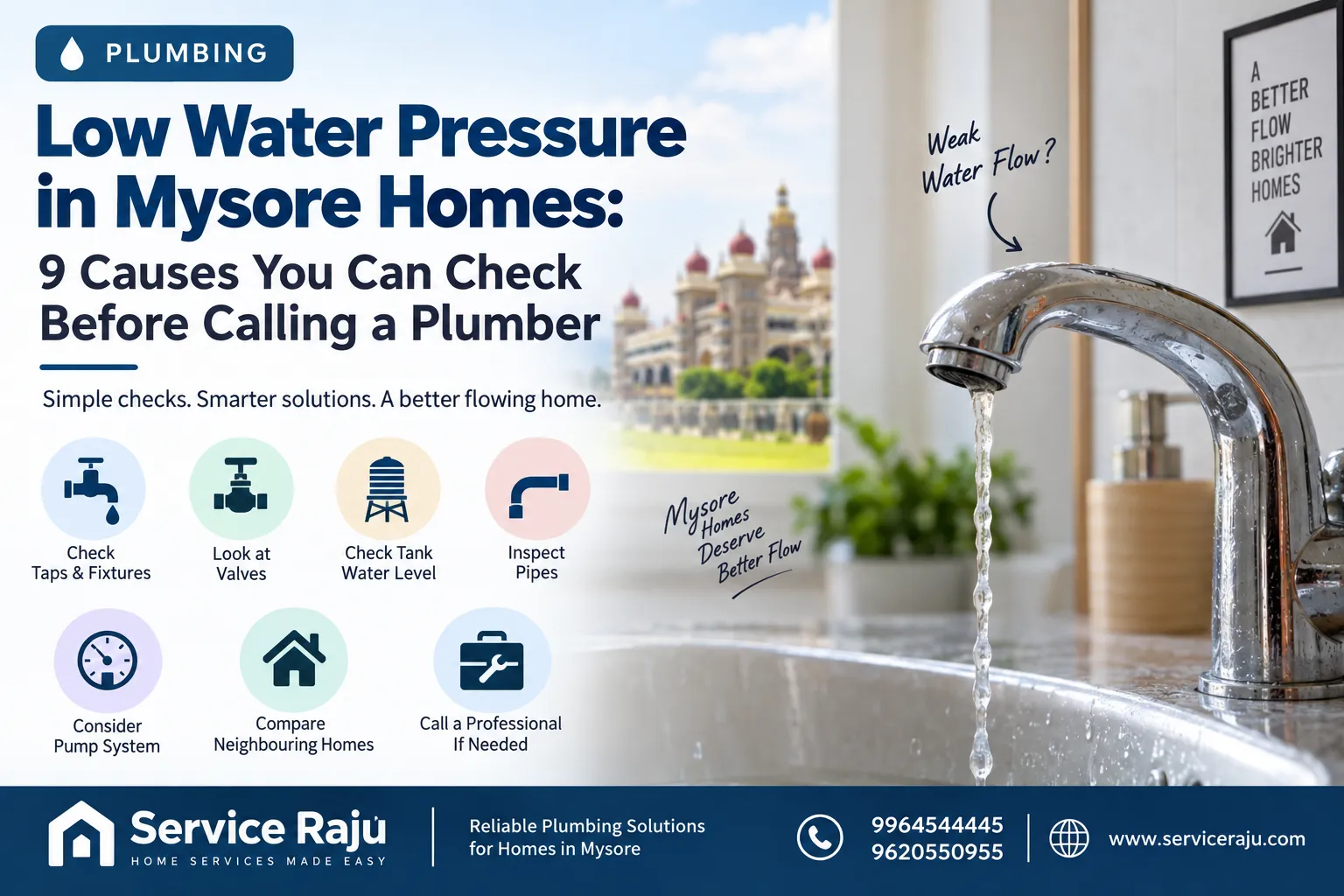
Low Water Pressure in Mysore Homes: 9 Causes You Can Check Before Calling a Plumber
1. Low Water Pressure in Mysore Homes: 9 Causes You Can Check Before Calling a Plumber
A weak shower, slow kitchen tap or bathroom faucet that suddenly takes twice as long to fill a bucket can be frustrating. But before replacing a pump or calling for major plumbing work, the first question is: Where exactly is the water pressure low?
That single observation can narrow down the possible cause considerably.
In a typical Indian home supplied from an overhead tank, available pressure depends partly on the vertical distance between the water level in the tank and the outlet. Pipe size, valves, fittings, fixture condition and the number of outlets being used at the same time also affect the flow you experience.
For homeowners searching for low water pressure Mysore solutions, the most useful first step is therefore not buying a pressure pump. It is identifying where the water is being restricted or pressure is being lost.
2. Quick Answer: Start With Where the Pressure Is Low
Use this simple observation to identify where you should begin checking:
| What You Notice | Possible Area to Investigate |
|---|---|
| Only one tap is weak | Tap aerator, angle valve, flexible pipe or local blockage |
| Only one shower is weak | Showerhead, valve, pipe branch or fitting |
| Entire bathroom is weak | Bathroom supply branch, valve or pipe restriction |
| One floor is weak | Tank height, floor branch or gravity limitation |
| Whole house is weak | Tank, main valve, inlet, pipe restriction, supply or pressure system |
| Pressure drops when two taps open | Pipe capacity, branch arrangement or available pressure |
| Pressure suddenly became weak | Valve, air lock, leak, supply change or component fault |
| Pressure gradually became weaker | Scale, corrosion, pipe restriction or ageing components |
This does not prove the cause. It simply tells you where to start looking.
3. Why Water Pressure Varies Inside a Mysore Home
Many Mysuru houses use an underground sump or water source that feeds an overhead tank. Water is then distributed from the overhead tank to fixtures.
In a gravity-fed system, the vertical difference between the tank's water surface and a tap creates the available static pressure. A larger vertical drop generally provides more pressure. A fixture located close to the tank level may therefore have less available pressure.
Pipe diameter, pipe length, fittings and simultaneous water demand can also affect the flow that reaches a fixture.
This is why you can sometimes have:
- Good pressure downstairs
- Weak pressure upstairs
- Good kitchen flow
- Weak shower flow
- Good cold-water flow
- Poor hot-water flow
without having one single problem affecting the entire house.
4. 9 Causes of Low Water Pressure
5. 1. A Clogged Tap Aerator or Showerhead
If only one tap or shower has become weak, start with the fixture itself.
Small openings inside aerators and showerheads can collect:
- Mineral deposits
- Sand
- Sediment
- Pipe debris
- Scale
The result may be a weak stream even though the rest of the house has normal flow.
A useful clue: If the kitchen tap works normally but one bathroom tap suddenly becomes weak, there is less reason to immediately suspect the main water line.
The problem may be local to that fixture.
Remove and clean the aerator or showerhead if it is designed for easy removal. If the flow remains poor, the restriction may be farther back in the line.
6. 2. A Partially Closed Valve
This is one of the simplest causes to overlook.
A valve may be partially closed after:
- Plumbing repair
- Bathroom renovation
- Geyser installation
- Tap replacement
- Water-line maintenance
A valve that looks open may not actually be fully open.
Check accessible isolation valves associated with the affected fixture.
Do not force a stuck valve. Old valves can break or begin leaking when excessive force is applied.
7. 3. Low Overhead-Tank Level
A low water level can reduce the available pressure in a gravity-fed system because the height of the water surface above the outlet is reduced.
This may be especially noticeable on an upper floor.
Check:
- Is the overhead tank receiving water?
- Did the pump run correctly?
- Is the tank level unusually low?
- Is the float valve functioning?
- Does the problem occur shortly before the tank refills?
If the pressure improves significantly after the tank fills, the tank and supply arrangement deserve closer attention.
8. 4. The Tank Is Not High Enough Above the Fixture
Sometimes the system is working exactly as designed, but the available gravity head is simply limited.
The pressure available from a gravity-fed system depends on the height difference between the tank water level and the fixture.
This can become obvious when:
- Ground-floor taps are strong
- First-floor taps are moderate
- Top-floor shower is weak
It can also become more noticeable after installing a large rain shower that requires stronger flow than the previous showerhead.
In such cases, simply replacing the showerhead may not solve the underlying limitation.
A plumber may need to assess the tank height, pipe route and whether a suitable booster arrangement is appropriate.
9. 5. Two or More Fixtures Are Sharing a Restricted Supply Line
Have you noticed this?
The shower works reasonably well when nobody is using the kitchen. Then someone opens the kitchen tap and suddenly the shower becomes weak.
That is an important clue.
When multiple fixtures operate simultaneously, the available flow has to be shared across the distribution system.
If a branch is undersized, excessively long or poorly arranged, the pressure or flow at individual fixtures can fall when demand increases.
This is particularly relevant in homes where additional bathrooms or fixtures were added after the original plumbing was installed.
10. 6. Old Pipes May Have Become Restricted
Older metal plumbing lines can develop internal corrosion and deposits over time.
The internal passage becomes smaller.
Even though the pipe may look normal from outside, the effective waterway inside can become significantly restricted.
A gradual pattern is an important clue:
Good pressure → slowly weaker over months or years → multiple fixtures eventually affected.
That pattern is different from a tap suddenly becoming weak because of a clogged aerator.
If old piping is suspected, repeated fixture replacement will not solve the underlying restriction.
A plumber may need to inspect accessible pipe sections and determine whether cleaning, repair or replacement is appropriate.
11. 7. An Air Lock May Be Restricting Flow
Air can sometimes become trapped in sections of a water-supply line, particularly after:
- The overhead tank becomes empty
- Plumbing work is completed
- A pipeline is drained
- A supply line is disconnected and reconnected
The symptoms can include:
- Spitting water
- Intermittent flow
- Water coming out strongly and then weakening
- Gurgling or unusual flow behaviour
Air-lock diagnosis depends on the plumbing arrangement, so do not assume every weak tap is caused by trapped air.
If the problem began immediately after plumbing work or the tank ran completely dry, however, it is worth considering.
12. 8. A Pressure Pump or Booster System May Have a Problem
Some homes and apartments use pumps or pressure-boosting systems to improve water delivery.
If the system previously provided good pressure and then suddenly became weak, possible areas for inspection include:
- Pump operation
- Electrical supply
- Pressure-control components
- Valves
- Filters
- Pipe connections
- Air entering the system
- Pump-related mechanical faults
Do not automatically increase pump settings without understanding the system.
A pressure increase that is inappropriate for the plumbing installation can create other problems.
13. 9. The Problem May Be Outside Your Home
Not every pressure problem begins inside the house.
If several nearby homes experience a similar reduction at approximately the same time, the cause may be associated with the external water supply rather than one property's internal plumbing.
This distinction matters.
Ask: "Are my neighbours experiencing the same problem?"
If yes, investigate the external supply.
If your neighbours have normal flow but your home has suddenly lost pressure, your internal plumbing deserves closer attention.
14. One Tap vs One Bathroom vs Whole House
This is one of the most useful observations you can make.
15. If Only One Tap Is Weak
Check:
- Aerator
- Tap cartridge
- Angle valve
- Flexible connector
- Local pipe restriction
The problem is more likely to be close to that fixture.
16. If One Bathroom Is Weak
Check:
- Bathroom isolation valve
- Supply branch
- Showerhead and taps
- Pipe restriction
- Branch-line configuration
If every fixture in that bathroom is affected but the kitchen is normal, the problem is unlikely to be just one tap.
17. If One Floor Is Weak
Consider:
- Vertical pipe arrangement
- Tank height
- Floor branch
- Pipe diameter
- Valve condition
- Gravity limitations
This is especially important in multi-storey houses.
18. If the Whole House Is Weak
Look farther upstream:
- Overhead tank level
- Main valve
- Inlet supply
- Pump
- Pressure system
- Major pipe restriction
- External water supply
- Possible leak
A whole-house problem generally deserves more systematic diagnosis than simply replacing individual taps.
19. What You Can Safely Check Yourself
Before calling a plumber, you can perform a few simple observations.
20. Check 1: Compare Multiple Fixtures
Open the kitchen tap, bathroom basin, shower and another floor's tap if available.
Record which ones are weak.
21. Check 2: Check the Tank
If your home uses a
 AC Repair
.webp) Ant Control Service
Ant Control Service
 Basin & Sink Services
.webp) Bath & Shower Services
Bath & Shower Services
.webp) Bath Fittings & Mirrors
Bath Fittings & Mirrors
 Bathroom Cleaning Service
 Bathroom Renovation Services
 Bed Bug Control Services
 Bedroom Painting
 Book a Carpenter Consultation
 Book Electrical Consulting
.webp) Cabinet Painting & Wood Refinishing
Cabinet Painting & Wood Refinishing
 Chimney Cleaning
 Civil Masonry Work
 Clean-Up Services
.webp) Clothes Hanger Installation
Clothes Hanger Installation
 Cockroach Control Services
---mysore-mysore-standard-300x200.webp) Commercial Cleaning
Commercial Cleaning
 Commercial Pest Control AMC Service
 Cupboard & Drawer Services
 Decorative Wall Panels
 Deep Sanitisation Service
 Detan & Bleach
 Door, Grill & Cabinet Painting Service
.webp) Doorbell & security
Doorbell & security
 Drain Blockage Clearing
 Electrical Appliance Services
 Electrical Wiring Services
 Empty Home Deep Cleaning
.webp) Fabrication
Fabrication
 Facials
.webp) Fan Installation & Repair
Fan Installation & Repair
 Full Home Cleaning Service
 Full Home Renovation
 Furniture Repair Service
 Gas Stove & Hob Repair
.webp) General Pest Control Services
General Pest Control Services
 General Plumbing & Consultation
 Geyser Repair
 Glass Cleaning
 Head Massage
.webp) Honeybee & Wasp-Services
Honeybee & Wasp-Services
 Kitchen & Bathroom Painting Service
 Kitchen Cleaning
 Kitchen Fittings
.webp) Kitchen Renovation
Kitchen Renovation
.webp) Laptop/Desktop service
Laptop/Desktop service
 Leak Detection and Repair
 LED TV Repair
 Living and Dining Room Painting
 Makeup, Saree & Styling
 Manicure & Pedicure
 MCB,Meter & Fuse Services
 Microwave Repair
 Mosquito Pest Control Service
 Multi-Room Painting Service
 Painting Consultation
 Quick Mini Cleaning Services
 Refrigerator Repair
 RO Water Purifier
.webp) Rodent Control Services (Rat & Mice Treatment)
Rodent Control Services (Rat & Mice Treatment)
.webp) Rooms Cleaning
Rooms Cleaning
 Shelves & Decor
 Sofa, Carpet & Mattress Cleaning
 Solar Water Heater Service
 Sump & Tank Cleaning
 Switch & Socket Services
 Tap & Mixer Service
.webp) Termite-Control-Services
Termite-Control-Services
 Threading & Face Wax
.webp) Tile & Granite Installation & Polishing
Tile & Granite Installation & Polishing
 Toilet & Commode Services
.webp) UPS and Inverter Repair Services
UPS and Inverter Repair Services
.webp) Wall Painting Service
Wall Painting Service
 Washing Machine Repair
 Water Level Controllers
 Water Tank and Pump Repair
 Waterproofing
 Waterproofing Services
 Waxing
 Window & Curtain Services
 Wooden Door Services