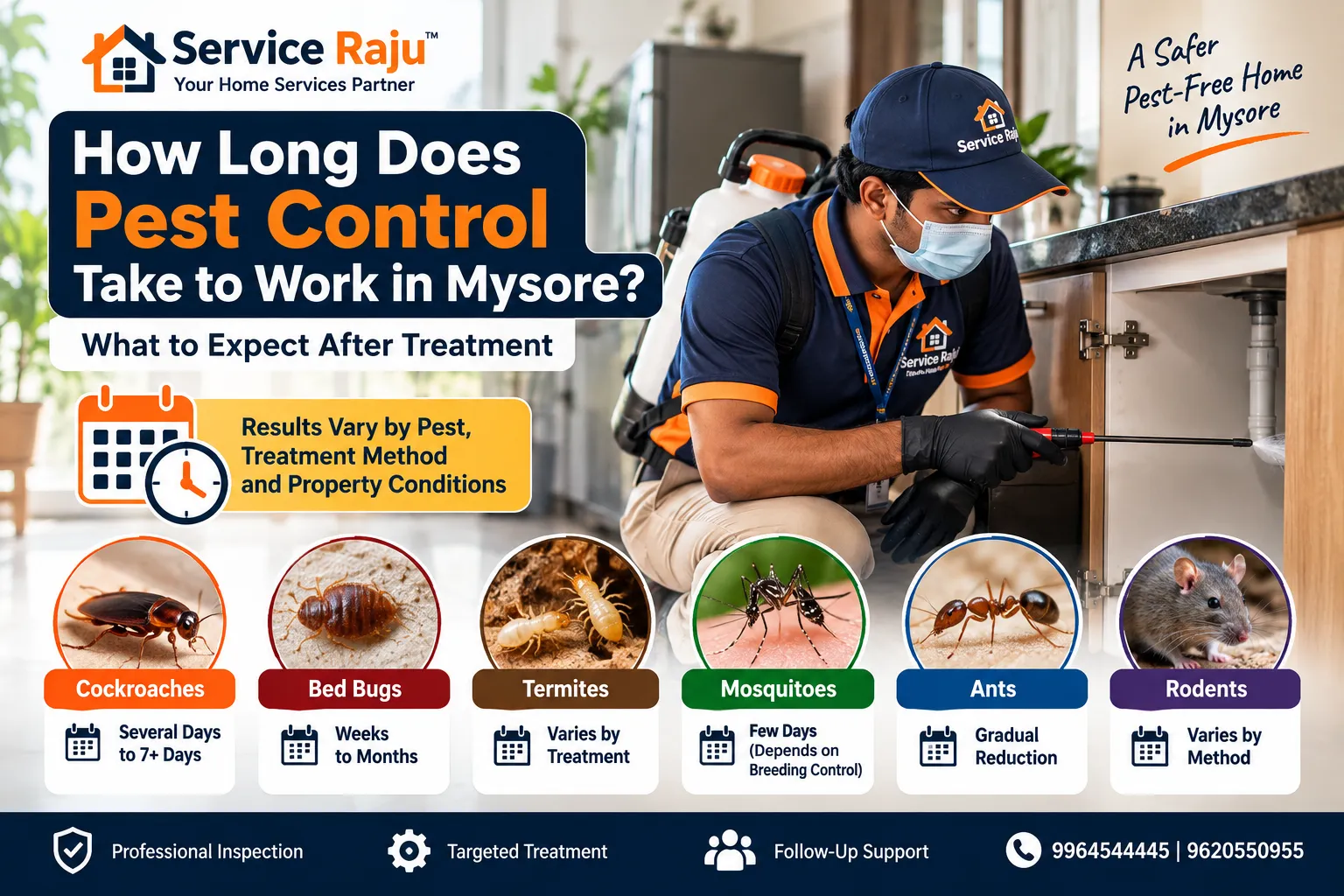
How Long Does Pest Control Take to Work in Mysore?
1. How Long Does Pest Control Take to Work in Mysore?
One of the most common questions after a pest-control visit is: “The treatment is finished, so why am I still seeing pests?”
The answer is not always “the treatment did not work.” The question how long does pest control take to work in Mysore has no single answer because different pests, treatment methods, infestation levels and property conditions behave differently.
A technician may complete a treatment visit relatively quickly, while the treatment effect continues afterward.
Cockroach bait programs can take 7 days or longer before fewer cockroaches are observed. Bed-bug control can take weeks to months and may require repeated treatment. Termite control can involve different systems, including liquid barriers and slow-acting bait systems.
The most important distinction is:
Service duration is not the same as time to results.
2. Quick Answer: How Long Does Pest Control Take to Work?
There is no universal treatment timeline.
| Pest | What Customers May Expect |
|---|---|
| Cockroaches | Noticeable reduction may take several days; bait programs can take 7 days or longer. |
| Bed bugs | Control can take weeks to months and may require follow-up. |
| Termites | Results depend on the treatment system, infestation and monitoring. |
| Mosquitoes | Results depend heavily on adult control and breeding-source management. |
| Ants | Activity may reduce gradually depending on nest location and treatment method. |
| Rodents | Control depends on trapping or baiting plus entry-point and food-source management. |
| General pest problems | Timing depends on the pest and treatment selected. |
These are general expectations, not guaranteed timelines. The product label, treatment method and instructions provided for the actual service should take priority.
3. TABLE OF CONTENTS
- Why Pest Control Does Not Always Work Instantly
- Treatment Time vs Time to Results
- How Long Cockroach Pest Control Takes
- How Long Bed Bug Treatment Takes
- How Long Termite Control Takes
- How Long Mosquito Control Takes
- How Long Ant and Rodent Control Takes
- Why You May Still See Pests After Treatment
- 7 Factors That Affect Pest Control Results
- When Continuing Pest Activity Is Normal
- When Should You Contact the Pest-Control Provider?
- What Should You Do After Pest Control?
- How Service Raju Handles Pest-Control Problems in Mysore
- Post-Treatment Monitoring Checklist
- FAQs About Pest Control Results in Mysore
- Final Takeaway
4. Why Pest Control Does Not Always Work Instantly
Many customers imagine pest control as: Technician arrives → treatment is applied → pests disappear.
Real pest management can be more gradual.
A treatment may need time to affect pests hiding inside cracks, cupboards, behind appliances, wall voids, under furniture, drain areas, pipe openings, mattresses, bed frames or storage areas.
The treatment method also matters. A visible spray may provide an immediate reduction in exposed insects, while a bait-based approach may work progressively as pests encounter and consume the bait.
For cockroaches, bait programs may take 7 days or longer before fewer cockroaches are observed.
Bed-bug control can take weeks to months, depending on infestation conditions. Follow-up may be necessary because some pesticides do not kill eggs.
The better question is:
“Is pest activity reducing according to the expected treatment process?”
5. Treatment Time vs Time to Results
6. Treatment Time
Treatment time means how long the technician spends performing the service. It can depend on property size, number of rooms, pest type, infestation level, preparation and treatment method.
7. Time to Results
Time to results means how long it takes before pest activity begins reducing. This can continue after the technician leaves.
A technician may complete a cockroach treatment during one visit while bait continues working afterward.
Similarly, a bed-bug treatment may require monitoring and follow-up rather than being judged only on the first day.
8. How Long Cockroach Pest Control Takes
Cockroach treatment is one of the clearest examples of gradual pest control.
If gel bait or bait stations are used, the objective is not necessarily to kill every cockroach immediately.
UC IPM notes that effective cockroach bait programs may take 7 days or longer before fewer cockroaches are observed.
You may therefore notice:
- A few live cockroaches after treatment
- Reduced activity over several days
- Dead cockroaches
- Activity around untreated food sources
- Cockroaches emerging from previously hidden areas
This does not automatically mean the treatment failed.
9. Why Cockroaches May Continue Appearing
Cockroaches can hide around kitchen cabinets, refrigerator areas, sink cabinets, drains, wall gaps, pipe openings, appliances and storage areas.
Food and water availability can also support continued activity.
That is why pest control should be combined with practical prevention and sanitation.
10. How Long Bed Bug Treatment Takes
Bed bugs require a different expectation.
The U.S. EPA states that treating bed bugs can take weeks to months, depending on the extent of infestation and other conditions.
Some pesticides do not kill eggs, so newly hatched bugs may appear after the initial treatment.
A bed-bug control program may therefore involve:
- Identification
- Inspection
- Preparation
- Initial treatment
- Monitoring
- Follow-up inspection
- Additional treatment if required
11. How Long Termite Control Takes
Termite control should not be judged in exactly the same way as cockroach control.
The treatment system matters.
Termite-control approaches can include liquid soil-applied termiticides, termite baits and wood treatments. Some termite bait systems use slow-acting insecticides.
A professional termite program may involve inspection, identifying activity, locating likely entry or feeding areas, selecting a treatment approach, treatment, monitoring and follow-up where required.
If termite activity appears again, the property should be reassessed rather than automatically repeating exactly the same treatment.
12. How Long Mosquito Control Takes
Mosquito control can sometimes produce a quick reduction in adult mosquito activity.
But another important question is: Where are new mosquitoes coming from?
- Standing water
- Plant trays
- Open containers
- Blocked drains
- Roof or terrace water
- Outdoor storage containers
- Water-storage areas
If breeding sources remain, new mosquitoes can continue emerging.
13. How Long Ant and Rodent Control Takes
14. Ants
Ant trails can reduce gradually depending on the treatment method and whether the colony source is being addressed.
15. Rodents
Rodent control can require monitoring because rodents may hide in false ceilings, storage areas, wall voids, utility spaces, kitchens and drainage areas.
Control may involve trapping, baiting, sanitation and closing entry points.
16. Why You May Still See Pests After Treatment
17. 1. The treatment needs more time
Some treatments are deliberately slow acting.
18. 2. Eggs have survived
This is particularly important with bed bugs because some treatments may not kill eggs.
19. 3. Some harbourage areas remain
Pests can hide in areas that are difficult to access.
20. 4. Food or water is still available
Sanitation and moisture conditions can support pest activity.
21. 5. New pests are entering
A treatment cannot automatically prevent every pest from entering from outside or neighbouring properties.
22. 6. The wrong pest was identified
Cockroaches, termites, bed bugs, mosquitoes and rodents require different control approaches.
23. 7. Follow-up is needed
Some infestations require monitoring or additional treatment.
24. 7 Factors That Affect Pest Control Results
- Pest Species: Different pests have different behaviour and life cycles.
- Infestation Size: A small infestation can behave differently from an established infestation.
- Treatment Method: Gel, bait, spray, trap and exclusion methods work differently.
- Property Layout: Apartments, independent houses and commercial properties have different access points.
- Preparation: Clutter and inaccessible areas can make inspection and treatment more difficult.
- Food and Moisture: Food residue, leaks and standing water can support pest activity.
- Follow-Up: Some pest problems need monitoring and additional treatment.
25. When Continuing Pest Activity Is Normal
A few pest sightings immediately after treatment do not automatically prove failure.
Cockroaches: A gradual decline can occur with bait-based programs.
Bed bugs: Activity can continue while surviving eggs hatch, which is why monitoring and follow-up can be necessary.
Termites: Visible activity needs to be interpreted according to the treatment system.
Mosquitoes: New adults may appear if breeding areas remain.
The useful measurement is the trend.
26. When Should You Contact the Pest-Control Provider?
- Pest activity remains unchanged.
- Activity increases.
- New rooms become affected.
- Live pests continue appearing regularly.
- Original hotspots show no improvement.
- A follow-up visit was recommended.
- You are unsure what post-treatment cleaning is allowed.
- You suspect untreated areas.
- The pest may have been incorrectly identified.
27. What Should You Do After Pest Control?
28. Follow Re-Entry Instructions
The correct re-entry period depends on the actual product and application method.
29. Do Not Immediately Clean Treated Areas
Some treatments need to remain undisturbed. Ask the technician which areas can be cleaned and when.
30. Do Not Automatically Apply Another Pesticide
A second chemical treatment can interfere with an existing treatment strategy and may create unnecessary exposure.
31. Keep Food Properly Stored
Reduce accessible food sources.
32. Remove Unnecessary Moisture
Repair leaks and standing-water sources where possible.
33. Monitor Activity
Write down sightings instead of relying on memory.
Day 1 → 7 sightings
Day 4 → 4 sightings
Day 8 → 1 sighting
That trend is much more useful than saying “I saw one cockroach.”
34. How Service Raju Handles Pest-Control Problems in Mysore
Service Raju's pest-control approach emphasizes understanding the pest problem, affected areas, likely entry points, previous treatment and the appropriate service requirement before treatment is selected.
Available pest-control services include:
- General Pest Control
- Cockroach Control
- Termite Control
- Bed Bug Control
- Mosquito Pest Control
- Rodent Control
- Honey Bee & Wasp Removal
- Commercial Pest Control
35. Typical Service Journey
- Customer enquiry
- Problem understanding
- Inspection or diagnosis where required
- Pest identification
- Treatment recommendation
- Customer approval
- Treatment
- After-treatment guidance
- Monitoring or follow-up where required
Service Raju's published inspection guidance currently lists a ₹99 inspection/diagnosis charge, with treatment charges separate according to the actual requirement.
Service Raju
Mysuru / Mysore & Bengaluru
9964544445
9620550955
www.serviceraju.com
36. Post-Treatment Monitoring Checklist
37. First 24 Hours
- ☐ Follow re-entry instructions
- ☐ Follow cleaning instructions
- ☐ Do not add another pesticide
- ☐ Keep treated areas as instructed
38. First Week
- ☐ Monitor pest sightings
- ☐ Check original hotspots
- ☐ Keep food stored properly
- ☐ Remove unnecessary moisture
- ☐ Record changes in activity
39. After the Expected Treatment Period
- ☐ Compare activity with the pre-treatment level
- ☐ Contact the provider if activity is not reducing
- ☐ Ask whether follow-up is required
- ☐ Check for new entry points
- ☐ Review sanitation and moisture conditions
40. FAQs About Pest Control Results in Mysore
41. How long does pest control take to work in Mysore?
There is no universal timeframe. It depends on the pest, treatment method, infestation level, property conditions and whether follow-up is needed. Cockroach bait programs may take seven days or longer before fewer cockroaches are observed.
42. How long does a pest-control visit take?
The visit duration and time to results are different. Treatment time depends on property size, pest type, infestation level and treatment scope.
43. Why am I still seeing cockroaches after pest control?
Cockroach bait programs can take seven days or longer to show fewer cockroaches. Food, water, hiding places and new entry can also contribute to continuing activity.
44. How long does bed bug treatment take to work?
Bed-bug control can take weeks to months, depending on infestation conditions, and repeated treatment may be necessary.
45. Does termite treatment work immediately?
Not necessarily. The expected result depends on whether the treatment uses a liquid barrier, bait system, wood treatment or another approach.
46. Is it normal to see pests after treatment?
It can be, depending on the pest and treatment method. The more useful question is whether activity is reducing over the expected period.
47. What if pest activity is not reducing?
Contact the pest-control provider for reassessment. Possible causes include insufficient time, untreated harbourage, continuing food or moisture sources, new pest entry or the need for follow-up.
48. Can I spray another pesticide after professional pest control?
Do not automatically do so. Follow the treatment provider's instructions and the product label.
49. Does one treatment permanently prevent pests?
No responsible pest-control service should promise permanent protection from every future pest. Building conditions, entry points, sanitation, moisture and new pest introduction can all affect future activity.
50. Should I book a follow-up pest-control visit?
If the treatment plan recommends monitoring or follow-up, follow that plan. Bed-bug infestations in particular may require repeated treatment because some pesticides do not kill eggs.
51. Final Takeaway
The answer to how long does pest control take to work in Mysore is not simply “one day.”
The technician's visit may finish quickly, but pest control can continue working afterward.
Cockroach bait may take seven days or longer. Bed-bug control can take weeks to months. Termite control depends on the treatment system and monitoring process. Mosquito control also depends on breeding-source management.
Don't judge a treatment only by what you see immediately after the technician leaves.
Instead:
Monitor → Compare Activity → Follow Instructions → Reassess When Necessary
Good pest control is not simply about killing the insects that are visible today. It is about understanding the pest, the property and the conditions allowing the infestation to continue.
For professional pest-control inspection and treatment in Mysuru and Bengaluru:
Service Raju
9964544445 | 9620550955
www.serviceraju.com
 AC Repair
.webp) Ant Control Service
Ant Control Service
 Basin & Sink Services
.webp) Bath & Shower Services
Bath & Shower Services
.webp) Bath Fittings & Mirrors
Bath Fittings & Mirrors
 Bathroom Cleaning Service
 Bathroom Renovation Services
 Bed Bug Control Services
 Bedroom Painting
 Book a Carpenter Consultation
 Book Electrical Consulting
.webp) Cabinet Painting & Wood Refinishing
Cabinet Painting & Wood Refinishing
 Chimney Cleaning
 Civil Masonry Work
 Clean-Up Services
.webp) Clothes Hanger Installation
Clothes Hanger Installation
 Cockroach Control Services
---mysore-mysore-standard-300x200.webp) Commercial Cleaning
Commercial Cleaning
 Commercial Pest Control AMC Service
 Cupboard & Drawer Services
 Decorative Wall Panels
 Deep Sanitisation Service
 Detan & Bleach
 Door, Grill & Cabinet Painting Service
.webp) Doorbell & security
Doorbell & security
 Drain Blockage Clearing
 Electrical Appliance Services
 Electrical Wiring Services
 Empty Home Deep Cleaning
.webp) Fabrication
Fabrication
 Facials
.webp) Fan Installation & Repair
Fan Installation & Repair
 Full Home Cleaning Service
 Full Home Renovation
 Furniture Repair Service
 Gas Stove & Hob Repair
.webp) General Pest Control Services
General Pest Control Services
 General Plumbing & Consultation
 Geyser Repair
 Glass Cleaning
 Head Massage
.webp) Honeybee & Wasp-Services
Honeybee & Wasp-Services
 Kitchen & Bathroom Painting Service
 Kitchen Cleaning
 Kitchen Fittings
.webp) Kitchen Renovation
Kitchen Renovation
.webp) Laptop/Desktop service
Laptop/Desktop service
 Leak Detection and Repair
 LED TV Repair
 Living and Dining Room Painting
 Makeup, Saree & Styling
 Manicure & Pedicure
 MCB,Meter & Fuse Services
 Microwave Repair
 Mosquito Pest Control Service
 Multi-Room Painting Service
 Painting Consultation
 Quick Mini Cleaning Services
 Refrigerator Repair
 RO Water Purifier
.webp) Rodent Control Services (Rat & Mice Treatment)
Rodent Control Services (Rat & Mice Treatment)
.webp) Rooms Cleaning
Rooms Cleaning
 Shelves & Decor
 Sofa, Carpet & Mattress Cleaning
 Solar Water Heater Service
 Sump & Tank Cleaning
 Switch & Socket Services
 Tap & Mixer Service
.webp) Termite-Control-Services
Termite-Control-Services
 Threading & Face Wax
.webp) Tile & Granite Installation & Polishing
Tile & Granite Installation & Polishing
 Toilet & Commode Services
.webp) UPS and Inverter Repair Services
UPS and Inverter Repair Services
.webp) Wall Painting Service
Wall Painting Service
 Washing Machine Repair
 Water Level Controllers
 Water Tank and Pump Repair
 Waterproofing
 Waterproofing Services
 Waxing
 Window & Curtain Services
 Wooden Door Services