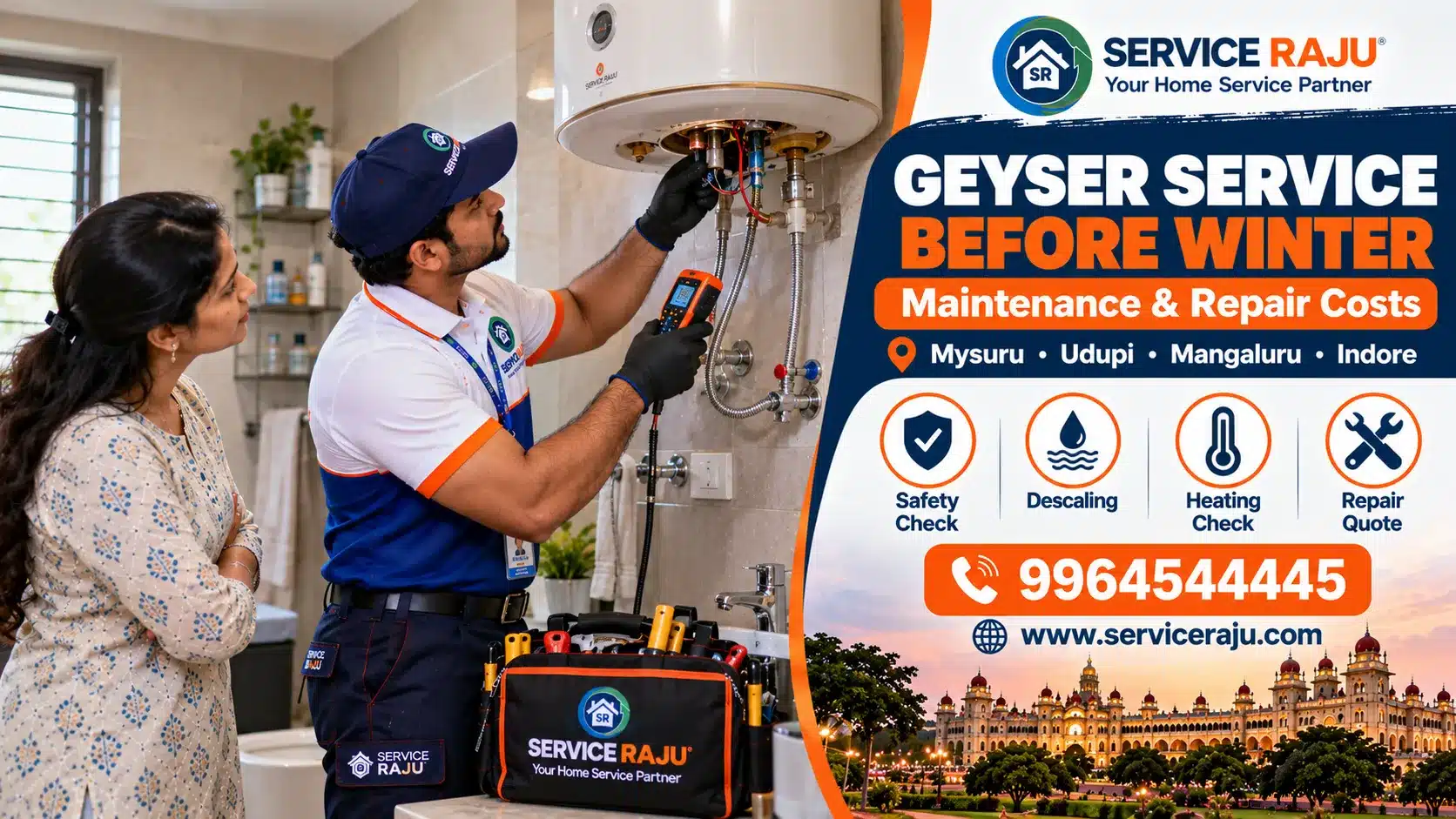
Geyser Service Before Winter: Maintenance & Repair Costs
Winter is approaching, and for many homes a geyser quickly becomes one of the most-used appliances of the day. Booking geyser service before heavy seasonal use can help identify leaks, scaling, heating problems, electrical issues and worn components before a breakdown leaves you without hot water.
But winter preparation should not be identical across every Service Raju location. Mysuru has a relatively moderate, cool winter, Udupi has a warm coastal climate with cooler December-to-February conditions, Mangaluru's more comfortable season runs broadly from October to February, while Indore experiences a more pronounced cool season from October into March. Karnataka Tourism also describes October to February as the state's winter period and notes cooler conditions in Mysuru and coastal Karnataka.
That means Geyser maintenance is useful in all four cities, but the timing and intensity of preparation can differ.
This guide explains what a professional Water heater service should cover before winter, the warning signs that should not be ignored, when Geyser descaling may be required, and what you can expect when comparing repair costs.
Quick Answer: When Should You Service Your Geyser Before Winter?
A practical pre-winter service window is October to early November for many homes, with earlier attention where the appliance has known problems, heavy scaling, leaks or electrical symptoms. Voltas recommends an annual pre-winter check and specifically identifies October or early November as a suitable maintenance period.
For Service Raju's locations:
| City | Practical Seasonal Focus |
|---|---|
| Mysuru | Check the geyser around October–November before cooler winter use increases |
| Udupi | Focus on maintenance before the cooler December–February period |
| Mangaluru | Pre-winter checks are useful from October, ahead of the cooler season |
| Indore | Earlier preventive service can be useful before the colder November–January period |
These are practical seasonal recommendations, not fixed service deadlines. The appliance's condition and the manufacturer's maintenance instructions should come first.
Table of Contents
- Why Geyser Service Before Winter Matters
- 10 Things a Professional Geyser Service Should Check
- 7 Common Geyser Problems Before Winter
- Safe Checks You Can Do at Home
- When Does a Geyser Need Descaling?
- Geyser Repair Cost: What You May Pay
- Repair or Replace Your Geyser?
- Seasonal Geyser Care: Mysuru, Udupi, Mangaluru & Indore
- Geyser Service by Service Raju
- FAQs
- Final Takeaway
Why Geyser Service Before Winter Matters
A geyser can appear to work normally during warmer months but show problems when daily hot-water demand increases.
Colder incoming water can increase the time and energy needed to reach the desired temperature. Voltas notes that winter puts additional demand on water heaters because inlet water is colder and heating cycles can become longer.
A pre-winter inspection can identify problems such as:
- Heating-element scaling
- Thermostat problems
- Thermal cut-out issues
- Water leakage
- Loose electrical connections
- Safety-valve problems
- Corrosion
- Sediment accumulation
The goal is not to service a geyser simply because the calendar says winter is coming. The goal is to make sure the appliance is safe and ready for the level of use you expect.
10 Things a Professional Geyser Service Should Check
1. Visible Leaks and Water Connections
The technician should inspect the geyser body, inlet and outlet connections, visible pipe joints and surrounding wall or floor for signs of leakage.
Look for:
- Water drops around connections
- Water collecting below the unit
- Rust or corrosion around fittings
- Dampness on the nearby wall
- Pressure-related dripping that appears abnormal
A small plumbing leak should not be ignored because repeated moisture can damage the surrounding wall, fittings or electrical components.
2. Heating Element Condition
The heating element is one of the most important components in an electric geyser.
Mineral scale can build up on the element, particularly where the incoming water contains dissolved minerals. Voltas identifies limescale on heating elements as a factor that can reduce heat transfer and increase heating time.
A technician may inspect the element for:
- Visible scale
- Burn marks
- Corrosion
- Damage
- Electrical continuity
Heavy scaling may require professional cleaning or replacement depending on the element's condition.
3. Thermostat and Temperature Control
The thermostat controls water temperature and helps prevent excessive heating.
A faulty thermostat can result in:
- Lukewarm water
- Water that becomes excessively hot
- Unstable temperature
- Unexpected heating cut-off
- Repeated thermal protection activation
Thermostat testing should be performed by a qualified technician rather than opening the electrical cover yourself.
4. Thermal Cut-Out and Safety Protection
Electric water heaters have safety systems designed to interrupt heating when abnormal temperature conditions occur.
If the geyser repeatedly trips its thermal protection or circuit protection, the symptom should be investigated rather than repeatedly reset.
Voltas and other manufacturer guidance identify the thermostat, safety systems and electrical condition as important pre-winter checks.
5. Electrical Wiring and Earthing
Water and electricity make geyser safety particularly important.
A professional Water heater service should check appropriate electrical connections, wiring condition, earthing and signs of overheating where accessible.
Watch for:
- Burning smell
- Discoloured switches or wires
- Repeated MCB tripping
- Sparking
- Shock or tingling sensation from the tap or water
- Loose or damaged cable insulation
If you experience a shock or repeated electrical tripping, switch off the power safely and arrange professional inspection rather than continuing to use the geyser.
6. Safety Valve and Pressure Protection
The pressure-relief system is a critical safety component of a storage water heater.
The technician should check the safety valve and associated pressure-protection arrangement for:
- Leakage
- Corrosion
- Incorrect installation
- Blocked discharge path
- Visible damage
Do not dismantle or bypass a safety valve. It should never be disabled simply to stop occasional dripping without determining why the valve is releasing water.
7. Tank Sediment and Internal Scaling
Storage geysers can accumulate sediment and mineral deposits over time.
Possible signs include:
- Longer heating time
- Rumbling or popping noises
- Reduced hot-water output
- Inconsistent heating
- Increased electricity consumption
Voltas identifies sediment and mineral accumulation as reasons for reduced heating efficiency and recommends periodic flushing and professional maintenance.
8. Anode Rod and Corrosion Protection
Some storage water heaters use a sacrificial anode to help protect the tank from corrosion.
During a professional service, the technician can determine whether the model has an anode rod and whether it requires inspection or replacement.
This is especially relevant if the geyser shows:
- Rust-coloured water
- Corrosion around the tank
- Repeated leakage
- Unusual tank deterioration
The exact maintenance interval depends on the water heater design, water conditions and manufacturer's instructions.
9. Water Flow and Inlet/Outlet Connections
A geyser can have heating components in good condition while the water flow remains poor because of a plumbing restriction.
The technician should consider:
- Inlet flow
- Outlet flow
- Flexible hoses
- Valves
- Blocked filters where fitted
- Pressure conditions
If the hot-water flow is weak but the geyser heats normally, the problem may be plumbing-related rather than a heating failure.
10. Overall Appliance Condition
A good seasonal service should end with an overall assessment.
Ask the technician:
- Is the geyser safe to continue using?
- Does it need cleaning or descaling?
- Are any parts close to failure?
- Is the tank showing corrosion?
- What repair should be done now?
- What maintenance should be planned later?
This helps you avoid both unnecessary part replacement and ignoring a genuine safety issue.
7 Common Geyser Problems Before Winter
1. Geyser Takes Too Long to Heat
Possible causes include scale on the heating element, a partially failing element, thermostat problems, low voltage or excessive heat loss.
2. Water Is Only Lukewarm
This can happen when the element is damaged or heavily scaled, the thermostat is faulty or the appliance is not receiving the correct electrical supply.
3. Geyser Makes Popping or Rumbling Sounds
Unusual sounds can be associated with sediment or mineral deposits around the heating area. Persistent noise should be checked rather than ignored.
4. Water Is Leaking
Leakage may come from a connection, valve, pipe joint or the tank itself. A leaking tank can indicate a more serious problem than a loose fitting.
5. MCB Keeps Tripping
Repeated electrical tripping should not be treated as a normal geyser behaviour. It can indicate an electrical fault requiring professional diagnosis.
6. Rust-Coloured Water Appears
Discoloured water can be associated with corrosion or other water-quality issues. The tank and water system should be assessed before continued use if the problem is persistent.
7. Hot-Water Flow Is Weak
Weak flow can come from plumbing restrictions, valves, flexible hoses or other inlet/outlet issues and does not necessarily mean the heating element is faulty.
Safe Checks You Can Do at Home
Some basic checks are reasonable for homeowners. Internal electrical or pressure-system work is not.
Check the Power Switch
Make sure the geyser's external power switch is on and that there is no obvious household power issue.
Check for Visible Leakage
Look around the exposed inlet/outlet connections and the area beneath the geyser.
Check the Temperature Behaviour
Notice whether the water is completely cold, lukewarm, excessively hot or changing temperature unexpectedly.
Listen for New Noises
Note popping, rumbling, hissing or other sounds that were not present previously.
Check the Surrounding Area
Make sure the geyser is not surrounded by excessive moisture and that electrical switches and connections remain dry.
Do not remove the geyser cover, touch internal wiring, open the pressure system or attempt electrical repairs yourself.
When Does a Geyser Need Descaling?
Geyser descaling is particularly relevant when mineral deposits accumulate on the heating element or inside the tank.
Common clues include:
- Heating takes longer than before
- Energy consumption appears higher
- Popping or rumbling sounds develop
- The element is visibly scaled during service
- The geyser has not been serviced for a long period
- The property receives mineral-rich water
Voltas recommends periodic sediment flushing and annual professional service, and identifies hard-water scale as a contributor to reduced heating efficiency.
Descaling should follow the manufacturer's instructions and the construction of the specific geyser. A technician should decide whether cleaning is sufficient or whether a heavily scaled or damaged element needs replacement.
Geyser Repair Cost: What You May Pay
The cost of Geyser repair varies with brand, capacity, model, fault, parts, accessibility and labour. Do not treat one online price as a universal Mysuru, Udupi, Mangaluru or Indore rate.
Service Raju's currently published Mysuru appliance-service page lists the following service packages:
| Service | Current Published Price | What It Covers |
|---|---|---|
| Geyser Inspection & Diagnosis | ₹249 | Full diagnostic inspection, thermostat testing, electrical safety audit, leakage detection and post-service cleanup |
| Geyser Service & Repair | ₹499 | Full dismantling, leak check, heating-rod descaling, tank deep cleaning and exterior cleanup |
| Geyser Installation | ₹499 | Secure mounting, pipe connections, power-safety testing and functional test |
| Geyser Uninstallation | ₹399 | Power disconnection, water drainage, bracket removal, pipe capping and cleanup |
Service Raju's currently published 2026 geyser guidance also lists starting prices of approximately ₹450 for thermostat replacement excluding the part, ₹599 for heating-element replacement depending on brand, and ₹799 for full descaling. These are starting prices and the final quotation depends on the actual model, diagnosis, parts and service scope.
Use the figures as a transparent reference point, not as a promise that every geyser repair will cost exactly the same.
What Can Increase the Repair Cost?
- Large-capacity storage geysers
- Premium or brand-specific parts
- Severely scaled heating elements
- Internal wiring damage
- Tank corrosion
- Safety-valve replacement
- Multiple failed components
- Hard-to-access installations
What Should Be Included in a Repair Quote?
Before approving repair, ask for:
- Diagnosis
- Part name
- Part price
- Labour charge
- Cleaning or descaling charge
- Total amount
- Repair/part warranty
A clear quotation makes it easier to decide whether repairing the existing geyser is sensible.
Repair or Replace Your Geyser?
Pre-winter service is also a good time to decide whether an ageing geyser should continue operating.
Repair May Make Sense When:
- The tank is structurally sound.
- The fault is limited to a replaceable component.
- Spare parts are available.
- The appliance has otherwise performed reliably.
- The repair cost is reasonable compared with replacement.
Replacement May Make More Sense When:
- The tank has serious corrosion.
- Major leaks are coming from the tank body.
- The appliance has repeated major failures.
- Required parts are unavailable.
- The repair cost is disproportionately high.
- The geyser is very old and inefficient.
Voltas gives a similar general decision framework, noting that minor component repairs can make sense on younger units while heavily corroded or repeatedly failing units may be better candidates for replacement.
There is no universal age or percentage rule that applies to every geyser. The condition of the tank and the diagnosed fault matter more than age alone.
Seasonal Geyser Care: Mysuru, Udupi, Mangaluru & Indore
Mysuru
Mysuru has a relatively moderate climate, with government tourism and district sources describing cooler winter conditions and most rainfall concentrated in the monsoon months. A pre-winter check around October or November is therefore practical before colder mornings increase hot-water use.
Udupi
Udupi's district climate information describes December, January and February as the cooler months, with October and November still warm and damp. That makes late-monsoon or early-winter maintenance a sensible time to check leaks, scaling and electrical condition before cooler use increases.
Mangaluru
Karnataka Tourism lists October to February as Mangaluru's best time to visit, reflecting the city's more comfortable post-monsoon and winter period. For geysers, a maintenance check around the transition into this period can help identify problems before increased hot-water demand.
Indore
Indore's cool season is more pronounced. Madhya Pradesh Tourism describes October to March as a favourable period, while Incredible India lists noticeably lower November and December temperature ranges than summer. A pre-winter geyser inspection can therefore be particularly useful before colder mornings become routine.
Geyser Service by Service Raju
Service Raju provides geyser service and repair support in Mysuru, with service planning that can also be adapted for its other target locations.
Available geyser services include:
- Geyser Inspection & Diagnosis
- Geyser Service & Repair
- Heating-element inspection and replacement
- Thermostat inspection and replacement
- Geyser cleaning and descaling
- Leakage inspection
- Geyser installation
- Geyser uninstallation
What to Tell the Technician
When booking, provide:
- Geyser brand
- Capacity in litres
- Storage or instant type
- Approximate age
- Main problem
- Whether the water is heating slowly
- Whether the MCB trips
- Whether there is leakage
- Whether unusual sounds are present
This information helps the technician prepare for a more useful inspection.
Book Geyser Service Before Winter
Service Raju — Your Home Service Partner
Call / WhatsApp: 9964544445
Website: www.serviceraju.com
FAQs About Geyser Service Before Winter
When should I service my geyser before winter?
A practical time for many Indian homes is October to early November, before winter use becomes frequent. Voltas specifically recommends an annual pre-winter service around October or early November. The exact timing should depend on local climate, appliance condition and manufacturer guidance.
Does every geyser need annual descaling?
Not necessarily. Descaling requirements depend on water conditions, geyser design, usage and the amount of accumulated mineral deposit. A technician should inspect the heating element and tank condition before recommending descaling.
Why does my geyser take longer to heat during winter?
Incoming water is colder during the cooler season, so the heater may need more time to reach the selected temperature. Heavy scaling, a weak heating element or thermostat problems can increase the delay further.
What does geyser servicing include?
It can include inspection, leak checks, heating-element assessment, descaling, thermostat and electrical checks, safety-valve inspection, tank cleaning and testing. The exact scope depends on the service package and geyser condition.
How much does geyser service cost in Mysore?
Service Raju's current published Mysuru page lists ₹249 for geyser inspection and diagnosis and ₹499 for its Geyser Service & Repair package. Published Service Raju guidance also lists starting prices of about ₹450 for thermostat replacement excluding the part, ₹599 for heating-element replacement and ₹799 for full descaling. Final prices depend on diagnosis, model and parts required.
What is geyser descaling?
Descaling is the process of removing mineral deposits that accumulate on the heating element or inside the water-heater system. It can improve heat transfer when scale is the cause of reduced performance.
Should I leave my geyser switched on all day?
Follow the manufacturer's operating guidance. Keeping a geyser powered continuously can cause unnecessary reheating and standby energy use. A properly functioning thermostat should control the heating cycle, but switching it off when hot water is not needed can reduce unnecessary operation.
Why is my geyser making a popping or rumbling sound?
Such noises can be associated with sediment or mineral deposits around the heating area. Persistent unusual noise should be checked during service rather than ignored.
What should I do if my geyser gives me an electric shock?
Stop using the geyser and switch off its power safely. Do not touch or investigate internal components yourself. Arrange urgent inspection by a qualified electrician or appliance technician because electric shock indicates a potentially serious electrical or earthing fault.
Should I repair an old geyser or replace it?
Compare the tank condition, diagnosed fault, spare-part availability, repair cost and replacement cost. Serious tank corrosion or repeated major failures can make replacement more practical, while a sound tank with a replaceable component may be worth repairing.
Final Takeaway
Geyser service before winter is less about a calendar date and more about making sure the appliance is safe, efficient and ready for increased hot-water use.
Use this sequence:
Inspect → Check Safety → Check Heating → Check Scale → Check Leakage → Test Controls → Repair Early → Service Before Peak Use.
For Mysuru, Udupi and Mangaluru, a pre-winter check around the October–November transition is a practical approach. For Indore, where the cool season is more pronounced, earlier preparation before colder November and December conditions can be sensible.
Don't wait for the first cold morning when the geyser suddenly stops heating. A professional inspection can identify small problems before they become urgent repairs.
Need geyser service, descaling or repair?
Book Service Raju Water Heater Service.
Call / WhatsApp: 9964544445
Website: www.serviceraju.com
 AC Repair
.webp) Ant Control Service
Ant Control Service
 Basin & Sink Services
.webp) Bath & Shower Services
Bath & Shower Services
.webp) Bath Fittings & Mirrors
Bath Fittings & Mirrors
 Bathroom Cleaning Service
 Bathroom Renovation Services
 Bed Bug Control Services
 Bedroom Painting
 Book a Carpenter Consultation
 Book Electrical Consulting
.webp) Cabinet Painting & Wood Refinishing
Cabinet Painting & Wood Refinishing
 Chimney Cleaning
 Civil Masonry Work
 Clean-Up Services
.webp) Clothes Hanger Installation
Clothes Hanger Installation
 Cockroach Control Services
---mysore-mysore-standard-300x200.webp) Commercial Cleaning
Commercial Cleaning
 Commercial Pest Control AMC Service
 Cupboard & Drawer Services
 Decorative Wall Panels
 Deep Sanitisation Service
 Detan & Bleach
 Door, Grill & Cabinet Painting Service
.webp) Doorbell & security
Doorbell & security
 Drain Blockage Clearing
 Electrical Appliance Services
 Electrical Wiring Services
 Empty Home Deep Cleaning
.webp) Fabrication
Fabrication
 Facials
.webp) Fan Installation & Repair
Fan Installation & Repair
 Full Home Cleaning Service
 Full Home Renovation
 Furniture Repair Service
 Gas Stove & Hob Repair
.webp) General Pest Control Services
General Pest Control Services
 General Plumbing & Consultation
 Geyser Repair
 Glass Cleaning
 Head Massage
.webp) Honeybee & Wasp-Services
Honeybee & Wasp-Services
 Kitchen & Bathroom Painting Service
 Kitchen Cleaning
 Kitchen Fittings
.webp) Kitchen Renovation
Kitchen Renovation
.webp) Laptop/Desktop service
Laptop/Desktop service
 Leak Detection and Repair
 LED TV Repair
 Living and Dining Room Painting
 Makeup, Saree & Styling
 Manicure & Pedicure
 MCB,Meter & Fuse Services
 Microwave Repair
 Mosquito Pest Control Service
 Multi-Room Painting Service
 Painting Consultation
 Quick Mini Cleaning Services
 Refrigerator Repair
 RO Water Purifier
.webp) Rodent Control Services (Rat & Mice Treatment)
Rodent Control Services (Rat & Mice Treatment)
.webp) Rooms Cleaning
Rooms Cleaning
 Shelves & Decor
 Sofa, Carpet & Mattress Cleaning
 Solar Water Heater Service
 Sump & Tank Cleaning
 Switch & Socket Services
 Tap & Mixer Service
.webp) Termite-Control-Services
Termite-Control-Services
 Threading & Face Wax
.webp) Tile & Granite Installation & Polishing
Tile & Granite Installation & Polishing
 Toilet & Commode Services
.webp) UPS and Inverter Repair Services
UPS and Inverter Repair Services
.webp) Wall Painting Service
Wall Painting Service
 Washing Machine Repair
 Water Level Controllers
 Water Tank and Pump Repair
 Waterproofing
 Waterproofing Services
 Waxing
 Window & Curtain Services
 Wooden Door Services