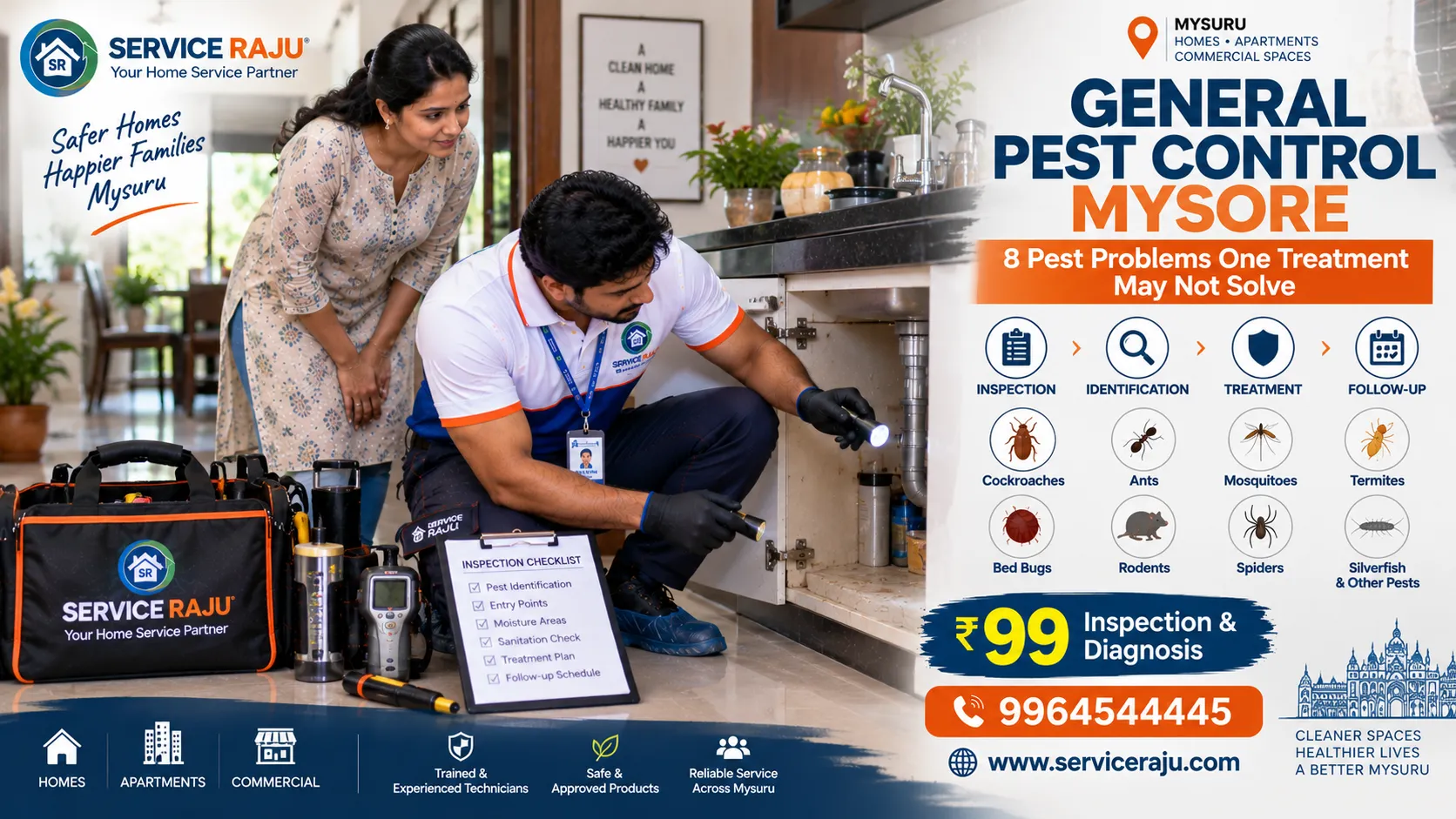
General Pest Control Mysore: 8 Pest Problems One Treatment May Not Solve
General Pest Control Mysore can be a practical solution for common household pest problems, but one general treatment should not automatically be expected to solve every infestation. Termites, bed bugs, rodents, cockroaches, mosquitoes, ants and other pests behave differently, hide in different places and may require different inspection and control methods.
That is why a professional service should begin with inspection and correct pest identification rather than simply applying the same treatment everywhere. Integrated Pest Management guidance from the U.S. EPA emphasizes inspecting, identifying, monitoring, preventing supporting conditions and then selecting an appropriate control method.
This guide explains 8 pest problems where one general treatment may not be enough, what a technician should check and when a specialist pest-control service may be more appropriate.
Quick Answer: Which Pest Problems May Need More Than One General Treatment?
A general treatment may not be sufficient when the property has:
- Termite infestation
- Bed bug infestation
- Established rodent activity
- Heavy or recurring cockroach activity
- Persistent mosquito breeding
- Recurring ant activity
- Honey bee or wasp nests
- Recurring multi-pest problems caused by building conditions
This does not mean every case automatically needs multiple treatments. The correct service depends on the pest, infestation level, property conditions, treatment method and follow-up requirements.
Table of Contents
- What Is General Pest Control?
- 8 Pest Problems One Treatment May Not Solve
- Why Pest Inspection Matters
- When Should You Choose a Specialist Pest Service?
- What Your Pest Control Quote Should Include
- How to Prepare Before Treatment
- What to Do After Treatment
- General Pest Control Service in Mysore
- FAQs
- Final Takeaway
What Is General Pest Control?
General pest control is a broad pest-management service intended for common household or commercial pest problems. The exact scope varies by service provider and property.
A good General Pest Control Service Mysore should still begin by understanding what pest is present and where it is active.
Before treatment, a technician should consider:
- What pest is present?
- Which rooms or areas are affected?
- Where are the pests hiding?
- How are they entering?
- Are food, water or moisture supporting the infestation?
- Has the property been treated previously?
- Does the problem require a specialist treatment?
EPA IPM guidance similarly recommends inspection, accurate identification, monitoring and evaluation before selecting the most appropriate control method.
8 Pest Problems One Treatment May Not Solve
1. Termite Infestation
Termites should not be treated like an ordinary surface-insect problem.
Subterranean termites can use concealed routes and may be associated with soil, foundations, wall-floor junctions, utility penetrations and wooden components.
Warning signs can include:
- Mud or shelter tubes
- Fresh wood damage
- Discarded wings
- Repeated termite activity
- Weakened wooden frames
- New activity after previous treatment
A general spray may affect visible insects without addressing the underlying route. When termites are suspected, arrange a dedicated termite inspection and treatment assessment.
Service Raju: Termite Inspection & Diagnosis is available before treatment, with the treatment scope quoted separately after inspection.
2. Bed Bug Infestation
Bed bugs require a different inspection approach because they can hide in very small cracks and protected areas around beds and furniture.
A technician may need to inspect:
- Mattress seams
- Bed frames
- Headboards
- Bedside furniture
- Furniture joints
- Cracks and crevices
- Nearby clutter
- Adjacent areas where appropriate
One general treatment may not eliminate an established bed bug infestation because hidden insects and eggs can remain. Depending on the treatment method, monitoring or follow-up may be required.
EPA guidance notes that bed bug eggs can survive some treatment methods and that follow-up inspection and treatment may be necessary.
3. Established Rodent Activity
Rodents are not solved simply by treating the room where a rat or mouse was seen.
A proper inspection should look for:
- Entry gaps
- Food sources
- Droppings
- Gnaw marks
- Nesting areas
- Utility openings
- Waste-storage areas
- Movement routes
Rodent management can require both population control and exclusion of access points. EPA guidance identifies food, water, shelter and building-entry conditions as important parts of pest management.
If rodents continue entering after treatment, ask for a dedicated rodent-control inspection rather than simply repeating a general service.
4. Heavy or Recurring Cockroach Activity
A few occasional cockroaches and a long-running infestation are very different service situations.
If cockroaches keep returning, inspect:
- Kitchen cabinets
- Under the sink
- Behind refrigerators
- Drains
- Appliance gaps
- Wall cracks
- Food-storage areas
- Moisture sources
Cockroaches need food, water and shelter, so removing these supporting conditions is an important part of long-term control.
If the activity is severe or recurring, a targeted cockroach-control treatment may be more appropriate than repeating a broad general spray.
5. Persistent Mosquito Breeding
A general indoor treatment cannot solve a mosquito problem if the breeding source is outside the treated area.
Check for standing water in:
- Plant trays
- Buckets
- Roof gutters
- Containers
- Unused equipment
- Drainage areas
- Construction materials
- Other water-holding objects
EPA recommends eliminating standing water because it can provide mosquito breeding sites.
If mosquitoes return quickly after indoor treatment, investigate outdoor breeding sources before simply repeating the same treatment.
6. Recurring Ant Activity With an Unknown Nest Route
Ants can enter through tiny gaps and follow established trails toward food and water sources.
Simply spraying visible ants may reduce what you see temporarily while the underlying route remains active.
A technician should check:
- Ant trails
- Entry gaps
- Wall penetrations
- Window gaps
- Food sources
- Moisture areas
- Possible nesting locations
When activity repeatedly returns from the same location, identifying the route and supporting conditions can be more useful than repeatedly treating the visible ants.
7. Honey Bee or Wasp Nest
Bee and wasp situations require different handling from routine household pest treatment.
The technician should first identify the insect and inspect the nest location.
Potential locations include:
- Roof spaces
- Wall cavities
- Balconies
- Utility areas
- Tree branches
- Sheds and external structures
Do not disturb a large or active nest yourself. A trained professional should assess the situation and determine the appropriate approach.
8. Recurring Multi-Pest Problems Caused by Building Conditions
Sometimes the property itself is supporting several different pest problems.
Common contributing conditions can include:
- Leaking plumbing
- Persistent dampness
- Standing water
- Unsealed wall gaps
- Open food-storage areas
- Excess clutter
- Damaged window screens
- Poor waste management
In such situations, repeating the same chemical treatment may give only temporary improvement if the conditions supporting pest activity remain.
EPA IPM guidance emphasizes prevention measures such as sanitation, exclusion, repair, moisture management and habitat modification alongside appropriate control methods.
Why Pest Inspection Matters
The biggest difference between a quick pest-control visit and a professional service process is often what happens before treatment.
| Inspection Point | Why It Matters |
|---|---|
| Pest identification | Different pests require different approaches |
| Activity location | Shows where the infestation is concentrated |
| Entry points | Helps identify how pests are getting inside |
| Food sources | Can support continued pest activity |
| Water and moisture | Can create favourable conditions |
| Harbourage | Shows where pests may hide or reproduce |
| Previous treatment | Helps explain recurring activity |
| Property type | Homes, apartments and commercial sites have different conditions |
EPA's IPM framework describes an ongoing cycle of inspection, identification, monitoring, control and evaluation rather than a one-size-fits-all treatment.
When Should You Choose a Specialist Pest Service?
Consider a specialist service when:
- The pest problem continues after general treatment
- There is evidence of termites
- There is evidence of bed bugs
- Rodent activity is established
- Mosquitoes keep returning because of outdoor breeding areas
- Ant activity repeatedly returns from the same route
- A bee or wasp nest is present
- Several pest types are appearing because of ongoing building conditions
The objective should not be to choose the most expensive treatment. The objective is to match the service to the actual pest problem.
What Your Pest Control Quote Should Include
Before booking a Pest Control Treatment Mysore, ask what is included.
| Item | What to Confirm |
|---|---|
| Pest | Which pest is being treated? |
| Area | Which rooms or spaces are included? |
| Method | What type of treatment is planned? |
| Preparation | What should the customer do before treatment? |
| Safety | What are the product-specific precautions and re-entry instructions? |
| Follow-up | Is a revisit or monitoring check included? |
| Warranty | What exactly is covered? |
| Price | Is the price for the complete agreed scope? |
A clear written scope makes it easier to compare services on more than just the lowest price.
How to Prepare Before Treatment
Preparation depends on the pest and treatment method. Follow the instructions provided for the actual service.
- Store exposed food securely.
- Remove or protect drinking water and utensils as instructed.
- Reduce unnecessary clutter from treatment areas.
- Provide access to sinks, cabinets and other inspection areas.
- Keep children and pets away according to the service instructions.
- Tell the technician about pets, children, elderly occupants or other concerns before treatment.
- Follow the product label and professional re-entry instructions.
Do not assume that every pest-control service requires the same preparation or evacuation period.
What to Do After Treatment
Good pest management continues after the technician finishes the treatment.
Ask:
- Which areas were treated?
- When can the area be reoccupied?
- When can treated surfaces be cleaned?
- Could some pest activity remain temporarily?
- What should be monitored?
- When should continued activity be reported?
- Is follow-up required?
Also correct the property conditions that may have supported the infestation. Seal accessible gaps, fix leaks, reduce clutter, store food properly and remove standing water where applicable. These preventive measures are consistent with IPM guidance.
General Pest Control Service in Mysore
Service Raju provides pest-control services for homes, apartments, offices, shops and other properties in Mysuru.
Our pest-control service categories include:
- General Pest Control
- Cockroach Control
- Termite Control
- Bed Bug Control
- Mosquito Pest Control
- Rodent Control
- Honey Bee / Wasp Removal
- Commercial Pest Control
The correct service depends on the pest and property condition. If the problem is clearly a specialist infestation, the technician can recommend the relevant service instead of treating every situation as a generic pest-control job.
Inspection & Diagnosis
Visiting Charge: ₹99
Service Raju can inspect the property to understand the pest problem, affected areas, likely entry points and treatment requirement.
Treatment charges are separate and depend on the actual pest problem and agreed treatment scope after inspection.
Call / WhatsApp: 9964544445
Website: www.serviceraju.com
Service Raju — Your Home Service Partner
FAQs About General Pest Control in Mysore
Can one general pest-control treatment solve every pest problem?
No. The appropriate treatment depends on the pest, infestation level, hiding locations, entry routes and property conditions. Termites, bed bugs and established rodents may require dedicated inspection and treatment.
Is general pest control enough for termites?
Termites can require a dedicated inspection because activity may occur through concealed routes and structural or soil interfaces. A termite-specific service is appropriate when termite activity is suspected.
Can general pest control remove bed bugs?
A routine general treatment may not be sufficient for an established bed bug infestation. Bed bugs can hide in mattresses, bed frames, furniture and cracks, and some treatment methods may require follow-up.
Why do cockroaches return after pest control?
Recurring cockroaches can be associated with continuing access to food, water, harbourage or entry routes, or with reinfestation from another area. A follow-up inspection can help identify the cause.
Why do mosquitoes keep coming back after treatment?
If breeding sites remain nearby, mosquitoes can continue to appear. Standing water in containers, gutters, trays and other locations should be investigated and removed where possible.
What should I do if rats continue entering after treatment?
Ask for an inspection of entry gaps, food sources, nesting locations and movement routes. Rodent control often requires both population management and access-point exclusion.
Should every pest-control service use chemical spraying?
No. Integrated Pest Management uses identification, prevention, exclusion, sanitation, monitoring and appropriate control methods. Pesticides are only one component of a broader pest-management approach.
What should I look for when choosing professional pest control in Mysore?
Look at inspection quality, correct pest identification, treatment scope, safety instructions, technician professionalism, follow-up and written terms—not simply the lowest quotation.
Does Service Raju provide inspection before treatment?
Yes. Service Raju offers Inspection & Diagnosis with a ₹99 visiting charge. The treatment quotation is determined separately after assessing the property and required service.
Final Takeaway
General Pest Control Mysore can be an effective starting point for many common pest situations, but one generic treatment should not automatically be expected to solve every infestation.
Use this simple sequence:
Identify → Inspect → Find the Source → Prevent Entry → Choose the Right Treatment → Monitor → Follow Up.
Termites, bed bugs, established rodents, recurring cockroaches, mosquito breeding, persistent ants, bee or wasp nests and multi-pest building conditions can all require a more specific inspection or treatment plan.
The goal is not simply to apply more pesticide. It is to understand why the pest is present and what needs to change for control to last.
Not sure which pest-control service your Mysore property needs?
Book Service Raju Inspection & Diagnosis — ₹99 visiting charge.
Call / WhatsApp: 9964544445
Website: www.serviceraju.com
 AC Repair
.webp) Ant Control Service
Ant Control Service
 Basin & Sink Services
.webp) Bath & Shower Services
Bath & Shower Services
.webp) Bath Fittings & Mirrors
Bath Fittings & Mirrors
 Bathroom Cleaning Service
 Bathroom Renovation Services
 Bed Bug Control Services
 Bedroom Painting
 Book a Carpenter Consultation
 Book Electrical Consulting
.webp) Cabinet Painting & Wood Refinishing
Cabinet Painting & Wood Refinishing
 Chimney Cleaning
 Civil Masonry Work
 Clean-Up Services
.webp) Clothes Hanger Installation
Clothes Hanger Installation
 Cockroach Control Services
---mysore-mysore-standard-300x200.webp) Commercial Cleaning
Commercial Cleaning
 Commercial Pest Control AMC Service
 Cupboard & Drawer Services
 Decorative Wall Panels
 Deep Sanitisation Service
 Detan & Bleach
 Door, Grill & Cabinet Painting Service
.webp) Doorbell & security
Doorbell & security
 Drain Blockage Clearing
 Electrical Appliance Services
 Electrical Wiring Services
 Empty Home Deep Cleaning
.webp) Fabrication
Fabrication
 Facials
.webp) Fan Installation & Repair
Fan Installation & Repair
 Full Home Cleaning Service
 Full Home Renovation
 Furniture Repair Service
 Gas Stove & Hob Repair
.webp) General Pest Control Services
General Pest Control Services
 General Plumbing & Consultation
 Geyser Repair
 Glass Cleaning
 Head Massage
.webp) Honeybee & Wasp-Services
Honeybee & Wasp-Services
 Kitchen & Bathroom Painting Service
 Kitchen Cleaning
 Kitchen Fittings
.webp) Kitchen Renovation
Kitchen Renovation
.webp) Laptop/Desktop service
Laptop/Desktop service
 Leak Detection and Repair
 LED TV Repair
 Living and Dining Room Painting
 Makeup, Saree & Styling
 Manicure & Pedicure
 MCB,Meter & Fuse Services
 Microwave Repair
 Mosquito Pest Control Service
 Multi-Room Painting Service
 Painting Consultation
 Quick Mini Cleaning Services
 Refrigerator Repair
 RO Water Purifier
.webp) Rodent Control Services (Rat & Mice Treatment)
Rodent Control Services (Rat & Mice Treatment)
.webp) Rooms Cleaning
Rooms Cleaning
 Shelves & Decor
 Sofa, Carpet & Mattress Cleaning
 Solar Water Heater Service
 Sump & Tank Cleaning
 Switch & Socket Services
 Tap & Mixer Service
.webp) Termite-Control-Services
Termite-Control-Services
 Threading & Face Wax
.webp) Tile & Granite Installation & Polishing
Tile & Granite Installation & Polishing
 Toilet & Commode Services
.webp) UPS and Inverter Repair Services
UPS and Inverter Repair Services
.webp) Wall Painting Service
Wall Painting Service
 Washing Machine Repair
 Water Level Controllers
 Water Tank and Pump Repair
 Waterproofing
 Waterproofing Services
 Waxing
 Window & Curtain Services
 Wooden Door Services