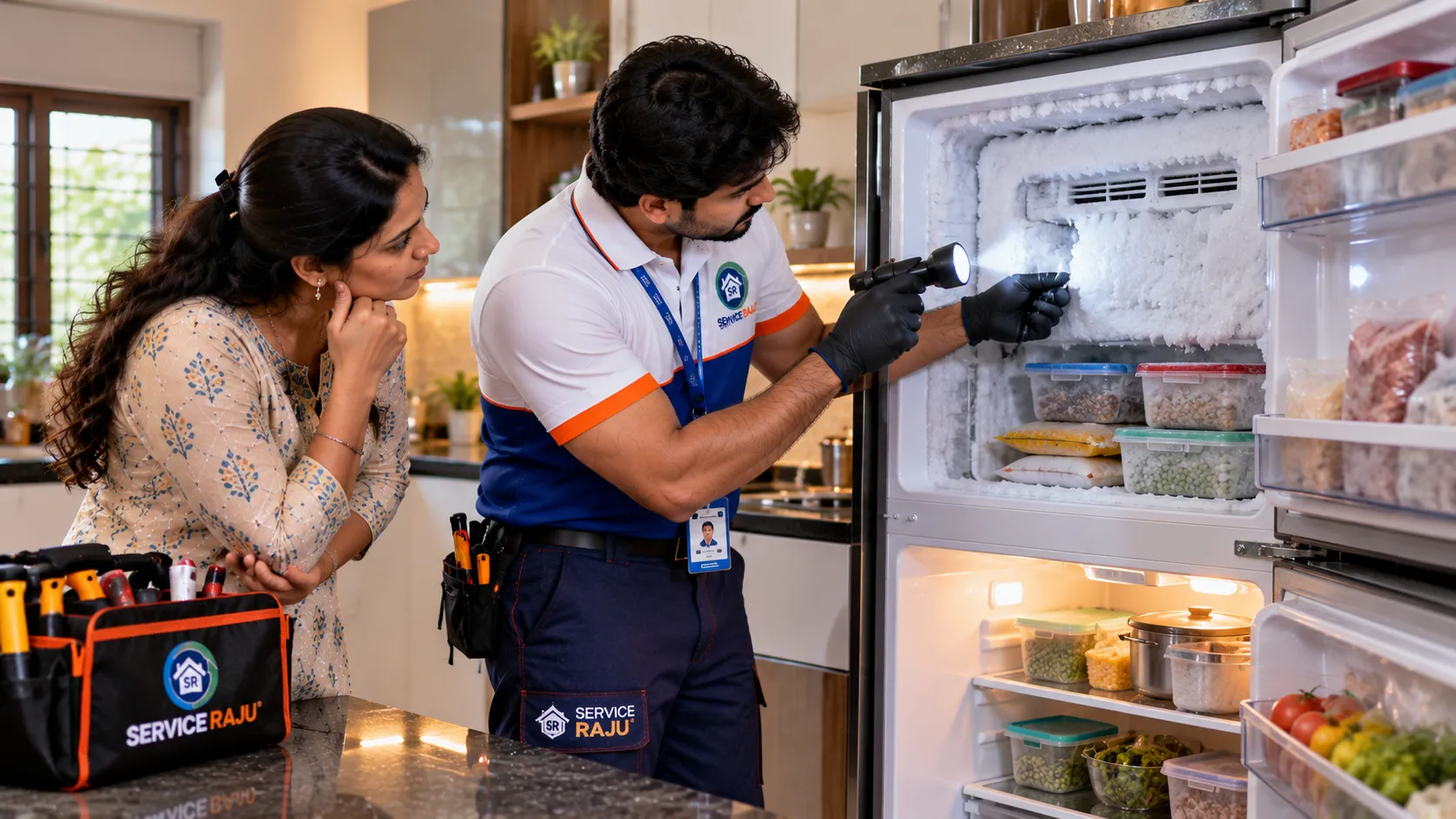
Fridge Making Too Much Ice? 7 Reasons Your Freezer Is Over-Freezing
Freezer over freezing is easy to dismiss at first. You may notice a thin layer of frost and assume it is normal, but heavy ice buildup can gradually reduce usable freezer space, restrict airflow and affect the refrigerator's performance.
Manufacturers note that some frost can occur during normal operation, especially when warm or humid air enters the freezer. But thick or recurring ice buildup can point to a problem with the door seal, temperature setting, airflow, defrosting process or another component.
This article focuses specifically on excessive ice and frost rather than the more common “refrigerator not cooling” problem. The aim is to help you understand what you can safely check yourself and when the appliance needs professional diagnosis.
Quick Answer: Why Is My Freezer Making Too Much Ice?
The seven main causes to check are:
- A damaged or poorly sealing freezer door gasket
- Frequent door opening or warm humid air entering
- An incorrect temperature setting
- A defrost-system fault
- Blocked airflow or overloaded freezer storage
- A sensor or electronic control problem
- A refrigeration-system or other internal fault requiring diagnosis
Not every frost problem means the refrigerator needs a gas refill. In fact, excessive frost is often related to moisture entering the freezer, sealing, defrosting or airflow rather than low refrigerant.
Table of Contents
- Is Some Freezer Frost Normal?
- 7 Reasons Your Freezer Is Over-Freezing
- Safe Checks You Can Try at Home
- What the Ice Pattern Can Tell You
- When It Becomes a Refrigerator Repair Problem
- Does Excess Ice Mean the Refrigerator Needs Gas?
- Repair or Replace?
- Refrigerator Repair Service in Mysore
- FAQs
- Final Takeaway
Is Some Freezer Frost Normal?
A small amount of frost can occur when moist air enters a freezer and the moisture freezes on cold surfaces. This can happen after frequent door opening or when warm food is placed inside.
Samsung's current India guidance says that some frost can be normal in direct-cool refrigerators, while heavy ice buildup can affect cooling performance and storage space. Whirlpool similarly explains that moisture entering the freezer can freeze and gradually build into substantial frost.
The distinction is important:
| Frost Condition | What It May Mean |
|---|---|
| Thin frost appearing occasionally | Can occur during normal operation |
| Frost after frequent door opening | Moisture entering the freezer |
| Thick ice returning quickly | Needs investigation |
| Ice covering vents | Airflow may be restricted |
| Ice mainly around one door edge | Possible sealing problem |
| Frost continually returns after defrosting | Possible persistent moisture or defrost fault |
7 Reasons Your Freezer Is Over-Freezing
1. The Freezer Door Gasket Is Not Sealing Properly
A damaged, dirty, warped or compressed gasket can allow warm, humid room air to enter the freezer. That moisture can freeze and gradually produce heavy frost.
Check the rubber seal around the freezer door for:
- Tears
- Cracks
- Deformation
- Gaps
- Sticky food residue
- Sections that have become compressed
Samsung and LG both identify poor door sealing or damaged gaskets as common contributors to frost buildup.
What you can do: clean the gasket with a soft cloth and warm water, make sure nothing is blocking the door and check whether the door closes fully.
If the gasket is torn, badly deformed or no longer seals correctly, it may require replacement.
2. The Door Is Being Opened Frequently
Every time the freezer door opens, warmer and more humid room air can enter.
The effect can become more noticeable when:
- The freezer is opened repeatedly while cooking
- The door remains open while food is being arranged
- The freezer is heavily used throughout the day
- The room is humid
Whirlpool explains that frequent or prolonged door opening allows humid air into the freezer, which can contribute to frost formation.
What you can do: reduce unnecessary door opening and make sure the door closes immediately after use.
3. The Temperature Setting Is Too Cold for the Situation
A temperature control set unnecessarily low can contribute to excessive cooling and freezing of food.
Samsung's current guidance for excess cooling recommends checking the temperature setting and adjusting it according to the appliance manual, food load and conditions. Its direct-cool guidance also explains that setting changes can be appropriate across seasons.
Instead of copying a temperature number from another refrigerator, use the setting recommended by your exact model's manual.
What you can do: check the control setting before assuming a component has failed.
4. The Defrost System Is Not Working Correctly
If your refrigerator has an automatic defrost system, recurring heavy frost can indicate that the system is not removing accumulated ice as intended.
Depending on the model, the defrost system can involve components such as:
- Defrost heater
- Defrost sensor or thermostat
- Control board
- Defrost timer in some designs
- Related wiring and controls
Whirlpool notes that a faulty defrost timer can cause a freezer to continually frost over, while manufacturer designs differ by model.
What you can do: if heavy frost repeatedly returns after proper defrosting, arrange professional diagnosis rather than repeatedly removing the ice without finding the cause.
5. Airflow Is Blocked by Ice or Stored Food
Freezers need appropriate airflow to distribute cold air.
Ice buildup or tightly packed food can obstruct vents and create uneven temperatures.
Look for:
- Food pressed against air vents
- Ice covering vents
- Overpacked shelves
- Restricted air-return openings
- Large containers blocking cold-air movement
LG specifically recommends checking air vents because frost buildup around them can restrict airflow and reduce cooling efficiency. Samsung likewise advises leaving space around food so cold air can circulate properly.
What you can do: rearrange stored food and keep required vents clear according to the appliance design.
6. A Sensor or Control Problem Is Affecting Temperature Management
Modern refrigerators use sensors and electronic controls to monitor and regulate temperature.
If the appliance is incorrectly sensing temperature or the control system is not responding properly, the refrigerator may cool differently from what the setting suggests.
Possible clues include:
- Temperature changes that do not match the control setting
- Repeated freezing of food in the refrigerator compartment
- Unusual cycling
- Error codes
- Persistent frost after basic checks
Samsung's current refrigerator guidance identifies temperature settings, sensors and airflow-related conditions among the areas to investigate when abnormal cooling is observed.
What you can do: record any error code and arrange model-specific diagnosis rather than replacing sensors based only on the symptom.
7. Another Refrigeration-System Fault Is Behind the Frost Pattern
In some cases, recurring abnormal frost can be associated with a deeper refrigeration or airflow problem that cannot be identified from the ice alone.
This is where visual diagnosis becomes important.
A technician may need to inspect:
- Evaporator area
- Airflow path
- Defrost components
- Temperature controls
- Fan operation
- Electrical components
- Refrigeration-system performance
Do not assume that the answer is automatically “gas filling.” A correct diagnosis should establish what component or system is actually responsible.
Safe Checks You Can Try at Home
Before booking fridge repair Mysore, several simple checks can be performed without opening internal components.
Check 1: Look at the Door Seal
Inspect the gasket for dirt, gaps, tears and deformation.
Check 2: Confirm the Door Closes Fully
Check whether drawers, food containers or shelves are preventing the door from closing.
Check 3: Check the Temperature Setting
Compare the current setting with the manufacturer's recommended setting.
Check 4: Look for Blocked Vents
Move food away from visible vents and airflow openings.
Check 5: Check for Heavy Ice
Look at where the frost is forming. Note whether it covers an entire surface, one side, the door edge, vents or a particular panel.
Check 6: Check Whether Warm Food Was Recently Stored
Warm food can introduce heat and moisture that later condenses and freezes.
Check 7: Note Any Error Code
Take a photograph of the display before resetting or switching the refrigerator off.
What the Ice Pattern Can Tell You
| Ice/Frost Pattern | Possible Clue |
|---|---|
| Frost around door edge | Possible door-seal or closure problem |
| Heavy frost near vents | Possible airflow restriction |
| Ice covering large areas | Possible moisture accumulation or defrost issue |
| One-sided freezer frost | May warrant inspection of sealing or airflow depending on model |
| Ice returns soon after defrosting | Persistent cause needs investigation |
| Food freezing in refrigerator section | Possible setting, airflow or control problem |
These patterns are only diagnostic clues. The same visual symptom can have different causes depending on the refrigerator's design.
When It Becomes a Refrigerator Repair Problem
Book professional fridge freezer repair Mysore when:
- Heavy ice returns soon after defrosting.
- The door gasket is damaged.
- Food freezes despite a normal temperature setting.
- Airflow vents repeatedly ice up.
- The refrigerator produces an unusual noise.
- A fan appears not to operate correctly.
- An error code appears.
- The refrigerator behaves differently after every defrost.
- You suspect a defrost-system fault.
- The appliance has a persistent abnormal cooling pattern.
If the issue involves internal electrical or refrigeration components, do not attempt to dismantle the appliance. Manufacturer guidance recommends professional service for internal faults and damaged door seals.
Does Excess Ice Mean the Refrigerator Needs Gas?
Not necessarily.
This is one of the most common assumptions customers make when a refrigerator behaves abnormally.
Heavy frost can be caused by warm moist air entering through the door, frequent door opening, incorrect settings, blocked airflow or a defrost problem. These are separate from a refrigerant-related fault.
That is why gas filling should never be the first diagnosis simply because you see ice.
A technician should first examine the frost pattern, airflow, door sealing, temperature control and relevant refrigeration components.
Repair or Replace?
Excessive ice alone does not tell you whether the refrigerator should be repaired or replaced.
Consider:
- Age of the refrigerator
- Current diagnosed fault
- Cost of replacement parts
- Previous repair history
- Overall appliance condition
- Availability of parts
- Expected continued use
A simple gasket replacement or defrost-system repair can be very different economically from a major refrigeration-system repair.
Get the fault identified first, then compare the repair cost with the condition of the appliance.
Refrigerator Repair Service in Mysore
Service Raju provides refrigerator inspection and repair support in Mysuru for customers experiencing abnormal cooling, excessive ice, frost buildup, leakage and other refrigerator problems.
The service can include diagnosis of:
- Excessive freezer ice
- Frost buildup
- Door gasket problems
- Airflow issues
- Defrost-related faults
- Temperature-control problems
- Fan-related symptoms
- Refrigerator cooling problems
- Refrigerator leakage
What to Tell the Technician
When booking refrigerator repair Mysore, provide:
- Refrigerator brand
- Model number
- Approximate age
- Whether it is single-door, double-door or another configuration
- Where the ice is forming
- How quickly the ice returns after defrosting
- Whether food is also freezing in the refrigerator compartment
- Any unusual noise or error code
A photograph of the ice pattern can also help the technician understand the complaint before the visit.
Book Refrigerator Inspection
Instead of assuming that excessive ice means a gas problem, start with diagnosis.
Call / WhatsApp: 9964544445
Website: www.serviceraju.com
Service Raju — Your Home Service Partner
FAQs About Freezer Over-Freezing
Is a small amount of freezer frost normal?
Some frost can occur during normal operation, particularly when moist room air enters the freezer. Heavy, recurring ice buildup is different and may require investigation.
Why is my freezer building ice even though it is still cooling?
The appliance can continue cooling while frost accumulates because moisture entering the freezer freezes on cold surfaces. A door-seal problem, frequent opening, blocked airflow or defrost issue can allow the condition to worsen.
Can a damaged gasket cause excessive ice?
Yes. A poor door seal allows warm humid air to enter, which can create more frost. Check for dirt, deformation, cracks or gaps around the gasket.
Can frequent door opening cause freezer ice buildup?
Yes. Frequent or prolonged door opening introduces humid room air, which can condense and freeze inside the freezer.
Why does ice return soon after I defrost the freezer?
If the ice returns quickly, the underlying cause may still be present. Possible causes include continued air leakage, blocked airflow, incorrect settings or a fault in the defrost system.
Can blocked vents cause frost problems?
Yes. Ice or stored food blocking air vents can restrict airflow. Manufacturer guidance recommends keeping airflow paths clear.
Does freezer ice buildup mean low refrigerant?
No. Excessive frost has many possible causes, including door sealing, moisture entry, airflow and defrost problems. A refrigerant-related issue should be diagnosed rather than assumed from the presence of ice.
Should I remove thick ice with a knife?
No. Do not use sharp objects to chip ice because you can damage the freezer liner or concealed components. Follow the appliance manufacturer's defrosting instructions.
When should I call a refrigerator technician?
Call a technician when heavy ice repeatedly returns, food is freezing unexpectedly, the gasket is damaged, vents repeatedly ice up, error codes appear or the appliance behaves abnormally after proper defrosting and basic checks.
Does Service Raju provide refrigerator repair in Mysore?
Yes. Service Raju provides refrigerator inspection and repair support in Mysuru as part of its home-appliance service category.
Final Takeaway
Freezer over freezing does not automatically mean your refrigerator needs a gas refill or a new compressor.
Start with:
Door Seal → Door Use → Temperature → Airflow → Frost Pattern → Defrost System → Professional Diagnosis.
If a little frost gradually becomes a thick layer of ice, do not ignore it. Heavy buildup can restrict airflow and reduce usable freezer space, while recurring frost can signal a problem that needs repair.
The most important step is to identify why the ice is forming before replacing parts or paying for unnecessary refrigeration work.
Freezer building too much ice in your Mysore home?
Book a Service Raju Refrigerator Inspection.
Call / WhatsApp: 9964544445
Website: www.serviceraju.com
 AC Repair
.webp) Ant Control Service
Ant Control Service
 Basin & Sink Services
.webp) Bath & Shower Services
Bath & Shower Services
.webp) Bath Fittings & Mirrors
Bath Fittings & Mirrors
 Bathroom Cleaning Service
 Bathroom Renovation Services
 Bed Bug Control Services
 Bedroom Painting
 Book a Carpenter Consultation
 Book Electrical Consulting
.webp) Cabinet Painting & Wood Refinishing
Cabinet Painting & Wood Refinishing
 Chimney Cleaning
 Civil Masonry Work
 Clean-Up Services
.webp) Clothes Hanger Installation
Clothes Hanger Installation
 Cockroach Control Services
---mysore-mysore-standard-300x200.webp) Commercial Cleaning
Commercial Cleaning
 Commercial Pest Control AMC Service
 Cupboard & Drawer Services
 Decorative Wall Panels
 Deep Sanitisation Service
 Detan & Bleach
 Door, Grill & Cabinet Painting Service
.webp) Doorbell & security
Doorbell & security
 Drain Blockage Clearing
 Electrical Appliance Services
 Electrical Wiring Services
 Empty Home Deep Cleaning
.webp) Fabrication
Fabrication
 Facials
.webp) Fan Installation & Repair
Fan Installation & Repair
 Full Home Cleaning Service
 Full Home Renovation
 Furniture Repair Service
 Gas Stove & Hob Repair
.webp) General Pest Control Services
General Pest Control Services
 General Plumbing & Consultation
 Geyser Repair
 Glass Cleaning
 Head Massage
.webp) Honeybee & Wasp-Services
Honeybee & Wasp-Services
 Kitchen & Bathroom Painting Service
 Kitchen Cleaning
 Kitchen Fittings
.webp) Kitchen Renovation
Kitchen Renovation
.webp) Laptop/Desktop service
Laptop/Desktop service
 Leak Detection and Repair
 LED TV Repair
 Living and Dining Room Painting
 Makeup, Saree & Styling
 Manicure & Pedicure
 MCB,Meter & Fuse Services
 Microwave Repair
 Mosquito Pest Control Service
 Multi-Room Painting Service
 Painting Consultation
 Quick Mini Cleaning Services
 Refrigerator Repair
 RO Water Purifier
.webp) Rodent Control Services (Rat & Mice Treatment)
Rodent Control Services (Rat & Mice Treatment)
.webp) Rooms Cleaning
Rooms Cleaning
 Shelves & Decor
 Sofa, Carpet & Mattress Cleaning
 Solar Water Heater Service
 Sump & Tank Cleaning
 Switch & Socket Services
 Tap & Mixer Service
.webp) Termite-Control-Services
Termite-Control-Services
 Threading & Face Wax
.webp) Tile & Granite Installation & Polishing
Tile & Granite Installation & Polishing
 Toilet & Commode Services
.webp) UPS and Inverter Repair Services
UPS and Inverter Repair Services
.webp) Wall Painting Service
Wall Painting Service
 Washing Machine Repair
 Water Level Controllers
 Water Tank and Pump Repair
 Waterproofing
 Waterproofing Services
 Waxing
 Window & Curtain Services
 Wooden Door Services