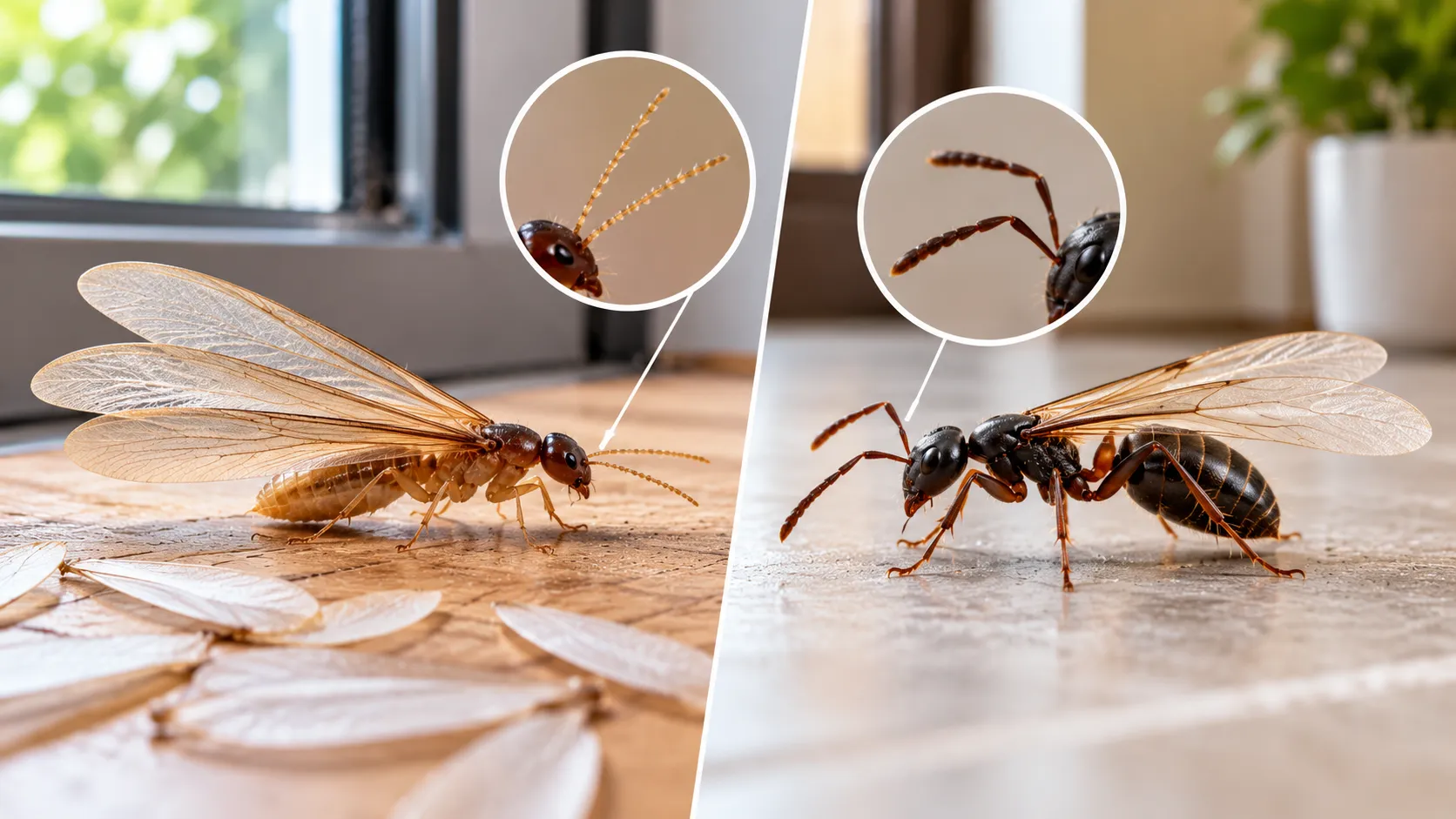
Flying Termites vs Flying Ants: How to Identify Them in Mysore Homes
Have you noticed a group of small winged insects around a window, balcony light or doorway in your Mysore home? Or have you found a scattering of delicate wings on the windowsill after the insects disappeared?
They could be flying ants—or termite swarmers. The two can look similar at first, but their body shape, antennae and wings offer useful clues. Correct identification matters because termite swarmers may indicate a termite colony nearby, while a single sighting does not automatically prove that the building’s wood or structure is infested.
This guide explains how to compare flying termites and flying ants, what shed wings may mean, where to look for additional clues and when to arrange a professional termite inspection in Mysuru.
Quick Difference Between Flying Termites and Flying Ants
When you can safely see an intact insect clearly, compare three features: the waist, antennae and wings. Extension entomology references use these characteristics to distinguish winged ants from termite swarmers.
| Feature | Termite swarmer | Flying ant |
|---|---|---|
| Waist | Body usually looks broad through the middle, without a pronounced pinch | Usually has a visibly narrow, pinched waist |
| Antennae | Generally straight or gently curved | Usually bent or elbow-shaped |
| Wings | Four wings of roughly similar length | Front wings are generally longer than the hind wings |
| Overall body | Often appears more evenly shaped | Head, narrow waist and abdomen look more distinctly separated |
Important: These are identification clues, not a substitute for expert identification. Wings may be broken or missing, and the insect’s appearance can vary by species. If you are uncertain, take clear photos and preserve a specimen for an inspector.
Reference: Purdue Extension: distinguishing ants from termites.
How to Identify Flying Termites and Flying Ants
1. Look for a pinched waist
A flying ant usually has a narrow waist between its middle body section and abdomen. A termite swarmer generally has a broader connection between these sections, so its body appears less pinched.
Look at the insect from above if you can do so without handling it. A clear close-up can help, but avoid relying on body shape alone.
2. Check the antennae
Flying ants commonly have antennae with a distinct bend. Termite swarmers generally have straighter antennae, sometimes appearing like a small row of beads.
Antennae can be difficult to see on dead or damaged insects. If this feature is unclear, compare the wings and waist as well.
3. Compare the four wings
Both reproductive ants and termites can have four wings. The useful difference is their relative size:
- Termite swarmers: the two pairs are generally similar in length and may extend well beyond the body.
- Flying ants: the front pair is generally longer than the rear pair.
If you find only detached wings, it may be harder to identify the insect confidently. Save a few wings and photograph them beside a ruler or another size reference.
What Do Shed Wings Near Windows Mean?
Termite swarmers and flying ants may shed their wings after a flight. That is why people sometimes discover wings on a windowsill, near a light, beside a door or on the floor without seeing the insects themselves.
A pile of similar-looking shed wings can be a reason to investigate—particularly if winged insects appeared indoors or seem to be emerging from a crack, wooden fitting or wall opening. However, shed wings alone do not identify the exact termite species, establish where a colony is located or prove that structural timber is being damaged.
Termite swarmers may be attracted to lights and can enter from outdoors. An inspection helps determine whether the evidence is consistent with a colony in or near the building.
Further reading: NC State Extension: termite swarmers and what they may mean.
Where to Check Around a Mysore Home
If you have found suspected termite swarmers, look for additional evidence from a safe distance. You do not need to pull apart walls, drill into timber or disturb a suspected nest.
Windows, doors and light sources
- Check windowsills, door thresholds and nearby floors for dead winged insects or shed wings.
- Note whether insects were concentrated around an indoor light or appeared to come from a specific gap.
- Photograph the location before cleaning up the evidence.
Wooden fittings and furniture
- Look for unusual damage, blistering, hollow-sounding areas or wood that appears weakened.
- Observe door frames, skirting, built-in cupboards and wooden fittings.
- Do not force open or break damaged material to search for insects.
Walls and accessible edges
- Look for narrow, earth-like shelter tubes on accessible surfaces.
- Notice recurring insect activity around the same crack or opening.
- Record any dampness or water leakage nearby, but do not assume moisture alone confirms termites.
Subterranean termites may build protective mud or shelter tubes, and termite damage can sometimes remain hidden inside wood. A qualified inspection is more reliable than judging the condition from a single visible surface.
Reference: University of Maryland Extension: termite identification and signs.
What to Do If You Find Flying Termites in Your House
- Take photographs. Capture an intact insect from above and, if possible, from the side. Include the wings and body clearly.
- Keep a sample. If safe, place a few insects or shed wings in a clean, sealed container for identification. Avoid touching unknown insects with bare hands.
- Note the location and timing. Record where they appeared, whether they were near a light, and whether the activity has happened more than once.
- Do not disturb suspected entry points. Avoid drilling, scraping or opening walls and wooden fittings to investigate.
- Arrange an inspection if the evidence is concerning. Repeated indoor swarms, insects emerging from the building, shed wings together with other signs, or suspected timber damage warrant professional assessment.
Spraying the visible flying insects may remove the swarmers you can see, but it does not establish whether a termite colony is present or address a hidden colony. Avoid applying pesticides unless the product is specifically labelled for the intended use and you can follow all label precautions.
When Should You Book a Termite Inspection in Mysore?
Consider arranging a professional termite inspection if:
- You repeatedly find suspected termite swarmers inside your home.
- Winged insects appear to emerge from a wall, ceiling, floor gap or wooden fitting.
- You find clusters of shed wings alongside other possible termite signs.
- You notice shelter tubes or unexplained damage to wooden materials.
- You are unsure whether the insects are termites or ants and want reliable identification.
A professional should assess the evidence, inspect accessible areas and explain whether treatment is indicated. The appropriate approach depends on the pest identification, the building and the inspection findings; not every sighting requires the same treatment.
Termite inspection support from Service Raju
Found winged insects or piles of shed wings inside your home? Service Raju can help you arrange pest-control assistance and discuss the inspection requirements. Share photographs, the location where you found the insects and whether the activity has occurred repeatedly.
Service availability, inspection scope and any recommended treatment should be confirmed when booking. An inspection is intended to assess the evidence; it is not a promise that termites will be found or that treatment will automatically be required.
Book or enquire: Service Raju Pest Control Services
Call: +91 99645 44445 | +91 96205 50955
Service Raju — Trusted Home Services in Mysuru, Udupi, Mangaluru & Indore.
Frequently Asked Questions
Are flying termites and flying ants the same insect?
No. They are different insects, although their winged reproductive forms can look similar. Compare the waist, antennae and relative wing lengths; when identification is uncertain, ask a pest professional to examine a specimen or clear photographs.
Do flying termites in a house always mean the house is infested?
Not necessarily. Swarmers may enter from outside, and a sighting alone does not prove that a colony is inside the structure. Repeated indoor activity, emergence from the building or other termite signs should prompt an inspection.
Why are there termite wings near my window?
Winged termites may shed their wings after swarming, and insects can gather near lights or windows. A cluster of similar wings is useful evidence to photograph and preserve, but it should be considered alongside the location and any other signs.
Can I identify termites from shed wings alone?
Sometimes the wing shape and size offer clues, but detached or damaged wings can be difficult to identify. Keep a sample and take clear photos; a professional can consider the wings together with other evidence.
Should I spray the insects as soon as I see them?
Do not rush to spray an unidentified insect. First document what you found and follow the pesticide label if any product is used. Killing visible swarmers does not confirm whether a hidden colony exists or solve a possible structural problem.
When should I contact a termite inspection service in Mysore?
Arrange an inspection if swarmers repeatedly appear indoors, seem to emerge from the building, or occur with shed wings, shelter tubes or suspected wood damage. If you are unsure whether they are termites or ants, identification is a sensible first step.
Conclusion
When comparing flying termites vs flying ants, start with the waist, antennae and wings. Similar-sized wings, a less pinched body and straighter antennae are clues that an insect may be a termite swarmer—but no single feature should be treated as a definitive diagnosis.
If you find winged insects or shed wings in your Mysore home, photograph the evidence, note where it appeared and arrange a professional inspection when the signs are repeated or concerning. Correct identification helps you decide what to do next without assuming that every insect sighting proves a termite infestation.
Need pest-control guidance? Contact Service Raju about pest-control services in Mysuru.
 AC Repair
.webp) Ant Control Service
Ant Control Service
 Basin & Sink Services
.webp) Bath & Shower Services
Bath & Shower Services
.webp) Bath Fittings & Mirrors
Bath Fittings & Mirrors
 Bathroom Cleaning Service
 Bathroom Renovation Services
 Bed Bug Control Services
 Bedroom Painting
 Book a Carpenter Consultation
 Book Electrical Consulting
.webp) Cabinet Painting & Wood Refinishing
Cabinet Painting & Wood Refinishing
 Chimney Cleaning
 Civil Masonry Work
 Clean-Up Services
.webp) Clothes Hanger Installation
Clothes Hanger Installation
 Cockroach Control Services
---mysore-mysore-standard-300x200.webp) Commercial Cleaning
Commercial Cleaning
 Commercial Pest Control AMC Service
 Cupboard & Drawer Services
 Decorative Wall Panels
 Deep Sanitisation Service
 Detan & Bleach
 Door, Grill & Cabinet Painting Service
.webp) Doorbell & security
Doorbell & security
 Drain Blockage Clearing
 Electrical Appliance Services
 Electrical Wiring Services
 Empty Home Deep Cleaning
.webp) Fabrication
Fabrication
 Facials
.webp) Fan Installation & Repair
Fan Installation & Repair
 Full Home Cleaning Service
 Full Home Renovation
 Furniture Repair Service
 Gas Stove & Hob Repair
.webp) General Pest Control Services
General Pest Control Services
 General Plumbing & Consultation
 Geyser Repair
 Glass Cleaning
 Head Massage
.webp) Honeybee & Wasp-Services
Honeybee & Wasp-Services
 Kitchen & Bathroom Painting Service
 Kitchen Cleaning
 Kitchen Fittings
.webp) Kitchen Renovation
Kitchen Renovation
.webp) Laptop/Desktop service
Laptop/Desktop service
 Leak Detection and Repair
 LED TV Repair
 Living and Dining Room Painting
 Makeup, Saree & Styling
 Manicure & Pedicure
 MCB,Meter & Fuse Services
 Microwave Repair
 Mosquito Pest Control Service
 Multi-Room Painting Service
 Painting Consultation
 Quick Mini Cleaning Services
 Refrigerator Repair
 RO Water Purifier
.webp) Rodent Control Services (Rat & Mice Treatment)
Rodent Control Services (Rat & Mice Treatment)
.webp) Rooms Cleaning
Rooms Cleaning
 Shelves & Decor
 Sofa, Carpet & Mattress Cleaning
 Solar Water Heater Service
 Sump & Tank Cleaning
 Switch & Socket Services
 Tap & Mixer Service
.webp) Termite-Control-Services
Termite-Control-Services
 Threading & Face Wax
.webp) Tile & Granite Installation & Polishing
Tile & Granite Installation & Polishing
 Toilet & Commode Services
.webp) UPS and Inverter Repair Services
UPS and Inverter Repair Services
.webp) Wall Painting Service
Wall Painting Service
 Washing Machine Repair
 Water Level Controllers
 Water Tank and Pump Repair
 Waterproofing
 Waterproofing Services
 Waxing
 Window & Curtain Services
 Wooden Door Services