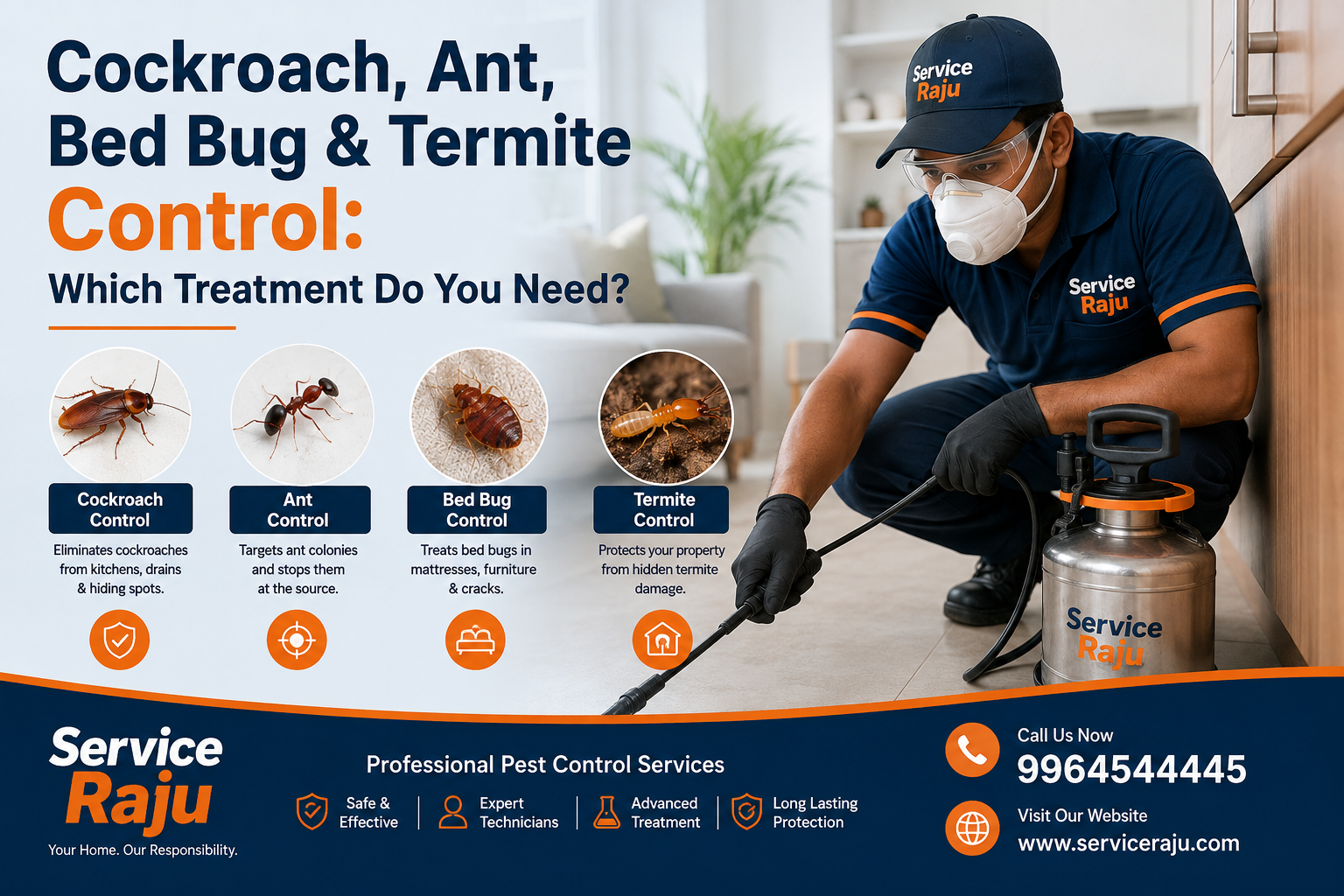
Cockroach, Ant, Bed Bug & Termite Control: Which Treatment Do You Need?
Pests can enter your home quietly, but once they find food, moisture, warmth, or shelter, they can multiply quickly. Cockroaches, ants, bed bugs, and termites are among the most common household pests, but each pest requires a different treatment approach.
Using the wrong pesticide or treatment method may provide only temporary relief. Professional pest control begins with correctly identifying the pest, locating its hiding or breeding areas, and choosing the right treatment.
In this guide, we explain the differences between cockroach control, ant control, bed bug treatment, and termite control, and help you understand which service your home may need.
2. 1. Cockroach Control
Cockroaches are commonly found in kitchens, bathrooms, drainage areas, cupboards, and other warm and damp locations. They are particularly attracted to food particles, grease, moisture, and waste.
3. Common Signs of Cockroaches
You may have a cockroach infestation if you notice:
- Live cockroaches, especially at night
- Small black droppings around cupboards or kitchen areas
- Cockroach egg cases
- Unpleasant odour
- Cockroaches hiding behind appliances
- Activity around sinks, drains, and garbage areas
4. What Treatment Is Used?
Professional cockroach control may involve a combination of targeted gel treatment, residual treatment, and inspection of harbourage areas, depending on the level and location of infestation.
Gel treatment is particularly useful for treating cracks, crevices, cupboards, and other areas where cockroaches hide.
5. Best For
Kitchens, apartments, houses, restaurants, offices, hotels, and commercial properties.
6. 2. Ant Control
Ants can appear around kitchens, balconies, windows, gardens, bathrooms, and food-storage areas. While a few ants may seem harmless, repeated activity can indicate an established colony nearby.
7. Common Signs of an Ant Infestation
Look for:
- Trails of ants moving toward food
- Ants around sugar and other food items
- Ant nests near walls or outdoor areas
- Ant activity around windows and doors
- Large numbers of ants appearing repeatedly
8. What Treatment Is Used?
Ant control focuses on locating the colony and treating the areas where ants travel and nest. Depending on the species and infestation, professional treatment may include targeted baiting and appropriate residual treatment.
Simply killing visible ants may not solve the problem because the colony can remain active.
9. Best For
Homes, kitchens, offices, shops, restaurants, gardens, and commercial premises.
10. 3. Bed Bug Control
Bed bugs are small insects that feed on blood and commonly hide in mattresses, bed frames, sofas, furniture joints, cracks, and other sheltered locations.
They can spread through luggage, used furniture, clothing, bedding, and other personal belongings.
11. Common Signs of Bed Bugs
Possible signs include:
- Small itchy bites, particularly after sleeping
- Tiny blood spots on bedsheets
- Dark spots on mattresses or furniture
- Live bed bugs
- Shed skins
- Bed bug eggs or eggshells
- A persistent infestation-related odour in severe cases
12. What Treatment Is Used?
Bed bug treatment requires a thorough inspection and targeted treatment of sleeping and hiding areas.
Professional treatment may involve treating:
- Mattress seams
- Bed frames
- Headboards
- Sofa joints
- Furniture cracks
- Skirting areas
- Wall and floor gaps
- Other potential hiding places
Because bed bugs can hide in difficult-to-reach locations and survive treatment when some areas are missed, follow-up treatment may be required depending on the infestation.
13. Best For
Bedrooms, mattresses, sofas, hostels, hotels, rental properties, PGs, and furnished apartments.
14. 4. Termite Control
Termites are different from cockroaches, ants, and bed bugs because they can cause structural and property damage.
They can attack wooden furniture, door frames, cupboards, flooring, and other cellulose-based materials. Some termite activity can remain hidden for a long time before visible damage appears.
15. Common Signs of Termites
Watch for:
- Hollow or damaged wood
- Mud tubes on walls or foundations
- Termite wings near windows or lights
- Doors or windows becoming difficult to operate
- Cracked or damaged wooden surfaces
- Visible termite activity
- Bubbling or damaged flooring in some cases
16. What Treatment Is Used?
The treatment depends on the type, location, and severity of the infestation.
Professional termite control may involve localized treatment, soil treatment, drilling and injection, wood treatment, or a termite management system, depending on the property.
For new construction or suitable existing properties, a professional may also recommend a termite prevention or soil-treatment system.
17. Best For
Independent houses, apartments, villas, offices, commercial buildings, construction sites, and properties with wooden structures.
18. Cockroach vs Ant vs Bed Bug vs Termite: Which Service Do You Need?
| Pest | Common Location | Main Concern | Typical Treatment Approach |
|---|---|---|---|
| Cockroaches | Kitchen, bathroom, drains | Hygiene & contamination | Gel + targeted treatment |
| Ants | Kitchen, walls, garden | Food contamination & nuisance | Baiting + targeted treatment |
| Bed Bugs | Mattress, bed, sofa | Bites & infestation | Thorough inspection + targeted treatment |
| Termites | Wood, walls, soil | Property damage | Structural/soil/wood treatment |
The important point is that one pest-control treatment does not automatically work for every pest. The correct service should be selected after identifying the pest and understanding where the infestation is located.
19. Why Professional Pest Control Is Better Than DIY Treatment
Store-bought sprays may kill insects that are directly exposed, but they may not address the source of the infestation.
Professional pest control focuses on:
20. 1. Pest Identification
Different pests require different treatment methods. Correct identification is the first step.
21. 2. Infestation Inspection
Technicians inspect likely hiding, breeding, nesting, and entry areas.
22. 3. Targeted Treatment
Treatment is applied to appropriate areas rather than unnecessarily spraying the entire property.
23. 4. Prevention Advice
Customers can receive practical recommendations to reduce food sources, moisture, hiding places, and entry points.
24. 5. Follow-Up When Required
Some infestations, particularly bed bugs and termites, may require additional visits or ongoing monitoring depending on the situation.
25. How to Prepare Your Home for Pest Control
Before the technician arrives, you may be advised to:
- Keep food and utensils properly covered
- Remove unnecessary clutter
- Clean accessible areas
- Provide access to cupboards and affected areas
- Keep children and pets away from treatment areas as instructed
- Follow the technician's instructions regarding re-entry and ventilation
Preparation requirements can vary depending on the pest and treatment method.
26. When Should You Call a Pest Control Professional?
Don't wait until the infestation becomes severe.
Consider professional pest control if:
- You repeatedly see pests
- DIY sprays provide only temporary relief
- You find pest eggs or droppings
- You notice property damage
- Bed bugs are affecting your sleep
- Cockroaches are repeatedly appearing in the kitchen
- Ant trails keep returning
- You suspect termites in wooden structures
Early inspection can help identify the problem before it becomes more difficult or expensive to manage.
27. Need Cockroach, Ant, Bed Bug or Termite Control?
Choosing the right pest control treatment starts with identifying the pest correctly.
Whether you're dealing with cockroaches in the kitchen, ants around food, bed bugs in your mattress, or termites damaging wooden structures, professional inspection can help determine the most appropriate treatment for your property.
Service Raju provides professional pest control services for residential and commercial properties, with treatment recommendations based on the pest, infestation level, and affected area.
If you're unsure which pest-control service you need, start with an inspection and diagnosis. A technician can identify the pest and recommend the appropriate treatment instead of applying a one-size-fits-all solution.
28. Service Raju – Trusted Pest Control Service
Services: Cockroach Control | Ant Control | Bed Bug Control | Termite Control | Rodent Control | Commercial Pest Control
Service Areas: Mysore & Bangalore
Book a Pest Control Service: Service Raju
 AC Repair
.webp) Ant Control Service
Ant Control Service
 Basin & Sink Services
.webp) Bath & Shower Services
Bath & Shower Services
.webp) Bath Fittings & Mirrors
Bath Fittings & Mirrors
 Bathroom Cleaning Service
 Bathroom Renovation Services
 Bed Bug Control Services
 Bedroom Painting
 Book a Carpenter Consultation
 Book Electrical Consulting
.webp) Cabinet Painting & Wood Refinishing
Cabinet Painting & Wood Refinishing
 Chimney Cleaning
 Civil Masonry Work
 Clean-Up Services
.webp) Clothes Hanger Installation
Clothes Hanger Installation
 Cockroach Control Services
---mysore-mysore-standard-300x200.webp) Commercial Cleaning
Commercial Cleaning
 Commercial Pest Control AMC Service
 Cupboard & Drawer Services
 Decorative Wall Panels
 Deep Sanitisation Service
 Detan & Bleach
 Door, Grill & Cabinet Painting Service
.webp) Doorbell & security
Doorbell & security
 Drain Blockage Clearing
 Electrical Appliance Services
 Electrical Wiring Services
 Empty Home Deep Cleaning
.webp) Fabrication
Fabrication
 Facials
.webp) Fan Installation & Repair
Fan Installation & Repair
 Full Home Cleaning Service
 Full Home Renovation
 Furniture Repair Service
 Gas Stove & Hob Repair
.webp) General Pest Control Services
General Pest Control Services
 General Plumbing & Consultation
 Geyser Repair
 Glass Cleaning
 Head Massage
.webp) Honeybee & Wasp-Services
Honeybee & Wasp-Services
 Kitchen & Bathroom Painting Service
 Kitchen Cleaning
 Kitchen Fittings
.webp) Kitchen Renovation
Kitchen Renovation
.webp) Laptop/Desktop service
Laptop/Desktop service
 Leak Detection and Repair
 LED TV Repair
 Living and Dining Room Painting
 Makeup, Saree & Styling
 Manicure & Pedicure
 MCB,Meter & Fuse Services
 Microwave Repair
 Mosquito Pest Control Service
 Multi-Room Painting Service
 Painting Consultation
 Quick Mini Cleaning Services
 Refrigerator Repair
 RO Water Purifier
.webp) Rodent Control Services (Rat & Mice Treatment)
Rodent Control Services (Rat & Mice Treatment)
.webp) Rooms Cleaning
Rooms Cleaning
 Shelves & Decor
 Sofa, Carpet & Mattress Cleaning
 Solar Water Heater Service
 Sump & Tank Cleaning
 Switch & Socket Services
 Tap & Mixer Service
.webp) Termite-Control-Services
Termite-Control-Services
 Threading & Face Wax
.webp) Tile & Granite Installation & Polishing
Tile & Granite Installation & Polishing
 Toilet & Commode Services
.webp) UPS and Inverter Repair Services
UPS and Inverter Repair Services
.webp) Wall Painting Service
Wall Painting Service
 Washing Machine Repair
 Water Level Controllers
 Water Tank and Pump Repair
 Waterproofing
 Waterproofing Services
 Waxing
 Window & Curtain Services
 Wooden Door Services