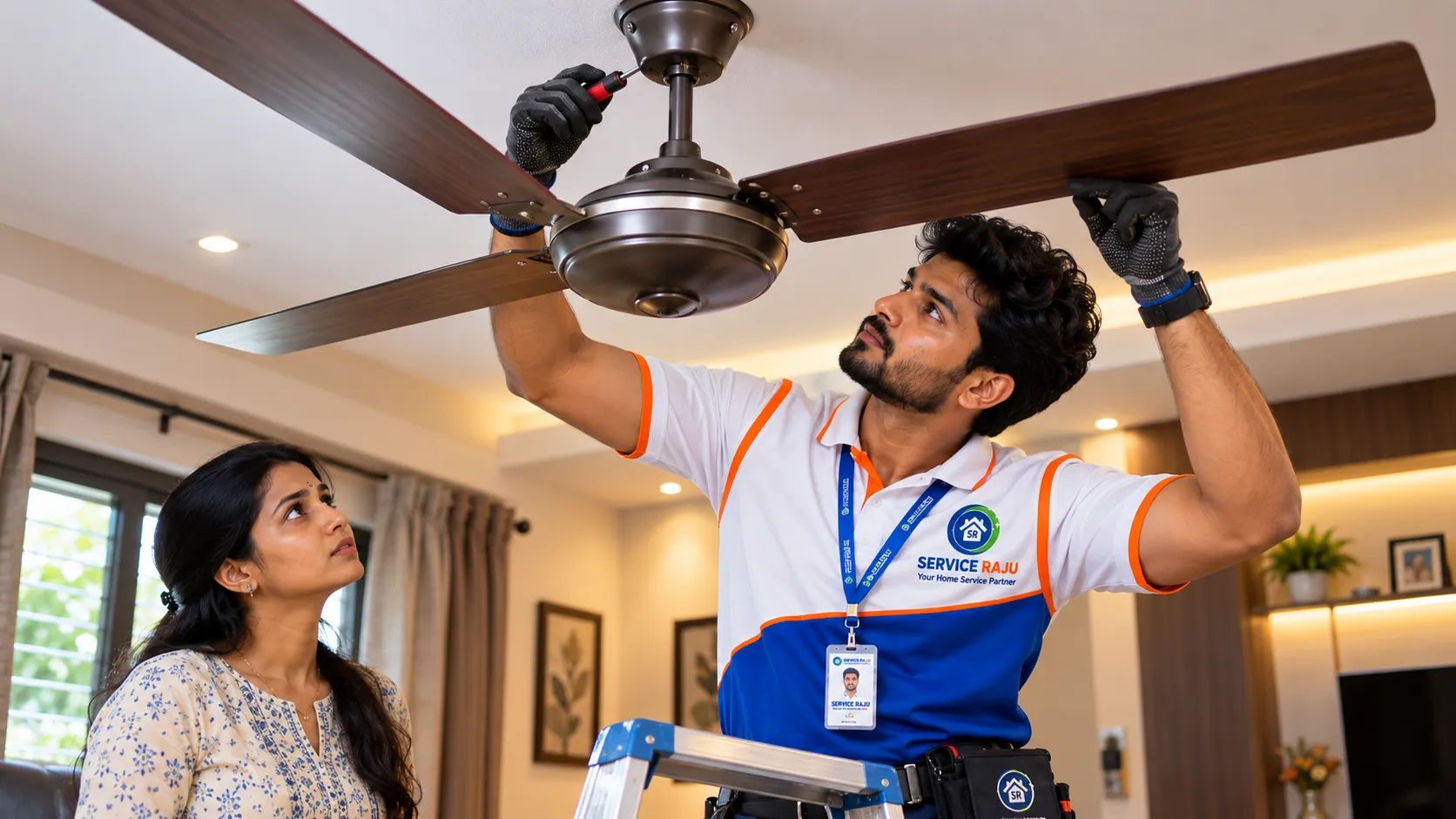
Ceiling Fan Making Noise or Wobbling? 9 Warning Signs Before It Fails
1. Ceiling Fan Making Noise or Wobbling? 9 Warning Signs Before It Fails
A ceiling fan that still turns on can be easy to ignore. You may notice a little ceiling fan noise, occasional clicking, slower-than-usual speed or a slight wobble and decide to continue using it. But these symptoms can indicate problems with the fan's blades, mounting, capacitor, regulator, motor or electrical connections.
A noisy or unstable fan does not always mean the motor has failed. In many cases, the underlying issue can be identified and repaired before it becomes a more serious problem. Knowing the warning signs can help you decide when it is time to book professional ceiling fan repair Mysore instead of waiting for the fan to stop completely.
2. Why Is My Ceiling Fan Making Noise?
Ceiling fan noise can come from several different parts of the fan. Loose components, blade imbalance, worn mechanical components, mounting issues, electrical problems and speed-control faults can all produce different sounds.
The type of sound can provide an important clue.
| Sound or Symptom | Possible Area to Check | Recommended Action |
|---|---|---|
| Clicking or ticking | Blade, screw, cover or moving component | Professional inspection if the sound continues |
| Humming | Motor, capacitor, regulator or electrical supply | Arrange electrical/fan inspection |
| Rattling | Loose component or mounting hardware | Stop using if the fan appears unstable |
| Grinding | Possible mechanical or bearing-related issue | Professional inspection recommended |
| Increasing vibration | Blade balance, mounting or mechanical issue | Check before continued operation |
The sound alone cannot confirm the exact fault. A technician should inspect the fan before replacing parts unnecessarily.
3. 9 Warning Signs Your Ceiling Fan Needs Attention
A ceiling fan does not necessarily fail without warning. These nine symptoms are worth taking seriously, particularly when they are new, becoming worse or occurring together.
4. 1. The Ceiling Fan Is Wobbling
Ceiling fan wobbling is one of the most obvious warning signs. A small amount of movement may sometimes be related to blade balance, but noticeable or increasing movement should not simply be ignored.
Possible causes include:
- Uneven or misaligned blades
- Loose blade screws
- Incorrect blade installation
- Mounting or bracket problems
- Mechanical wear
- Improper installation
If the fan is shaking significantly, switch it off and arrange an inspection rather than continuing to operate it at high speed.
5. 2. You Hear Clicking or Ticking
A repetitive clicking or ticking sound can indicate that something is moving or vibrating when the fan rotates.
The source may be associated with a blade, screw, canopy, cover or another component. If the sound increases with fan speed or appears every time the blades complete a rotation, professional inspection can help identify the source.
Do not place your hands near moving blades or attempt to adjust components while the fan is operating.
6. 3. The Fan Produces a Persistent Humming Sound
A mild electrical hum may not always indicate a serious fault, but a new or unusually loud humming sound deserves attention.
Potential causes can include the motor, capacitor, regulator or electrical connections. A technician can determine whether the noise is mechanical, electrical or simply characteristic of the particular fan.
If humming is accompanied by slow rotation, difficulty starting or unusual heating, the fan should be inspected sooner rather than later.
7. 4. The Fan Is Running Slower Than Before
If the fan previously produced strong airflow but now runs noticeably slower at the same setting, there may be an issue with the capacitor, regulator, motor or electrical supply.
Dust accumulation and mechanical resistance can also affect performance depending on the fan and its condition.
Do not automatically assume that replacing the capacitor will fix every slow fan. The actual cause should be diagnosed first.
8. 5. The Fan Struggles to Start
A ceiling fan that needs a push to start, takes longer than usual to begin rotating or intermittently refuses to start should not be treated as a normal condition.
A capacitor problem is one possible cause, but other electrical or motor-related issues can produce similar symptoms.
If the fan repeatedly struggles to start, professional fan repair Mysore can help identify whether the problem is a replaceable component or a larger motor/electrical fault.
9. 6. You Notice a Burning Smell
A burning or overheated electrical smell is a more serious warning sign.
If you notice a burning smell from the fan, regulator or nearby electrical point:
- Switch the fan off.
- If safe to do so, isolate the relevant electrical supply.
- Do not continue testing the fan repeatedly.
- Arrange professional electrical inspection.
A burning smell should not be treated as a normal fan characteristic.
10. 7. The Regulator Is Not Controlling Speed Properly
If changing the regulator setting produces little difference in fan speed, causes intermittent operation or creates unusual noise, the regulator or associated electrical circuit may need inspection.
Modern electronic regulators and traditional fan controls can behave differently, so replacing a regulator without checking compatibility may not solve the problem.
A technician can inspect the regulator, wiring and fan together rather than treating each component as an isolated problem.
11. 8. Vibration Is Increasing
All rotating equipment can experience some movement, but increasing vibration is a warning that something has changed.
Possible causes include blade imbalance, loose components, mounting problems or mechanical wear.
Persistent vibration can also make noise worse and place additional stress on mounting components. If the vibration is clearly increasing, arrange an inspection instead of waiting for complete fan failure.
12. 9. The Motor Becomes Abnormally Hot
Ceiling fan motors can become warm during operation, but excessive or unusual heating deserves attention, particularly when it occurs together with slow speed, humming, intermittent starting or a burning smell.
Do not attempt to diagnose internal motor faults by opening the motor housing yourself. Electrical and motor-related inspection should be performed by a qualified technician.
13. What Can Cause Ceiling Fan Problems?
A ceiling fan can develop problems for several reasons. Identifying the actual cause is important because replacing one component without addressing the underlying fault may not provide a lasting solution.
14. Blade imbalance
Uneven blade weight, alignment issues or incorrect installation can create wobbling and vibration.
15. Loose mounting components
The fan's mounting arrangement needs to remain secure. Problems with mounting can cause movement and abnormal vibration.
16. Capacitor deterioration
A capacitor can affect starting performance and fan speed. A deteriorating capacitor is one possible cause of a fan becoming slow or difficult to start.
17. Regulator problems
A faulty or incompatible regulator can affect speed control and may produce unusual operating behaviour.
18. Motor or mechanical wear
Older fans may develop mechanical or motor-related problems over time. Unusual noise, vibration and heating can be indicators that the fan requires inspection.
19. Electrical connection issues
Loose or damaged electrical connections can create unsafe conditions and should be inspected by a professional.
20. When Is Fan Capacitor Replacement Needed?
Fan capacitor replacement is commonly considered when a ceiling fan becomes slow, struggles to start or fails to maintain normal speed. However, these symptoms do not prove that the capacitor is faulty.
A technician should check the fan and its electrical components before replacing the capacitor.
Signs that may justify checking the capacitor include:
- Fan speed has reduced noticeably.
- The fan takes longer to start.
- The fan struggles to start consistently.
- Airflow is weaker than it was previously.
- The fan behaves differently at different speed settings.
Using the correct capacitor specification is important. The replacement should be compatible with the particular fan rather than selected only because it physically fits.
21. What Is Ceiling Fan Balancing?
Ceiling fan balancing is the process of correcting uneven rotation so the fan operates more smoothly.
If one blade is positioned differently, has a different effective weight or the blade assembly is not properly aligned, the fan may wobble as it rotates.
Balancing should be considered when:
- The fan visibly moves from side to side.
- Vibration increases at higher speeds.
- There is repetitive rattling or movement.
- The fan was recently installed or its blades were replaced.
- The problem started after maintenance or cleaning.
Balancing alone may not solve the issue if the underlying problem is the mounting, motor or another mechanical component.
22. What Should You Avoid Doing Yourself?
Ceiling fans combine moving mechanical parts with electrical connections. Some basic visual checks are reasonable when the fan is switched off, but electrical repairs should not be treated as a DIY experiment.
Avoid:
- Working on wiring while the electrical supply is live.
- Opening electrical components without appropriate knowledge.
- Continuing to operate a severely wobbling fan.
- Ignoring a burning smell.
- Using an incorrectly rated replacement capacitor.
- Repeatedly testing a fan that is overheating.
- Standing directly underneath an unstable fan while attempting repairs.
If the problem involves wiring, the motor, regulator, capacitor or mounting, professional inspection is the safer option.
23. Repair or Replace the Ceiling Fan?
Not every noisy fan needs to be replaced. The right decision depends on the fan's age, condition, fault, repair cost, availability of parts and overall reliability.
| Situation | Repair May Make Sense | Replacement May Be Considered |
|---|---|---|
| Minor wobbling | Blade alignment or balancing can correct the issue | If the fan has major structural damage |
| Slow speed | Capacitor or regulator may be serviceable | If the motor has serious damage |
| Clicking/rattling | Loose or replaceable component | If major mechanical wear is present |
| Electrical fault | Damaged component or connection may be repairable | If repair is uneconomical or the fan is severely damaged |
A professional diagnosis is usually more useful than replacing the fan based on symptoms alone.
24. When Should You Book Fan Repair?
Do not wait until the fan completely stops working if you notice multiple warning signs.
It is worth arranging a professional inspection when:
- The fan is visibly wobbling.
- Noise is becoming louder.
- The fan is running slower than before.
- The fan struggles to start.
- The regulator is behaving abnormally.
- The fan vibrates heavily at higher speeds.
- The motor becomes unusually hot.
- You notice a burning smell.
- The same fault keeps returning after minor adjustments.
Early inspection can help determine whether the issue is a simple adjustment, balancing problem, capacitor fault, regulator issue or a larger electrical or motor problem.
If your ceiling fan is noisy, wobbling, slow or difficult to start, Service Raju provides professional home electrical service for fan-related problems.
A technician can inspect the fan, mounting, blades, regulator, capacitor and relevant electrical components to identify the likely cause before recommending repair or replacement.
Our related services include:
- Fan Installation & Repair
- Electrician Service
- Switch & Regulator Repair
- Electrical Repair & Maintenance
Ceiling fan making unusual noise or wobbling? Don't wait for complete failure. Book a professional inspection to identify the problem and determine whether repair is possible.
CTA: Book Ceiling Fan Repair
Call Service Raju: +91 9964544445
Trusted Home Services in Mysuru, Udupi, Mangaluru & Indore.
26. Frequently Asked Questions
27. Why is my ceiling fan wobbling?
A wobbling fan can be caused by blade imbalance, loose components, incorrect blade alignment, mounting problems or mechanical issues. A technician should inspect the fan if the movement is noticeable or increasing.
28. Why is my ceiling fan making a clicking noise?
Clicking can come from a loose blade, screw, cover or another component moving during rotation. If the sound continues, professional inspection can help identify the exact source.
29. Can a bad capacitor make a ceiling fan slow?
Yes, a deteriorating capacitor can contribute to slow speed or starting problems. However, other electrical and mechanical faults can cause similar symptoms, so the capacitor should be tested before replacement.
30. How do I know if my ceiling fan needs balancing?
Visible side-to-side movement, increasing vibration or repetitive movement at higher speeds can indicate a balancing or installation issue. Professional inspection can determine whether balancing is appropriate.
31. Should I use a ceiling fan if it is wobbling?
If the wobbling is significant or getting worse, it is safer to switch the fan off and arrange an inspection rather than continuing to operate it.
32. Why does my fan hum but not run properly?
Humming combined with poor starting or slow operation can be associated with the capacitor, motor, regulator or electrical supply. The exact cause requires inspection.
33. When should I replace instead of repair a ceiling fan?
Replacement may make more sense when the fan has serious motor or structural damage, repair costs are disproportionate to the fan's value, or suitable replacement parts are unavailable. A technician can assess the condition first.
 AC Repair
.webp) Ant Control Service
Ant Control Service
 Basin & Sink Services
.webp) Bath & Shower Services
Bath & Shower Services
.webp) Bath Fittings & Mirrors
Bath Fittings & Mirrors
 Bathroom Cleaning Service
 Bathroom Renovation Services
 Bed Bug Control Services
 Bedroom Painting
 Book a Carpenter Consultation
 Book Electrical Consulting
.webp) Cabinet Painting & Wood Refinishing
Cabinet Painting & Wood Refinishing
 Chimney Cleaning
 Civil Masonry Work
 Clean-Up Services
.webp) Clothes Hanger Installation
Clothes Hanger Installation
 Cockroach Control Services
---mysore-mysore-standard-300x200.webp) Commercial Cleaning
Commercial Cleaning
 Commercial Pest Control AMC Service
 Cupboard & Drawer Services
 Decorative Wall Panels
 Deep Sanitisation Service
 Detan & Bleach
 Door, Grill & Cabinet Painting Service
.webp) Doorbell & security
Doorbell & security
 Drain Blockage Clearing
 Electrical Appliance Services
 Electrical Wiring Services
 Empty Home Deep Cleaning
.webp) Fabrication
Fabrication
 Facials
.webp) Fan Installation & Repair
Fan Installation & Repair
 Full Home Cleaning Service
 Full Home Renovation
 Furniture Repair Service
 Gas Stove & Hob Repair
.webp) General Pest Control Services
General Pest Control Services
 General Plumbing & Consultation
 Geyser Repair
 Glass Cleaning
 Head Massage
.webp) Honeybee & Wasp-Services
Honeybee & Wasp-Services
 Kitchen & Bathroom Painting Service
 Kitchen Cleaning
 Kitchen Fittings
.webp) Kitchen Renovation
Kitchen Renovation
.webp) Laptop/Desktop service
Laptop/Desktop service
 Leak Detection and Repair
 LED TV Repair
 Living and Dining Room Painting
 Makeup, Saree & Styling
 Manicure & Pedicure
 MCB,Meter & Fuse Services
 Microwave Repair
 Mosquito Pest Control Service
 Multi-Room Painting Service
 Painting Consultation
 Quick Mini Cleaning Services
 Refrigerator Repair
 RO Water Purifier
.webp) Rodent Control Services (Rat & Mice Treatment)
Rodent Control Services (Rat & Mice Treatment)
.webp) Rooms Cleaning
Rooms Cleaning
 Shelves & Decor
 Sofa, Carpet & Mattress Cleaning
 Solar Water Heater Service
 Sump & Tank Cleaning
 Switch & Socket Services
 Tap & Mixer Service
.webp) Termite-Control-Services
Termite-Control-Services
 Threading & Face Wax
.webp) Tile & Granite Installation & Polishing
Tile & Granite Installation & Polishing
 Toilet & Commode Services
.webp) UPS and Inverter Repair Services
UPS and Inverter Repair Services
.webp) Wall Painting Service
Wall Painting Service
 Washing Machine Repair
 Water Level Controllers
 Water Tank and Pump Repair
 Waterproofing
 Waterproofing Services
 Waxing
 Window & Curtain Services
 Wooden Door Services