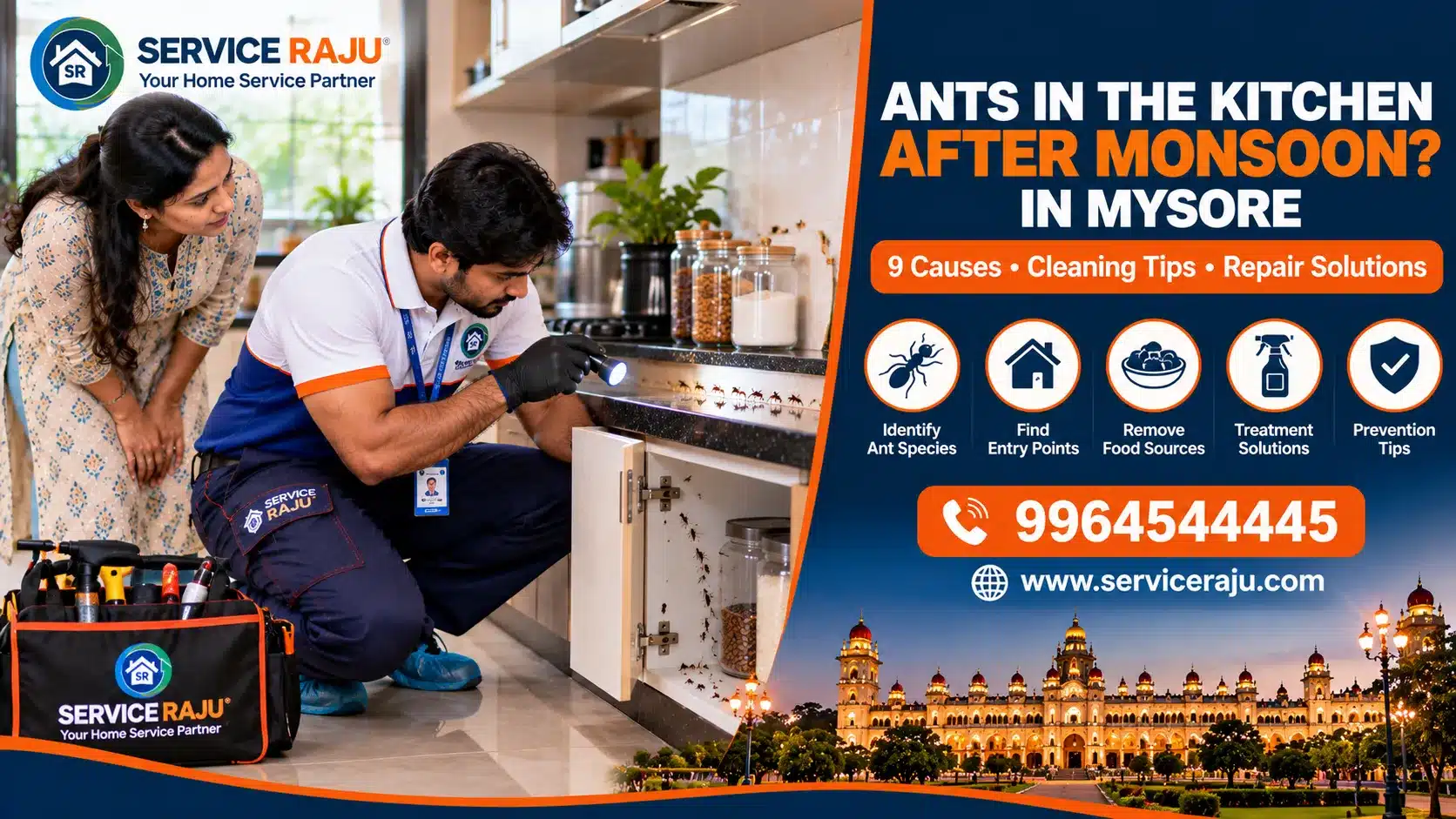
Ants in the Kitchen After Monsoon: Why They Suddenly Appear and How to Stop Them
ant control Mysore becomes an urgent search when ants suddenly start appearing across your kitchen after the monsoon. You may see them around the countertop, sink, food containers, cabinets, electrical points, windows or tiny wall gaps. Cleaning the visible ants may make the problem disappear for a few hours, but it often does not explain why they entered in the first place.
Ants are usually looking for one or more of three things: food, moisture and a route into a protected area. Kitchen spills, sugar, food crumbs, leaking taps, damp corners and gaps around pipes or cabinets can all make a kitchen attractive to foraging ants.
The bigger issue is that the ants you can see may be workers travelling from a hidden nest or entry route. That is why repeatedly spraying the visible trail may not solve a continuing infestation.
This guide explains why ants suddenly appear after the monsoon, where they commonly enter, what you can safely do at home and when professional kitchen ant control may be the better solution.
Quick Answer: Why Are Ants Suddenly Appearing in My Kitchen?
Sudden ant activity is commonly associated with:
- Easy access to food
- Water or moisture near the kitchen
- New entry points around walls, windows or pipes
- Cracks around cabinets and countertops
- Food waste or sticky residues
- Outdoor vegetation connecting to the building
- Changes in weather or nesting conditions
- A hidden nest close to the kitchen
- Multiple ant trails entering through different points
Finding a few ants does not automatically mean there is a large indoor colony. The important clues are repeated trails, increasing numbers, activity at several locations and ants returning after cleaning or DIY treatment.
Table of Contents
- Why Ants Enter Kitchens After the Monsoon
- 9 Places Ants Commonly Enter or Hide
- Black Ants vs Red Ants: Does It Matter?
- Why Spraying Visible Ants May Not Solve the Problem
- Safe DIY Steps to Reduce Ant Activity
- How Professional Ant Inspection Works
- What Professional Ant Treatment May Involve
- How to Stop Ants From Returning
- Ant Control Service in Mysore, Udupi, Mangaluru & Indore
- FAQs
- Final Takeaway
Why Ants Enter Kitchens After the Monsoon
The kitchen is one of the most attractive areas of a home for foraging ants because it combines food, water and many sheltered spaces.
Common attractions include:
- Sugar and sweet foods
- Food crumbs
- Spilled beverages
- Food waste
- Moist sinks
- Leaking taps
- Damp cabinets
- Wet cloths and sponges
- Open food containers
EPA guidance specifically identifies kitchens and food-preparation areas as common indoor locations for ants and recommends looking at food storage, food waste, moisture and entry points when investigating an infestation.
The important point is that weather alone does not explain every ant problem. The property conditions around the kitchen can determine whether ants continue entering.
9 Places Ants Commonly Enter or Hide
1. Around the Kitchen Sink
The sink area provides both moisture and potential food residue.
Check:
- Tap connections
- Sink edges
- Pipe openings
- Cabinet interiors
- Wall gaps behind the sink
Keep the sink area as dry as practical and investigate any persistent leakage.
2. Behind Kitchen Cabinets
Small gaps behind modular cabinets can provide protected travel routes.
Look for ant trails near:
- Cabinet corners
- Hinges
- Back panels
- Wall joints
- Plumbing openings
Do not assume that the colony is actually inside the cabinet. The cabinet may simply be part of the travel route.
3. Around Windows
Ants can enter through very small gaps around window frames and then move toward food or moisture.
Check for trails along:
- Window edges
- Sill joints
- Frame corners
- Cracked sealant
When the entry point is clearly visible, sealing the gap can be an important preventive measure after the active problem has been addressed.
4. Wall Cracks and Gaps
Small cracks around skirting, tiles, walls and cabinets can become ant access points.
EPA guidance recommends checking and sealing practical entry points, particularly around baseboards, cupboards, pipes, sinks and similar locations.
5. Around Plumbing Pipes
Pipe penetrations often leave small gaps around the wall opening.
Check around:
- Sink pipes
- Water-supply lines
- Drain connections
- RO purifier pipes
- Dishwasher connections
If moisture is also present, plumbing repair may be necessary alongside pest control.
6. Electrical Points and Appliance Gaps
Ant trails can sometimes appear around electrical fixtures, appliance gaps and concealed voids.
Do not spray liquid pesticide into electrical sockets, switchboards or appliances.
If ants repeatedly enter an electrical point, have the pest-control technician inspect the surrounding area and use a treatment method appropriate to the location.
7. Food Storage Areas
Open or poorly sealed food can attract foraging ants.
Pay particular attention to:
- Sugar containers
- Jaggery
- Sweets
- Biscuits
- Pet food
- Open grains
- Spilled food inside cabinets
Store attractive food in sealed containers and clean spills quickly.
8. Wet Cloths, Sponges and Damp Corners
A wet kitchen cloth or constantly damp corner can provide a moisture source.
Allow reusable cloths and sponges to dry properly and investigate leaking taps or pipes.
9. Outdoor Plants and Building Edges
Ants can travel along vegetation or sheltered exterior surfaces before entering through a window, door or wall opening.
Trim vegetation that touches or bridges the building and inspect nearby cracks and entry points.
EPA ant-management guidance recommends trimming vegetation that touches the structure and addressing moisture sources and access points around the home.
Black Ants vs Red Ants: Does It Matter?
Customers often search separately for black ant control and red ant control, but colour alone is not enough to determine the exact ant species or the correct treatment.
| What You Notice | What to Do |
|---|---|
| Small black ants around food | Check food sources, trails and entry points |
| Red or reddish ants | Photograph them and identify the species before selecting treatment |
| Very small ants in several rooms | Inspect multiple trails and possible nesting areas |
| Large ants with wood-area activity | Check for moisture and possible nesting inside or around structural wood |
| Ants repeatedly returning after treatment | Request professional inspection rather than repeating random spraying |
Different ant species can have different food preferences and nesting behaviours, so a professional should identify the situation before deciding on a treatment approach.
Why Spraying Visible Ants May Not Solve the Problem
Seeing a long line of ants on your kitchen counter makes it tempting to spray every visible insect.
That can reduce what you see temporarily, but it may not address the nest or the route that produced the trail.
Extension guidance explains that indoor ant baits can work by being carried back to the nest, while spraying may be temporary when the nest is not addressed. It also warns that insecticide sprays can interfere with baiting.
Another issue is that the trail may simply reappear through another entry point.
Think of the problem as:
Food/Water → Entry Point → Ant Trail → Hidden Nest.
Good ant management looks at the whole chain instead of focusing only on the visible trail.
Safe DIY Steps to Reduce Ant Activity
1. Clean Food Trails
Wipe kitchen counters, floors and cabinet surfaces where food residue is visible.
2. Seal Food
Keep sugar, sweets and other attractive foods in tightly closed containers.
3. Remove Food Waste
Clean waste bins regularly and avoid leaving food residue around the kitchen.
4. Reduce Moisture
Fix dripping taps, dry wet areas and do not leave standing water unnecessarily.
5. Follow the Ant Trail
Instead of killing the first ants you see, observe where the trail goes. Look toward gaps around windows, cabinets, pipes and walls.
6. Seal Obvious Entry Gaps
Once the active route is understood, practical cracks and gaps can be sealed with an appropriate material.
7. Keep Outdoor Vegetation Trimmed
Prevent branches and plants from providing a direct bridge to windows, walls and roofs.
These measures follow the general principle of reducing food, moisture and access rather than relying only on pesticide application.
How Professional Ant Inspection Works
A professional ant control service should begin by understanding the pattern of infestation.
Step 1: Identify the Activity
The technician checks where ants are appearing and how extensive the activity is.
Step 2: Follow the Trail
The visible ant trail can provide clues about entry points and possible nesting areas.
EPA guidance recommends inspecting active areas, food and moisture sources and likely entry points when investigating ants.
Step 3: Inspect the Kitchen
Particular attention should be given to:
- Sink areas
- Cabinets
- Food storage
- Plumbing gaps
- Wall joints
- Windows
- Appliance surroundings
Step 4: Check External Entry Routes
Where practical, the technician can also inspect external walls, windows, vegetation and other areas connected to the ant trail.
Step 5: Recommend the Appropriate Treatment
The treatment should be selected according to the pest, activity pattern, property conditions and accessible treatment locations.
What Professional Ant Treatment May Involve
Professional ant infestation treatment can involve a combination of inspection, habitat modification and targeted pest-control methods.
Depending on the property and species, a technician may recommend:
- Targeted baiting
- Localized treatment of active entry areas
- Crack-and-crevice treatment
- Entry-point correction
- Moisture-source correction
- Follow-up monitoring
Ant baits can be effective because worker ants can carry bait back to the colony, but bait success depends on the species, placement, competing food sources and other conditions.
Where pesticides are used, they should be selected and applied according to the applicable product label and professional safety instructions.
How to Stop Ants From Returning
After treatment, prevention matters just as much as the immediate reduction in visible ants.
| Problem | Prevention Step |
|---|---|
| Food access | Keep food sealed and clean spills quickly |
| Moisture | Repair leaks and keep sinks/corners dry |
| Entry gaps | Seal practical cracks and pipe gaps |
| Outdoor access | Trim vegetation touching the house |
| Waste | Clean and empty bins regularly |
| Recurring trails | Inspect the source rather than repeatedly killing visible ants |
EPA guidance similarly recommends sealed food storage, reducing moisture, repairing leaks, trimming vegetation and addressing entry points as part of ant prevention.
Ant Control Service in Mysore, Udupi, Mangaluru & Indore
Service Raju provides ant control service for residential and commercial properties across its service areas, including Mysuru/Mysore, Udupi, Mangaluru/Mangalore and Indore.
The service can be considered for:
- Kitchen ant infestations
- Black ant activity
- Red ant activity
- Ant trails around sinks
- Ants entering through wall gaps
- Ant activity around food storage
- Recurring ant infestations
- Commercial kitchen ant problems
When DIY Cleaning Is Not Enough
Professional ant removal service becomes more useful when:
- Ants return every day.
- Multiple ant trails appear.
- The infestation spreads beyond the kitchen.
- Ants appear around electrical points or concealed gaps.
- Cleaning temporarily works but the ants return.
- You cannot find the entry point.
- DIY treatment has not solved the problem.
Do not simply increase the amount of pesticide being used. The treatment should be based on the actual infestation pattern and the safety requirements of the property.
Book Ant Control Service
Tell us:
- Where you are seeing ants
- What colour/size they appear to be
- How long the problem has been present
- Whether they return after cleaning
- Whether you have already tried any treatment
This helps the technician understand the problem before visiting.
Service Raju — Your Home Service Partner
Call / WhatsApp: 9964544445
Website: www.serviceraju.com
FAQs About Ant Control in Mysore
Why are ants suddenly appearing in my kitchen?
Ants may be responding to accessible food, moisture or a new entry route. Kitchen spills, food storage, sink areas and small gaps around pipes or walls can all provide attractive conditions.
Why do ants keep coming back after I spray them?
Spraying visible ants may reduce the workers you can see without addressing the nest or entry route. Extension guidance notes that sprays can provide temporary control when the nest is not addressed.
What attracts ants to the kitchen?
Common attractions include sugar and other food residues, food waste, moisture, leaking fixtures and accessible storage. EPA guidance specifically recommends checking food, food waste and moisture when investigating indoor ant activity.
What is the best kitchen ant control method?
The appropriate method depends on the ant species, infestation pattern and property conditions. Inspection should come first so that entry routes, food sources and possible nesting areas can be identified.
Can ants enter through electrical points?
Ants can travel through small gaps and concealed building spaces. However, electrical points should not be treated by spraying liquids into sockets or switchboards. Have a pest-control professional inspect the area safely.
Are black ants and red ants treated differently?
They can have different food preferences and nesting behaviour, so colour alone should not determine the treatment. Correct identification and inspection are preferable.
Does kitchen cleaning remove an ant infestation?
Cleaning can remove food sources and reduce attraction, but it does not necessarily eliminate an established colony. If ants continue returning, inspect entry points and consider professional treatment.
How can I prevent ants from returning after treatment?
Store food in sealed containers, clean spills quickly, reduce moisture, repair leaks, keep waste areas clean, seal practical entry points and trim vegetation touching the building.
When should I call professional ant control?
Call a professional when ant activity is persistent, widespread, repeatedly returns after DIY treatment, involves concealed areas or occurs around locations where safe pesticide application is difficult.
Does Service Raju provide ant control in Mysore?
Yes. Service Raju provides ant-control services for residential and commercial properties in Mysuru/Mysore and its listed service areas, including Udupi, Mangaluru/Mangalore and Indore.
Final Takeaway
Sudden ants in the kitchen are not always just a cleaning problem.
Use this simple approach:
Find the food → Find the moisture → Follow the trail → Find the entry point → Identify the problem → Treat appropriately → Prevent re-entry.
If you only kill the ants that are visible on the kitchen counter, the trail can return because the underlying food source, entry route or colony has not been addressed.
For persistent activity, professional ant control Mysore can help identify where the ants are coming from and determine an appropriate treatment plan.
Seeing ants throughout your kitchen after the monsoon?
Book Ant Control Service with Service Raju.
Call / WhatsApp: 9964544445
Website: www.serviceraju.com
 AC Repair
.webp) Ant Control Service
Ant Control Service
 Basin & Sink Services
.webp) Bath & Shower Services
Bath & Shower Services
.webp) Bath Fittings & Mirrors
Bath Fittings & Mirrors
 Bathroom Cleaning Service
 Bathroom Renovation Services
 Bed Bug Control Services
 Bedroom Painting
 Book a Carpenter Consultation
 Book Electrical Consulting
.webp) Cabinet Painting & Wood Refinishing
Cabinet Painting & Wood Refinishing
 Chimney Cleaning
 Civil Masonry Work
 Clean-Up Services
.webp) Clothes Hanger Installation
Clothes Hanger Installation
 Cockroach Control Services
---mysore-mysore-standard-300x200.webp) Commercial Cleaning
Commercial Cleaning
 Commercial Pest Control AMC Service
 Cupboard & Drawer Services
 Decorative Wall Panels
 Deep Sanitisation Service
 Detan & Bleach
 Door, Grill & Cabinet Painting Service
.webp) Doorbell & security
Doorbell & security
 Drain Blockage Clearing
 Electrical Appliance Services
 Electrical Wiring Services
 Empty Home Deep Cleaning
.webp) Fabrication
Fabrication
 Facials
.webp) Fan Installation & Repair
Fan Installation & Repair
 Full Home Cleaning Service
 Full Home Renovation
 Furniture Repair Service
 Gas Stove & Hob Repair
.webp) General Pest Control Services
General Pest Control Services
 General Plumbing & Consultation
 Geyser Repair
 Glass Cleaning
 Head Massage
.webp) Honeybee & Wasp-Services
Honeybee & Wasp-Services
 Kitchen & Bathroom Painting Service
 Kitchen Cleaning
 Kitchen Fittings
.webp) Kitchen Renovation
Kitchen Renovation
.webp) Laptop/Desktop service
Laptop/Desktop service
 Leak Detection and Repair
 LED TV Repair
 Living and Dining Room Painting
 Makeup, Saree & Styling
 Manicure & Pedicure
 MCB,Meter & Fuse Services
 Microwave Repair
 Mosquito Pest Control Service
 Multi-Room Painting Service
 Painting Consultation
 Quick Mini Cleaning Services
 Refrigerator Repair
 RO Water Purifier
.webp) Rodent Control Services (Rat & Mice Treatment)
Rodent Control Services (Rat & Mice Treatment)
.webp) Rooms Cleaning
Rooms Cleaning
 Shelves & Decor
 Sofa, Carpet & Mattress Cleaning
 Solar Water Heater Service
 Sump & Tank Cleaning
 Switch & Socket Services
 Tap & Mixer Service
.webp) Termite-Control-Services
Termite-Control-Services
 Threading & Face Wax
.webp) Tile & Granite Installation & Polishing
Tile & Granite Installation & Polishing
 Toilet & Commode Services
.webp) UPS and Inverter Repair Services
UPS and Inverter Repair Services
.webp) Wall Painting Service
Wall Painting Service
 Washing Machine Repair
 Water Level Controllers
 Water Tank and Pump Repair
 Waterproofing
 Waterproofing Services
 Waxing
 Window & Curtain Services
 Wooden Door Services