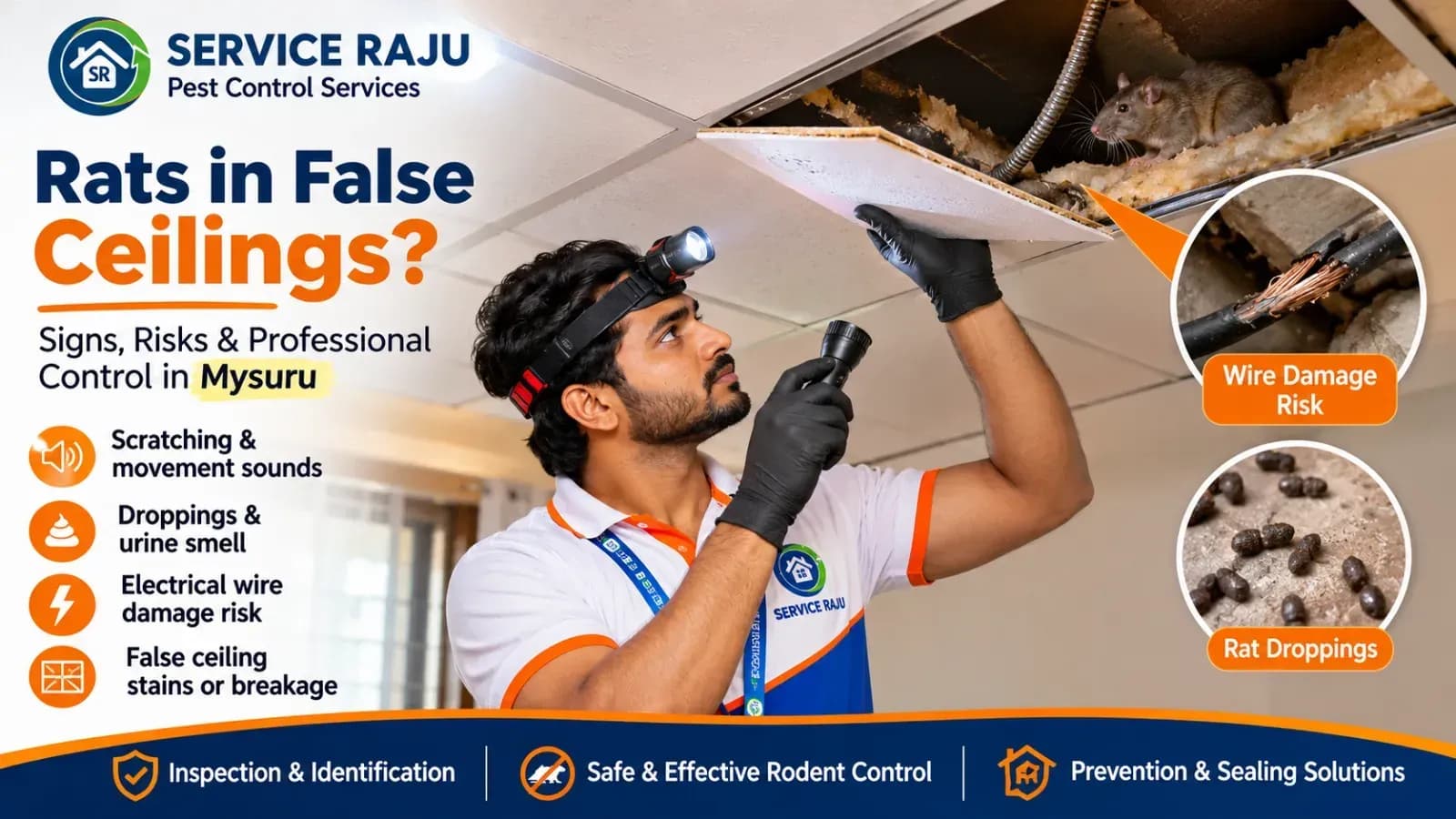
Rats in False Ceilings: Signs, Hidden Damage and Professional Rodent Control in Mysuru
Hearing scratching, running or movement sounds above your ceiling, especially at night? Noticing a foul smell, small droppings or damaged ceiling panels? These could be warning signs of rats or mice living inside your false ceiling or roof space.
Rats can enter buildings through small openings around pipes, service ducts, roof gaps and utility passages. Once inside a false ceiling, they may remain hidden while moving between ceiling spaces, wall cavities and other parts of the property. Their activity can damage insulation, contaminate surfaces and potentially affect electrical wiring.
If you are searching for rats in false ceiling solutions or professional rodent pest control in Mysuru, it is important to identify the entry points, assess the affected areas and choose a suitable control plan. Simply placing a trap in one corner may not address the source of the problem.
In this guide, Service Raju explains why rats enter false ceilings, how to identify their presence, what damage they may cause, how professional rodent control works and how to reduce the risk of another infestation.
Hearing rats above your ceiling? Contact Service Raju to enquire about rodent inspection and pest-control availability in Mysuru.
Explore Service Raju Pest Control Services | Call +91 9964544445
Table of Contents
- Why rats enter false ceilings
- Warning signs of rats inside false ceilings
- Possible damage caused by rats in ceiling spaces
- Rat damage to electrical wires: What property owners should know
- How to identify rat entry points
- Professional rodent inspection and control
- How to prevent rats from returning
- Common mistakes to avoid
- How to choose a rodent control service in Mysuru
- Rodent control enquiries with Service Raju
- Frequently asked questions
1. Why Do Rats Enter False Ceilings?
False ceilings create concealed spaces between the visible ceiling and the original roof or slab. Depending on the building design, these spaces may contain electrical cables, lighting fixtures, air-conditioning lines, ducts and other building services.
Rats and mice may use these concealed spaces as routes to move around a building or as sheltered places to rest and nest. They are attracted by access, shelter, nearby food sources and suitable nesting materials.
Common reasons rodents enter ceiling spaces
- Small openings and gaps: Openings around pipes, cables, ducts, roof edges and service penetrations can provide access.
- Nearby food sources: Kitchens, restaurants, food storage areas, waste bins and pantry spaces may attract rodents to the building.
- Sheltered nesting areas: False ceilings may provide dark and relatively undisturbed spaces.
- Connected building spaces: Rodents may move through wall cavities, utility ducts, roof spaces and openings between rooms.
- Unsealed construction gaps: Poorly sealed service openings or damaged ceiling sections may make entry easier.
- Nearby vegetation and waste: Overgrown vegetation, stored materials and unmanaged waste near buildings may provide shelter or food.
Rats do not enter only old or poorly maintained buildings. Newer houses, apartments, offices, shops and commercial properties can also experience rodent activity if suitable access points are present.
2. Warning Signs of Rats Inside False Ceilings
Because false ceilings conceal the roof space, rodent activity may become noticeable through sounds, smells or physical evidence rather than direct sightings.
Common signs to watch for
| Warning sign | What you may notice | What it could indicate |
|---|---|---|
| Scratching sounds | Repeated scratching, gnawing or movement above the ceiling | Possible rodent movement in a concealed space |
| Running sounds | Quick movement or footsteps above a room, particularly at night | Possible movement through ceiling or roof spaces |
| Droppings | Small dark droppings near access openings, cupboards or roof access points | Possible rodent activity nearby |
| Unpleasant smell | Persistent foul or decaying smell from a ceiling area | Possible nesting, contamination or a dead animal |
| Gnawing marks | Chewed packaging, wood, insulation or other materials | Possible rodent feeding or gnawing activity |
| Damaged ceiling panel | Staining, disturbed panels or unusual openings | Possible access, contamination or unrelated building damage requiring inspection |
| Repeated sightings | Rats or mice seen near the kitchen, roof edge or service duct | Possible entry route into concealed building spaces |
Why are scratching sounds more noticeable at night?
Rats are generally more active during darker and quieter periods. When household activity decreases, sounds from concealed roof spaces may become easier to hear.
However, scratching sounds do not automatically confirm rats. Birds, squirrels, loose building components, plumbing movement and other causes may produce similar noises. A proper inspection is necessary before deciding on treatment.
Where should you look for evidence?
- Around ceiling access panels and inspection openings
- Near kitchen and pantry ceilings
- Around cable and pipe entry points
- Above cupboards and storage spaces
- Near roof edges, ventilation openings and service ducts
- Along accessible wall and ceiling junctions
Do not open or remove ceiling panels without checking for electrical hazards and ensuring that the structure can be accessed safely.
3. What Damage Can Rats Cause Inside False Ceilings?
Rodents may cause damage while moving, nesting and gnawing inside concealed building spaces. The extent of damage depends on the infestation, building materials, wiring arrangement and how long the activity continues.
Common types of damage
1. Damage to electrical wiring
Rats gnaw on materials to keep their teeth worn down. Electrical cable insulation can be damaged if cables are accessible. Exposed or damaged wiring may create electrical hazards, including short circuits and fire risks.
2. Damage to insulation
Rodents may disturb or tear suitable insulation materials while creating movement routes or nesting areas.
3. Contamination from droppings and urine
Rodent waste can contaminate concealed surfaces, insulation and stored materials. Cleaning contaminated areas requires suitable protective measures.
4. Damage to ceiling materials
Movement, nesting and gnawing may affect some ceiling components or materials. Damaged panels and disturbed fittings should be assessed before repair.
5. Unpleasant odours
Rodent urine, droppings, nesting materials or a dead rodent in an inaccessible area may create persistent odours inside a room.
6. Damage to stored materials
Cardboard, fabric, paper and other materials stored near roof access areas may be chewed or contaminated.
Important: If there is suspected electrical damage, treat it as a safety issue rather than only a pest-control problem. Have the wiring assessed by a qualified electrician before using affected circuits or equipment.
4. Rat Damage to Electrical Wires: What Property Owners Should Know
One of the more serious concerns associated with rats inside false ceilings is possible damage to electrical cable insulation. If a rodent chews through cable insulation, the exposed conductor or damaged cable may create a risk of electric shock, short circuits or overheating.
Possible warning signs of electrical problems
- Repeated tripping of a circuit breaker
- Unusual burning smells near ceiling lights or electrical points
- Flickering lights or electrical equipment behaving unexpectedly
- Visible damaged cables around accessible service openings
- Unusual sounds or signs of damage near electrical fixtures
These symptoms can have several causes and do not prove rodent damage. A qualified electrician should inspect the affected electrical installation.
Safety precautions
- Do not touch exposed or damaged wires.
- Do not insert tools, hands or metal objects into ceiling openings.
- Do not remove ceiling panels near suspected damaged wiring unless a competent professional has made the area safe.
- If there is smoke, sparking or a burning smell, keep people away and arrange urgent electrical assistance.
- Isolate the affected circuit only if it is safe to do so.
- Do not allow pest-control chemicals or liquids to be applied to electrical equipment or live wiring.
Rodent control and electrical repair are different tasks. Pest-control treatment may address the rodent problem, but damaged electrical cables must be assessed and repaired by a qualified electrician.
5. How to Identify Rat Entry Points Into False Ceilings
Removing or controlling rodents without addressing their access routes can allow the problem to continue. Finding the likely entry points is therefore an important part of a rodent inspection.
Common entry locations
- Gaps around plumbing pipes
- Openings around electrical cable routes
- Air-conditioning pipe and duct openings
- Roof edges and damaged roof sections
- Ventilation openings without suitable protection
- Gaps near external walls and ceiling junctions
- Unsealed service ducts and utility passages
- Openings around water tank and terrace service areas
What should an inspection check?
A systematic inspection may include:
- Checking accessible ceiling openings and roof access areas.
- Looking for droppings, gnawing marks, nesting materials and other physical evidence.
- Checking pipe, cable and duct penetrations for gaps.
- Examining nearby kitchens, storage areas and waste disposal points.
- Identifying possible movement routes between the roof, walls and ceiling.
- Assessing whether an electrical inspection or ceiling repair is also required.
Not every gap is a rodent entry point. A technician should assess the opening and its location before recommending sealing or repair.
6. Professional Rodent Inspection and Control in Mysuru
When rats are suspected inside a false ceiling, the most useful first step is to identify the likely access route and understand the extent of the activity. A professional rodent-control plan should be based on inspection findings rather than applying a generic treatment throughout the property.
Step 1: Discuss the symptoms
Share when you hear scratching or running sounds, where they occur, whether droppings have been found and whether anyone has seen a rodent.
Step 2: Inspect accessible areas
The technician assesses suitable access points, nearby spaces and visible signs of activity. Any ceiling access should be carried out safely and with attention to electrical services and the condition of the panels.
Step 3: Identify the likely rodent activity and entry routes
Inspection findings help determine whether the issue appears to involve rats, mice or another animal and which areas may need further assessment.
Step 4: Select an appropriate control method
Depending on the site, infestation and safety conditions, suitable rodent-management methods may include properly selected traps, monitoring and other legally permitted control measures. The placement of any control device must consider children, pets, food areas and access by non-target animals.
Step 5: Recommend proofing and sanitation
Where appropriate, the provider may recommend sealing suitable entry gaps, protecting vulnerable openings, improving waste management and removing conditions that attract rodents.
Step 6: Monitor and reassess
Follow-up checks may be needed to assess whether rodent activity has reduced, whether control devices need attention and whether further entry points remain.
What does a good rodent-control plan include?
| Control activity | Purpose |
|---|---|
| Inspection | Identify evidence, affected areas and possible entry routes. |
| Rodent identification | Help select a suitable control approach. |
| Control-device placement | Manage rodent activity using appropriate, safely positioned methods. |
| Entry-point recommendations | Reduce opportunities for rodents to enter concealed spaces. |
| Sanitation guidance | Reduce access to food, waste and nesting materials. |
| Follow-up monitoring | Check for continued activity and the need for further action. |
Ask the provider what is included in the service. Do not assume that ceiling opening, electrical repair, contaminated-material removal, building repairs or permanent proofing are included in a standard pest-control quotation.
7. How to Prevent Rats From Returning to False Ceilings
Rodent control is more effective when the conditions that allow rodents to enter and remain inside the building are also addressed. Prevention should combine suitable proofing, sanitation and periodic checks.
Seal suitable openings
- Inspect gaps around pipes, cables and ducts.
- Repair damaged roof sections and accessible building openings.
- Use suitable rodent-resistant materials for appropriate gaps.
- Protect ventilation openings with suitable mesh where permitted by the design.
- Check that sealing work does not obstruct ventilation, drainage or essential services.
Maintain good sanitation
- Keep kitchen counters and food preparation areas clean.
- Store food in closed, rodent-resistant containers.
- Use covered waste bins and remove waste regularly.
- Clean food spills and crumbs promptly.
- Avoid leaving pet food exposed overnight.
Maintain the building surroundings
- Remove unnecessary cardboard, clutter and stored waste.
- Keep vegetation and stored materials away from building openings where practical.
- Maintain drainage and waste disposal areas.
- Check roof edges, service ducts and utility openings periodically.
- Arrange repairs for damaged ceiling panels and access covers.
Schedule periodic checks
For homes, offices, restaurants and commercial buildings with a history of rodent activity, periodic inspections can help identify new signs before the problem becomes widespread. Inspection frequency should depend on the property, previous activity and surrounding conditions.
8. Common Mistakes to Avoid When Rats Are in a False Ceiling
Some quick reactions can make a rodent problem more difficult or create unnecessary safety risks.
- Ignoring repeated sounds: Continued scratching or movement sounds should be investigated rather than ignored.
- Opening ceiling panels without checking hazards: Concealed wiring, unstable panels and other services may create risks.
- Using poison without a plan: Uncontrolled bait placement can expose children, pets and non-target animals. A dead rodent in an inaccessible ceiling may also create a persistent odour.
- Sealing every opening immediately: Poorly planned sealing may trap animals inside or obstruct essential building services. Confirm that the space has been assessed before closing access routes.
- Using smoke or fire to remove rodents: This is dangerous and can cause fire, toxic exposure and building damage.
- Applying chemicals near electrical equipment: Chemicals and liquids must never be applied in ways that create electrical hazards or violate product-label instructions.
- Cleaning droppings without protection: Rodent waste should be handled using appropriate precautions. Avoid dry sweeping or vacuuming droppings because this can put contaminated dust into the air.
- Ignoring the source of attraction: Leaving food waste, clutter or open entry points may allow rodents to return.
If rodent droppings or nesting material are found, keep people and pets away from the affected area and seek appropriate cleaning guidance. Extensive contamination or inaccessible ceiling spaces may require trained personnel and suitable protective equipment.
9. How to Choose a Rodent Pest Control Service in Mysuru
When searching for rat control in Mysore or professional rodent removal, compare providers based on the inspection process, control method, safety instructions and follow-up arrangements.
Questions to ask before booking
- Do you inspect false ceilings and accessible roof spaces?
- Will you identify possible rodent entry points?
- Which control method do you recommend for this property?
- How will children, pets and non-target animals be protected?
- Are bait stations or traps included, if required?
- Is sealing of entry points included or quoted separately?
- Will electrical damage need a separate electrician?
- Is follow-up monitoring included?
- Are inspection and visiting charges applicable?
- What exactly is included in the written quotation?
A responsible provider should explain the proposed work and its limitations. Be cautious of claims that promise permanent elimination from a single visit without inspecting the property.
10. Rodent Control Enquiries with Service Raju in Mysuru
If you hear scratching sounds above your ceiling, notice droppings near roof access areas or suspect rats inside your false ceiling, Service Raju can help you enquire about pest-control services in Mysuru.
Share the affected location and the signs you have noticed so the team can discuss the appropriate inspection and available service options.
When you contact Service Raju, share:
- Your property location and locality in Mysuru.
- Whether the property is a house, apartment, office, shop or commercial building.
- Where you hear scratching or running sounds.
- Whether you have noticed droppings, gnawing marks or a foul smell.
- Whether the ceiling has an accessible inspection panel.
- Whether there are children, pets or electrical concerns in the affected area.
Service scope and availability: Confirm whether false-ceiling inspection, rodent control, bait or trap placement, follow-up visits and entry-point proofing are available and included in the quotation. Electrical repairs, ceiling repairs and contaminated-material removal may require separate specialists.
Book a Rodent Control Enquiry in Mysuru
Do not ignore repeated rodent sounds above your ceiling. Early inspection can help identify the likely source of activity and the next steps needed to protect your property.
Call Service Raju: +91 9964544445
Explore Pest Control Services: https://www.serviceraju.com/services/mysuru
Trusted Home Services in Mysuru, Udupi, Mangaluru & Indore.
11. Frequently Asked Questions About Rats in False Ceilings
1. How do I know if rats are inside my false ceiling?
Common signs include scratching or running sounds, droppings near access points, gnawing marks, nesting materials and unpleasant smells. These signs may have other causes, so an inspection is needed to confirm rodent activity.
2. Why do rats enter false ceilings?
Rats may enter through gaps around pipes, cables, ducts, roof edges and other openings. False ceilings can provide sheltered spaces and routes through the building.
3. Can rats damage electrical wires inside a false ceiling?
Yes. Rodents may gnaw on accessible cable insulation. Damaged wiring can create electrical hazards. Have suspected electrical damage inspected by a qualified electrician.
4. Are scratching sounds at night a sign of rats?
They can be a sign of rodent activity, especially when accompanied by droppings or other evidence. However, birds, squirrels, loose components and plumbing movement can also cause sounds. Inspection is needed to identify the source.
5. Can rats enter through small gaps around pipes?
Yes. Gaps around plumbing, electrical cables and utility ducts may provide access. The size and condition of the opening should be assessed and suitable proofing recommended.
6. Should I use rat poison inside a false ceiling?
Do not place poison randomly inside a ceiling. Poorly positioned bait can expose children, pets and non-target animals, and a dead rodent may remain inaccessible. Use an appropriate control plan with safe placement and monitoring.
7. Can sealing entry points solve the problem?
Sealing suitable openings can help prevent further entry, but only after the affected space and any remaining rodent activity have been assessed. Poorly timed sealing can trap animals inside. Sealing must also preserve ventilation and building services.
8. Will one rodent-control visit solve the problem?
Not necessarily. Results depend on the number of rodents, access points, infestation conditions and control method. Monitoring and follow-up may be required.
9. Does rodent control include electrical wire repair?
Not automatically. Pest control and electrical repair are separate tasks. Damaged wiring should be assessed and repaired by a qualified electrician. Confirm the exact service scope before booking.
10. How can I book rat control in Mysuru?
Contact Service Raju at +91 9964544445 or visit the Mysuru services page. Share the signs you have noticed and your location to confirm current rodent-control availability.
Conclusion: Do Not Ignore Rats in Your False Ceiling
Scratching sounds, droppings, gnawing marks and unpleasant smells may indicate rats or mice inside a false ceiling. Rodents can damage insulation and accessible electrical cable coverings, contaminate concealed spaces and create ongoing problems if entry points remain open.
The right approach is to identify the source, inspect accessible areas safely, choose an appropriate rodent-control method and address suitable entry points. Electrical damage and building repairs should be handled by the relevant qualified professionals.
If you suspect rats inside your ceiling in Mysuru, contact Service Raju to discuss your rodent-control requirement and confirm available inspection and treatment options.
Service Raju – Your Home Service Partner.
Call Now: +91 9964544445
Explore Pest Control Services in Mysuru
Trusted Home Services in Mysuru, Udupi, Mangaluru & Indore.