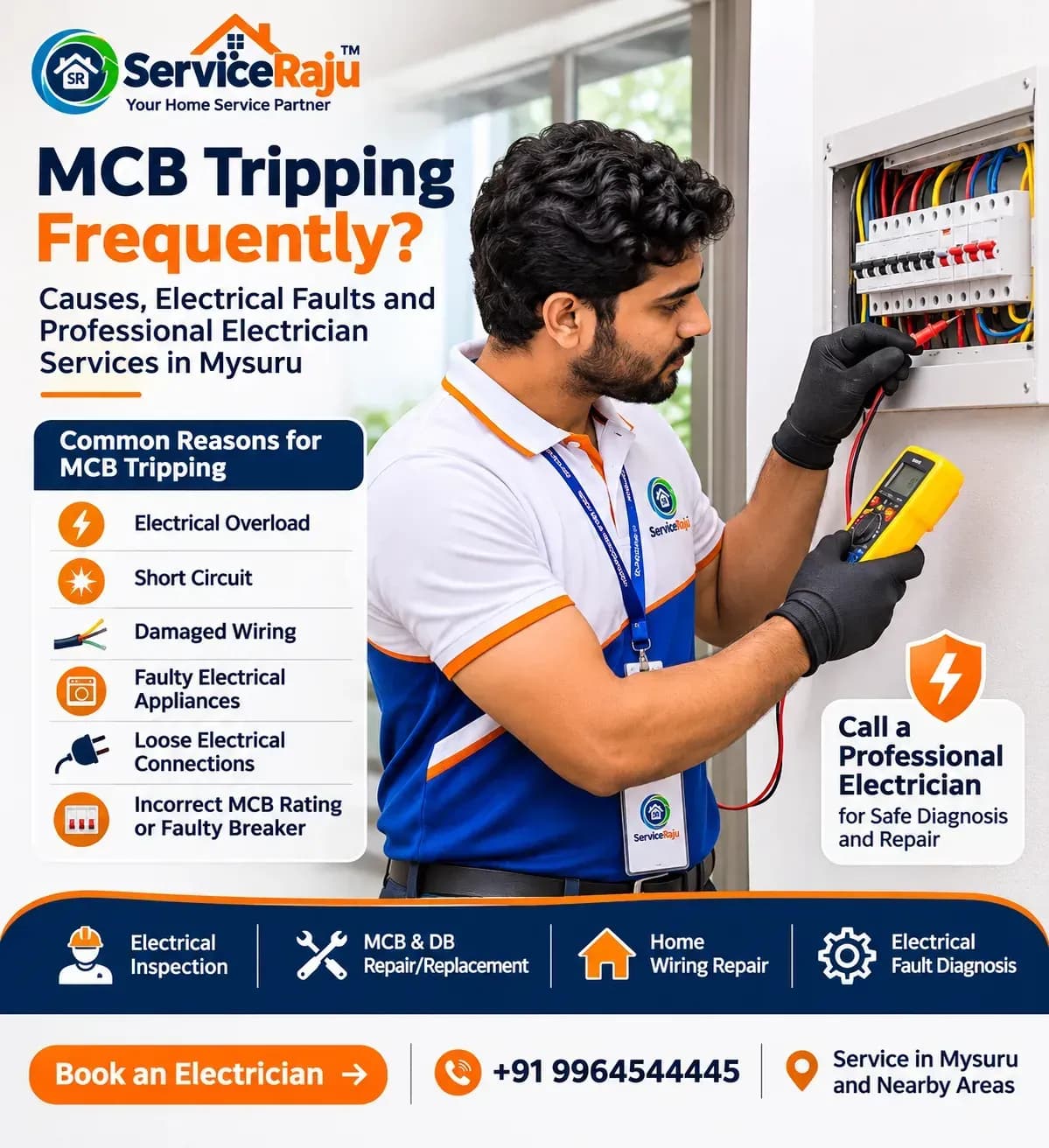
MCB Tripping Frequently? Causes, Electrical Faults and Professional Electrician Services in Mysuru
Does your home's MCB switch off repeatedly, especially when you turn on multiple appliances? Frequent MCB tripping can indicate an electrical overload, short circuit, damaged wiring, faulty appliance or another problem in the electrical installation. It is a warning that should not be ignored.
An MCB (Miniature Circuit Breaker) is a protective device designed to disconnect a circuit when it detects certain overcurrent conditions. It helps protect electrical wiring and connected installations. If it keeps tripping, simply switching it back on without identifying the cause may leave the underlying electrical fault unresolved.
If you are searching for MCB tripping frequently, an electrician near me or professional electrical repair in Mysuru, this guide explains common causes, warning signs, the difference between MCB and RCCB tripping, and when to arrange a qualified electrician.
Need electrical assistance? Contact Service Raju to discuss your electrical problem and confirm technician availability in your area.
Call: +91 9964544445
Explore Service Raju Home Services in Mysuru
Table of Contents
- What does it mean when an MCB trips repeatedly?
- Six common reasons for MCB tripping
- Difference between MCB and RCCB tripping
- Why does the MCB trip when multiple appliances are running?
- Can frequent MCB tripping damage electrical appliances?
- When should you call a professional electrician?
- How an electrician checks an electrical distribution board
- Electrical repair and wiring services in Mysuru
- How to book an electrician with Service Raju
- Frequently asked questions
1. What Does It Mean When an MCB Trips Repeatedly?
When an MCB trips, it automatically switches off the electrical circuit it protects. This can happen when the circuit experiences an overload or a short circuit, depending on the type and characteristics of the protective device.
For example, an MCB may trip when several high-power appliances operate on the same circuit and the total electrical load exceeds the circuit's safe capacity. It may also trip when damaged wiring or an electrical fault causes excessive current to flow.
Common signs of an MCB tripping problem
- The MCB switches off when certain appliances are switched on.
- The same circuit trips repeatedly during normal use.
- The breaker trips when multiple appliances operate together.
- Power is lost in one room or a group of connected rooms.
- The breaker trips immediately after being switched on.
- You notice unusual heat, buzzing, burning smells or visible damage near electrical equipment.
The timing and circumstances of the trip can help an electrician investigate the problem. However, they do not establish the exact cause without proper inspection and testing.
2. Six Common Reasons for MCB Tripping
Reason 1: Electrical overload
An electrical overload occurs when the current drawn by connected appliances exceeds the capacity of the circuit or its protective arrangement.
This may happen when several high-power appliances are used simultaneously on the same circuit.
Examples include:
- Geyser and washing machine operating on an inadequately rated shared circuit.
- Iron box and other high-power appliances running together.
- Multiple kitchen appliances connected to an overloaded circuit.
- Too many appliances connected through extension boards or multi-plug adapters.
What should be checked? A qualified electrician can assess the connected load, circuit wiring, breaker rating and distribution of appliances. The correct solution may involve redistributing loads or upgrading a circuit after checking that the wiring and protective devices are suitable.
Reason 2: Short circuit
A short circuit occurs when electrical conductors make an unintended connection, creating a low-resistance path that can cause a very high current to flow.
Short circuits may result from damaged cable insulation, faulty accessories, moisture entering electrical fittings or wiring damage.
Possible warning signs include:
- MCB trips immediately when a circuit is energised.
- Sparks or flashes from an electrical fitting.
- Burning smell near a switch, socket or distribution board.
- Visible damage to wiring or electrical accessories.
A suspected short circuit requires professional inspection. Do not keep resetting the breaker to see whether it will stay on.
Reason 3: Damaged electrical wiring
Wiring can deteriorate or become damaged due to ageing, overheating, poor installation, mechanical damage, pests or moisture. Damaged insulation and loose or deteriorated connections can create electrical faults.
Possible signs include:
- Repeated breaker tripping without an obvious appliance-related reason.
- Intermittent power supply.
- Burning smell or unusual heat near electrical points.
- Discoloured switches or sockets.
- Visible damaged cables or exposed conductors.
Concealed wiring problems may not be visible from outside. An electrician may need to carry out suitable tests to identify the affected circuit and recommend a safe repair.
Reason 4: Faulty electrical appliances
Sometimes the problem is not in the fixed house wiring but in an appliance connected to the circuit. A damaged heating element, motor, power cord or internal electrical component may cause a protective device to operate.
Appliances that may need inspection include:
- Geysers and water heaters
- Air conditioners
- Washing machines
- Refrigerators
- Microwave ovens
- Water pumps
- Irons and other heating appliances
If tripping appears to happen when a particular appliance is used, stop using that appliance and arrange an inspection. Do not repeatedly reconnect it to test whether the breaker trips again.
Reason 5: Loose electrical connections
Loose connections at terminals, switches, sockets or distribution boards can create resistance and localised heating. Depending on the fault, this may lead to intermittent operation, arcing or other dangerous conditions.
Warning signs may include:
- Buzzing or crackling near an electrical point.
- Warm or discoloured switches and sockets.
- Intermittent power.
- Burning smell near the distribution board.
Loose connections should be inspected and corrected by a qualified electrician after the circuit has been safely isolated. Never open a live distribution board or attempt to tighten internal terminals yourself.
Reason 6: Incorrect MCB rating or a faulty breaker
An MCB must be selected to suit the circuit, cable capacity, installation conditions and required protection. An incorrectly selected breaker may not provide suitable protection for the wiring. A worn or faulty breaker may also fail to operate as intended.
What an electrician should check:
- MCB rating and trip characteristics.
- Suitability for the connected circuit and cable size.
- Signs of heat damage or physical deterioration.
- Terminal and busbar condition.
- Whether the breaker is operating correctly.
Never install a higher-rated MCB simply to stop repeated tripping. The protective device must be matched to the wiring and circuit design. A higher rating without the required checks can create a serious overheating and fire risk.
3. Difference Between MCB and RCCB Tripping
MCB and RCCB devices serve different protective purposes. Understanding the difference can help you explain what is happening when a switch in your distribution board trips.
| Feature | MCB | RCCB |
|---|---|---|
| Full form | Miniature Circuit Breaker | Residual Current Circuit Breaker |
| Main protection purpose | Protects against overload and short-circuit overcurrent conditions within its design. | Detects residual current imbalance, which may indicate current leakage to earth. |
| Typical reason for operation | Overload or short circuit. | Earth leakage or residual current above its operating threshold. |
| What may need inspection | Load, wiring, short circuits, breaker and connections. | Appliances, wiring insulation, moisture, leakage paths and the RCCB. |
An RCCB does not normally provide overload and short-circuit protection by itself. It is commonly used with suitable overcurrent protection. Other protective devices, such as RCBOs, combine residual-current and overcurrent protection functions.
If the RCCB trips rather than the MCB, the investigation may need to focus on earth leakage or insulation faults. A qualified electrician can identify which device operated and carry out appropriate tests.
4. Why Does the MCB Trip When Multiple Appliances Are Running?
When several appliances operate together, their combined electrical demand may exceed the capacity of a particular circuit. This is one possible reason an MCB trips during busy household periods.
Example household situations
- A geyser and an iron are used at the same time.
- A microwave and other kitchen appliances operate on one circuit.
- An air conditioner operates alongside additional high-power equipment on an unsuitable shared circuit.
- Multiple appliances are connected through one extension board.
However, the number of appliances alone does not determine whether a circuit is overloaded. The electrical load, circuit design, cable size, breaker rating and installation condition all matter.
A professional electrician can assess the load and recommend suitable circuit arrangements. Do not solve repeated tripping by replacing the breaker with a higher-rated model without a proper assessment.
5. Can Frequent MCB Tripping Damage Electrical Appliances?
An MCB tripping is a protective response, but repeated interruptions can be inconvenient and may affect some appliances depending on their design and operating state.
Potential concerns include:
- Unexpected shutdown of appliances while operating.
- Interruption of electronic equipment and ongoing processes.
- Repeated restarting of certain devices.
- Possible loss of unsaved work on connected electronic equipment.
Repeated tripping should not be treated as a normal operating condition. The underlying cause should be identified rather than repeatedly restoring power.
If an appliance is suspected of causing the problem, stop using it until it has been inspected. Do not continue testing it by repeatedly switching the circuit on and off.
6. When Should You Call a Professional Electrician?
Arrange professional electrical inspection when an MCB trips repeatedly, particularly when the reason is unclear or the problem is becoming more frequent.
Call an electrician if:
- The same MCB keeps tripping during normal household use.
- The breaker trips immediately after being switched on.
- One particular appliance appears to trigger the problem.
- Power interruptions occur in different rooms or circuits.
- You notice buzzing, crackling or unusual heat near electrical equipment.
- Switches or sockets show signs of damage or discolouration.
- You suspect old, damaged or concealed wiring.
Important electrical safety precautions
- Do not repeatedly reset a breaker that keeps tripping.
- Never bypass an MCB, RCCB or other protective device.
- Never replace a breaker with a higher-rated one just to prevent tripping.
- Do not open a live distribution board.
- Do not touch damaged, exposed or wet electrical equipment.
- If you notice smoke, sparks or a burning smell, keep away and seek urgent qualified assistance.
If it is safe to do so, keep away from the affected circuit and arrange professional help. If the area is wet or there is visible damage, do not touch the switchboard or electrical equipment.
7. How Does an Electrician Check an Electrical Distribution Board?
When an electrician attends an MCB tripping complaint, the inspection should identify the affected circuit and establish why the protective device is operating. The exact checks depend on the installation, symptoms and test findings.
Typical inspection areas
- Understand the complaint: Identify which breaker trips, when it happens and which appliances or rooms are affected.
- Visual inspection: Look for visible damage, overheating, discolouration, loose external fittings and signs of moisture.
- Check circuit loading: Assess the connected appliances and whether the circuit is being overloaded.
- Inspect protective devices: Check the MCB or RCCB type, rating, condition and suitability for the installation.
- Carry out appropriate electrical tests: Depending on the fault, the electrician may use suitable instruments to assess insulation resistance, continuity, polarity or other relevant electrical parameters.
- Identify the fault: Determine whether the issue relates to wiring, an appliance, connections, load or a protective device.
- Explain the repair: Share the findings, recommended work, parts required and quotation before proceeding.
Testing inside a distribution board should be performed only by a competent person using appropriate procedures and equipment. Live testing, where necessary, requires suitable training and safety controls.
8. Electrical Repair and Wiring Services in Mysuru
Electrical systems need proper installation, inspection and repair to operate safely. If you are experiencing repeated MCB tripping or another household electrical problem, Service Raju accepts enquiries for electrical service requirements in Mysuru.
Common electrical service enquiries
- MCB inspection and replacement enquiries.
- Electrical fault diagnosis and repair.
- Home electrical wiring repair.
- Switch and socket installation or replacement.
- Fan and light fixture installation.
- Electrical connection and fitting repairs.
- UPS and inverter service enquiries.
- Water motor-related electrical work.
The appropriate repair depends on the fault and site conditions. The technician should explain the work scope, required materials, charges and applicable service terms before starting.
9. Electrical Problems in Houses, Apartments and Offices
Electrical faults can occur in different types of properties. The inspection approach depends on the building layout, distribution board, wiring arrangement and connected equipment.
Independent houses
Possible requirements include circuit overload assessment, switchboard repairs, wiring inspection, appliance-related faults and distribution board checks.
Apartments
Residents may experience circuit-specific tripping, appliance faults, socket problems or issues that require coordination with building management. Common-area and building-level electrical systems may be outside an individual apartment service scope.
Offices and commercial premises
Workplaces may have multiple circuits, computers, air conditioning equipment and other electrical loads. Electrical inspection should consider the connected load and the requirements of the premises.
Always confirm whether the problem is within your individual property or involves a shared building electrical system.
10. How to Book a Professional Electrician with Service Raju
If your MCB is tripping frequently or you suspect an electrical fault, Service Raju can help you enquire about electrician availability in Mysuru.
Simple booking process
- Contact Service Raju: Call the team or visit the Mysuru services page.
- Explain the problem: Mention whether the MCB trips immediately, after some time or when a particular appliance is used.
- Share your location: Provide your Mysuru locality and property type.
- Describe any warning signs: Mention burning smells, sparks, heat, buzzing, water leakage or damaged fittings.
- Confirm the appointment: Check technician availability and the expected visit time.
- Discuss the quotation: Confirm inspection charges, labour, materials and replacement parts before approving work.
- Review the repair: Ask what caused the fault and whether any further electrical work is recommended.
Information to keep ready
- Your location and contact number.
- Which MCB or protective device is tripping, if known.
- When the tripping occurs.
- Which appliances were operating at the time.
- Any visible warning signs or unusual smells.
- Whether the issue affects one room or several areas.
Book an electrician with Service Raju. Contact the team to explain your electrical problem and confirm service availability.
Call Now: +91 9964544445
Explore Service Raju Electrical and Home Services
11. Frequently Asked Questions About MCB Tripping
1. Why is my MCB tripping frequently?
Common reasons include electrical overload, short circuits, damaged wiring, faulty appliances, loose connections or an unsuitable or faulty breaker. A professional inspection is needed to identify the actual cause.
2. Why does my MCB trip when I switch on the geyser?
The geyser may have an electrical fault, damaged heating element, insulation problem or connection issue. The circuit may also be overloaded or unsuitable for the appliance. Stop using the geyser and arrange a qualified inspection if it causes repeated tripping.
3. Why does the MCB trip immediately after switching it on?
Immediate tripping can indicate a short circuit, a serious wiring fault, an appliance fault or a problem with the protective device. Do not repeatedly reset it. Keep away from the affected circuit and arrange professional inspection.
4. Can an overloaded circuit cause MCB tripping?
Yes. If the connected electrical load exceeds the circuit's capacity, the MCB may trip to protect the circuit. An electrician should assess the load, cable size and breaker rating before recommending changes.
5. What is the difference between MCB and RCCB tripping?
An MCB primarily protects against overload and short-circuit overcurrent conditions. An RCCB detects residual current imbalance, which may indicate earth leakage. The electrician should identify which device has operated before diagnosing the fault.
6. Should I replace my MCB with a higher-rated one?
No, not without a proper electrical assessment. The MCB rating must be suitable for the wiring and circuit design. Installing a higher-rated breaker without checking the cable capacity can create an overheating and fire risk.
7. Can a faulty appliance trip the MCB?
Yes. An appliance with a damaged cable, heating element, motor or internal electrical component may cause a protective device to operate. Stop using the suspected appliance and arrange an inspection.
8. Is frequent MCB tripping dangerous?
Repeated tripping can indicate an unresolved electrical problem. Burning smells, sparks, unusual heat, smoke or damaged wiring are serious warning signs. Keep away from the affected equipment and seek qualified assistance.
9. Can an electrician inspect an MCB distribution board at home?
A qualified electrician can inspect the distribution board, protective devices, circuit loading, connections and relevant wiring. Testing and repair must follow suitable electrical safety procedures.
10. How can I book an electrician in Mysuru?
Contact Service Raju at +91 9964544445 or visit the Mysuru services page. Explain the tripping problem and your locality to confirm service availability and appointment details.
Conclusion – Do Not Ignore an MCB That Keeps Tripping
An MCB tripping frequently is a warning that something in the electrical circuit may need attention. Overload, short circuits, damaged wiring, faulty appliances, loose connections and protective-device problems are all possible causes.
Do not repeatedly reset the breaker, bypass safety devices or install a higher-rated MCB without an electrical assessment. Identifying the actual fault is the right first step towards a safe and suitable repair.
If you are searching for an electrician near me in Mysuru or need help with an MCB tripping problem, contact Service Raju to discuss your requirement and confirm technician availability.
Service Raju – Your Home Service Partner.
Call Now: +91 9964544445
Explore Service Raju Services in Mysuru
Trusted Home Services in Mysuru, Udupi, Mangaluru & Indore.