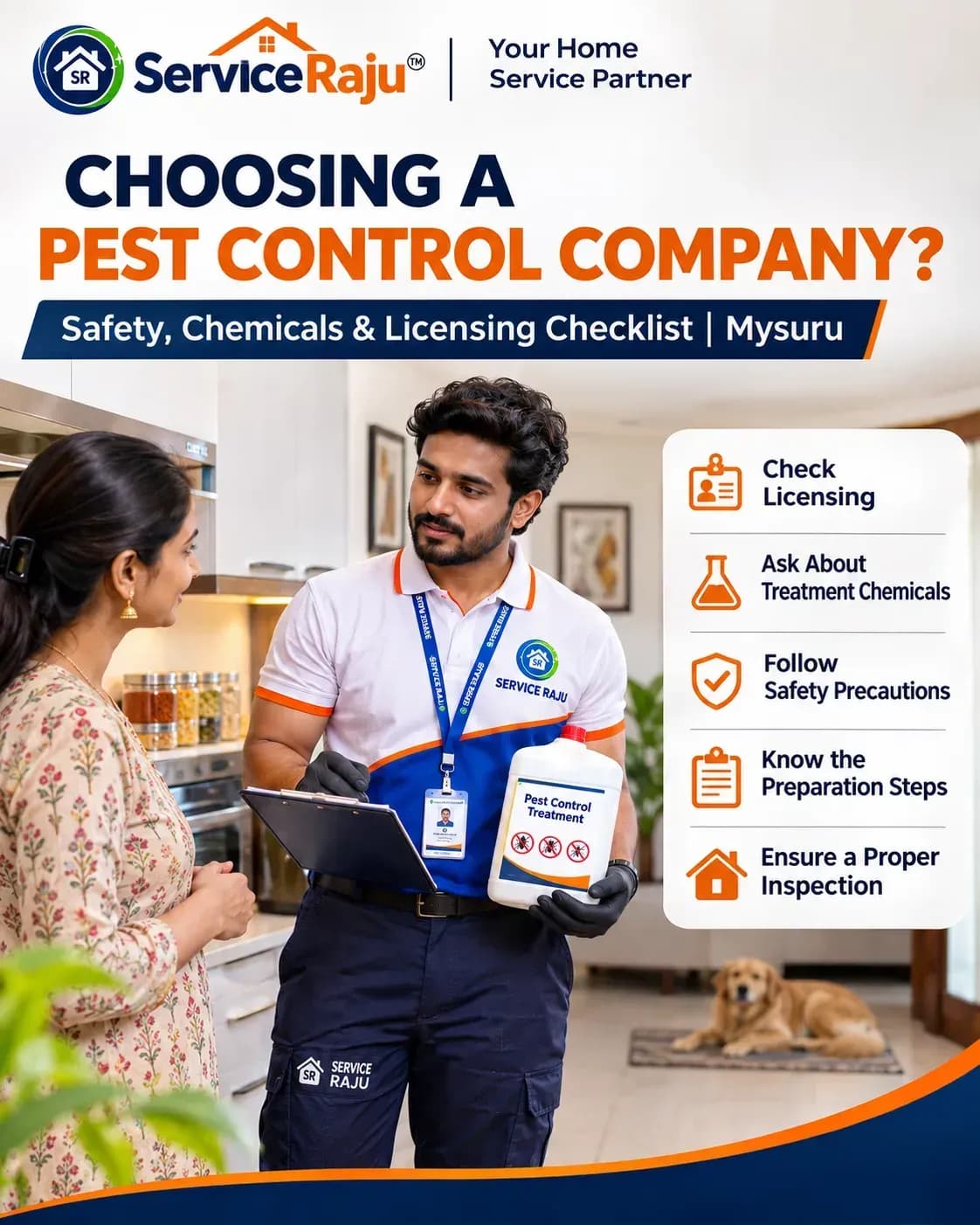
How to Choose a Licensed Pest Control Company in Mysuru: Safety, Chemicals and Service Checklist
Looking for reliable pest control in Mysore? Whether you are dealing with cockroaches in the kitchen, termites in wooden furniture, bed bugs in bedrooms, mosquitoes around your property or rodents in a storage area, choosing the right pest-control provider is about more than simply comparing prices.
Pest-control treatments may involve insecticides and other products that need to be selected, handled and applied correctly. An unsuitable product, incorrect application, poor preparation or unclear re-entry instructions can create avoidable risks for residents, children, pets and workers.
Before booking pest control services in Mysuru, it is important to ask about the provider's applicable licences and credentials, the products proposed, the treatment method, safety precautions and follow-up arrangements. This guide explains what homeowners, tenants, apartment associations, hotels and businesses should check before allowing a pest-control treatment at their premises.
At Service Raju, we believe that customer communication, responsible treatment planning and clear safety instructions should be important parts of every pest-control enquiry. Customers should confirm the exact service, treatment scope and availability before scheduling.
Need pest-control assistance? Contact Service Raju to discuss your pest problem and ask about the appropriate service and safety arrangements.
Call: +91 9964544445
Explore Service Raju Services in Mysuru
Table of Contents
- Why choosing a qualified pest-control provider matters
- How to check pest-control licensing and credentials
- Questions to ask about treatment chemicals
- What a professional inspection should include
- How to prepare your home before treatment
- Children, pets and food-storage precautions
- What to do after pest-control treatment
- Warning signs of an unreliable pest-control provider
- Customer checklist before booking
- How to enquire about pest control with Service Raju
- Frequently asked questions
1. Why Choosing a Qualified Pest-Control Provider Matters
Pest-control work involves identifying a pest, understanding where it lives and breeds, assessing the affected area and selecting a suitable control method. Chemical treatment is only one possible part of a pest-management plan.
A provider should understand the product being used, its approved purpose, the correct application instructions, protective equipment and the precautions required at the property.
What can go wrong with careless pest-control work?
- A product may be used for a purpose or location that is not permitted by its label.
- The treatment may be applied at an unsuitable concentration or in an inappropriate area.
- Food, utensils, drinking water or children's belongings may not be protected properly.
- Residents or pets may return before the product's stated re-entry conditions are met.
- Technicians may work without suitable protective equipment.
- The actual infestation may remain unresolved because the pest or its hiding places were not correctly identified.
Professional pest management should consider both pest control and the safety of people, animals and the surrounding environment. A responsible provider should explain what will be done and what customers need to do before and after the treatment.
2. How to Check Pest-Control Licensing and Credentials in Mysuru
One of the first questions to ask a pest-control company is whether it holds the licences and authorisations applicable to the products and commercial operations it undertakes.
In India, the Insecticides Act, 1968 and the Insecticides Rules, 1971 provide the regulatory framework for insecticides. Section 13 of the Act addresses licensing, including commercial pest-control operations using insecticides. The Rules also contain provisions concerning pest-control operators and specified restricted-use products.
Read the legislation: Insecticides Act, 1968 and Insecticides Rules, 1971.
What should customers ask the company?
- What is the company's legal name and business address?
- Which licence or authorisation applies to the pest-control operation being offered?
- Can the company provide a copy or relevant details of its current licence?
- Is the licence valid for the relevant activity and location?
- Who is the responsible technical person?
- Are the technicians trained for the proposed treatment?
- Does the proposed work involve any restricted-use insecticide or special fumigation activity requiring additional authorisation?
Important licensing distinction: The legal requirements depend on the activity and insecticide involved. The Rules contain specific provisions for certain pest-control operations and restricted-use products, including specified fumigants. Do not assume that one licence description automatically covers every chemical, treatment or fumigation activity. Ask the provider to identify the applicable authorisation and verify it with the competent licensing authority where necessary.
For specialised fumigation, ask whether the additional permission required for that activity has been obtained. Never assume that an ordinary household pest-control booking authorises a company to perform every type of fumigation.
Why does technical qualification matter?
Technical knowledge helps a responsible person understand pest identification, product selection, application instructions, exposure risks and treatment precautions. The Insecticides Rules prescribe qualification and training requirements for specified pest-control operator licensing provisions. Customers can ask who is responsible for technical supervision and how the assigned team is trained.
Do not rely only on a website badge, social-media advertisement or verbal statement such as "government approved". Ask for verifiable details.
3. Questions to Ask About Pest-Control Treatment Chemicals
Before treatment, ask the company to explain which product or formulation it proposes to use and why it is appropriate for the target pest and treatment location.
Ask these questions before approving the treatment
- What is the product's trade name and active ingredient?
- Is the product registered and labelled for the intended pest and application site?
- Is it intended for household use, professional pest-control use or another specified purpose?
- What application method will be used?
- What precautions are required during application?
- What is the product's stated re-entry period for the proposed use?
- What first-aid instructions and emergency contact information are available?
- Can the technician show the original product label or provide the product details?
Why the product label matters
The label and accompanying leaflet provide essential directions for the approved use of an insecticide. Depending on the product, these can include its active ingredients, target pests, approved application sites, dilution or dosage instructions, warnings, first aid and safety precautions.
Do not accept a vague explanation such as "strong chemical", "imported chemical" or "100% safe chemical" in place of product details. A product must be appropriate for its intended use and applied according to its approved directions.
Customers can refer to the Insecticides Rules and the product's own label and leaflet. The label for the actual product being applied is particularly important.
Be careful with absolute safety claims
No pesticide application should be described as completely risk-free in every situation. Risk depends on the product, concentration, application method, exposure, ventilation, surface and people or animals present.
Be cautious if a provider promises that a chemical is completely harmless, requires no precautions or can be sprayed anywhere in the home. Ask for the actual product information and follow its approved instructions.
4. What a Professional Pest-Control Inspection Should Include
A proper assessment should begin with the pest problem, not with an automatic decision to spray every room. Different pests have different nesting locations, breeding patterns and control requirements.
What should the technician assess?
- Pest identification: Identify the pest as accurately as possible before selecting a treatment.
- Infestation level: Assess the visible activity and likely extent of the problem.
- Hiding and breeding locations: Check relevant cracks, gaps, furniture joints, drains, storage areas or other pest-specific locations.
- Property use: Understand whether the site is a home, kitchen, office, hotel, hostel, shop or other establishment.
- Occupant considerations: Ask about children, pets, elderly residents, food preparation and sensitive areas.
- Treatment selection: Explain why the proposed method is suitable for the pest and site.
- Pre-treatment instructions: Provide practical preparation steps before starting work.
- Post-treatment instructions: Explain cleaning restrictions, ventilation and re-entry conditions where applicable.
- Follow-up plan: Clarify whether monitoring or another visit may be needed.
For some infestations, inspection and non-chemical measures may be important alongside or instead of chemical treatment. The plan should be based on the pest and property conditions.
5. How to Prepare Your Home Before Pest-Control Treatment
Preparation depends on the target pest, the product and the treatment method. Always follow the instructions supplied by the responsible pest-control professional and the product label.
General preparation questions
- Which rooms and surfaces will be treated?
- Should food, utensils, drinking water and cooking equipment be removed or covered?
- Should bedding, toys and personal belongings be stored away?
- Do cupboards or drawers need to be emptied?
- Should residents leave the premises during application?
- Are there any specific instructions for aquariums, pets or indoor plants?
- What should be done with items that cannot be moved?
Kitchen preparation
Ask how food, utensils, cooking surfaces and drinking-water containers should be protected. Do not allow insecticide to contaminate food, food-contact surfaces or drinking water. Follow the treatment-specific instructions for cleaning surfaces before using them again.
Bedroom and furniture preparation
For bed bug or other furniture-related treatment, ask which furniture components need inspection, whether bedding must be washed and how mattresses or other treated items should be handled. Do not assume every product is suitable for direct application to mattresses, pillows or bedding.
Outdoor and common-area preparation
For mosquito, rodent or other outdoor pest management, discuss water storage, children's play areas, pet access, drainage and any nearby sensitive locations. The required precautions depend on the treatment method.
6. Children, Pets and Food-Storage Precautions
Children and pets may come into contact with treated floors, furniture, toys, corners or other surfaces. Food and drinking water can also be affected if treatment is not planned properly.
Before treatment
- Inform the company that children, elderly residents or pets live at the property.
- Explain whether anyone has special sensitivity or a relevant exposure concern, without assuming that a general treatment is suitable for every household.
- Remove or protect food, utensils, pet bowls, toys and other items as directed.
- Ask whether pets, including birds and aquarium animals, need special arrangements.
- Confirm which areas must remain unoccupied during application.
After treatment
- Follow the exact re-entry instructions for the product and treatment.
- Do not allow children or pets into restricted areas before the stated conditions are met.
- Follow the technician's instructions about ventilation and surface cleaning.
- Do not wash treated areas immediately unless the instructions require it.
- Keep product containers, labels and service instructions away from children.
There is no single waiting period that applies to every pest-control treatment. Re-entry depends on the product, application method, location and label instructions. Ask for the specific instructions for the treatment performed.
7. What to Do After Pest-Control Treatment
Customer responsibilities do not end when the technician finishes applying the product. Correct aftercare helps reduce unnecessary exposure and supports the agreed pest-management plan.
Ask the technician to explain:
- When residents may safely re-enter the treated areas.
- Whether ventilation is required and for how long, according to the product instructions.
- Which surfaces should be cleaned and which should not be disturbed immediately.
- When kitchen counters, utensils and food-preparation areas may be used again.
- How to handle bedding, toys and pet accessories.
- Whether monitoring or follow-up treatment is recommended.
- Whom to contact if there is an unexpected reaction or continuing pest activity.
Keep a record of the service
Retain the invoice, treatment details, product information supplied, safety instructions and any follow-up commitment. These records can help if you need to ask questions later or report an unexpected issue.
If anyone experiences breathing difficulty, dizziness, vomiting, eye irritation or another concerning symptom after a suspected pesticide exposure, move away from the exposure area if it is safe to do so and seek prompt medical advice. In a serious emergency, contact emergency medical services. Keep the product label or service details available for healthcare professionals.
8. Warning Signs of an Unreliable Pest-Control Provider
Price and convenience are important, but a very low quotation should not be the only reason to choose a pest-control provider. Be cautious if the company cannot explain its treatment method or avoids reasonable safety questions.
Watch out for these warning signs
- No verifiable credentials: The company refuses to share relevant licence or authorisation details.
- Unclear chemical information: The technician will not identify the product or show its label details.
- Unsupported safety promises: The company claims that every chemical is completely harmless or needs no precautions.
- No inspection: The provider recommends the same chemical treatment without understanding the pest or property.
- Unsafe application: The technician ignores food, water, electrical equipment, occupants or pet precautions.
- No re-entry guidance: The provider cannot explain when people may return to treated areas.
- Unclear pricing: The company does not explain the service scope, additional charges or follow-up conditions.
- No service record: The provider refuses to give an invoice or written treatment details.
- Pressure tactics: The customer is pushed to approve immediate treatment without a clear explanation.
Do not allow an application to proceed if you have serious unanswered safety concerns. Ask for clarification or seek another qualified provider.
9. Customer Checklist Before Booking Pest Control in Mysuru
Use this checklist when comparing pest-control companies for your home, apartment, office, hotel or commercial property.
| What to verify | Question to ask |
|---|---|
| Company identity | What is the company's legal name and business address? |
| Applicable licence | Which licence or authorisation covers the proposed activity and product? |
| Technical responsibility | Who is responsible for technical supervision? |
| Product details | What is the product name, active ingredient and intended use? |
| Application method | Where and how will the product be applied? |
| Safety precautions | What should residents, children and pets do before and after treatment? |
| Re-entry | What exact re-entry instructions apply to this product and treatment? |
| Price and scope | What is included in the quotation and what costs extra? |
| Follow-up | Is monitoring or another visit required, and is it included? |
| Documentation | Will an invoice and treatment details be provided? |
A company that answers these questions clearly gives customers a better basis for making an informed booking decision.
10. Pest-Control Services for Homes and Businesses
Different premises need different pest-management plans. The inspection and safety arrangements should reflect the building, pest type, occupants and daily activities.
Homes and apartments
Common enquiries include cockroach, ant, mosquito, bed bug, termite and rodent problems. Treatment planning should consider kitchens, bedrooms, children's areas, pets and shared spaces.
PG accommodations and hostels
Multiple occupants and shared facilities make communication especially important. The provider should explain room preparation, access restrictions, occupant notification and the timing of any follow-up work.
Hotels and resorts
Guest rooms, kitchens, laundry areas, storage spaces and outdoor areas may have different pest-management needs. Coordinate the treatment with the property manager and follow the applicable product and site safety instructions.
Restaurants and commercial kitchens
Food safety is essential. Discuss food removal or protection, utensils, food-contact surfaces, application areas and the steps required before food preparation resumes.
Offices and shops
Plan the treatment around employees, visitors, equipment, stock and operating hours. Ask which areas will be treated and when they can be used again.
11. How to Enquire About Pest Control with Service Raju
If you are looking for professional pest control in Mysuru, Service Raju can help you discuss your pest problem and enquire about relevant service options.
Before arranging an appointment, share the details of the infestation and ask about the proposed treatment, applicable credentials, product information and safety instructions.
Information to share when contacting the team
- Your name and contact number.
- Your property location and locality.
- The pest you have noticed, if known.
- Which rooms or areas are affected.
- Whether the property is residential or commercial.
- Whether children, pets or food-preparation areas need special consideration.
- Photographs or videos of visible pest activity, if available.
Discuss these points before confirming
- Inspection and treatment scope.
- Product and application details.
- Applicable licence or authorisation for the proposed activity.
- Preparation and re-entry instructions.
- Quotation, exclusions and additional charges.
- Follow-up arrangements and written service terms.
Service availability and treatment options depend on the pest, location and current operational arrangements. Confirm the exact service before booking.
Contact Service Raju
Call Now: +91 9964544445
Explore Services: https://www.serviceraju.com/services/mysuru
Trusted Home Services in Mysuru, Udupi, Mangaluru & Indore.
12. Frequently Asked Questions About Pest Control Safety in Mysuru
1. How do I choose a licensed pest-control company in Mysuru?
Ask for the company's legal identity and the licence or authorisation applicable to the proposed commercial pest-control activity and products. Verify relevant details with the competent licensing authority, and ask about the responsible technical person, product label, treatment method and safety instructions.
2. Is a pest-control company required to have a licence in India?
The Insecticides Act, 1968 includes licensing provisions for commercial pest-control operations using insecticides. The applicable requirements depend on the activity and products involved. Certain operations and restricted-use insecticides have additional provisions under the Insecticides Rules, 1971. Customers should ask which authorisation applies to the proposed service.
3. Should a pest-control technician tell me which chemical is being used?
Customers should ask for the product name, active ingredient, intended use and label instructions. The provider should be able to explain the proposed product and relevant safety precautions before treatment.
4. Are pest-control chemicals completely safe for children and pets?
No chemical treatment should be described as completely risk-free in every situation. Safety depends on the product, application, exposure and site conditions. Inform the provider about children and pets and follow the product-specific preparation and re-entry instructions.
5. How long should I stay away after pest-control treatment?
There is no universal waiting period for all treatments. The re-entry period depends on the product label, application method and treatment conditions. Ask the technician for the exact instructions applicable to your service.
6. Should I remove food and utensils before pest-control treatment?
Follow the preparation instructions for the actual treatment. Food, utensils, drinking water and food-contact surfaces must be protected from contamination. Ask the technician which items should be removed, covered or cleaned before use.
7. Can a pest-control company use any available pesticide?
No. The product must be appropriate for its registered or approved purpose and used according to its label and applicable rules. Ask for the product details and do not accept unexplained chemical substitutions.
8. What should I do if someone feels unwell after pest-control treatment?
Move away from the suspected exposure area if safe, seek prompt medical advice and provide the product label or treatment details to healthcare professionals. For serious symptoms or an emergency, contact emergency medical services.
9. Should every pest-control service include a follow-up visit?
Not necessarily. Follow-up needs depend on the pest, infestation, treatment method and product instructions. Ask whether monitoring or another visit is recommended and whether it is included in the quotation.
10. How can I enquire about pest control with Service Raju?
Call +91 9964544445 or visit Service Raju's Mysuru services page. Explain the pest problem and location, then confirm the available treatment, safety arrangements and quotation before booking.
Conclusion: Choose Pest Control with Safety, Transparency and Trust
Choosing a pest-control company should involve more than comparing prices or promotional claims. Customers should check the provider's applicable credentials, understand the product being used, ask how the treatment will be carried out and obtain clear preparation and re-entry instructions.
Whether you need cockroach control, termite treatment, mosquito management, bed bug control or another pest-management service, make safety and transparent communication part of your booking decision.
At Service Raju, we encourage customers to ask questions and understand the proposed service before confirming an appointment. Contact the team to discuss your pest-control requirement and confirm current availability.
Service Raju – Your Home Service Partner.
Call Now: +91 9964544445
Explore Service Raju Services in Mysuru
Trusted Home Services in Mysuru, Udupi, Mangaluru & Indore.
Important Regulatory Note
This article is general customer guidance, not legal advice or a substitute for checking the latest rules, licence conditions, product registrations and directions from the competent authority. Licensing requirements can depend on the particular activity, insecticide and treatment method. Customers and service providers should verify current requirements with the relevant licensing authority before undertaking regulated work.