Water Leakage Detection in Mysuru – Thermal Imaging, Wall Scanner, Hydro Pressure Testing and Moisture Meter Inspection
Hidden water leakage inside walls, floors and concealed pipelines can cause serious property damage if it remains undetected. Damp patches, peeling paint, wet ceilings, recurring seepage and unexplained water loss may indicate a plumbing leak or another moisture-related problem. Traditional inspection methods may sometimes involve opening walls or tiles before the suspected source is identified.
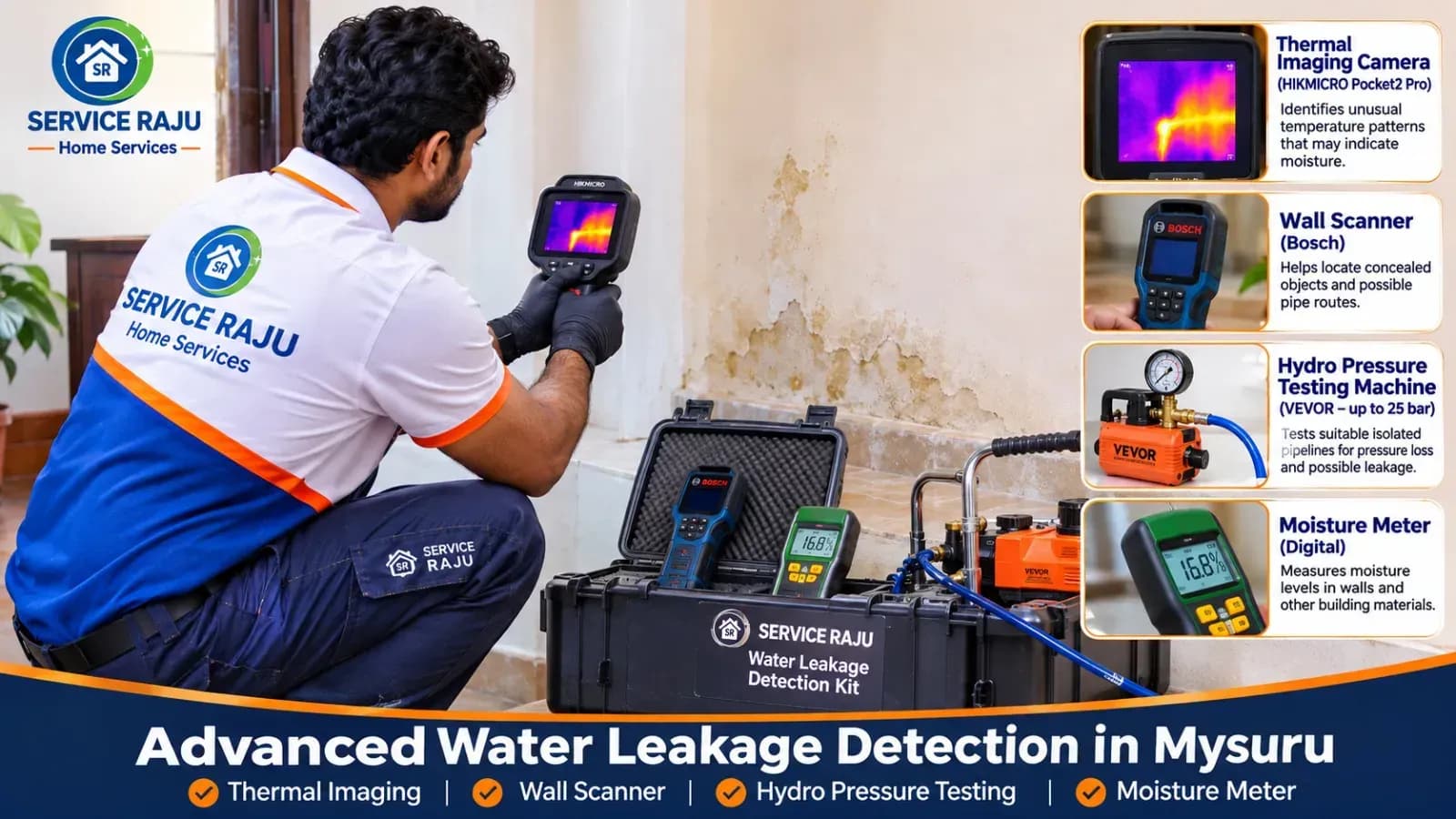
Service Raju provides professional water leakage detection enquiries in Mysuru, using a combination of inspection equipment such as thermal imaging cameras, wall scanners, hydro pressure testing machines and digital moisture meters. Each tool provides different information that can help investigate suspicious moisture areas, assess suitable water pipelines and recommend the next corrective step.
If you are searching for water leakage detection in Mysuru, hidden water leakage detection, or concealed pipe leakage inspection, this guide explains how these tools work, what they can and cannot confirm, and when to arrange a professional inspection.
Need help investigating a suspected water leak? Contact Service Raju to discuss your property and arrange an inspection enquiry.
Explore Service Raju Services in Mysuru | Call +91 9964544445
Table of Contents
- What is advanced water leakage detection?
- Thermal imaging camera inspection
- Wall scanner inspection
- Hydro pressure testing for water pipes
- Digital moisture meter inspection
- Why combine all four inspection methods?
- Common signs of hidden water leakage
- When should you book a professional inspection?
- What happens after the inspection?
- Water leakage detection in Mysuru with Service Raju
- Frequently asked questions
1. What Is Advanced Water Leakage Detection?
Advanced water leakage detection is a systematic inspection process used to investigate suspected moisture and concealed pipeline problems. Instead of immediately breaking a wall or floor, an inspector uses suitable tools to gather information about the affected area and narrow down possible causes.
Water can travel through plaster, masonry, concrete, floor screed and other building materials. As a result, the visible damp patch may be some distance away from the actual source of leakage. A wet ceiling, for example, may be caused by a pipe above it, a bathroom waterproofing failure, a drain connection or water entering from another location.
Professional inspection may combine four complementary methods:
- Thermal imaging: Identifies unusual surface temperature patterns that may be associated with moisture or other building conditions.
- Wall scanning: Helps investigate concealed objects and possible pipe routes, depending on the scanner model and material.
- Hydro pressure testing: Assesses pressure behaviour in a suitable isolated water pipeline section.
- Moisture meter testing: Measures moisture conditions in accessible building materials.
These methods provide supporting evidence. No single tool should automatically be treated as proof of a concealed leak. Findings need to be interpreted together with the building layout, plumbing arrangement, visible symptoms and appropriate follow-up checks.
2. Thermal Imaging Camera Inspection for Water Leakage
Thermal imaging is a useful inspection method for investigating unusual temperature patterns on walls, ceilings and other accessible surfaces. A thermal camera displays differences in surface temperature, helping an inspector identify areas that may need further moisture investigation.
Service Raju uses a HIKMICRO Pocket2 Pro thermal imaging camera as part of its inspection equipment.
How thermal imaging helps
- Scans accessible wall and ceiling surfaces for unusual temperature patterns.
- Helps identify areas that may require moisture meter verification.
- Supports comparison between a suspected damp area and nearby unaffected surfaces.
- Helps document thermal patterns during an inspection.
- Can assist in narrowing down areas for further investigation before deciding whether opening the surface is necessary.
Can a thermal camera directly confirm a water leak?
No. A thermal camera measures surface temperature patterns; it does not directly see water flowing inside a concealed pipe. Wet materials may produce temperature differences under suitable conditions, but similar patterns can also result from sunlight, air movement, insulation differences, plumbing temperature, construction materials and other factors.
For reliable interpretation, thermal observations should be compared with moisture readings, visible conditions, plumbing information and other appropriate tests.
Best suited for: Initial investigation of suspicious wall and ceiling patterns, comparison of affected areas and supporting a wider leakage inspection.
3. Wall Scanner Inspection for Concealed Pipes and Objects
Before drilling, cutting or opening a wall, it is important to understand what may be concealed behind the surface. A suitable wall scanner can help locate certain objects or indicate possible pipe routes, depending on its model, detection technology, wall material and scanning conditions.
Service Raju uses a Bosch wall scanner as part of its inspection toolkit. The exact detection capabilities depend on the specific scanner model and site conditions.
How wall scanner inspection helps
- Investigates concealed objects in accessible wall sections.
- Helps identify possible routes of certain concealed services where the scanner supports detection.
- Assists in planning a safer and more targeted inspection or opening point.
- Helps reduce the risk of drilling into detected objects.
- Provides supporting information when investigating suspected concealed pipe leakage.
Does a wall scanner confirm water leakage?
No. A wall scanner is not a direct water leak detector. It may help identify certain concealed objects or possible pipe locations, but it cannot independently confirm that a pipe is leaking. Its results depend on the scanner's specifications, wall composition, depth, object type and scanning conditions.
Best suited for: Investigating concealed objects and possible pipe routes, and helping plan further inspection before opening a wall.
4. Hydro Pressure Testing for Water Pipeline Leakage
When a concealed water supply pipeline is suspected, pressure testing can help assess whether a suitable isolated section maintains pressure under controlled test conditions.
Service Raju uses a hydro pressure testing machine with a rated capability of up to 25 bar (2.5 MPa). The machine's maximum rating is not a recommended test pressure for every residential pipeline. The appropriate pressure must be determined according to the pipe material, system design, manufacturer's limits, fittings, valves and safe testing procedure.
How hydro pressure testing works
- Identify the pipeline: Determine which water supply section needs to be tested.
- Isolate the correct section: Separate the test section from connected equipment and other parts of the plumbing system as appropriate.
- Prepare the test: Check the pipe material, fittings, valves and suitability for pressure testing.
- Apply controlled pressure: Use suitable equipment and a safe pressure within the system's permitted limits.
- Monitor pressure: Observe the pressure behaviour over the specified test period.
- Interpret the result: Investigate pressure loss while considering temperature changes, trapped air, valve leakage, equipment connections and other possible causes.
What does a pressure drop mean?
A pressure drop may indicate a leak or another issue in the test arrangement, but it does not automatically identify the exact leak location. The inspector must check the test setup, isolation points, connections and pipeline conditions before drawing a conclusion.
Pressure testing is not suitable for every pipe or plumbing arrangement. It should not be performed at the machine's maximum rated pressure without confirming that the pipeline and connected components can safely withstand the test.
Best suited for: Assessing suitable isolated water supply pipeline sections when concealed pipe leakage is suspected.
5. Digital Moisture Meter Inspection for Damp Walls
A digital moisture meter helps assess moisture conditions in accessible building materials. It can provide useful readings when investigating damp walls, ceiling seepage, recurring wet patches and other moisture-related complaints.
How moisture meter inspection helps
- Measures moisture-related readings on suitable accessible surfaces or materials.
- Compares suspected damp areas with nearby reference areas.
- Helps identify variations in moisture readings across an affected wall or ceiling.
- Supports assessment alongside thermal imaging and visible inspection.
- Can help monitor changes during a follow-up inspection when comparable measurement conditions are used.
Why compare readings?
A single reading may not provide enough information to understand a moisture problem. Comparing the suspected area with nearby unaffected material can provide additional context. Readings may vary with material type, surface condition, salts, temperature, meter settings and the instrument's measurement method.
A moisture meter reading does not independently identify the source of water. The inspector must consider plumbing leaks, external seepage, waterproofing issues, condensation and other possible causes.
Best suited for: Assessing and comparing moisture conditions in walls, ceilings and other suitable building materials.
6. Why Combine Thermal Imaging, Wall Scanner, Hydro Pressure Testing and Moisture Meter Inspection?
Each inspection tool provides a different type of information. Combining appropriate methods can help narrow down the suspected problem more effectively than relying on one reading or one visual observation.
| Equipment | Main inspection purpose | Important limitation |
|---|---|---|
| HIKMICRO Pocket2 Pro thermal camera | Identifies unusual surface temperature patterns that may be associated with moisture. | Does not directly confirm water inside a concealed pipe. |
| Bosch wall scanner | Helps investigate certain concealed objects and possible pipe routes, depending on model. | Does not directly detect or confirm a water leak. |
| Hydro pressure testing machine | Assesses pressure behaviour in a suitable isolated pipeline section. | Pressure loss does not by itself locate the leak or prove the cause. |
| Digital moisture meter | Measures moisture conditions in suitable accessible materials. | Does not independently identify the moisture source. |
Example: Investigating a damp bedroom wall
Suppose a homeowner notices a recurring damp patch on a bedroom wall next to a bathroom. A systematic inspection may involve:
- Visually examining the damp patch and nearby plumbing layout.
- Using thermal imaging to identify unusual temperature patterns around the affected surface.
- Taking moisture meter readings at the suspected area and nearby comparison points.
- Using a wall scanner, where suitable, to investigate possible concealed objects or pipe routes.
- Considering a controlled pressure test if an appropriate isolated water supply pipeline is suspected.
- Reviewing all findings to recommend the next inspection or corrective action.
This combined approach helps distinguish between a suspected supply pipe issue and other possible moisture sources. Depending on the findings, further inspection or a targeted opening may still be necessary.
7. Common Signs That Your Property May Have Hidden Water Leakage
Hidden water leakage may develop gradually. Watch for the following signs, especially when they repeatedly appear in the same location.
Damp patches on walls
Persistent dampness, discolouration or wet patches may indicate water entering or travelling through the wall. The cause could be a concealed pipe, external seepage or another moisture source.
Peeling paint and bubbling plaster
Paint that blisters, flakes or separates from the wall may be associated with prolonged moisture exposure. Repairing the paint without identifying the underlying cause may lead to the problem returning.
Wet ceilings
Ceiling dampness below a bathroom, terrace, water tank or upper-floor plumbing line may require investigation. The source should be identified before carrying out cosmetic repairs.
Unexpected increase in water consumption
An unexplained increase in water usage may indicate a leaking pipe, faulty tap, toilet cistern or other plumbing issue. Check visible fixtures and arrange a plumbing inspection if the cause remains unclear.
Recurring seepage after repairs
If the same wall or ceiling becomes wet again after patching or repainting, the original moisture source may not have been resolved.
Suspected concealed pipeline leakage
Older buildings and newer properties can both experience concealed pipe problems. CPVC, GI and other pipe systems require inspection methods appropriate to the material and installation.
8. Common Types of Water Leakage Problems We Help Investigate
Water leakage complaints can originate from different parts of a property. Identifying the likely source is important before choosing a repair method.
- Concealed water supply pipe leakage: Suspected leaks in water supply lines running inside walls or floors.
- Bathroom wall seepage: Moisture appearing in walls adjoining bathrooms or shower areas.
- Ceiling leakage: Wet patches or seepage appearing below upper floors or plumbing installations.
- Terrace and external wall seepage: Moisture entering through exposed building surfaces or waterproofing defects.
- Recurring dampness: Persistent moisture that returns after surface repairs.
- Unexplained water loss: Possible leakage in a suitable plumbing section when visible fixtures do not explain the usage.
Not every damp patch is caused by a concealed water supply pipe. Drainage problems, waterproofing failure, rainwater entry, condensation and other building defects may need different inspection or testing methods.
9. When Should You Book a Professional Water Leakage Inspection?
Consider arranging an inspection if you notice one or more of the following:
- A damp patch that keeps returning in the same location.
- Water seepage on a wall adjoining a bathroom or kitchen.
- A wet ceiling without an obvious source.
- Unexplained water loss or a sudden increase in water consumption.
- Repeated plumbing repairs that have not resolved the moisture problem.
- Suspected concealed CPVC, GI or other water supply pipeline leakage.
- Moisture affecting a newly renovated property or recently painted wall.
- A need to investigate before opening tiles, flooring or walls.
Early investigation may help reduce unnecessary surface damage and prevent continued moisture exposure. However, the appropriate inspection method depends on the suspected source and site conditions.
10. What Happens After a Water Leakage Inspection?
A professional inspection should conclude with a clear explanation of the observations and the recommended next step. The available findings depend on the equipment used, accessibility and the nature of the suspected problem.
Inspection findings
The inspector records visible conditions, suspected damp areas and relevant observations from the inspection.
Equipment readings and observations
Where applicable, the inspection may include thermal images, moisture meter readings, wall scanner observations and hydro pressure test results. Each result should be described according to what the instrument actually measures.
Suspected leakage location
The report may identify an area requiring further investigation or a suspected pipeline section. A suspected location should not be described as a confirmed leak unless sufficient evidence supports that conclusion.
Recommended corrective action
Recommendations may include plumbing repair, further testing, waterproofing assessment, drainage inspection or a targeted opening to confirm the source.
Professional inspection report
Where a report is included in the service, it may document the customer and property details, inspection observations, equipment used, relevant readings, limitations and recommended corrective action.
Important: An inspection report documents observations and professional assessment. It should clearly distinguish between confirmed findings, suspected causes and areas that could not be verified without further access.
11. Advanced Water Leakage Detection in Mysuru with Service Raju
If you are experiencing damp walls, ceiling seepage, recurring moisture or suspected concealed pipeline leakage, Service Raju can help you enquire about professional water leakage inspection in Mysuru.
Our inspection toolkit includes multiple diagnostic instruments that provide complementary information about suspected moisture and pipeline conditions.
Service Raju inspection equipment
- HIKMICRO Pocket2 Pro Thermal Imaging Camera: For observing surface temperature patterns that may help investigate suspicious moisture areas.
- Bosch Wall Scanner: For investigating certain concealed objects and possible pipe routes, depending on scanner capabilities and site conditions.
- Hydro Pressure Testing Machine: Rated up to 25 bar (2.5 MPa), used for suitable isolated pipeline testing at an appropriate safe test pressure.
- Digital Moisture Meter: For assessing moisture conditions in suitable accessible building materials.
Who can enquire about this service?
- Homeowners experiencing damp walls or recurring seepage.
- Apartment residents investigating concealed plumbing problems.
- Builders and contractors requiring support with suspected pipeline leakage.
- Property managers handling recurring water leakage complaints.
- Owners of older buildings experiencing unexplained moisture.
Service availability, inspection charges, report inclusions and the inspection scope should be confirmed before booking. The exact testing method will depend on the suspected source, pipeline arrangement, building materials and site accessibility.
Book Water Leakage Detection in Mysuru
Do not rush into breaking walls or tiles before understanding the possible source of the problem. Arrange an inspection enquiry and discuss the symptoms, affected area and plumbing layout with the Service Raju team.
Call Now: +91 9964544445
Website: www.serviceraju.com/services/mysuru
Service Raju – Your Home Service Partner.
Trusted Home Services in Mysuru, Udupi, Mangaluru & Indore.
12. Frequently Asked Questions About Water Leakage Detection in Mysuru
1. What is advanced water leakage detection?
It is an inspection approach that uses suitable equipment, such as thermal imaging cameras, wall scanners, moisture meters and pressure testing machines, to investigate suspected moisture and concealed pipeline problems.
2. Can thermal imaging detect hidden water leakage?
Thermal imaging can identify unusual surface temperature patterns that may be associated with moisture. It cannot directly see water inside a concealed pipe or independently confirm a leak. Other observations and tests are needed to interpret the findings.
3. Can a wall scanner detect concealed water pipes?
Some wall scanners can detect certain concealed objects or indicate possible pipe routes, depending on the model and site conditions. A wall scanner does not directly confirm whether a pipe is leaking.
4. What is hydro pressure testing?
Hydro pressure testing assesses the pressure behaviour of a suitable isolated water pipeline section under controlled conditions. Pressure loss may indicate a leak or another issue in the test setup and requires further investigation.
5. What is the purpose of a moisture meter?
A moisture meter measures moisture-related conditions in suitable accessible materials. Comparing readings across affected and unaffected areas can help assess dampness, but the instrument does not independently identify the water source.
6. Can water leakage be detected without breaking walls?
Some suspected leaks can be investigated using non-invasive or minimally invasive inspection methods. However, results depend on the building, pipe arrangement and accessibility. A targeted opening may still be necessary to confirm or repair a leak.
7. Does Service Raju use thermal imaging for leakage inspection?
Service Raju's inspection equipment includes a HIKMICRO Pocket2 Pro thermal imaging camera. Thermal observations can support moisture investigation when interpreted with other inspection findings.
8. What is the maximum pressure capacity of the Service Raju hydro testing machine?
The machine is rated up to 25 bar (2.5 MPa). This is its equipment rating, not a recommended test pressure for every pipeline. The safe test pressure must be determined according to the pipeline and component specifications.
9. How much does water leakage detection cost in Mysuru?
The inspection charge may depend on the property, affected area, suspected pipeline, accessibility and equipment required. Contact Service Raju to confirm the current inspection fee and what is included before booking.
10. Can I receive a water leakage inspection report?
Ask the Service Raju team whether a report is included in your inspection booking. Where provided, it can document observations, equipment readings, limitations and recommended corrective action.
11. Does every damp wall indicate a concealed pipe leak?
No. Dampness can also result from waterproofing failure, rainwater entry, drainage issues, condensation or other building conditions. Inspection is important to narrow down the possible cause.
12. How do I book water leakage detection in Mysuru?
Contact Service Raju at +91 9964544445 or visit the Service Raju Mysuru service page to enquire about availability, inspection charges and booking.
Conclusion
Hidden water leakage can damage walls, ceilings, flooring and other parts of a property if the underlying moisture source is not investigated. Thermal imaging, wall scanning, hydro pressure testing and moisture meter inspection each provide different information that can support a systematic investigation.
For water leakage detection in Mysuru, choose an inspection provider that explains what each instrument can measure, distinguishes suspected findings from confirmed leaks, follows safe testing procedures and provides clear recommendations.
Contact Service Raju to discuss your suspected leakage problem and enquire about an advanced water leakage inspection.
Call Service Raju: +91 9964544445