
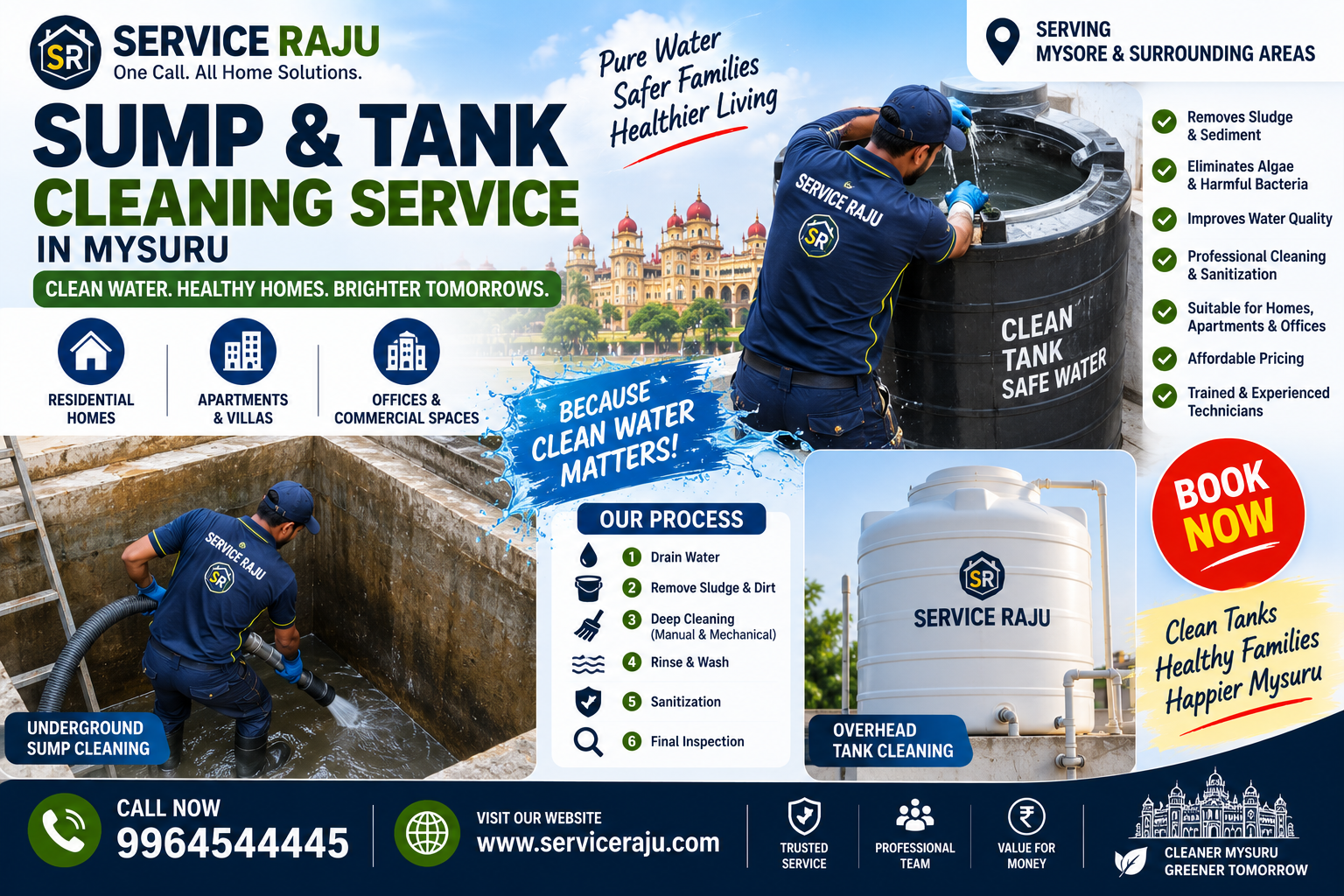
Sump & Tank Cleaning Service in Mysuru
Looking for sump cleaning Mysore or professional overhead tank cleaning? Your underground sump and overhead water tank are two of the most important parts of your home’s water-storage system.
Yet they are often forgotten.
Water can look clean when it comes out of the tap while sediment, sludge, algae, dirt and deposits have accumulated inside the storage tank.
Government water-supply maintenance guidance recommends routine inspection and cleaning of water-storage reservoirs, with the cleaning process involving draining, internal cleaning and washing of the tank surfaces.
That is why sump and tank cleaning Mysore is not simply about making the tank look cleaner.
It is about maintaining the water-storage system that your home, apartment, office or commercial property depends on every day.
Service Raju provides professional sump and overhead tank cleaning services in Mysuru, covering underground sumps, overhead tanks and combined tank-cleaning requirements.
Need tank cleaning now?
📞 Call Service Raju: 9964544445
🌐 www.serviceraju.com
📍 Serving Mysore / Mysuru and surrounding areas
Why Your Sump and Overhead Tank Need Cleaning
Your water-storage system continuously collects whatever enters it through the water supply, environment or surrounding conditions.
Over time, you may find:
- Sand
- Silt
- Sediment
- Mud
- Dust
- Algae
- Slime
- Organic debris
- Mineral deposits
- Other settled material
An underground sump and an overhead tank also face different environmental conditions.
An underground sump can accumulate heavier sediment at the bottom.
An overhead tank may be exposed to heat, dust, insects and environmental contamination if the lid, vents or access points are not properly protected.
Indian government guidance for water-storage facilities recommends that tanks be kept covered and cleaned regularly. The National Health Mission’s Kayakalp guidance specifically discusses manual cleaning of overhead tanks and maintaining cleaning records.
So, cleaning the overhead tank alone may not be enough if the underground sump is heavily contaminated too.
For many homes, the better solution is:
Underground Sump Cleaning + Overhead Tank Cleaning
11 Signs Your Water Storage Tank Needs Cleaning
You don’t have to wait until the tank becomes visibly filthy.
Watch for these signs.
1. Mud or Sediment in the Water
If you notice fine particles settling at the bottom of buckets or containers, inspect the water-storage system.
Sediment can accumulate in the sump before eventually being carried toward the pumping system.
2. Black or Green Deposits
Dark, green or slimy deposits inside an overhead tank are a reason to arrange an inspection and cleaning.
Do not assume that a simple drain-and-refill will remove deposits stuck to the tank surface.
3. Unusual Water Smell
A musty or unusual smell can have several possible causes.
The tank is one place worth checking, especially when the odour is associated with stored water.
4. Floating Particles
Visible particles in stored water may indicate sediment, debris or contamination somewhere in the storage system.
The source should be investigated rather than simply filtering the water at the tap.
5. Long Time Since the Last Cleaning
If you cannot remember when your tank was last cleaned, it is probably time to inspect it.
Keep a simple record of the last cleaning date.
6. Heavy Sludge in the Sump
Underground sumps can collect material that is difficult to see because the tank is below ground.
A sump may appear to be functioning normally while a layer of sediment has accumulated at the bottom.
7. Algae Growth in the Overhead Tank
Light and warmth can encourage biological growth in some water-storage environments.
If algae is visible, the tank should be properly cleaned rather than simply refilled.
8. Tank Lid or Access Cover Problems
A damaged, loose or poorly fitted cover can allow unwanted material to enter the tank.
Cleaning should be combined with checking the physical condition of the lid and access point.
9. Repeated Blockage Around Water Fixtures
Sediment from a storage system can potentially contribute to deposits and blockages in downstream components.
If taps, aerators or filters repeatedly collect particles, inspect the storage system.
10. Water-Storage System Has Been Unused
A tank that has been unused for an extended period should be cleaned and assessed before being returned to service.
Government guidance also recommends cleaning and disinfecting tanks that have previously held water but have been out of use.
11. You Are Moving Into a New Home
A new tenant or homeowner should know when the tank and sump were last cleaned.
If there is no reliable record, cleaning the storage system can be a sensible part of move-in maintenance.
Underground Sump vs Overhead Tank Cleaning
Many Mysuru homes use a combination of:
Water Supply → Underground Sump → Pump → Overhead Tank → Home
That means there are potentially two storage points to maintain.
Underground Sump Cleaning
An underground sump commonly requires attention to:
- Bottom sediment
- Sludge
- Sand
- Mud
- Settled debris
- Wall deposits
- Pump-area buildup
The cleaning approach depends on the sump’s construction, size, access and condition.
Overhead Tank Cleaning
An overhead tank may require attention to:
- Algae
- Slime
- Sediment
- Dust
- Deposits
- Internal walls
- Tank lid/access area
The two tanks should not automatically be treated as identical cleaning jobs.
The cleaning method should be selected according to the tank’s material, accessibility, condition and contamination.
Professional Sump & Tank Cleaning Process
A proper sump cleaning Mysore service should follow a systematic process rather than simply emptying the tank and refilling it.
Step 1: Inspection
The technician assesses:
- Tank type
- Approximate capacity
- Access
- Sediment level
- Internal condition
- Visible deposits
- Pump/access arrangements
Step 2: Isolate the Water Supply
The appropriate inlet/outlet arrangements are managed so that water does not continue entering or being used while cleaning is underway.
Government water-system operation guidance also recommends arranging an alternative water supply where necessary before reservoir cleaning.
Step 3: Drain the Tank
Remaining water is removed using suitable methods and equipment.
For underground sumps, pumping equipment may be required depending on the tank configuration.
Step 4: Remove Sludge and Sediment
Settled material is removed from the bottom.
This is one of the most important stages of sump cleaning because simply draining the water does not remove the sludge layer.
Step 5: Clean Internal Surfaces
The tank’s walls, floor and other accessible internal surfaces are cleaned using suitable methods.
Government guidance for water-storage cleaning specifically includes cleaning internal walls and floor surfaces.
Step 6: Rinse
The tank is rinsed to remove loosened dirt and cleaning residue.
Step 7: Sanitization Where Required
Where sanitization is included in the service, an appropriate treatment should be used according to the intended water use, product instructions and applicable safety requirements.
Do not assume that every cleaning chemical is suitable for potable-water storage.
Step 8: Final Inspection
The technician checks the tank before it is returned to service.
Step 9: Refill
Once the cleaning process is complete and the tank is ready for use, the water-storage system can be restored.
What Professional Tank Cleaning Removes
Depending on the condition of the tank, professional cleaning can address:
| Contamination / Deposit | Typical Cleaning Requirement |
|---|---|
| Sand | Removal from tank bottom |
| Silt | Sludge removal |
| Mud | Physical cleaning |
| Algae | Surface cleaning |
| Slime | Scrubbing/appropriate treatment |
| Dust | Washing/rinsing |
| Settled debris | Manual/mechanical removal |
| Mineral deposits | Assessment and suitable cleaning |
| Organic debris | Removal and sanitation as appropriate |
The exact result depends on the tank’s condition and material.
Professional cleaning should never be marketed as a guarantee that every contaminant or microorganism will be eliminated.
If water quality remains abnormal after tank cleaning, the source should be investigated separately.
How Often Should You Clean a Sump and Overhead Tank?
There is no single interval that is perfect for every property.
Cleaning frequency can depend on:
- Water source
- Tank size
- Household usage
- Sediment level
- Environmental exposure
- Tank condition
- Lid condition
- Previous cleaning frequency
- Property type
For example, a household with significant sediment entering its storage system may require more frequent cleaning than a property with very little accumulation.
Government guidance for healthcare-related water-storage systems recommends regular tank cleaning and specifically states that overhead tanks should be manually cleaned at least every six months in that context.
For a normal home, the best approach is to establish a practical schedule based on inspection and actual buildup rather than blindly following one number.
Simple rule:
If you see sediment, algae, sludge or other buildup, don’t wait for the next scheduled date.
Arrange an inspection.
Who Needs Sump & Tank Cleaning in Mysuru?
Independent Houses
Homes with underground sumps and overhead tanks can book combined cleaning.
Villas
Larger properties may have multiple tanks or larger-capacity storage systems.
Apartments
Apartment complexes often have larger underground reservoirs and overhead storage tanks requiring planned maintenance.
Rental Properties
Cleaning the tank before a new tenant moves in can form part of property handover maintenance.
Offices
Employee and visitor water systems should be maintained as part of building maintenance.
Shops and Commercial Properties
Businesses with stored water can arrange periodic tank cleaning according to usage and storage requirements.
Schools and Institutions
Large water-storage systems require organized maintenance and cleaning records.
Restaurants and Food Businesses
Water-storage hygiene is especially important where water is used for food preparation and cleaning.
For larger properties, the cleaning scope should be assessed before quoting because tank capacity, access and sludge volume can vary significantly.
Sump & Tank Cleaning for Apartments and Large Properties
Apartment tank cleaning is different from cleaning a small residential tank.
Large systems may include:
- Multiple underground sumps
- Multiple overhead tanks
- Transfer pumps
- Float systems
- Large access covers
- Separate water lines
- Common-area plumbing
Before cleaning, the building management should plan:
- Water availability
- Cleaning date
- Tank isolation
- Resident communication
- Alternative water arrangement
- Pump shutdown
- Cleaning access
- Refill schedule
This makes the operation much smoother.
For apartment associations, it is also useful to maintain a tank cleaning record containing:
- Date
- Tank identification
- Approximate capacity
- Cleaning scope
- Technician/service provider
- Observations
- Next planned inspection
What Affects Water Tank Cleaning Cost in Mysuru?
One of the most common searches is:
“Water tank cleaning near me price?”
But there is no sensible single price for every property.
Cost can depend on:
- Tank capacity
- Sump size
- Number of tanks
- Tank location
- Accessibility
- Sludge quantity
- Cleaning difficulty
- Number of technicians required
- Equipment required
- Sanitization requirements
- Residential vs commercial property
Current Mysuru search results show a competitive market with multiple dedicated tank-cleaning providers, while larger platforms also list separate overhead and underground tank-cleaning services.
For that reason, capacity + scope + condition are better pricing inputs than simply asking for a flat citywide rate.
Best Way to Get an Accurate Quote
Send the service provider:
- Tank photo
- Sump photo if accessible
- Approximate capacity
- Number of tanks
- Location
- Last cleaning date
This can make quotation and scheduling much easier.
DIY Tank Cleaning vs Professional Cleaning
Small accessible household tanks may look simple to clean.
But there are several reasons homeowners should be careful.
DIY Cleaning Problems
You may face:
- Confined-space risks
- Slippery surfaces
- Difficult access
- Heavy sludge
- Poor ventilation
- Electrical/pump hazards
- Difficulty removing settled material
- Improper chemical use
- Incomplete rinsing
Never enter a confined underground tank or sump simply because it appears empty.
A professional assessment is safer when access is difficult or the tank is deep.
Professional Cleaning
A professional team can bring:
- Appropriate pumps
- Cleaning tools
- Protective equipment
- Scrubbing equipment
- Sludge-removal methods
- Cleaning workflow
- Sanitization procedures where applicable
The goal is not simply speed.
The goal is complete and controlled cleaning without creating another safety or contamination problem.
What to Check Before Booking a Tank Cleaning Service
Before hiring a water tank cleaning Mysore provider, ask these 10 questions:
1. Do you clean underground sumps?
Some providers specialize mainly in overhead tanks.
2. Do you clean overhead tanks?
Confirm the service separately.
3. Can you clean both together?
A combo service may be convenient for homes with both storage systems.
4. Is sludge removal included?
Don’t assume it is included.
5. Is rinsing included?
Ask how the tank is cleaned after scrubbing.
6. Is sanitization included?
If required, ask exactly what treatment is being used and whether it is appropriate for the intended water use.
7. Is equipment included?
Ask whether pumps and cleaning equipment are part of the quoted service.
8. Are there extra charges for large tanks?
Clarify capacity limits.
9. Is the final inspection included?
The job should not end immediately after draining the tank.
10. Can you provide a cleaning record?
For apartments, offices and commercial properties, documentation can be useful.
Mysuru Areas We Serve
Service Raju serves customers across Mysuru/Mysore and surrounding areas.
Common service locations include:
- Vijayanagar
- Hebbal
- Bogadi
- Dattagalli
- Gokulam
- Kuvempunagar
- JP Nagar
- Rajarajeshwari Nagar
- Jayalakshmipuram
- Vontikoppal
- Bannimantap
- Hootagalli
- Hunsur Road
- Yadavagiri
- Saraswathipuram
- Vidyaranyapuram
- Ramakrishna Nagar
- Siddhartha Layout
- Lakshmipuram
- Nazarbad
- Krishnamurthy Puram
- Jayanagar
- Ashokapuram
- Udayagiri
- Sathagalli
- Srirampura
- Kuvempu Nagar
- Metagalli
- Rajendra Nagar
- Nanjangud and surrounding areas where service availability applies
You can contact Service Raju to confirm availability for your exact location.
Why Choose Service Raju?
Service Raju’s service model covers multiple home-maintenance requirements, allowing customers to arrange related services through one home-service provider.
For tank cleaning, the important things are:
Systematic Cleaning
The service should follow a defined cleaning process instead of simply draining and refilling.
Residential & Commercial Requirements
Different property types can have different tank sizes and cleaning requirements.
Sump + Overhead Tank
Customers with both systems can request a combined cleaning requirement.
Local Mysuru Coverage
Service Raju serves Mysuru and surrounding areas.
Transparent Scope
The final requirement can be determined based on tank size, accessibility and condition.
You can also explore the Service Raju Mysuru home-service options when tank cleaning reveals related plumbing or water-storage problems.
Sump & Tank Cleaning Checklist
Before booking:
☐ Identify underground sump
☐ Identify overhead tank
☐ Check approximate capacity
☐ Check last cleaning date
☐ Look for visible sludge
☐ Check for algae
☐ Check tank lid/access cover
☐ Check for unusual water smell
☐ Check for sediment
☐ Take photos if possible
☐ Ask whether sludge removal is included
☐ Ask whether sanitization is included
☐ Confirm total scope
☐ Confirm price
☐ Confirm cleaning date
After cleaning:
☐ Internal surfaces checked
☐ Sludge removed
☐ Tank rinsed
☐ Access cover checked
☐ Pump area checked
☐ Cleaning date recorded
☐ Tank refilled only after cleaning is complete
FAQs About Sump Cleaning Mysore
What is sump cleaning?
Sump cleaning is the process of removing accumulated sludge, sediment, dirt and other deposits from an underground water-storage sump and cleaning its accessible internal surfaces.
Is sump cleaning different from overhead tank cleaning?
Yes. Underground sumps and overhead tanks have different access conditions and can accumulate different types of deposits. The cleaning approach should be based on the tank’s condition and construction.
How often should I clean my overhead water tank?
There is no single interval suitable for every property. Regular inspection and cleaning based on actual buildup is important. Government guidance for certain institutional settings recommends regular cleaning, including at least six-monthly manual cleaning of overhead tanks in the cited healthcare context.
Can you clean both sump and overhead tank together?
Yes, a combined sump and tank cleaning Mysore requirement can be arranged for properties that have both systems.
Does tank cleaning remove sludge?
Yes, sludge and settled sediment are among the main materials targeted during a proper tank-cleaning process.
Does cleaning remove algae?
Cleaning can remove visible algae and deposits, but future growth depends on conditions such as light exposure, tank condition and maintenance.
Is tank sanitization the same as cleaning?
No. Physical cleaning removes dirt and deposits. Sanitization is an additional treatment intended to reduce microbial contamination when appropriately applied.
Is it safe to enter an underground sump?
Underground tanks can present confined-space and other hazards. Homeowners should not enter deep or poorly ventilated sumps themselves.
How much does sump cleaning cost in Mysore?
The price depends on tank size, capacity, access, sludge level, number of tanks, equipment and service scope. Request a property-specific quotation rather than relying on a generic price.
Can dirty water tanks affect plumbing?
Sediment and debris can contribute to deposits or blockages in downstream components. If you continue seeing particles after cleaning, the water source, plumbing and filtration system should also be investigated.
Should I clean the sump if the overhead tank is already clean?
Yes. If your property uses an underground sump to feed the overhead tank, both storage points should be considered part of the same water-storage system.
Can I book water tank cleaning near me in Mysuru?
Yes. Service Raju provides home services across Mysuru and surrounding areas. Contact the team with your location, tank type and approximate capacity to check service availability.
Book Sump & Overhead Tank Cleaning in Mysuru
Your home’s water-storage system is easy to ignore because it is usually hidden.
But the underground sump and overhead tank can accumulate sediment and deposits over time.
If you cannot remember the last time your tank was cleaned, or you are seeing sludge, algae, unusual smell or particles in the water, now is a good time to inspect it.
Don’t wait until the tank becomes heavily contaminated.
Book professional:
Underground Sump Cleaning
Overhead Water Tank Cleaning
Sump + Overhead Tank Combo Cleaning
Service Raju
📞 9964544445
🌐 www.serviceraju.com
📍 Serving All Areas of Mysore / Mysuru
Clean Tank. Better Maintenance. Peace of Mind.
Leave a Reply