
Last Updated: September 3, 2026
Have you noticed more mosquitoes around your Mysore home after recent rain?
You may be checking your garden and finding nothing obvious, yet mosquitoes continue appearing inside bedrooms, bathrooms, balconies and living areas.
The reason is simple:
Mosquito breeding does not always happen in a large pond or open drain.
Small amounts of stagnant water around a home can sometimes become potential breeding sites.
Buckets, plant trays, roof drains, discarded containers, water tanks, blocked gutters and even small objects that collect rainwater can create mosquito-friendly conditions.
Mysuru’s seasonal rainfall, humidity, greenery and water bodies contribute to mosquito pressure in the city, making mosquito management an important monsoon home-maintenance issue.
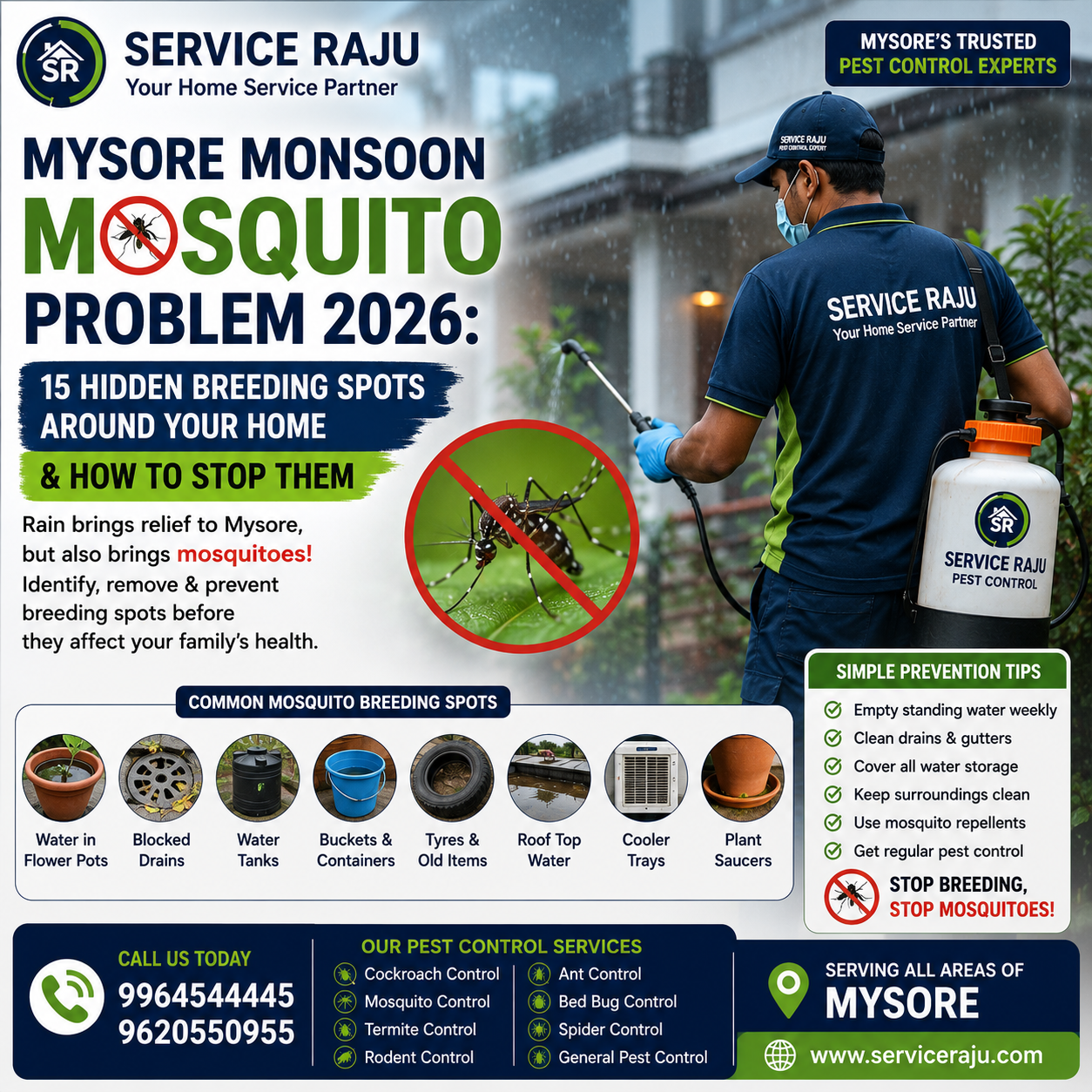
In this guide, Service Raju explains 15 places around your home that you should inspect after rain, how to reduce mosquito breeding opportunities, warning signs that your property may have a mosquito problem, and when professional mosquito control may be appropriate.
Why Are Mosquitoes Increasing After Rain in Mysore?
Rain itself doesn’t automatically create a mosquito infestation.
The bigger issue is standing water.
After rainfall, water can collect in small containers, drains, plant pots, roof areas and other places around your property.
Mosquitoes can use suitable stagnant water as breeding habitat.
The Government of India continues to emphasize source reduction, anti-larval measures, bed nets and integrated vector management as important components of monsoon-related disease prevention.
So the first step isn’t simply spraying mosquitoes.
It’s finding where they may be breeding.
15 Hidden Mosquito Breeding Spots Around a Mysore Home
1. Flower Pot Trays
Plant pots are one of the easiest places to overlook.
After rain, check:
- Plant trays
- Decorative pots
- Balcony planters
- Garden containers
Empty unnecessary standing water and keep these areas clean.
2. Buckets and Containers
Any outdoor container capable of holding rainwater deserves attention.
Check:
- Buckets
- Tubs
- Plastic containers
- Paint buckets
- Storage boxes
- Broken household items
Turn containers upside down when they are not being used.
3. Terrace Water Collection
Your terrace may appear dry, but small depressions can retain water after rain.
Inspect:
- Low spots
- Roof corners
- Drain surrounds
- Unused containers
- Construction materials
- Plastic sheets
Standing water should be removed where possible.
4. Blocked Terrace Drains
A blocked rainwater outlet can create persistent water accumulation.
Check for:
- Leaves
- Mud
- Plastic
- Debris
- Algae
- Sediment
A clean and functioning drainage system helps prevent water from remaining on the terrace.
5. Overhead Water Tank Area
Inspect around the water tank rather than only inside it.
Look for:
- Overflow
- Leaking connections
- Open covers
- Water collecting around the tank
- Damaged pipes
- Broken fittings
A properly maintained tank should be securely covered.
6. Gutters and Downpipes
Leaves and debris can block rainwater flow.
When water remains trapped inside gutters or disconnected sections of downpipes, it can create persistent moisture.
Clean gutters and check that rainwater flows properly.
7. Balcony Corners
Balconies can collect water around:
- Floor drains
- Plant pots
- Railings
- Corners
- Outdoor furniture
- Decorative objects
After heavy rain, walk around the balcony and look for water that remains after surrounding surfaces have dried.
8. Old Tyres
Discarded tyres are notorious for collecting rainwater.
If you have old tyres stored around your home, garage or garden:
Do not allow them to collect water.
Remove them or store them so they cannot hold rainwater.
9. Construction Materials
If your property is under construction or renovation, inspect:
- Bricks
- Pipes
- Plastic sheets
- Cement containers
- Open drums
- Construction equipment
Anything capable of holding rainwater should be emptied or covered.
10. Underground Sump and Water Storage Areas
Check around:
- Sump covers
- Pump areas
- Drainage points
- Water-storage structures
Make sure covers are properly fitted and surrounding areas do not remain unnecessarily wet.
11. Garden Drainage
A garden can have hidden water pockets.
Look around:
- Plant beds
- Decorative pots
- Garden furniture
- Irrigation equipment
- Low-lying areas
Improve drainage where water repeatedly accumulates.
12. AC Outdoor Unit Area
The AC outdoor unit itself isn’t necessarily a mosquito breeding site, but its surrounding area can sometimes collect water.
Check:
- Drainage
- Outdoor trays
- Nearby containers
- Pipe areas
- Low spots
Remove unnecessary standing water.
13. Open Drains
Open or poorly maintained drains can become mosquito-friendly environments.
Check for:
- Stagnant water
- Blockages
- Excess vegetation
- Waste accumulation
- Poor water flow
Drainage maintenance should be part of regular monsoon home care.
14. Pet Water Bowls
If you have pets, don’t forget their water containers.
Change water regularly and clean the bowls.
Avoid allowing water to remain undisturbed for unnecessarily long periods.
15. Small Objects You Normally Ignore
This is where many homeowners get surprised.
Mosquitoes don’t need a large water body.
Inspect:
- Coconut shells
- Bottle caps
- Broken toys
- Plastic covers
- Flower vases
- Cans
- Discarded containers
- Tarpaulin folds
- Small garden objects
After rainfall, walk around the property and remove anything holding water.
How to Check Your Home for Mosquito Breeding After Rain
Use this simple 10-minute inspection.
Outside
☐ Check garden
☐ Check plant pots
☐ Check buckets
☐ Check tyres
☐ Check terrace
☐ Check gutters
☐ Check drains
☐ Check balcony
☐ Check water tank
☐ Check construction materials
Inside
☐ Check bathroom drains
☐ Check utility area
☐ Check water-storage areas
☐ Check indoor plants
☐ Check unusual damp areas
Repeat the inspection after significant rainfall.
Why Are Mosquitoes Still Inside My House If There Is No Standing Water?
This is a very common question.
Mosquitoes may enter from outside and rest in sheltered areas.
They can also be associated with breeding sites elsewhere in the surrounding environment.
Possible entry areas include:
- Open windows
- Doors
- Ventilation openings
- Gaps
- Balcony doors
- Nearby vegetation
- Drainage areas
So finding no breeding site inside your house does not necessarily mean there is no mosquito source nearby.
7 Signs Your Home May Have a Mosquito Problem
Watch for:
1. Mosquitoes Increasing Suddenly
A noticeable increase after rainfall deserves investigation.
2. Mosquitoes During the Day
Certain mosquito species can be active during daylight hours.
3. Repeated Mosquitoes in One Room
This may indicate a nearby resting or entry area.
4. Mosquitoes Around Your Garden
Check for stagnant water and dense vegetation.
5. Mosquitoes Around Drains
Inspect drainage and water accumulation.
6. Larvae in Standing Water
Small wriggling larvae in stagnant water are an obvious warning sign.
7. Persistent Mosquito Activity Despite Cleaning
If you remove obvious breeding sources but mosquito activity continues, investigate surrounding areas.
Mosquitoes and Monsoon Health: Why Prevention Matters
Mosquitoes are not simply a nuisance.
Some mosquito species can transmit diseases, including dengue, malaria and chikungunya, depending on the mosquito species and pathogen involved.
India’s Ministry of Health has continued to emphasize integrated vector management and source reduction during the monsoon season.
However, homeowners should not assume that every mosquito sighting means a particular disease is present.
The practical response is:
Reduce breeding opportunities + reduce mosquito entry + use appropriate protection + seek medical advice for concerning symptoms.
Does Mosquito Fogging Solve the Problem?
Fogging can reduce adult mosquitoes in certain situations, but it should not be treated as a complete solution.
Why?
Because fogging primarily targets adult mosquitoes.
If breeding sites remain:
Standing water → larvae → adult mosquitoes → more mosquitoes
The cycle can continue.
That’s why mosquito management should combine source reduction, environmental management, monitoring and appropriate control measures.
Fogging vs Residual Treatment vs Source Reduction
Source Reduction
This means removing or preventing mosquito breeding sites.
Examples:
- Empty standing water
- Clean drains
- Cover tanks
- Remove containers
- Improve drainage
This is one of the most important steps.
Fogging
Fogging can be used in appropriate circumstances to reduce adult mosquito populations.
It should be performed using suitable equipment and products according to their label and applicable requirements.
Residual Treatment
Appropriate residual treatments may help manage mosquitoes in selected resting or entry areas.
The exact approach depends on the property and mosquito problem.
The best treatment isn’t necessarily the one that creates the biggest cloud of spray.
The objective is to break the mosquito cycle.
Can Mosquito Nets Help?
Yes.
Physical barriers can be very useful.
Consider:
- Window screens
- Door screens
- Mosquito nets
- Bed nets
- Balcony protection where appropriate
The Government of India includes bed nets among measures used in integrated vector-management strategies.
For homes with persistent mosquito entry, improving physical barriers can complement other control measures.
What You Can Do Today to Reduce Mosquitoes
Start with these 10 steps:
1. Empty standing water
Check your entire property.
2. Clean terrace drains
Remove leaves and debris.
3. Empty plant trays
Don’t allow water to remain unnecessarily.
4. Cover water containers
Use secure covers.
5. Clean gutters
Ensure rainwater flows freely.
6. Remove old tyres
Don’t allow them to collect water.
7. Check balconies
Remove stagnant water after rain.
8. Clean outdoor areas
Reduce unnecessary clutter.
9. Install screens
Reduce mosquito entry through windows and doors.
10. Consider professional inspection
If mosquito activity remains high despite source reduction, get the property assessed.
Common Mosquito-Control Mistakes
Mistake 1: Only Spraying Inside the Bedroom
The breeding source may be outside.
Mistake 2: Ignoring Plant Trays
Small water collections can be overlooked.
Mistake 3: Forgetting the Terrace
Roof drains and containers deserve inspection.
Mistake 4: Leaving Buckets Outside
An uncovered bucket can collect rainwater.
Mistake 5: Ignoring Gutters
Blocked gutters can retain water.
Mistake 6: Depending Only on Fogging
Adult mosquito reduction doesn’t eliminate every breeding source.
Mistake 7: Ignoring Neighbouring Areas
Mosquitoes don’t respect property boundaries.
What About Apartments in Mysore?
Apartment mosquito control can be more complicated because the potential sources may include:
- Common drains
- Basement areas
- Parking areas
- Terrace
- Rainwater systems
- Landscaping
- Water-storage areas
- Construction areas
- Neighbouring properties
If multiple apartments experience mosquito problems simultaneously, building-level inspection and source reduction may be more effective than treating one flat alone.
How Much Does Mosquito Pest Control Cost in Mysore?
There is no single price for every mosquito-control service.
The cost can depend on:
- Property size
- Indoor/outdoor area
- Infestation level
- Treatment method
- Number of treatment areas
- Equipment required
- Follow-up requirements
- Residential or commercial property
Published 2026 Mysore pest-control market references show mosquito-control pricing can vary according to treatment type and property requirements rather than having one universal rate.
Always confirm what the quoted service includes before booking.
When Should You Call Professional Mosquito Control?
Consider professional inspection when:
- Mosquitoes are present every day
- Activity increases significantly after rain
- You repeatedly find larvae
- Mosquitoes are present throughout the property
- Your home has persistent standing-water problems
- Common areas have mosquito breeding
- DIY prevention hasn’t reduced the problem
- You need help identifying breeding and resting areas
A professional should first understand where the mosquito pressure is coming from before recommending treatment.
Service Raju Mosquito Pest Control in Mysore
Service Raju provides pest-control services for residential and commercial properties across Mysore.
Our pest-control services include:
- Mosquito Control
- Cockroach Control
- Termite Control
- Ant Control
- Rodent Control
- Bed Bug Control
- General Pest Control
- Residential Pest Control
- Commercial Pest Control
For mosquito problems, the practical approach is to combine source reduction, inspection and appropriate treatment rather than relying on one method alone.
Service Raju also provides related home services such as:
- Plumbing
- Water Tank Cleaning
- Water Leakage Detection
- Drain Cleaning
- Waterproofing
- Home Deep Cleaning
- Electrical Services
- AC Service
- Painting
- Carpentry
- Renovation
This matters because mosquito problems can sometimes be connected to water accumulation, drainage, plumbing or property-maintenance issues.
Why Choose Service Raju for Pest Control in Mysore?
Local Mysore Service
Service Raju serves residential areas throughout Mysore.
Inspection-Based Approach
The first step is understanding the pest problem and possible contributing conditions.
Multiple Pest Services
Cockroaches, mosquitoes, termites, rodents, ants and other common household pests can be addressed through appropriate service options.
Home-Service Ecosystem
If your pest problem is connected to plumbing, drainage, water storage or cleaning, related home services are also available.
Convenient Booking
One provider can help coordinate multiple home-maintenance requirements.
Frequently Asked Questions
Why are mosquitoes increasing after rain in Mysore?
Rain creates opportunities for water to collect in containers, drains, plant trays, roof areas and other locations. These water collections can provide breeding habitat for mosquitoes.
Where do mosquitoes breed around a house?
Potential sites include plant trays, buckets, tyres, blocked drains, gutters, water-storage areas, discarded containers, roof depressions and other places where stagnant water remains.
Does rain itself create mosquitoes?
Rain doesn’t directly create mosquitoes, but rainfall can create or refill standing-water habitats where mosquitoes may breed.
Does fogging kill all mosquitoes?
No. Fogging can reduce adult mosquitoes in appropriate situations, but it does not eliminate every breeding source. Source reduction remains important.
How can I prevent mosquitoes after rain?
Inspect the property, remove standing water, clean drains and gutters, cover water containers and reduce mosquito entry through doors and windows.
Can mosquitoes breed in small amounts of water?
Some mosquito species can use relatively small water-holding containers. That’s why small objects around the property should not be ignored.
Should I empty plant-pot trays?
Yes. Avoid unnecessary standing water in plant trays and containers.
Are mosquitoes dangerous?
Some mosquito species can transmit diseases. The risk depends on the mosquito species, pathogen and local transmission conditions. Preventing breeding and reducing mosquito exposure are important parts of mosquito management.
Can mosquito control be done without spraying?
Source reduction and physical barriers are important non-chemical measures. Established mosquito problems may require additional professional control depending on the situation.
Does mosquito pest control work permanently?
No treatment should be described as permanently eliminating mosquitoes. New mosquitoes can enter from surrounding areas, and new breeding sites can develop after rainfall. Long-term management requires ongoing prevention.
The 15-Point Mysore Mosquito Checklist
After rain, check:
1. Plant trays
2. Buckets
3. Containers
4. Terrace
5. Roof drains
6. Gutters
7. Downpipes
8. Water tanks
9. Balconies
10. Old tyres
11. Construction materials
12. Garden areas
13. Sumps
14. Outdoor drains
15. Small objects holding rainwater
Final Takeaway
If mosquitoes suddenly increase around your Mysore home after rain, don’t simply ask:
“Which mosquito spray should I use?”
Ask:
“Where are they breeding?”
The most useful first step is to identify and eliminate standing-water sources.
Remember the simple formula:
Find Water → Remove Water → Block Entry → Monitor → Treat When Necessary
A few minutes of inspection after rainfall can help you identify problems before mosquito activity becomes a bigger household nuisance.
Need Mosquito Pest Control in Mysore?
If mosquitoes are becoming a daily problem around your home, apartment, office, garden or commercial property, Service Raju can help with professional pest-control solutions across Mysore.
📞 Call: 9964544445 / 9620550955
🌐 Website: www.serviceraju.com
📍 Serving All Areas of Mysore / Mysuru
Service Raju — One Call. All Home Solutions.
Leave a Reply