
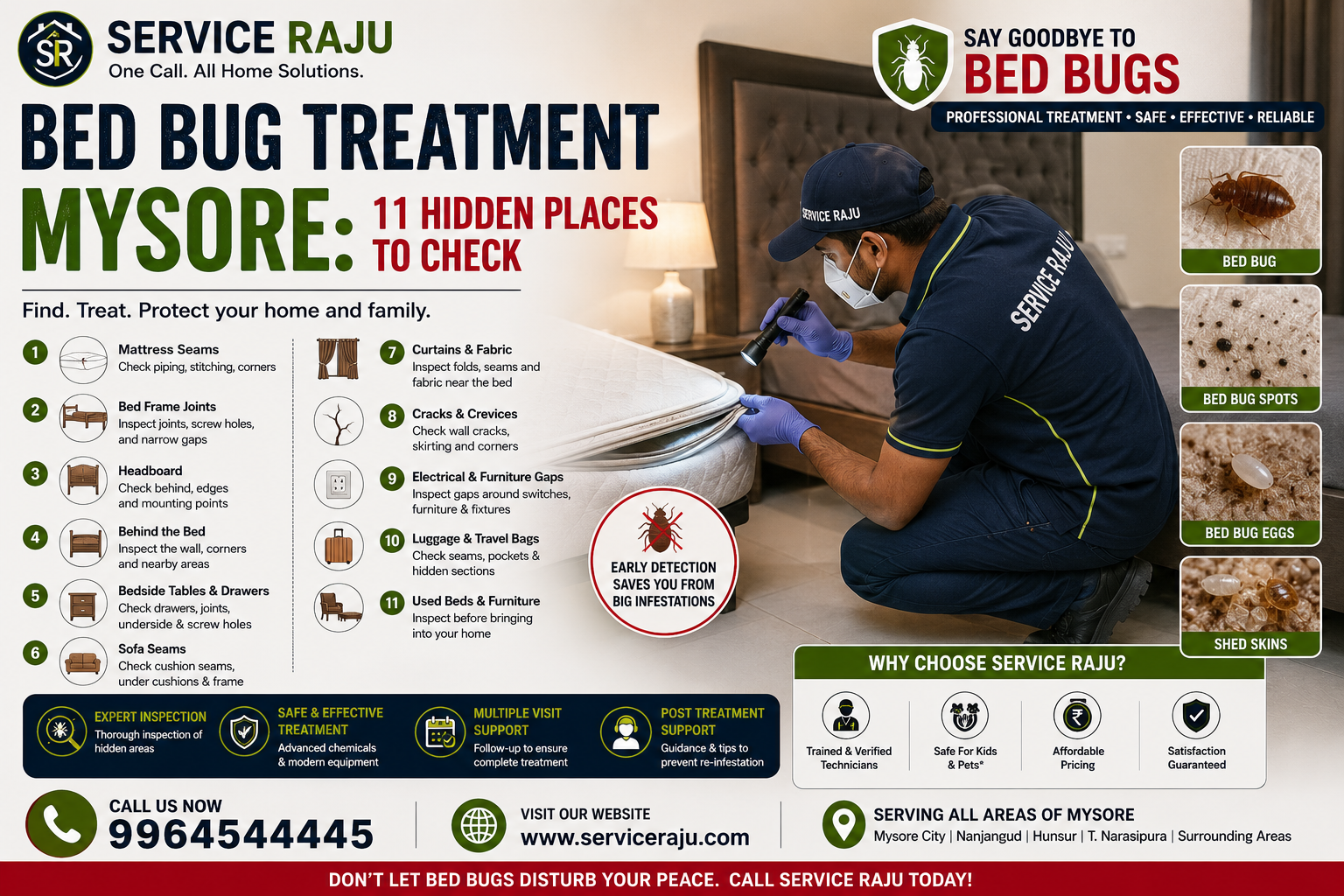
If you are searching for bed bug treatment Mysore, the first step is not spraying everything you see. It is finding where the infestation is hiding. Bed bugs are small, flat insects that can hide in extremely narrow gaps around sleeping areas, furniture and luggage. They can also travel into homes through clothing, bags, bedding and used furniture.
A common mistake is checking only the mattress.
Bed bugs can move beyond the mattress and hide around the bed frame, headboard, nearby furniture, cracks and other protected areas. This is why finding the actual hiding locations is an important part of effective control.
This guide explains 11 places to check, how bed bugs can enter your home, what you should do before treatment and when professional bed bug control Mysore becomes the better option.
Why Bed Bugs Can Be Difficult to Find
Bed bugs are reddish-brown, wingless insects that are generally only a few millimetres long. During the day, they often remain hidden in cracks, seams and protected areas close to where people sleep.
You may not see a live bug immediately.
Instead, you might notice:
- Small dark spots on sheets or mattresses
- Tiny blood stains on bedding
- Shed skins
- Eggs or very small pale insects
- Live bed bugs around mattress seams
- An unusual musty smell in heavier infestations
- Repeated unexplained bites after sleeping
Bites alone are not enough to confirm bed bugs because they can look similar to bites from other insects. Physical evidence around sleeping areas is more useful for confirming an infestation.
11 Hidden Places to Check for Bed Bugs
1. Mattress Seams
Start with the mattress.
Carefully inspect the piping, stitching, folds, corners and underside of the mattress. Pay particular attention to areas that remain undisturbed.
Look for dark spotting, shed skins, eggs or live insects.
2. Bed Frame Joints
Wooden and metal bed frames can contain joints, screw holes and narrow gaps where bed bugs may hide.
Do not inspect only the top surface. Check underneath the frame and around connection points.
3. Headboard
Headboards are frequently overlooked.
If your headboard is attached directly to the wall, inspect the rear section, mounting points and gaps around the edges.
A large or complicated headboard can provide multiple protected hiding places.
4. Behind the Bed
Look behind the bed and along the wall immediately surrounding the sleeping area.
Bed bugs tend to remain relatively close to their host, especially when an infestation is developing.
5. Bedside Tables and Drawers
Check bedside tables, drawer joints, screw holes and the underside of furniture.
Remove the contents and inspect the corners carefully rather than simply looking at the outside.
6. Sofa Seams
If people regularly sleep or rest on a sofa, do not assume the bedroom is the only affected area.
Inspect:
- Cushion seams
- Under cushions
- Sofa joints
- Back panels
- Underside fabric
- Gaps around the frame
Bed bugs can spread to sofas and nearby furniture when an infestation is established.
7. Curtains and Nearby Fabric
Inspect curtains, especially when they are very close to the bed.
Pay attention to folds, seams and areas where fabric touches nearby furniture or walls.
8. Cracks and Crevices
Small gaps around furniture, skirting boards and wall joints can become hiding locations.
The EPA recommends reducing clutter and sealing cracks and crevices where appropriate as part of bed bug prevention.
9. Electrical and Furniture Gaps
Bed bugs can hide in extremely narrow protected spaces.
This can include gaps around furniture and some wall fixtures.
Do not dismantle electrical components yourself. If inspection is required around electrical fittings, leave it to a trained professional.
10. Luggage and Travel Bags
Travel is one of the most important ways bed bugs can enter a home.
The CDC notes that bed bugs can spread through luggage, clothing, bedding and personal belongings.
If you recently stayed in a hotel, hostel, guest house or another property, inspect your luggage before storing it inside your bedroom.
11. Used Beds, Sofas and Furniture
Second-hand furniture can introduce bed bugs into an otherwise clean home.
The EPA specifically recommends inspecting second-hand furniture, beds and couches before bringing them into the house.
Never assume that expensive, clean-looking or recently purchased furniture is automatically pest-free.
How Bed Bugs Enter a Mysore Home
Bed bugs do not mean your home is dirty.
They are excellent hitchhikers and can enter through:
- Travel luggage
- Overnight bags
- Clothing
- Used mattresses
- Used sofas
- Second-hand furniture
- Bedding
- Moving boxes
- Visitors’ belongings
The CDC states that cleanliness does not determine whether a property has bed bugs; infestations can occur in many types of accommodation.
This is important because many homeowners spend time cleaning the entire house without addressing the actual source.
Cleaning is useful, but identification and targeted treatment are equally important.
What to Do If You Find Bed Bugs
If you discover a live bed bug or strong evidence of an infestation, avoid immediately moving mattresses, sofas or other furniture from one room to another.
Moving infested items can spread the problem.
Instead:
- Keep the affected area as undisturbed as possible.
- Inspect the surrounding sleeping area.
- Check nearby furniture.
- Separate potentially infested washable items.
- Wash and dry suitable fabrics according to their care instructions.
- Avoid randomly spraying multiple pesticides.
- Arrange a professional inspection if the infestation is confirmed or keeps returning.
The EPA recommends using precautions around laundry and notes that high heat in a dryer can kill bed bugs.
Why DIY Bed Bug Treatment Often Fails
One of the biggest problems with DIY treatment is treating only the places where you can see the insects.
A visible bug may be only a small part of the infestation.
Bed bugs can hide in seams, cracks and furniture structures. Eggs can also be difficult to see.
Common DIY mistakes include:
- Spraying only the mattress
- Treating only one room
- Ignoring the bed frame
- Ignoring sofas
- Moving furniture between rooms
- Using excessive pesticide
- Failing to inspect after treatment
- Assuming one application always solves the problem
Professional control should begin with inspection rather than simply applying chemicals everywhere.
Professional Bed Bug Treatment Process
A proper professional bed bug control Mysore service should be based on the property and infestation rather than a one-size-fits-all approach.
Step 1: Inspection
The technician examines:
- Mattress seams
- Bed frame
- Headboard
- Bedroom furniture
- Sofa and cushions where relevant
- Cracks and crevices
- Other areas showing evidence
Step 2: Infestation Assessment
The technician determines where activity is concentrated and whether nearby furniture or rooms may also require attention.
Step 3: Targeted Treatment
Treatment is applied to appropriate areas using products and methods suitable for the infestation and property.
The objective is to reach likely hiding areas rather than simply spraying visible surfaces.
Step 4: Follow-Up
Bed bug control can require more than one intervention because eggs and hidden insects can complicate eradication.
Current market offerings in Mysore reflect this: Urban Company advertises a two-visit bed bug service, while HomeTriangle’s Mysore service currently lists a 45-day cover and free revisit if bed bugs return during that period.
The exact number of visits required for your property should be determined by the infestation and treatment plan.
How to Prepare Your Home Before Treatment
Good preparation can make treatment easier and give the technician better access to hiding areas.
Before the appointment:
- Remove unnecessary clutter around beds.
- Keep access available around furniture.
- Do not move an infested mattress to another bedroom.
- Separate washable bedding where instructed.
- Keep pets and children away from treatment areas during service.
- Follow the technician’s instructions regarding food, clothing and personal belongings.
- Do not apply additional pesticides immediately before professional treatment unless specifically instructed.
Preparation requirements can vary depending on the treatment method.
What to Do After Treatment
Follow the technician’s re-entry and cleaning instructions carefully.
Do not immediately wash or wipe treated surfaces if doing so would remove the treatment, unless instructed.
Also:
- Wash bedding as advised.
- Dry suitable fabrics using appropriate heat settings.
- Keep the bedroom uncluttered.
- Monitor mattress seams and nearby furniture.
- Report continuing activity according to the service instructions.
- Avoid bringing second-hand furniture into the home without inspection.
The EPA recommends reducing clutter, frequent vacuuming and careful handling of potentially infested laundry as part of prevention.
Bed Bug Treatment Cost in Mysore
The price of bed bug treatment near me can vary considerably.
Important factors include:
- Number of bedrooms
- Number of beds and mattresses
- Furniture quantity
- Infestation severity
- Number of rooms requiring treatment
- Treatment method
- Follow-up requirements
For a current Mysore benchmark, HomeTriangle lists bed bug treatment at approximately ₹2,399 for 1 BHK, ₹2,699 for 2 BHK, ₹3,299 for 3 BHK, ₹3,899 for 4 BHK and ₹4,399 for 5 BHK. These are competitor-listed prices and can change.
Another recent 2026 market guide places typical home bed bug treatment around ₹1,500–₹4,000, depending on property and infestation factors.
Therefore, the cheapest quote is not necessarily the best comparison. Check what is included, whether inspection is performed, whether follow-up is provided and which areas are actually covered.
How to Prevent Bed Bugs From Returning
After treatment, prevention becomes important.
Inspect luggage after travel
Do not immediately place travel luggage on the bed.
Inspect seams, pockets and folds before storing it.
Check second-hand furniture
Inspect used beds, mattresses, sofas and furniture before bringing them home.
Reduce clutter
Less clutter means fewer potential hiding places.
Monitor sleeping areas
Regularly check mattress seams, bed frames and nearby furniture.
Be careful with shared laundry
Keep potentially infested items contained during transport and follow proper washing and drying procedures.
Act early
The CDC notes that early detection and eradication can make infestations easier to control.
When to Call a Professional
Consider professional bed bug treatment Mysore when:
- You have confirmed live bed bugs.
- You repeatedly find dark spots or shed skins.
- Bites continue after cleaning.
- Bed bugs appear in more than one room.
- You recently brought in second-hand furniture.
- Bed bugs appeared after travel.
- DIY treatment has failed.
- The infestation keeps returning.
Do not wait until every bedroom is affected.
Early professional inspection can help identify the extent of the problem before it becomes more difficult to manage.
Why Choose Service Raju for Bed Bug Control in Mysore?
Service Raju provides bed bug control services in Mysuru as part of its local pest-control service catalogue. The current Mysuru services page specifically lists Bed Bug Control Services.
The focus should be on proper inspection, targeted treatment and clear post-treatment instructions rather than simply spraying a room.
Service Raju also lists bed bug control among its pest-control services and describes its service process around inspection, treatment and customer support.
For booking or inspection, contact Service Raju at 9964544445 or visit www.serviceraju.com.
Frequently Asked Questions
Are bed bugs caused by poor hygiene?
No. Bed bugs can infest clean homes, hotels and other accommodation. They are commonly transported through luggage, clothing, bedding and furniture.
Can bed bugs hide in sofas?
Yes. Bed bugs can spread to sofas, cushions and nearby furniture, particularly when people regularly sleep or rest there.
Can bed bugs enter a home through luggage?
Yes. Luggage is a recognised way bed bugs can travel from one location to another.
Are bed bugs known to spread disease?
The CDC states that bed bugs are not known to spread diseases to people. However, bites can cause itching, sleep loss and, rarely, allergic reactions.
Is one treatment enough?
Not always. The required treatment plan depends on the infestation, hiding locations and treatment method. Some professional services use follow-up visits because bed bug eggs and hidden insects can make control more difficult.
Should I throw away my mattress?
Not automatically.
A mattress may be treatable depending on its condition and the infestation. Throwing away furniture without addressing the rest of the infestation can allow bed bugs to remain elsewhere in the home.
What is the best way to find bed bugs early?
Regularly inspect mattress seams, bed frames, headboards and nearby furniture, particularly after travel or bringing second-hand furniture into your home.
Final Bed Bug Checklist
Before booking treatment:
- Check mattress seams.
- Inspect the bed frame.
- Check the headboard.
- Inspect bedside furniture.
- Check sofas and cushions.
- Look for dark spots and shed skins.
- Check luggage after recent travel.
- Inspect second-hand furniture.
- Avoid spreading furniture between rooms.
- Arrange professional inspection when infestation is confirmed.
Bed bugs are easier to manage when you identify the problem early. If you are seeing repeated signs in your Mysore home, don’t rely only on visible bugs or random sprays. A proper inspection can identify where the infestation is hiding and help determine the right treatment approach.
For professional bed bug control Mysore, contact Service Raju – 9964544445 or visit www.serviceraju.com.
Leave a Reply